
The short version
- A full UK driving licence lets you drive in many countries, but rules and requirements vary and change over time.
- Check GOV.UK guidance for the specific country you are visiting before you travel.
- You may need extra documents, such as an International Driving Permit, in certain countries.
- Your UK insurance may not automatically extend to driving abroad, so check with your insurer.
- Rules on speed limits, priority, equipment and local laws differ from the UK and must be followed.
Start with GOV.UK for the country you are visiting
Rules on driving abroad with a UK licence vary by country and can change, so the starting point should always be current GOV.UK guidance for the specific country you plan to visit, checked close to your travel date. General articles like this one can explain the principles, but the exact requirements, including whether an International Driving Permit is needed, depend on the country and can be updated.
What I tell pupils who ask about this near the end of their course is simple: treat a foreign trip like a small project. Do not assume that because a friend drove somewhere last year with no problems, the same rules still apply, or that they applied correctly in the first place.
Documents you may need to carry
As a minimum, you should expect to carry your full UK driving licence. Many countries also expect you to have your passport and proof of insurance with you while driving. Some countries require an International Driving Permit alongside your UK licence, particularly outside the European Union, though requirements have changed in recent years and differ by country, so check current guidance rather than relying on older information.
If you hire a car abroad, the hire company will usually check your licence details and may have its own age, experience or additional documentation requirements on top of the legal minimum for that country.
- Full UK driving licence, checked it has not expired.
- Passport or accepted form of identification.
- Proof of insurance for the vehicle you are driving.
- An International Driving Permit if required for that country.
- Vehicle registration and any required local documents if driving your own car.
Insurance for driving abroad
Do not assume your UK car insurance automatically covers driving abroad in full. Many policies provide only limited cover abroad by default, sometimes just meeting the minimum legal requirement of the country you are in rather than your usual level of cover. Contact your insurer before travelling to confirm exactly what is included and whether you need to arrange extra cover for the trip.
If you are hiring a car abroad, check what is included in the hire company's insurance, what the excess is, and whether you want to buy additional excess protection. Read the terms carefully, since some hire insurance excludes certain types of damage or driving on particular types of road.
Rules of the road are not the same everywhere
Driving on the other side of the road is the most obvious difference for UK drivers, but it is far from the only one. Speed limits, priority rules at junctions and roundabouts, requirements for warning triangles or high-visibility vests, and rules on mobile phone use or drink-driving limits can all differ significantly from the UK.
Some countries also require specific equipment to be carried in the car, such as a breathalyser, spare bulbs, or a first aid kit, and may fine you on the spot for not having them. Local speed limits can also depend on weather conditions or vehicle type in ways that do not apply in the UK, so read local signage carefully rather than assuming UK conventions apply.
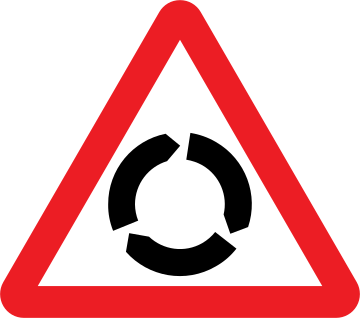
- Which side of the road traffic drives on.
- Speed limits, which may differ by road type and weather.
- Priority rules at junctions and roundabouts.
- Required safety equipment, such as triangles or high-visibility clothing.
- Local drink-driving limits, which may be stricter than the UK.
Driving in the EU and elsewhere
For trips within the European Union, current guidance sets out whether a UK licence alone is sufficient or whether an International Driving Permit is also required, and this can vary by individual country rather than applying uniformly across the EU. Always check the specific country's rules on GOV.UK before travelling, particularly since arrangements have been subject to change.
Outside Europe, requirements vary even more widely. Some countries accept a UK licence for a limited period as a visitor, others require an International Driving Permit from the outset, and some require a local licence for longer stays. If you are moving abroad rather than visiting temporarily, check how long you can drive on a UK licence before you are required to exchange it for a local one.
Practical preparation before you travel
Beyond documents and insurance, a bit of practical preparation makes driving abroad far less stressful, particularly on your first trip driving on the opposite side of the road. Give yourself time to adjust in a quiet area before joining busier roads, and be extra careful at roundabouts and junctions where habits from UK driving can catch you out.
If you are hiring a car, check the controls before you drive off, particularly the position of the indicators and wipers, since these are commonly swapped or positioned differently between manufacturers and markets. Plan your route in advance, including toll roads or low-emission zones, some of which require a permit or sticker to be purchased before you drive into the zone.
- 1Check current GOV.UK guidance for the specific country before travelling.
- 2Confirm your UK insurance position for driving abroad, or arrange extra cover.
- 3Check whether an International Driving Permit is required and apply in good time if so.
- 4Learn local speed limits, priority rules and required safety equipment.
- 5Take a short period to adjust to the controls and road side before busier driving.
Coming back to UK driving afterwards
After a period of driving abroad, particularly on the opposite side of the road, take a little care readjusting to UK roads too. Some drivers report a brief period of instinctively reaching for the wrong side of the car or hesitating at roundabouts, especially after an extended trip.
For learners still working towards their test, this article is really about future planning rather than immediate test preparation, since the practical test is conducted entirely on UK roads under UK rules. Fast Track Driving Lessons intensive courses run from 10 to 40 hours at £61.23 per hour, with free theory test practice available at /theory, and getting comfortable with UK road rules first will make it easier to spot the differences abroad later.
Common questions
Can I drive abroad with just my UK driving licence?
In many countries, yes, but not all, and requirements can change. Always check current GOV.UK guidance for the specific country you are visiting before you travel, since some countries also require an International Driving Permit.
Do I need an International Driving Permit for every country?
No. It depends on the country and can change over time. Check GOV.UK guidance for the country you plan to visit, since some accept a UK licence alone while others require an International Driving Permit as well.
Does my UK car insurance cover me if I drive abroad?
Not necessarily to your usual level. Many policies provide only limited cover abroad, sometimes just the legal minimum for that country. Contact your insurer before travelling to confirm exactly what is covered.
What documents should I carry when driving abroad?
Typically your full UK driving licence, passport, proof of insurance, and any International Driving Permit required for that country. Hire car documents should also be carried if using a rental vehicle.
Are speed limits and priority rules the same as in the UK?
No. Speed limits, priority at junctions and roundabouts, and required safety equipment vary by country. Always check local rules rather than assuming UK conventions apply.
Can I hire a car abroad on a provisional UK licence?
Most hire companies require a full licence and set their own minimum age and experience requirements, in addition to the legal minimum for that country. Check with the hire company before travelling.
How long can I drive on a UK licence if I move abroad long term?
This varies significantly by country. Some allow driving on a UK licence for a limited period before requiring you to exchange it for a local licence. Check the specific country's rules if you are relocating rather than visiting.
See course prices
Reading about it only gets you so far. Our instructors drill this with you in the car, on the roads around your test centre.