
The short version
- You can apply for a provisional driving licence from 15 years and 9 months.
- Most learners can drive a car on public roads from their 17th birthday.
- Some 16-year-olds can drive a car if they qualify under enhanced mobility benefit rules.
- A learner must be insured, supervised correctly and display L plates.
- You can usually ride a moped at 16 after CBT, but that is not the same as learning in a car.
The short answer: what age can you start driving?
In the UK, most learners can start driving a car on public roads at 17. You do not have to wait until 17 to apply for your provisional licence: GOV.UK says you can apply from 15 years and 9 months, but the car entitlement normally starts on your 17th birthday. If you are asking, “Can I have my first driving lesson on my birthday?”, the answer is yes, provided your provisional licence is valid, you are insured for the car, and you are supervised properly.
There is a key exception. Some 16-year-olds can drive a car if they receive, or have applied for, the enhanced rate of the mobility component of Personal Independence Payment, with equivalent disability mobility rules changing over time and by nation. Check the current DVLA or DVA guidance before relying on this, because benefit names and eligibility can change. For mopeds, 16 is also important: you can normally ride a moped at 16 after completing compulsory basic training, known as CBT.
This article is general guidance, not legal advice. Driving law is precise, and if your situation involves disability benefits, medical licensing, private land, insurance conditions or a prosecution, you should check GOV.UK, nidirect for Northern Ireland, your insurer, or get proper legal advice.
Applying for your provisional licence before you turn 17
The provisional licence is the bit many learners forget until the last minute. In Great Britain it is issued by the DVLA, and in Northern Ireland by the DVA. For a car, you can apply before you can actually drive on the road, which is useful because it gives time for the licence to arrive and for you to check the details are correct. The published GOV.UK fee is £34 online or £43 by post at the time of writing, but fees can change, so always check the official application page before paying.
As an instructor, I always ask to see a learner’s provisional licence before the first lesson. Not a screenshot, not a parent saying it has been applied for, but the actual licence or a proper licence check where appropriate. If a learner gets in the driver’s seat before the entitlement is active, the issue is not just a technicality. It can affect legality, insurance and whether anyone should be supervising that drive at all.
When the licence arrives, check your name, address, date of birth and the vehicle categories. If you move house later, keep the licence updated. The licence is not just for the test centre; it is evidence that you are entitled to learn in that vehicle category and it is one of the first practical things that keeps your learning clean and straightforward.
- Apply through the official GOV.UK or nidirect route, not an unofficial paid checking site.
- Use your legal name and correct address so the licence matches your test booking and ID.
- Do not drive on public roads until the relevant entitlement is active.
- Keep your licence safe, as you will need it for lessons and tests.
- Tell DVLA or DVA about relevant medical conditions when required.
Can you practise before 17 on private land?
You may see under-17 driving experiences advertised on private sites, and some families ask whether a 16-year-old can practise in a farmyard, field or empty car park. The key phrase is private land with the landowner’s permission, and not a road or public place. A supermarket car park, industrial estate or school car park may feel private when it is quiet, but if the public has access, road traffic law and insurance issues can still apply.
From a teaching point of view, private practice can help with basic clutch feel, steering and stopping, but it can also build bad habits. I often see new 17-year-olds who have been “driving round a yard” for months and can move the car, but they stare at the bonnet, steer late, cross their hands wildly or brake without checking mirrors. Movement is not the same as road driving. Good driving starts with observation, planning and control together.
If you do any pre-17 driving experience, keep it structured and safe. Use a site designed for it, make sure insurance and permission are clear, and do not treat it as permission to drive anywhere nearby. The moment you are on a road or public place, the normal age, licence, insurance and supervision rules matter.
Your first legal car lesson at 17: what must be in place
On your first proper lesson on public roads, you need a valid provisional licence, insurance for the vehicle, and correct supervision. If you are with an approved driving instructor, the training car will normally be insured and fitted with dual controls. If you are practising in a family car, do not assume the insurance covers you. Your name usually needs to be added as a learner driver, or you need a suitable learner policy.
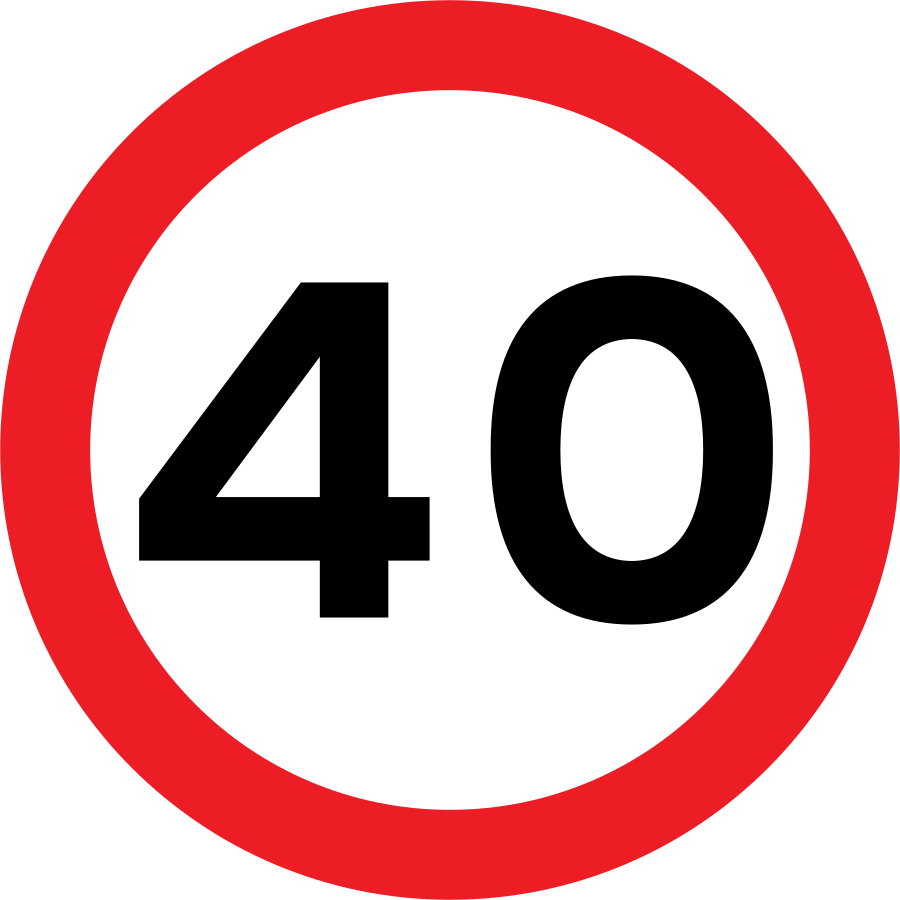
L plates are compulsory for learner drivers in Great Britain, and in Wales you can use D plates instead. They must be visible from the front and rear. I have seen learners arrive with one tiny plate in the rear window, half hidden by tinted glass, or a front plate stuck on the bonnet where it blows off at 40 mph. That is avoidable trouble, and it tells me the learner has not yet got into the habit of checking the car before driving.
You also need to meet the eyesight requirement. Highway Code Rule 92 says you must be able to read a vehicle number plate from 20 metres, using glasses or contact lenses if you need them. Examiners check this at the start of the practical test. If you cannot read the plate, the test will not continue, and in lessons it is something I would rather find out on the driveway than at a busy junction.
- Valid provisional licence with car entitlement active.
- Insurance that specifically covers you as a learner in that car.
- L plates or D plates fitted clearly front and rear.
- A legal, roadworthy vehicle with tax and MOT if required.
- Eyesight that meets the DVLA standard, with glasses or lenses if needed.
Who can supervise a learner driver?
If you are not with an instructor, your supervising driver must be at least 21 and must have held a full driving licence for the type of vehicle for at least 3 years. They must be fit to supervise. That means they cannot treat the drive like a passenger lift, sit on their phone, fall asleep, drink alcohol, or leave you to make all the decisions before you are ready. The supervisor is there because you are not yet fully licensed.
In the car, the biggest family-practice problem I see is mixed messages. Mum says “go”, Dad says “wait”, an older sibling says “you’re too slow”, and the learner starts driving for approval rather than safety. Examiners do not mark confidence by volume or speed. They mark whether your driving is safe, legal and controlled. A hesitant decision can be a fault, but a rushed unsafe decision is usually worse.
Learner drivers are allowed on motorways in England, Scotland and Wales only when accompanied by an approved driving instructor in a car fitted with dual controls. Highway Code Rule 253 covers motorway restrictions and exceptions. A parent or friend cannot take a learner onto the motorway, even if they are an excellent driver with decades of experience.
- Supervisor aged 21 or over.
- Full licence held for at least 3 years for that vehicle category.
- Sober, alert and able to guide the learner.
- No mobile phone use while supervising.
- No motorway practice unless with an ADI in a dual-control car where the rules allow it.
Starting at 16: mopeds and disability mobility exceptions
At 16, you cannot normally learn to drive a standard car on public roads. What you can usually do is ride a moped, provided you have the right provisional entitlement, complete CBT, display L plates, and follow the moped restrictions. CBT is not a full test; it is basic training that allows you to ride on the road under learner conditions. It does not qualify you to drive a car.
The car exception for some 16-year-olds is there for mobility reasons. GOV.UK guidance refers to the enhanced rate of the mobility component of Personal Independence Payment, and there are equivalent or related disability benefit arrangements that may apply depending on where you live and your circumstances. Because these rules are linked to benefits and licensing, do not rely on something a friend was told years ago. Check the current DVLA or DVA wording and speak to Motability or your insurer if a vehicle is involved.
When I teach a 16-year-old who is legally entitled to learn in a car, I approach the lessons exactly as I would with any learner: control first, observation early, and no shortcuts. Being allowed to start earlier does not reduce the standard expected at the test. The examiner will still expect independent, safe driving, correct responses to signs and road markings, and good judgement around vulnerable road users.
When can you take your theory and practical tests?
For most car learners, you can take the theory test from 17, or from 16 if you are legally entitled to drive a car under the disability mobility exception. The car theory test fee published by GOV.UK is £23 at the time of writing, but official fees can change. Once you pass, your theory test certificate is valid for 2 years. If it expires before you pass the practical test, you must take and pass the theory again.
You cannot pass the practical test without first passing the theory test, and you need to be old enough and properly licensed for the category. The DVSA practical car test fee is published as £62 for weekday tests and £75 for evenings, weekends and bank holidays at the time of writing, but again you should check GOV.UK because fees and booking arrangements can change. Use the official booking service to avoid unnecessary extra charges.
A common mistake is booking a test date because it is available, not because the learner is ready. Examiners do not give an easier test to a 17-year-old on a first attempt. They are looking for safe driving without serious or dangerous faults, and with no more than the permitted number of driving faults under the DVSA marking system. Age gets you legal access to the test; it does not get you test standard.
- 1Apply for your provisional licence in good time.
- 2Start learning the Highway Code before your first lesson, not after.
- 3Begin lessons and private practice only when you are legally entitled and insured.
- 4Book the theory test when your hazard perception and knowledge are consistently ready.
- 5Book the practical test when your instructor agrees you can drive safely without help.
- 6Keep checking official DVSA and DVLA fee pages because prices can change.
Age is only the starting point: what actually costs learners
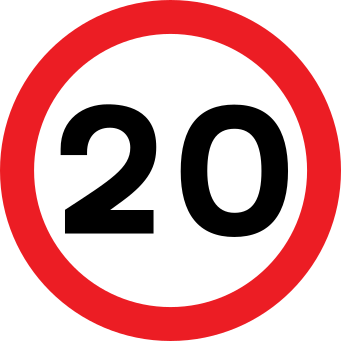
New learners often think the big hurdle is reaching 17. In the passenger seat, I see the real hurdle as judgement. Can you decide when to emerge without making another driver brake? Can you notice a 20 mph limit before the examiner has to watch you miss it? Can you keep position on a narrow road without panicking every time a bus appears? Those are the things that decide whether you are ready.
The Highway Code matters from day one. Rule 99 covers seat belt requirements, Rule 92 covers eyesight, and the speed-limit rules in the Code are not optional just because you are learning. In residential areas, I often see learners concentrate so hard on the clutch that they stop reading the road. The specific fault that costs people is not “being new”; it is failing to act on what they have seen, or not seeing it early enough.
After you pass, the New Drivers Act is also worth knowing. If you get 6 or more penalty points within 2 years of passing your first driving test, your licence can be revoked and you will have to apply again and retake both tests. That 6-point rule is published by GOV.UK and is a strong reason to build calm habits before the test, not after it.
- Age-related mistake: assuming 17 means you are automatically ready for a test. Why it costs you: examiners mark performance, not birthday.
- Licence mistake: driving before the provisional entitlement is active. Why it costs you: you may be driving otherwise than in accordance with a licence.
- Insurance mistake: practising in a family car without being named or covered. Why it costs you: uninsured driving can lead to serious penalties.
- Supervision mistake: going out with someone who is not eligible or not fit to supervise. Why it costs you: the practice may be illegal and unsafe.
- Road-reading mistake: focusing only on pedals and missing signs, mirrors or pedestrians. Why it costs you: this often leads to serious faults on test.
Common questions
Can I drive on the road on my 17th birthday?
Yes, most learners can drive a car on public roads from their 17th birthday, as long as their provisional licence is valid for category B, they are insured, supervised correctly and displaying L plates or D plates in Wales. Do not drive at midnight unless all those requirements are already in place.
Can I take driving lessons before I am 17?
You cannot normally take car lessons on public roads before 17, unless you qualify under the disability mobility exception. You may be able to do an under-17 driving experience on private land with permission, but that is not the same as being allowed to drive on the road.
Can I take my theory test before I turn 17?
Most car learners can take the theory test from 17. If you are legally entitled to drive a car at 16 because of the enhanced mobility benefit rules, you may be able to take it earlier, but check the official DVSA booking guidance for your circumstances.
Can my parent teach me to drive at 17?
Yes, if your parent is at least 21, has held a full licence for the vehicle category for at least 3 years, and the car is properly insured for you as a learner. They must supervise properly and cannot use a mobile phone or be unfit through drink, drugs or tiredness.
Do I need L plates if I am with a driving instructor?
Yes. Learner drivers need L plates displayed clearly at the front and rear of the vehicle, even in an instructor’s car. In Wales, D plates may be used instead.
What happens if I drive too young or without insurance?
Driving before you are legally entitled, or without valid insurance, can lead to prosecution, penalty points, fines and problems getting insurance later. GOV.UK publishes that uninsured driving can result in a fixed penalty of £300 and 6 penalty points, with more serious outcomes if it goes to court, but penalties can change and legal advice should be taken for any specific case.
Find your course length
Reading about it only gets you so far. Our instructors drill this with you in the car, on the roads around your test centre.