
You're on the approach to a motorway, watching the slip road open into fast-moving traffic. The cars already on the carriageway seem close together, the signs are arriving quickly, and your mind is running through every possibility at once. That reaction is common, especially if you're a learner using a motorway for the first time or a qualified driver returning after a long break.
Motorway driving becomes manageable when you replace vague confidence with repeatable actions. You need to know where to look, when to adjust speed, how to choose a gap, and what to do when signals or traffic conditions change. The UK Highway Code provides the foundation, but practical decision-making is what makes those rules useful behind the wheel.
These tips for motorway driving focus on the moments that cause the most hesitation, including joining, changing lanes, keeping a safe gap, dealing with fatigue, and responding to weather or lane-control signals. Motorways are statistically among the safest roads in Great Britain, but that doesn't make careless speed, poor spacing, or late decisions harmless. Good motorway technique is calm, deliberate, and predictable.
Table of Contents
- 1. Maintain a Safe Following Distance Using the Two-Second Rule
- 2. Use Mirrors Correctly and Check Blind Spots Before Changing Lanes
- 3. Understand and Respect Motorway Lane Discipline and Etiquette
- 4. Master Smooth Acceleration and Deceleration to Maintain Control and Comfort
- 5. Plan Motorway Journeys and Manage Fatigue Effectively
- 6. Manage Motorway Merging and Slip Road Technique Confidently
- 7. Adapt Your Driving to Varying Weather and Road Conditions
- 8. Maintain Concentration and Manage Motorway Distractions
- 8-Point Motorway Driving Tips Comparison
- Steering Ahead with Confidence
1. Maintain a Safe Following Distance Using the Two-Second Rule
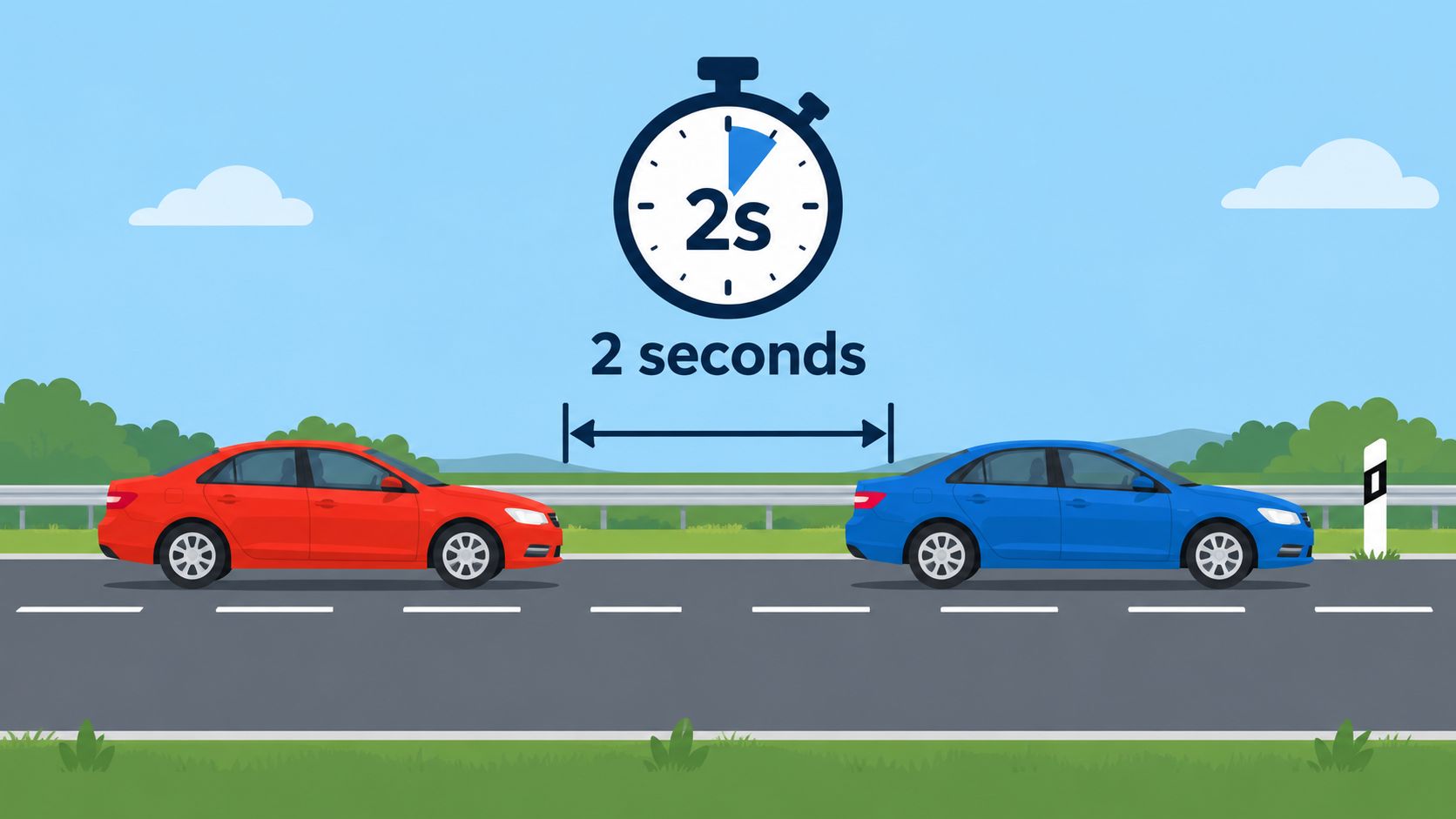
Following distance gives you time to recognise a hazard, decide what to do, and brake without forcing the driver behind into an emergency stop. On a dry motorway, choose a fixed point such as a sign, bridge support, or road marking. When the vehicle ahead passes it, count steadily. Your car shouldn't reach the same point before at least two seconds have passed.
The gap needs to grow in poor conditions. The Highway Code's guidance supports leaving a larger distance when roads are wet, icy, or affected by spray. A four-second gap is a useful minimum in wet conditions, while ice demands even more caution because grip and braking performance can change sharply.
Practical rule: If you can't see enough road ahead to stop safely, you're travelling too close or too quickly for the conditions.
Busy traffic requires patience rather than constant acceleration and braking. If you sit three seconds behind the vehicle ahead, you create room for small speed changes to settle instead of joining the stop-start wave. That makes your own driving calmer and reduces the chance of a sudden brake application.
Handling a tailgater
A driver behind you may reduce the space they've left, but you mustn't retaliate by braking sharply. Ease off the accelerator gradually, increase the space in front of your vehicle, and keep your steering and speed stable. If you need to slow further, do it progressively and allow the other driver a chance to pass when it's safe.
Practise the timing on ordinary roads before a motorway lesson. Your instructor can ask you to maintain different gaps while traffic changes around you, which builds judgement rather than a memorised action. Fast Track Driving Lessons also provides mock tests and motorway-focused practice, giving learners an opportunity to rehearse spacing while concentrating on mirrors, signs, and lane position at the same time.
2. Use Mirrors Correctly and Check Blind Spots Before Changing Lanes
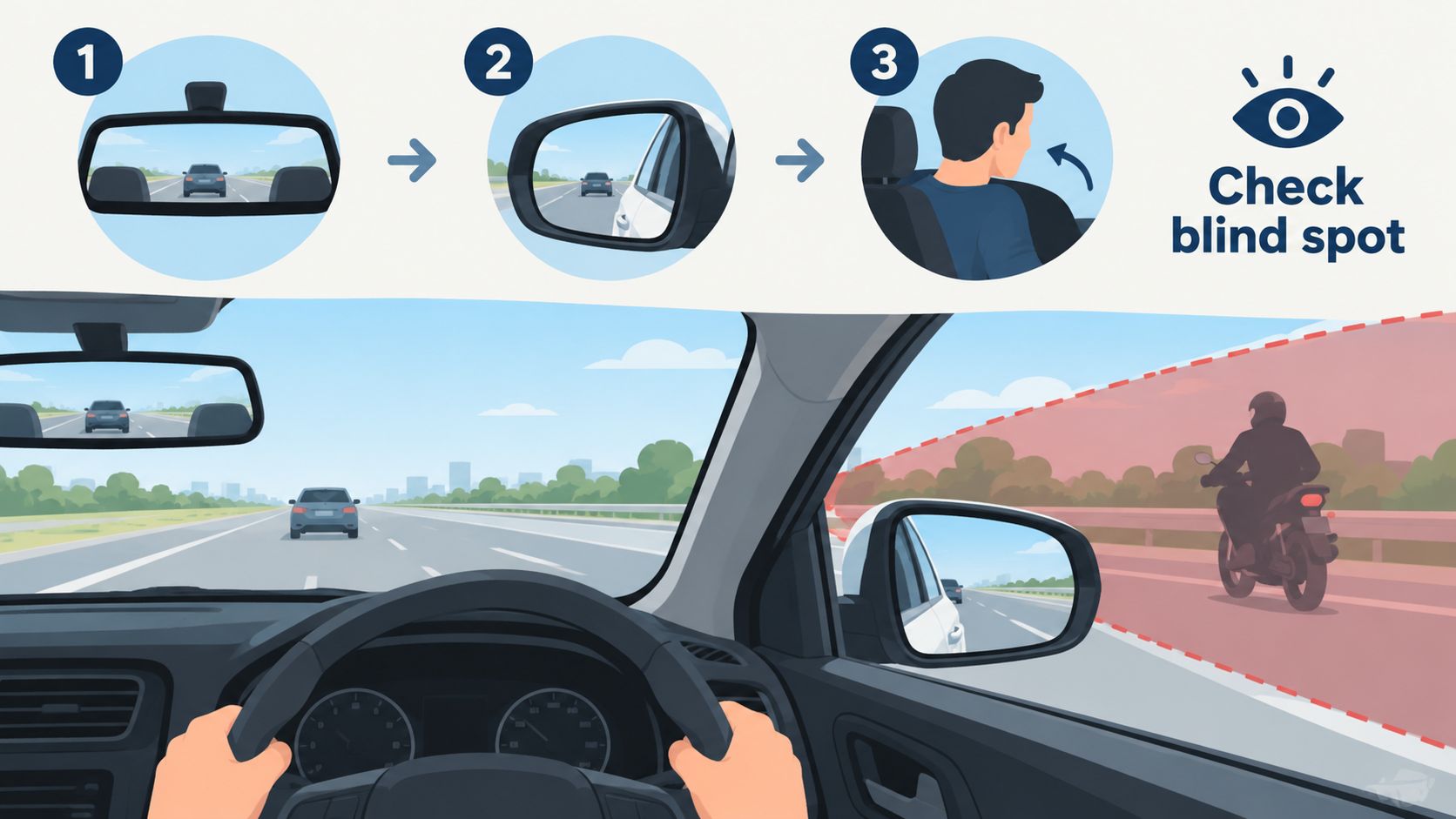
A motorway lane change starts before the signal. First check the interior mirror to understand what's behind you, then the relevant side mirror to assess the target lane. Finally, make a brief shoulder check for the blind spot before moving. The sequence should be quick and purposeful, not a long glance that takes your attention away from the road ahead.
Mirrors don't show every vehicle. A car can sit just behind your rear quarter, hidden from both mirrors, and reach your position quickly because of the speed difference between lanes. This is why a signal doesn't give you priority. It tells others what you intend to do, but you still need to confirm that the move is safe.
Make the check part of the decision
Don't move first and check afterwards. Assess the gap, signal once you've identified your intention, check again if the situation changes, and steer smoothly into the lane. Change one lane at a time, especially when traffic is heavy or vehicles are approaching quickly from behind.
Set your mirrors before joining the motorway. A poorly positioned side mirror can leave a larger unseen area, while an incorrectly adjusted interior mirror makes it harder to judge closing speed. Ask your instructor to watch your routine during an intensive or semi-intensive lesson and point out whether you're checking early enough.
If the blind-spot check reveals a vehicle, abandon the lane change. Maintain your lane, keep a steady speed, and wait for a better opening. Missing an opportunity costs seconds. Moving into an occupied space can cause a collision.
Fast Track Driving Lessons mock tests can include motorway-style routes where mirror discipline is observed alongside signalling and lane choice. Practise an obvious shoulder check at first, provided it remains brief and controlled. With repetition, the movement becomes natural rather than something you remember only when an examiner is watching.
3. Understand and Respect Motorway Lane Discipline and Etiquette
The normal motorway pattern is simple. Keep left when you're travelling normally, move right to overtake, and return left when you've completed the manoeuvre and it's safe. The Highway Code guidance on middle-lane hogging explains why remaining in a lane when the left lane is available creates unnecessary obstruction.
Lane discipline isn't about making every journey look perfect. Traffic may fill the lanes, roadworks may alter the layout, and a sequence of slower vehicles may require you to remain in an overtaking lane temporarily. The important question is whether you're using the left lane when it's reasonably available, rather than treating the middle lane as a permanent cruising lane.
Join, settle, overtake, return
After joining, establish a safe speed in the left lane before deciding whether to overtake. Check the interior and side mirrors, assess the blind spot, signal, and move decisively when the gap is clear. Don't drift across lanes while still deciding what you want to do.
Once you've passed the vehicle, check the left lane before returning. Leave enough room to avoid cutting in, signal left, and move back smoothly. If traffic behind is faster, don't panic or stay right indefinitely. Complete your overtake safely, then return left.
On a motorway with three or more lanes, goods vehicles and buses over 7.5 tonnes, vehicles drawing trailers, and vehicles fitted with a speed limiter must not use the right-hand lane, as set out in the government's motorway signs, signals and road markings guidance. It's a useful detail for learners because not every vehicle has the same lane options.
A learner who keeps left, plans overtakes early, and avoids weaving gives other drivers fewer surprises. During a mock test, ask your instructor to comment specifically on whether you return left promptly and whether your decisions remain safe when traffic compresses.
4. Master Smooth Acceleration and Deceleration to Maintain Control and Comfort
Smooth control is a safety skill, not merely a comfort preference. Pressing the accelerator progressively helps the car build speed without startling traffic around you. Releasing the accelerator early, followed by light braking when necessary, gives the driver behind more warning than a late, forceful brake application.
A slip road is a good example. You need enough acceleration to match the traffic you're joining, but chasing a gap with an abrupt surge can leave you with too much speed and too little time to assess the merge. Build speed in stages, keep scanning, and make the final adjustment once you understand the traffic flow.
Read the traffic before touching the brake
When you see a queue forming ahead, look beyond the nearest vehicle. Ease off the accelerator as soon as you can, allowing the gap to close gradually. Use gentle braking if the traffic continues to slow. This approach avoids the familiar pattern of one driver braking hard, the next braking harder, and the queue behind becoming unstable.
The same principle applies before an exit. Move into the left lane in good time, signal, and reduce speed progressively once you're on the slip road. Don't brake heavily on the main carriageway when you suddenly realise the exit is close. If you miss it, continue to the next junction rather than making a sudden manoeuvre.
Smooth steering matters too. Make one controlled movement into a lane and one controlled movement back. Jerking the wheel can unsettle the car and leaves less margin if another driver changes position.
On a long downhill section, selecting a lower gear briefly can help the vehicle hold speed without constant heavy braking. Use this as part of normal vehicle control, not as a substitute for observing signs or adapting to traffic. Ask your instructor to assess the smoothness of your pedals and steering during motorway practice. Good technique often feels less dramatic than aggressive driving, and that's precisely why it works.
5. Plan Motorway Journeys and Manage Fatigue Effectively
A driver can be too tired to continue without falling asleep. Difficulty focusing, repetitive thoughts, missed signs, or drifting within the lane are warnings that your judgement and vehicle control are deteriorating. Treat them as instructions to stop, not minor discomforts to push through.
Plan breaks before leaving, using suitable motorway service areas as part of the route rather than emergency destinations. Check their locations, allow enough time to leave the carriageway safely, and use the stop to walk, drink, and reset your attention. Remaining parked while staring at the same road environment does little to restore concentration.
Treat tiredness as a reason to stop
Opening a window or increasing the music changes the cabin, but it does not replace sleep. Caffeine may improve alertness temporarily, yet it is not a sound reason to continue when you are struggling to stay awake. If drowsiness appears, leave at a suitable junction or service area and rest.
Fatigue weakens the observation skills expected in motorway driving. You may miss a mirror check, misread a variable speed limit, or react late when traffic slows. DVSA test expectations include effective observation and planning, and both become harder when tired.
Use this practical guidance on how to help reduce tiredness on a long journey when preparing for a longer drive. A planned pause is safer than waiting until concentration has already failed.
If another licensed driver is travelling with you, sharing the driving can reduce the workload. The person taking over must be alert, insured, and licensed to drive that vehicle. Driving alone requires deliberate pauses before tiredness becomes overwhelming.
Learners should raise fatigue management during motorway lessons, particularly if they plan to drive long distances after passing. Fast Track Driving Lessons provides intensive and semi-intensive tuition, while structured practice can build habits around route planning, scanning, and stopping. Electric-car owners should also include realistic charging needs in the plan. Learning to understand true EV range performance helps make charging stops part of a safer, less pressured journey.
6. Manage Motorway Merging and Slip Road Technique Confidently
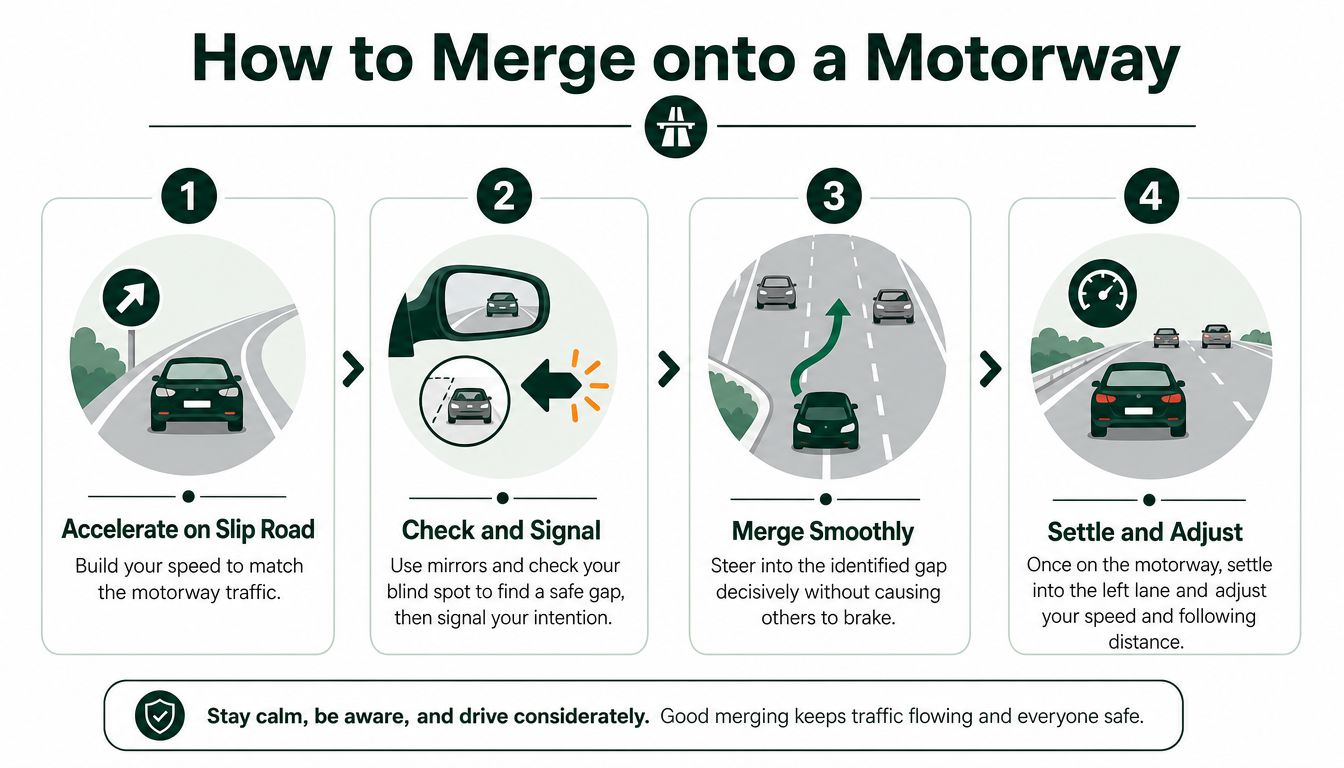
Joining traffic is easier when you use the slip road for its intended purpose, building speed and assessing the flow before the merge point. Look at the vehicles in the left lane, not just the first gap you notice. Your target is a space that lets you join at a compatible speed and continue without immediate braking.
The UK Highway Code says drivers joining a motorway should give priority to traffic already on it. That doesn't mean waiting at the end of the slip road for a perfect opening while your speed falls away. Use the available length, keep observing, and adjust your speed so you can blend into a suitable gap without forcing another driver to brake.
Choose the gap before you reach it
Check the interior mirror, left side mirror, and blind spot. Signal once you've identified the gap you're aiming for, then move smoothly when it's safe. A late signal or hesitant steering movement can leave other drivers uncertain about your plan, while an early signal without a gap assessment can suggest an intention you can't safely complete.
Don't merge at a much lower speed than the traffic flow unless conditions require it. At the same time, don't treat the motorway limit as a target regardless of traffic, signs, or weather. Your speed should match the conditions and the vehicles around you while remaining legal.
Exiting requires the opposite preparation. Move left in good time, signal early, and reduce speed gradually once you're on the exit slip road. If you pass the junction, continue to the next one. Never reverse, stop, or cut across lanes to recover a missed exit.
Fast Track Driving Lessons mock motorway routes can include merge and exit practice near a chosen test area. Repeating the process with an approved instructor helps separate the tasks, first matching speed, then finding a gap, then steering into it. A learner who knows exactly what to do is less likely to freeze when the traffic is busy.
Watch the practical merge sequence before your next lesson.
7. Adapt Your Driving to Varying Weather and Road Conditions
A motorway that feels straightforward in dry daylight can become a different road in heavy rain, fog, ice, or dense spray. The correct response isn't one fixed speed reduction. It's a combination of better visibility, a larger gap, gentler inputs, and a willingness to stop if the conditions exceed what you can manage.
In rain, tyres may lose grip through standing water, and spray from a lorry can obscure the road ahead. Increase your following distance, ease your speed down, and avoid sharp steering or braking. A four-second gap is a practical minimum in wet conditions, but you may need more when visibility is poor or water is pooling.
Let visibility determine your pace
Dipped headlights help you remain visible in reduced light and poor weather. Full beam can reflect from fog and worsen the glare in front of you, so do not use it only to see further. If conditions become difficult, reduce speed enough to maintain a clear view of the road and be ready for stopped or slow-moving traffic.
Ice requires particularly gentle control. Avoid sudden accelerator, brake, or steering inputs, especially on exposed bridges and raised sections where temperatures can differ from the surrounding road. If the car begins to lose grip, stay calm, ease off the accelerator, and avoid abrupt braking while you regain control.
The Highway Code advice on driving in adverse weather is useful revision, but an instructor can explain how the car's response changes in practice. Discuss what you'd do before conditions deteriorate, rather than waiting until visibility has already collapsed.
For electric-car drivers, cold conditions may also affect journey planning and charging decisions. Practical advice on managing your EV in cold weather can complement your driving preparation, but it doesn't replace the fundamentals of grip, visibility, and space.
8. Maintain Concentration and Manage Motorway Distractions
Motorway driving can feel easy because the road is wide and the route is familiar. That sense of ease is dangerous if it turns into passive driving. Straight sections, repetitive scenery, cruise control, conversations, and sat-nav prompts can all reduce the attention you're giving to traffic behaviour.
Keep your phone out of reach before you set off. Don't adjust the sat-nav, eat, search for a cable, or reach into a bag while moving. If you miss an exit, accept it and use the next safe junction. A missed turn is a navigation problem. A sudden lane change across traffic can become a serious safety problem.
Scan deliberately
Look well ahead for brake lights, lane closures, queues, roadworks, and changes in traffic density. Check mirrors regularly, but don't stare at them or follow a rigid countdown that distracts from the road. Your scan should keep updating three things, what's ahead, what's beside you, and what's approaching from behind.
Cruise control can help maintain a stable speed on an open motorway, but it doesn't remove your responsibility to monitor traffic and signs. Be ready to cancel it when conditions change. Variable speed limits, congestion, gradients, and poor weather all require active judgement.
Passengers need to understand that the driver can't safely respond to every conversation or request. Ask them to handle navigation, adjust the audio, or wait until you've stopped. At a service area, take the opportunity to eat, drink, stretch, and reset rather than trying to solve every need from the driver's seat.
During Fast Track Driving Lessons, ask your instructor to watch your scanning habits as well as your manoeuvres. Mock motorway tests can recreate the mental workload of a real assessment, where late reactions, missed signs, or weak mirror routines may reveal that concentration has dropped.
The wider safety context supports this disciplined approach. In Great Britain, motorways carried about 21% of all road traffic in 2024, yet accounted for 6% of fatalities and 4% of casualties, with 91 people killed and 5,055 casualties recorded on motorways, according to the government's reported road casualties by road type. Motorways are designed for orderly, high-speed flow, but concentration remains the driver's responsibility.
8-Point Motorway Driving Tips Comparison
| Technique | Implementation complexity | Resource requirements | Expected outcomes | Ideal use cases | Key advantages |
|---|---|---|---|---|---|
| Maintain a Safe Following Distance (Two‑Second Rule) | Low, simple, repeatable habit | None beyond attention; practice time | Consistent safe spacing; fewer rear‑end collisions | Everyday motorway driving; learner practice; wet/icy with 4s | Easy to learn; speed‑adaptive; DVSA‑aligned |
| Use Mirrors Correctly & Check Blind Spots | Medium, coordinated three‑point check | Properly adjusted mirrors; instructor feedback for learners | Fewer lane‑change collisions; improved test performance | Lane changes, overtaking, merging, test routes | Reduces blind‑spot risks; protects motorcycles/small vehicles |
| Understand & Respect Lane Discipline | Medium, requires constant awareness | Knowledge of rules; motorway practice | Smoother traffic flow; fewer conflicts; legal compliance | Continuous motorway travel; overtaking sequences; examinations | Predictable driving behaviour; avoids penalties |
| Master Smooth Acceleration & Deceleration | Medium, needs control and anticipation | Practice with instructor; time to develop feel | Improved stability, passenger comfort, reduced fuel/brake wear | Merging, adapting to traffic, test evaluation of control | Enhances control; conserves fuel; favoured by examiners |
| Plan Journeys & Manage Fatigue | Medium, planning + self‑monitoring | Time to plan; service area info; possible co‑driver | Reduced fatigue‑related incidents; safer long trips | Long distances, night driving, EV route planning | Prevents microsleeps; improves journey reliability |
| Manage Merging & Slip Road Technique | High, multi‑tasking under pressure | Slip road practice; instructor supervision | Safer motorway entry/exit; fewer merge collisions | Joining/exiting motorways; busy traffic; test scenarios | Immediate safety impact; critical for test success |
| Adapt Driving to Weather & Road Conditions | Medium–High, situational judgement required | Weather info; sometimes equipment (tyres); practice | Lower skid/aquaplane risk; safer handling in adverse conditions | Rain, fog, ice, heavy spray, seasonal transitions | Significant risk reduction; demonstrates mature driving |
| Maintain Concentration & Manage Distractions | Medium, sustained self‑discipline | Pre‑set devices, rest planning, in‑vehicle routines | Fewer distraction‑related incidents; better hazard detection | Long, monotonous journeys; high‑speed driving; tests | Fundamental to all safety techniques; reduces reaction delays |
Steering Ahead with Confidence
A learner may join a busy motorway, find the traffic moving faster than expected, then face a lane change within minutes. Confidence comes from having a clear response: build a safe gap, scan mirrors before changing lanes, match the flow when joining, return left after overtaking, and react early to signs or weather.
The Highway Code is the main government reference for motorway conduct. It advises giving priority to traffic already on the motorway, matching the speed of traffic in the left-hand lane, avoiding solid white lane lines, and remaining in the left-hand lane long enough to adjust before overtaking. It also explains that the hard shoulder is not a normal running lane and that joining drivers should blend into traffic rather than stay too close to faster vehicles. Review the official motorway rules and guidance before a lesson or planned journey.
Speed control needs deliberate practice. In free-flowing motorway conditions in 2024, 44% of car drivers exceeded the speed limit, while 7% were more than 10 mph over it, according to Great Britain vehicle speed-compliance statistics. The practical lesson is to hold a stable, legal speed and check regularly for speed drift. Driving substantially below the traffic flow without a reason can create its own problems, so match conditions while staying within the limit.
Learners may drive on motorways only with an approved driving instructor in a dual-control car. Supervised practice therefore gives you a controlled way to handle the first join, lane change, and variable traffic. DVSA test expectations become easier to apply when you practise decisions in realistic scenarios instead of memorising isolated rules.
Build a repeatable routine
Before setting off, prepare the route, vehicle, mirrors, phone, and rest plan. On the motorway, keep your eyes moving and make decisions early. If traffic feels rushed, increase the space around your car. If fatigue or weather makes the drive unsafe, stop.
Fast Track Driving Lessons provides motorway lessons alongside intensive and semi-intensive tuition, mock tests near selected test centres, and learner materials for practical and theory preparation. Whether you are starting from scratch, returning to driving, or preparing for a test, focused motorway practice can turn uncertainty into actions you can repeat.
For guided practice with joining, lane discipline, motorway signals, and examiner-focused mock routes, visit Fast Track Driving Lessons to explore instructor-matched intensive and semi-intensive tuition. Choose manual or automatic lessons, discuss your motorway goals with a DVSA-approved instructor, and practise the decisions that matter on real journeys.
Written by Fast Track editorial team.