
The UK car theory test pass score is 43 out of 50 for the multiple-choice section, which is 86%, and 44 out of 75 for hazard perception. You must pass both parts in the same sitting.
You may be checking your booking date, revising late at night, or wondering whether a strong score in one part can rescue a weaker result in the other. It can't. The test works like a pair of locks: the multiple-choice section tests what you know, while hazard perception tests how well you recognise developing danger.
That sounds stricter than it feels in practice. Once you understand how each section is marked, you can stop treating revision as one large task and focus on the skill that needs attention. A learner who knows the Highway Code but clicks too late at hazards needs different practice from someone who spots danger well but loses marks on road signs or stopping distances.
The official GOV.UK theory test pass mark guidance confirms the current thresholds for car learners. This guide breaks them down in straightforward terms, then applies them to realistic revision decisions, so you know exactly what passing requires and how to prepare without relying on luck.
Table of Contents
- What Your Theory Test Pass Score Means: The Two Thresholds
- How the UK Theory Test Is Structured
- Multiple Choice Scoring and What 43 Out of 50 Really Means
- Hazard Perception Scoring and How to Reach 44 Out of 75
- Why So Many Learners Miss the Pass Mark and How to Avoid It
- Your Next Steps After Understanding the Pass Score
What Your Theory Test Pass Score Means: The Two Thresholds
You leave the test centre cautiously hopeful. The multiple-choice questions felt familiar, yet the video clips were harder to judge. Your result can then show a pass in one part and a miss in the other. A strong score in one section cannot balance a result below the threshold in the second.
For a UK car test, the theory test pass score is separate for each section. You need 43 correct answers out of 50 multiple-choice questions, equal to 86%, and at least 44 points out of 75 in hazard perception. Both results must be achieved in the same sitting, as the official GOV.UK pass mark and result information explains.
A pass requires clearing two separate thresholds, and neither can compensate for the other. The multiple-choice threshold checks your understanding of signs, road users, safe following distances and Highway Code rules. The hazard perception threshold checks whether you can recognise a situation developing into a hazard and click at the right moment.
The two parts work like separate checks before a door opens. Passing one does not carry the other over the line. Accurate hazard clicking cannot make up for an unsuccessful multiple-choice result, just as excellent knowledge cannot rescue a low hazard perception score.
This explains why balanced preparation matters. Repeating practice questions may help you remember rules, but it will not necessarily improve your timing in video clips. First identify the weak skill: recalling a rule, applying it to a question, or judging when a hazard starts to develop. That turns revision into a clear task rather than one large, worrying problem.
The national pass rate is 44.8%, so many learners are missing one threshold rather than both. Prepare for each part separately, then practise switching between knowledge and observation.
The simple rule: passing the theory test means meeting both section thresholds, not reaching one combined total.
How the UK Theory Test Is Structured
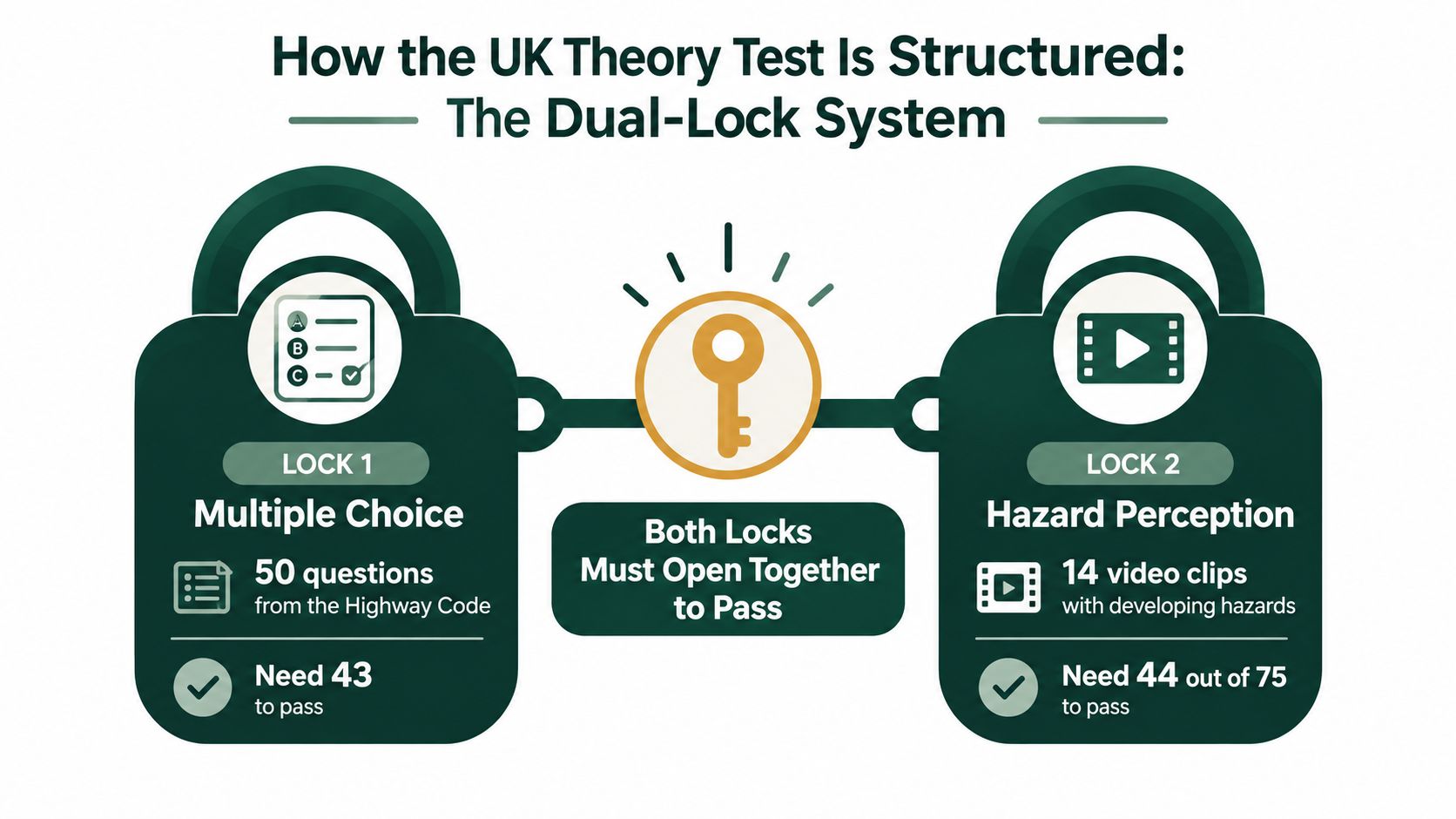
The test has two parts taken in the same sitting. Treat them as a dual-lock system, where each lock needs its own key.
Lock one tests what you know
The multiple-choice section contains 50 questions. You'll answer questions based on the rules and situations covered by the Highway Code, including signs, road markings, vulnerable road users, vehicle handling and safe driving decisions. Some questions use photographs or a short scenario, so you must understand the rule rather than recognise a sentence by memory.
The target is 43 correct answers. That part is similar to opening a lock with a knowledge key. You have to choose the correct response from the options presented, and the section rewards careful reading as much as recall.
Lock two tests what you notice
Hazard perception uses video clips showing ordinary road scenes. You're looking for developing hazards, meaning situations that may require you to change speed, direction or position. A parked vehicle on its own may not yet be a developing hazard, but a person stepping from behind it can change the situation quickly.
The two sections test different driving abilities for a reason. A driver can understand a rule in a quiet room yet fail to recognise a risk early enough on the road. Equally, someone with strong observation skills may still need to revise the rules behind safe decisions.
You can find a fuller explanation of the format in this guide to what's included in the theory test. The key point is to practise both parts rather than assuming one type of revision covers everything.
Multiple Choice Scoring and What 43 Out of 50 Really Means
The multiple-choice threshold is 43 out of 50, or 86%. In practical terms, that allows seven incorrect answers. The threshold is demanding because the test expects a reliable grasp of everyday road safety, not occasional recognition of the right answer.
Official car multiple-choice pass mark: 43 correct answers from 50 questions.
Read the question before recalling the answer
Questions are based on Highway Code subjects and may describe a situation rather than ask for a definition. Look for words that change the meaning, such as “first”, “safest”, “most likely” or “should”. Two answers may sound sensible, but only one will respond to the exact question.
There's no benefit in rushing through familiar topics while ignoring areas that repeatedly cause mistakes. Use DVSA-style theory questions to sort errors into categories. For example, you might find that you understand signs but confuse rules involving vulnerable road users. That diagnosis is more useful than recording another overall score.
The pass mark has also remained consistent for many years. A DVSA-focused explanation of the long-running theory test threshold states that it hasn't moved since 2007, with the established standard remaining 43 out of 50 for multiple choice and 44 out of 75 for hazard perception.
A high hazard score can't rescue this section
Each part stands alone. Suppose you perform strongly on the video clips but answer fewer than 43 multiple-choice questions correctly. You haven't passed the theory test, because the knowledge lock remains closed. The same applies in reverse.
Use the margin intelligently. Don't aim to scrape over the line in practice and hope nerves won't affect you on the day. A stable understanding of the topics gives you room to handle an unfamiliar photograph, an awkwardly worded scenario or a question you haven't seen before.
Hazard Perception Scoring and How to Reach 44 Out of 75
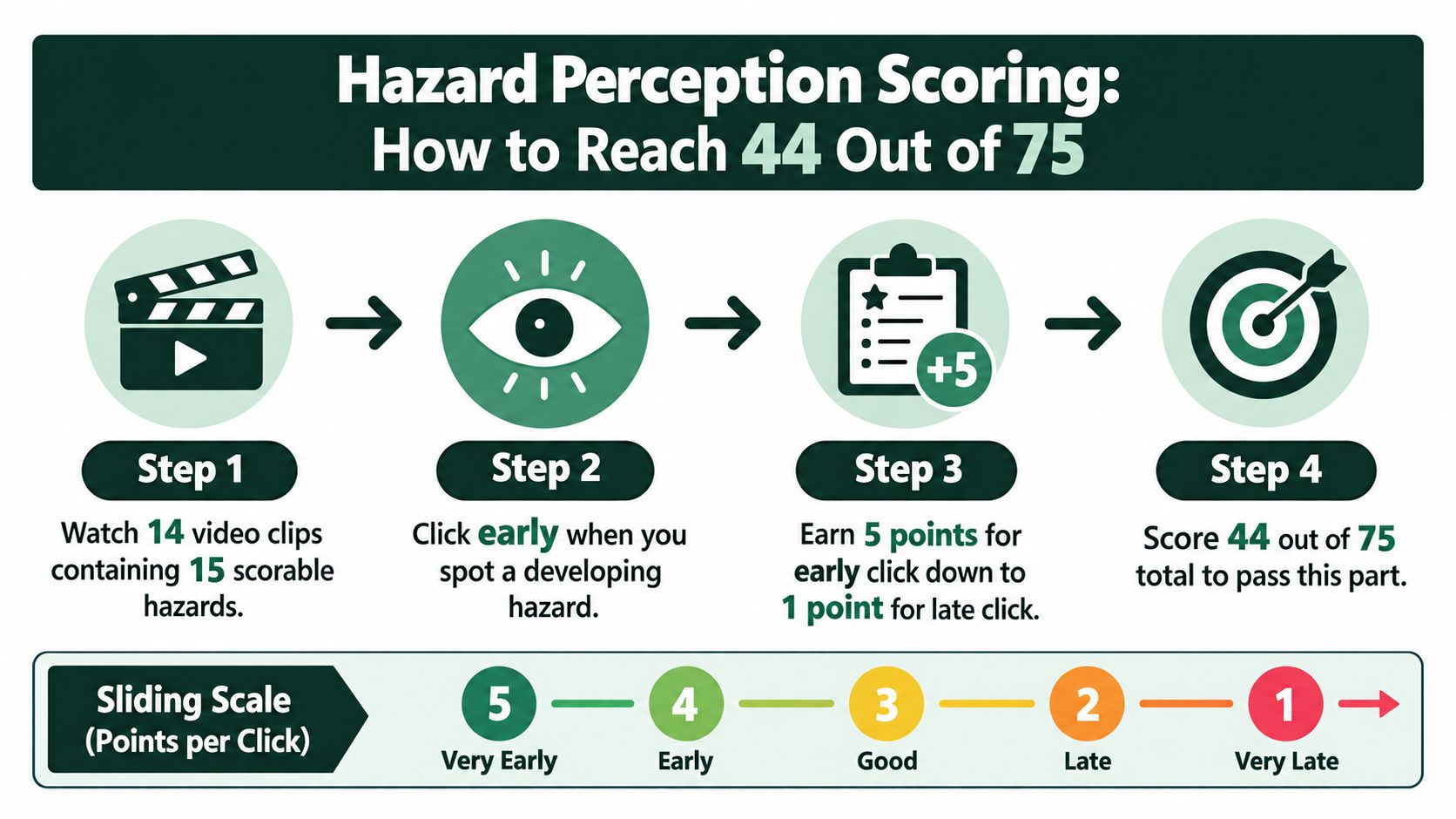
Hazard perception feels less like a quiz and more like a timing exercise. You watch 14 video clips, identify developing hazards and click when you recognise that a situation may require action. The scoring rewards early, appropriate awareness rather than random clicking.
Timing matters more than speed
A developing hazard might be a pedestrian moving towards the road, a vehicle beginning to emerge from a side road or a cyclist changing position near parked cars. You won't score because something is present. You need to identify the point at which it starts developing into a situation that could affect your driving.
A timely click can earn more than a late click. Clicking before the hazard has developed may score nothing because you've responded to a possibility rather than a clear developing risk. Clicking repeatedly in a pattern can also be treated as unsuitable behaviour, so steady observation is safer than trying to game the scoring window.
Consider a pedestrian near a parked vehicle. At first, the pedestrian may be standing safely on the pavement. If they step towards the carriageway and your path could be affected, that is the moment to recognise the developing hazard. Waiting until they're already in front of you is late, while clicking continuously from the start doesn't show precise awareness.
Watch this hazard perception visual before practising, then focus on the point at which a risk changes rather than clicking at every movement.
The target is 44 out of 75. Northern Ireland's official theory test guidance gives the same car and motorcycle standard, with 43 out of 50 for the questions and 44 out of 75 for hazard perception. That consistency helps remove a common worry: the pass score doesn't change because you're taking the test in a different part of the UK.
For focused practice, use this explanation of hazard perception and developing hazards. Review why a click scored well, scored late or scored nothing. That feedback teaches judgement, which is the skill the clips are designed to measure.
Why So Many Learners Miss the Pass Mark and How to Avoid It
The national result shows why balanced preparation deserves attention. DVSA data for Great Britain records a car theory test pass rate of 44.8% in 2025/26, with 1,311,480 passes from 2,924,430 tests, meaning fewer than half of candidates reached the required thresholds, as shown in the official car theory test statistics.
That figure doesn't mean the test is impossible. It suggests that many learners arrive with an uneven profile. They may know question-bank answers but lack hazard timing, or they may practise clips without revising the rules that explain the safest response.
Multiple Choice Versus Hazard Perception at a Glance
| Feature | Multiple Choice | Hazard Perception |
|---|---|---|
| Main skill | Knowledge and interpretation | Observation and timing |
| What you do | Select answers to questions and scenarios | Identify developing hazards in video clips |
| Common pitfall | Memorising wording without understanding the rule | Clicking too early, too late or repeatedly |
| Useful practice | Revise Highway Code topics and review wrong answers | Watch clips, click deliberately and study feedback |
| Pass requirement | 43 out of 50 | 44 out of 75 |
Use a targeted routine
- Diagnose the weak lock: Keep separate records for question mistakes and hazard-perception results. A single combined revision score can hide the problem.
- Revisit topics in spaced sessions: Return to signs, road markings, junctions, stopping distances and vulnerable road users instead of cramming one topic repeatedly.
- Practise under test conditions: Complete timed mock tests without checking notes. Then review every wrong answer, including guesses that happened to be correct.
- Make hazard practice deliberate: Watch the road scene first, identify the developing risk and click once you can explain what may force you to change speed, direction or position.
- Build a safety margin: Aim for consistent practice results above the pass threshold. This isn't about chasing a perfect score. It's about reducing the effect of nerves and unfamiliar questions.
If multiple choice is your weaker section, explain each answer aloud in your own words. If hazard perception is the problem, stop treating it as a reaction-speed contest. Good performance comes from recognising a meaningful change in the scene and responding at the appropriate point.
Your Next Steps After Understanding the Pass Score
Passing becomes much clearer when you treat preparation as two linked routines. Revise the knowledge needed for the multiple-choice section, then practise the visual judgement required for hazard perception. Neither routine replaces the other.
Start with a short skills check. Complete a set of questions without notes and record the subjects behind your errors. Follow that with hazard clips and note whether your clicks were early, late or unsuitable. Your next revision session should address the larger weakness, while still keeping the other section active.
A practical plan for test readiness
- Learn the rule: Read the relevant Highway Code topic and make sure you understand why the answer is safe.
- Apply the rule: Use scenario-based questions rather than relying only on memorised wording.
- Train observation: Practise spotting developing hazards in changing road scenes.
- Simulate the sitting: Take both parts in sequence so the format feels familiar.
- Check consistency: Book the test when your practice shows dependable performance in both locks, not just one fortunate attempt.
After you pass, keep your result details safe and move your attention towards practical preparation. Your theory result is one step towards the practical test, not proof that every on-road skill is already secure. Continue developing observation, planning, speed control and independent decision-making with your instructor.
A near miss is useful if you treat the result as information. If questions were the issue, organise revision by topic. If hazard perception was the issue, review the clips and timing decisions rather than repeating questions alone. Structured support can also help, including mock tests on routes near your chosen test centre and the free Learner Hub for DVSA-style practice.
You don't need to feel ready for every possible question before you begin. You need a clear understanding of both pass marks, honest feedback from practice and a routine that steadily closes your weaker gap.
Fast Track Driving Lessons offers intensive and semi-intensive tuition with local DVSA-approved instructor matching, plus a free Learner Hub with DVSA-style theory questions and step-by-step driving guides. Visit Fast Track Driving Lessons to connect your theory preparation with structured practical training.
Written by Fast Track editorial team.