

Are you really revising for the UK theory test if you're only answering one multiple-choice question after another? That habit can build familiarity without preparing you for hazard perception, timed decision-making, explanations, case-study-style material or the pressure of a realistic mock.
The better question is which revision format matches the way you learn. Some resources prioritise official DVSA coverage. Others offer guided teaching, quick topic drills, app-based convenience or a closer simulation of the test environment. A smaller group connects theory knowledge to the practical skills you'll need behind the wheel.
This comparison assesses ten resources by coverage, format, practical use, access route and limitations. It also separates free tools from paid products and distinguishes car preparation from higher-category study. The official car test contains 50 multiple-choice questions in 57 minutes, with 43 correct answers required, and you must also pass hazard perception overall, as set out in GOV.UK's pass-mark guidance. That makes broad question access useful, but not sufficient on its own.
Fast Track Driving Lessons' free Learner Hub is particularly relevant if you want theory practice to support intensive or semi-intensive tuition. It isn't the only credible option, but its combination of DVSA-style questions, step-by-step guides and practical preparation gives it a different role from an app used purely for drilling.
Table of Contents
- 1. Theory Practice
- 2. Official DVSA Theory Test Kit
- 3. Safe Driving for Life
- 4. Driving Test Success
- 5. Theory Test Pro
- 6. Driving Theory 4 All
- 7. TopTests.co.uk
- 8. The AA Driving Theory App
- 9. Deep River Development Driving Theory Test Kit
- 10. RAC Driving Theory Test App
- Driving Theory Practice: Top 10 Resource Comparison
- Build a Revision Routine That Reflects the Test
1. Theory Practice
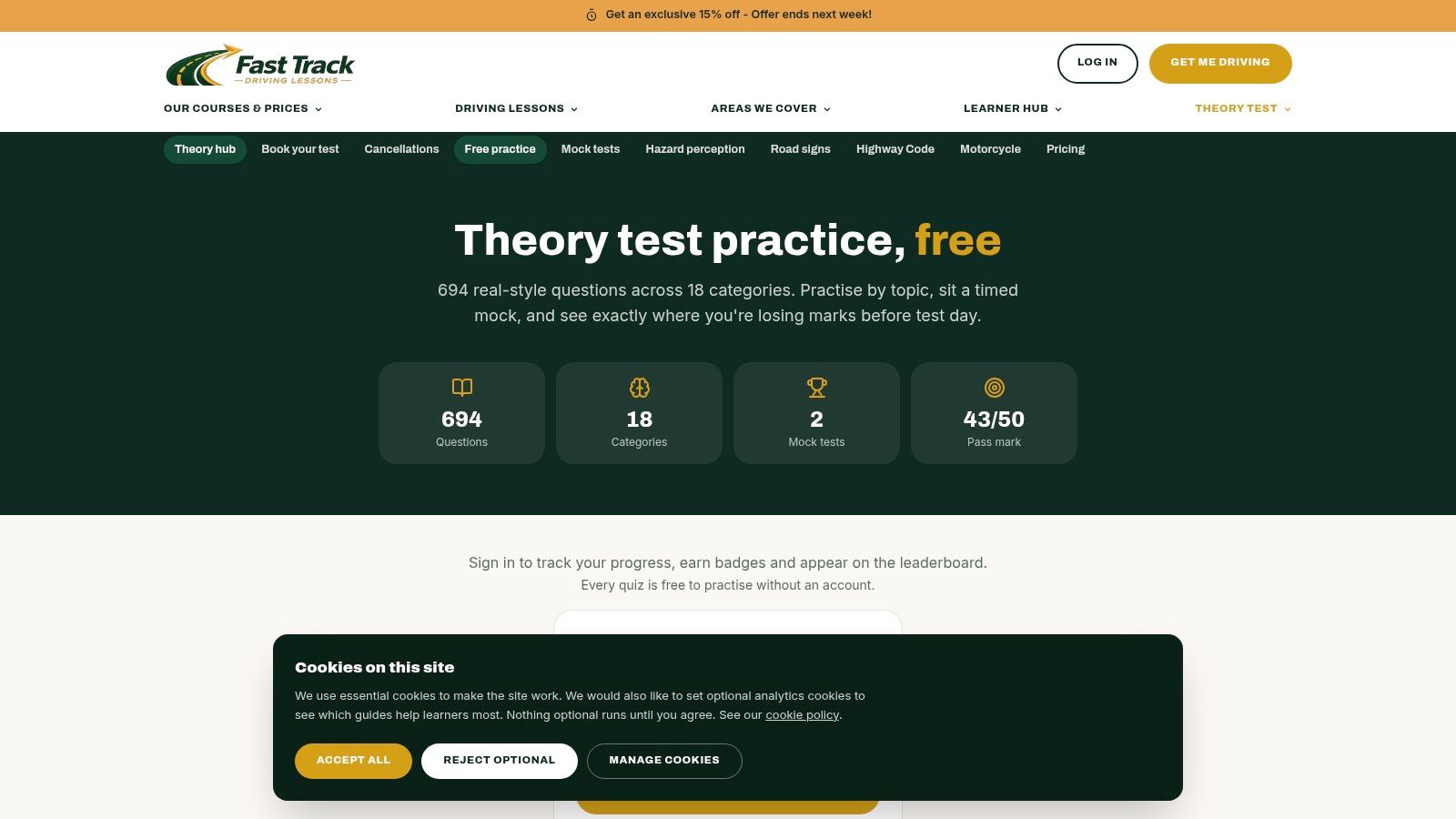
Fast Track Driving Lessons' Theory Practice hub is the most complete theory-to-practical option in this list. It brings together DVSA-style multiple-choice practice, hazard-perception preparation and explanations with practical driving guides, so revision isn't isolated from the behaviours you'll need during lessons and the practical test.
The resource is available through the free Learner Hub and is designed for learners at different stages. A complete beginner can use the guided material to understand what must be learned before intensive tuition. Someone with existing experience can use topic practice and mock tests to expose gaps before committing to a concentrated course. Learners preparing near a chosen test centre can also use mock-test preparation linked to local routes, where available.
Practical rule: Use question explanations to change your driving decisions, not just to increase a score on the next quiz.
The strongest feature is the connected workflow. Theory questions and hazard perception sit alongside step-by-step guidance, instructor-led courses and practical mock-test preparation. Fast Track also offers PracticalTest Assist, which monitors DVSA test alerts and supports learners seeking suitable cancellations. That makes the hub more useful for people who want a route from revision to test readiness, rather than another standalone question bank.
Where it fits best
- For full-format preparation: It addresses both multiple-choice knowledge and hazard perception, rather than treating the exam as one quiz.
- For intensive learners: The guides help identify what to study before concentrated practical tuition begins.
- For practical transfer: Instructor support, local-route mock tests and guidance connect theory to examiner-marked driving behaviour.
- For access and clarity: The Learner Hub is free, while course pricing, instructor checks and course recommendations are presented separately.
Online questions and hazard videos still can't reproduce the full pressure or environment of a live test. Availability of bespoke one-to-one theory coaching may also depend on local instructor coverage and demand. Visit Theory Practice from Fast Track Driving Lessons to assess whether that broader pathway suits your revision style.
The distinction between a quiz and a test matters here. LearnStream's assessment advice provides useful context for separating recall practice from more demanding assessment conditions.
2. Official DVSA Theory Test Kit
Which resource offers the clearest route from official revision material to test-style practice? The Official DVSA Theory Test Kit is a strong choice for learners who want DVSA content in one app. It combines the official revision question bank with explanations, hazard-perception clips, the Official Highway Code and progress tools.
Its controlled format supports several revision stages. You can study by topic, test recall with mock exams, review mistakes and monitor progress without assembling a routine across separate products. That makes it more useful for structured revision than for quick, isolated drills.
The app also covers both parts of the car theory test. Official guidance sets out 14 video clips in the hazard-perception section, containing 15 developing hazards, while the pass mark is 44 out of 75. These figures are explained in the official GOV.UK test guidance.
Format and limitations
Authority is the main advantage. The question bank is tied to DVSA material, reducing uncertainty about whether practice content reflects the test syllabus. Topic work and mock tests serve different purposes: the former exposes knowledge gaps, while the latter checks timing, recall and answer selection in a more realistic format.
The app is less suitable for learners who prefer browser-based study or a larger desktop screen. It is also a paid option, with pricing subject to the current app-store listing and any promotion, so check those details before buying.
Use it for official coverage and full-format practice. Add instructor-led preparation if you also need feedback on how theory applies behind the wheel. Fast Track's theory revision tools provide a separate route for connecting question practice with practical driving preparation.
3. Safe Driving for Life
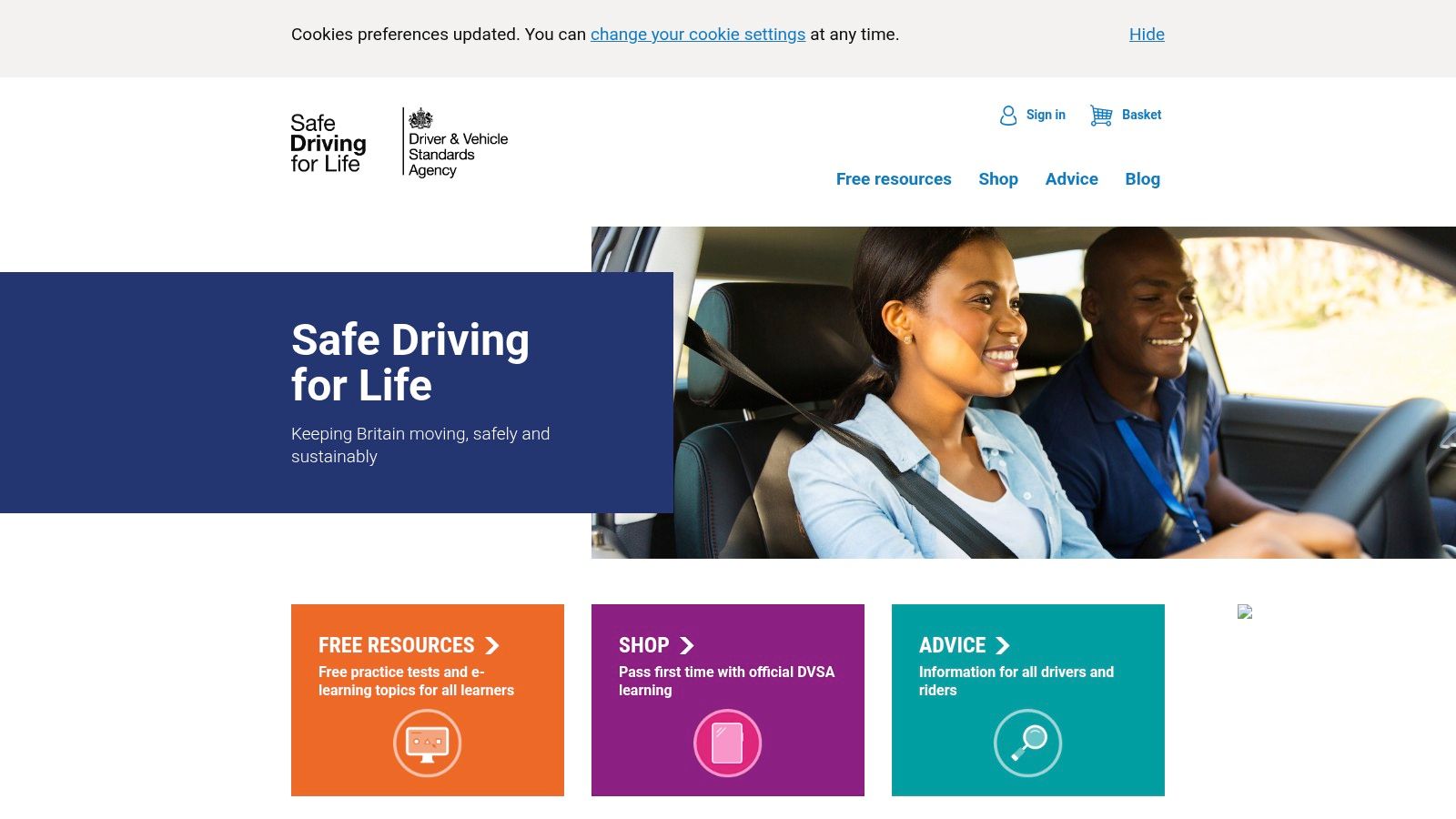
Safe Driving for Life is the official learning hub associated with DVSA guidance and TSO-published materials. It's a sensible first stop for learners who want free practice tests, official advice and clear routes into structured paid e-learning products.
The free material works best as a baseline. It helps you understand the test, practise official-style questions and identify whether you need more support before choosing a paid course. Its coverage extends beyond car learners, with separate products for motorcycles and vocational categories. That separation matters because professional-vehicle tests use different thresholds and question structures.
Free access and paid pathways
The site also sells e-learning kits that combine questions, hazard clips and explanatory guidance into a more organised study route. That's useful if you prefer a course rather than assembling your own routine from scattered tests. The trade-off is that paid access is typically time-limited, so you should check the current terms before relying on it as a long-term reference library.
The site is content-rich, which is helpful once you know what you need but can feel busy for a first-time visitor. Start with the vehicle category and official practice route that match your licence. Don't assume car preparation transfers directly to LGV or PCV study, because nidirect's category guidance confirms those tests have their own scoring arrangements.
4. Driving Test Success
Driving Test Success gives learners a choice between a mobile app and browser-based study. Its 4-in-1 app combines theory questions, hazard perception, the Highway Code and road signs, while DTS Anytime adds timed mocks, progress tracking and learning plans through a web subscription.
That dual access route is its clearest practical advantage. You can use the app for short sessions away from home and the browser product for longer revision or mock tests. Learners who dislike being locked into one device will find that more flexible than an app-only resource.
App or browser
The product is suited to structured revision rather than random question sampling. Topic targeting helps you revisit weak areas, and timed mocks introduce a more demanding format than untimed drills. Some plans also include pass-guarantee terms, but those conditions and fair-use rules need checking before purchase rather than being treated as a universal promise.
The limitation is that the two versions aren't identical. Features, interface and subscription terms differ between the app and DTS Anytime, so compare the exact product you're buying. A one-off app purchase may suit a learner who wants a compact revision tool, while a subscription may be more useful for someone who wants a browser-based learning plan.
For the official test structure, compare your chosen routine with DVSA's theory-test format guidance, which explains how the assessment developed from its original form into the broader modern exam.
5. Theory Test Pro
Theory Test Pro is built around realistic simulation and is commonly accessed through driving schools, instructors and public libraries. It offers multiple-choice and hazard-perception practice through mobile apps and a desktop browser, making it one of the more adaptable choices for learners who don't want an app-only experience.
Its access model is unusual. In participating council areas, a library card may provide free at-home access, although availability depends on the library's subscription. Some instructors also provide access to learners. That means the first step isn't necessarily opening a payment page. It's checking whether your local library or instructor already includes it.
Why simulation matters
The product's value lies in its test-like presentation. That can help learners who know the material but struggle when questions appear in an unfamiliar sequence or when the interface creates time pressure. Progress tracking also gives instructors a way to monitor revision when the platform is supplied through a school or library.
The limitation is predictability. Direct purchase routes may be less obvious, and the content you can access depends on the organisation providing the subscription. Confirm whether your library offers home access and whether the vehicle category you need is included.
Use Theory Test Pro for simulation, then pair it with a deliberate topic-revision method. Fast Track's guide to revising for the theory test is relevant if you need help turning mock results into a targeted routine.
6. Driving Theory 4 All
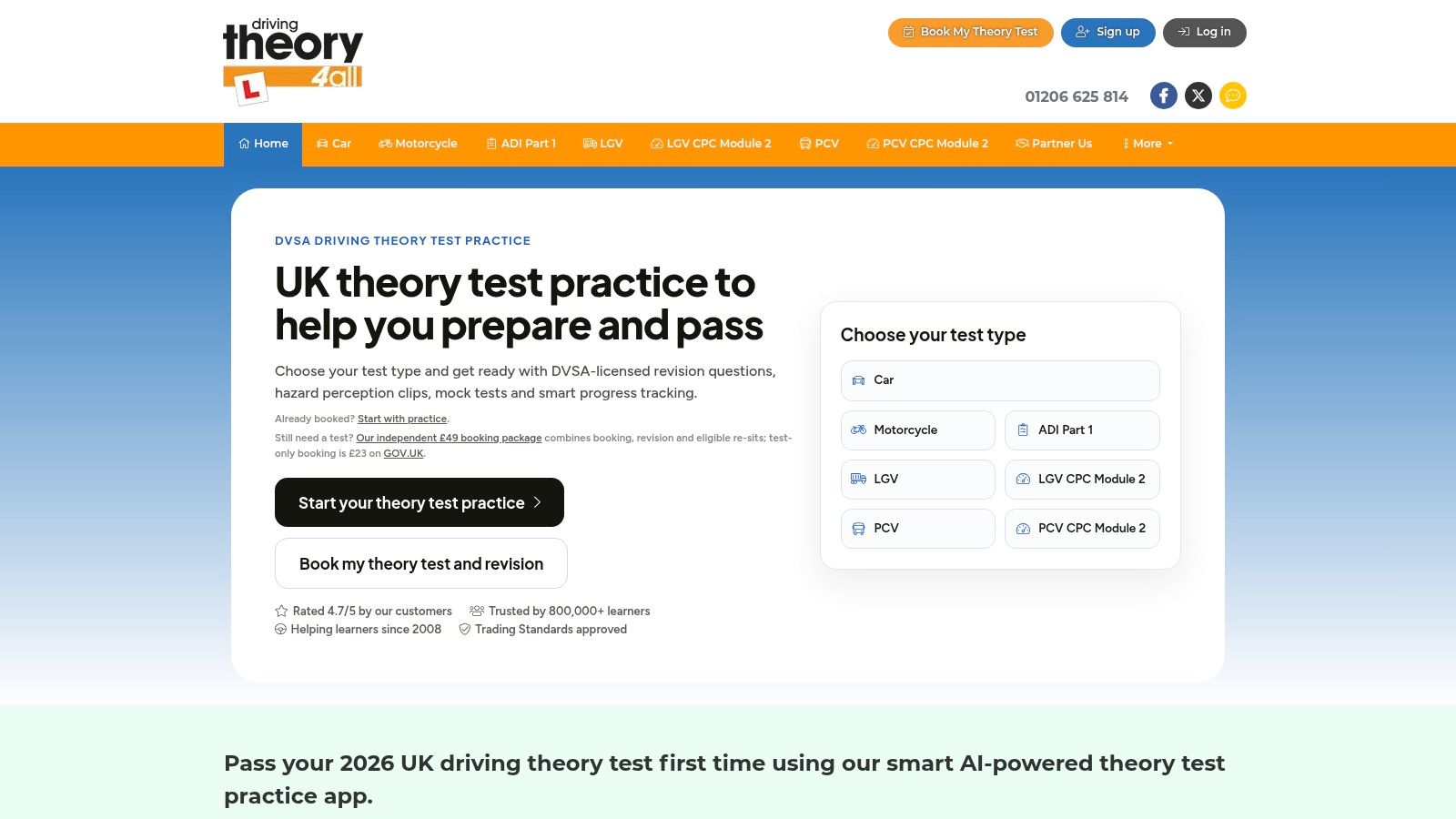
Driving Theory 4 All targets learners who need instruction before repeated testing. Picture-based questions, plain-English explanations, topic notes, voiceovers and personal notes create a guided course rather than a rapid-fire quiz.
That format is useful when wrong answers reflect missing context. Learners can study a topic, review why an answer is correct and save points for later. Voiceovers offer another route through dense material, particularly for people who prefer listening while viewing the questions.
A broader licence focus
The platform works in a browser and through apps, covering car, LGV, PCV and ADI preparation. This makes it more relevant to vocational candidates than car-only tools. Professional-vehicle theory requires its own preparation, rather than just extending car-test revision. nidirect's preparation guidance recommends checking that practice materials reflect official-style wording, explanations and test-like screens.
Its course structure can slow revision for learners who already know the syllabus and want short drills between lessons. Free access is limited, while fuller use requires paid access, so review the available sample material before choosing it.
The practical decision depends on the error pattern. Choose Driving Theory 4 All when incorrect answers expose knowledge gaps, especially for LGV, PCV or ADI preparation. Choose a drill-focused resource when the remaining work is recall, timing and exam-condition practice.
7. TopTests.co.uk
TopTests.co.uk is a convenient web option for learners who want to start practising without installing an app. Its free service includes mock tests, topic drills, exam-simulator sessions and marathon modes, while Premium adds DVSA-licensed questions, case studies and enhanced explanations.
The free tier is useful for building a daily habit. Mobile and desktop access removes a common barrier, and short topic sessions work well when you have limited time before or after a driving lesson. Marathon practice can also expose endurance problems that a handful of isolated questions won't reveal.
Free doesn't mean identical
The important limitation is content status. The free tier uses look-alike questions, while DVSA-licensed material sits behind Premium. That doesn't make the free practice useless, but it changes what you should infer from a score. A strong result on a look-alike set isn't the same evidence as strong performance on official licensed content.
The free tier also doesn't include hazard-perception clips. You'll therefore need another resource for the second part of the test, particularly because official hazard guidance says each developing hazard can score up to five points, clicking continuously or in a pattern scores nothing, and responses can't be reviewed or changed after the clip. Those rules are explained in GOV.UK's hazard-perception guidance.
Use TopTests for accessible question drills and mock-test repetition. Don't let it become your only preparation route.
8. The AA Driving Theory App
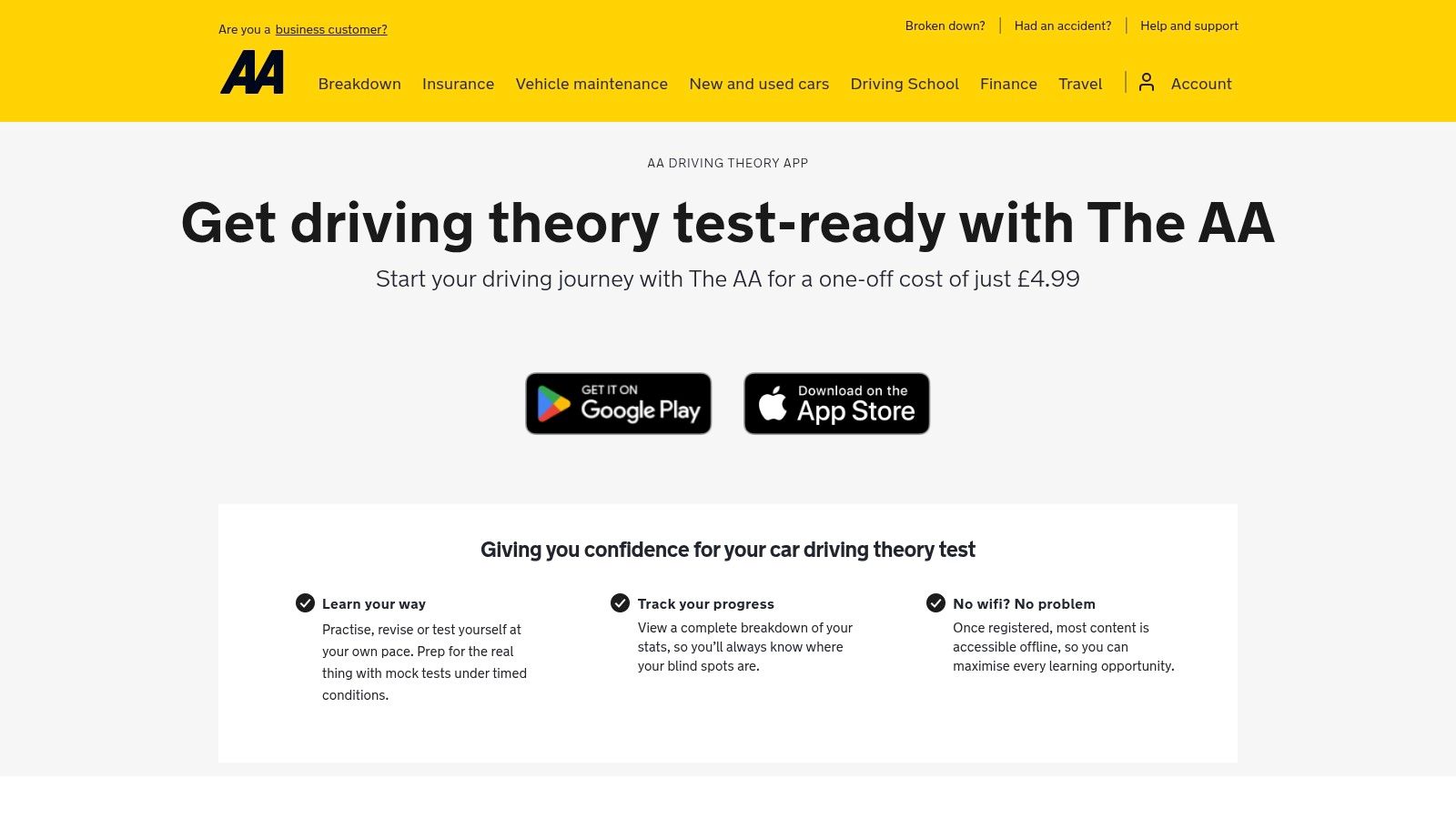
The AA Driving Theory App offers a straightforward mobile revision experience backed by a familiar UK motoring organisation. It combines DVSA-based questions with hazard-perception videos, flashcards, timed mocks and topic tracking, and it supports offline access after initial setup.
The app's strongest use is targeted repetition. Flashcards work for quick recall, while progress statistics help you identify weak topics rather than just counting how many questions you've answered. Offline access is practical for learners who revise during travel or in places with unreliable connectivity.
A focused car tool
The AA's app is primarily aimed at car learners, so it's less suitable if you're preparing for a vocational category or ADI assessment. It also isn't the official DVSA app. Its content is licensed or derived rather than produced by DVSA itself, which is a distinction worth keeping in mind when comparing app-store descriptions.
Hazard perception deserves separate attention even when an app includes it. The official system allows only one attempt per clip and rewards clicking as the hazard begins to develop, not repeated patterned clicking. Use the app's clips to practise timing, then connect that skill to Fast Track's hazard-perception preparation if you want theory learning linked to practical observation.
The AA app suits learners who want a polished, compact car-focused tool. It's less convincing as a complete pathway from first principles to practical test readiness.
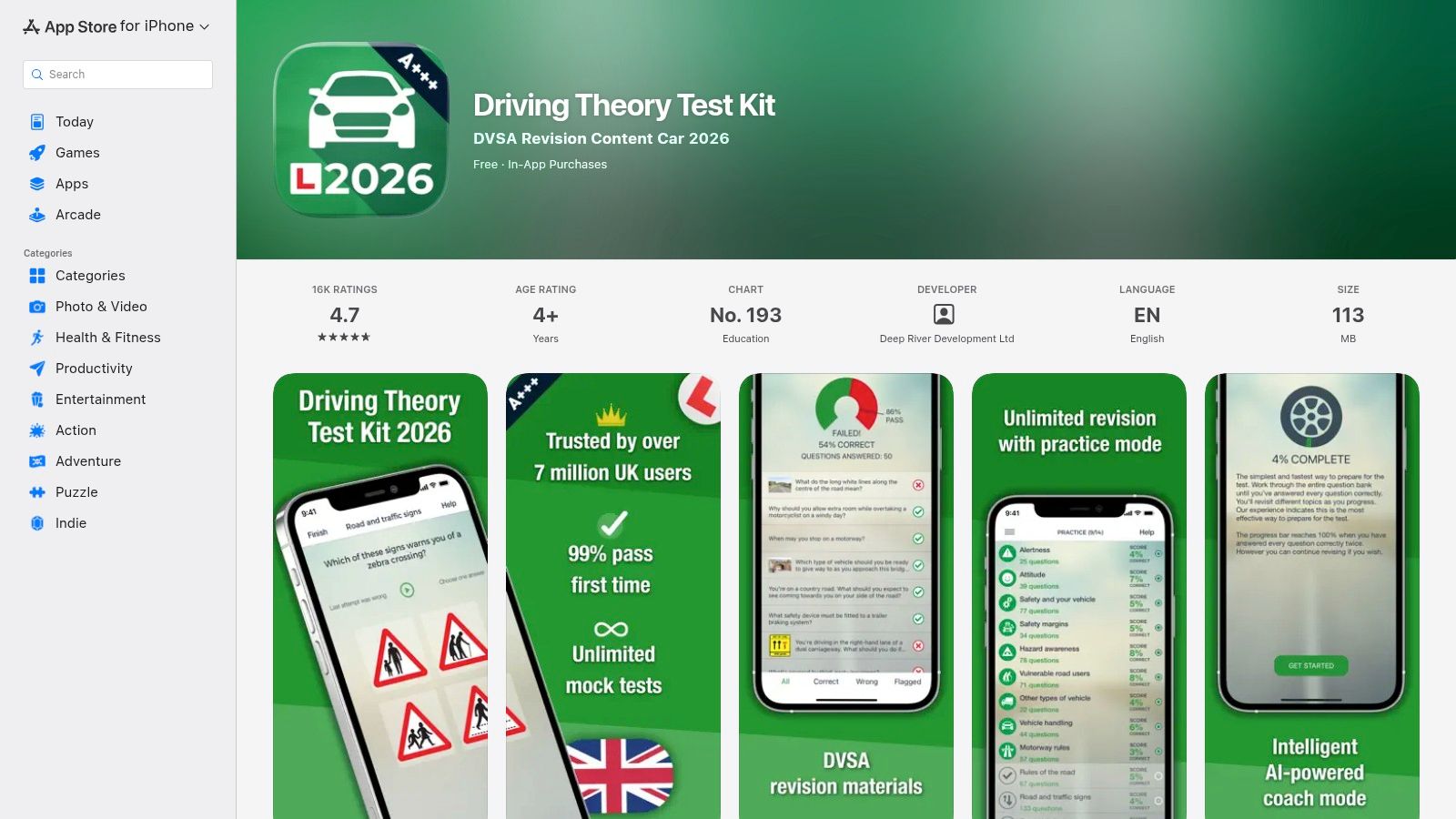
9. Deep River Development Driving Theory Test Kit
Deep River Development's Driving Theory Test Kit is a mature app-based alternative for learners who want simple, fast revision. It provides DVSA-licensed content, topic practice, mock exams and progress tracking through iOS and Android versions.
The uncomplicated interface is its practical strength. Learners who already know the basics can open the app, select a topic and work through questions without navigating a large course. That makes it suitable for short daily sessions and rapid drills during the final revision period.
App-only trade-off
The absence of a browser or desktop course is the main limitation. If you prefer studying on a larger screen, or if you want to review explanations while taking notes on a computer, you'll need another resource. Price and exact inclusions can also vary by platform or version, so check the current store listing before buying.
Its usefulness depends on how you use the licensed material. Don't measure progress only by the number of completed questions. Mark recurring errors, revisit the relevant Highway Code topic and test whether you can apply the rule in a new scenario. That approach is more reliable than memorising the position of a correct answer in a familiar quiz.
The app is a good fit for speed and simplicity. It's a weaker choice for guided learners who need a course structure or for anyone who wants theory study integrated with instructor-led practical preparation.
10. RAC Driving Theory Test App
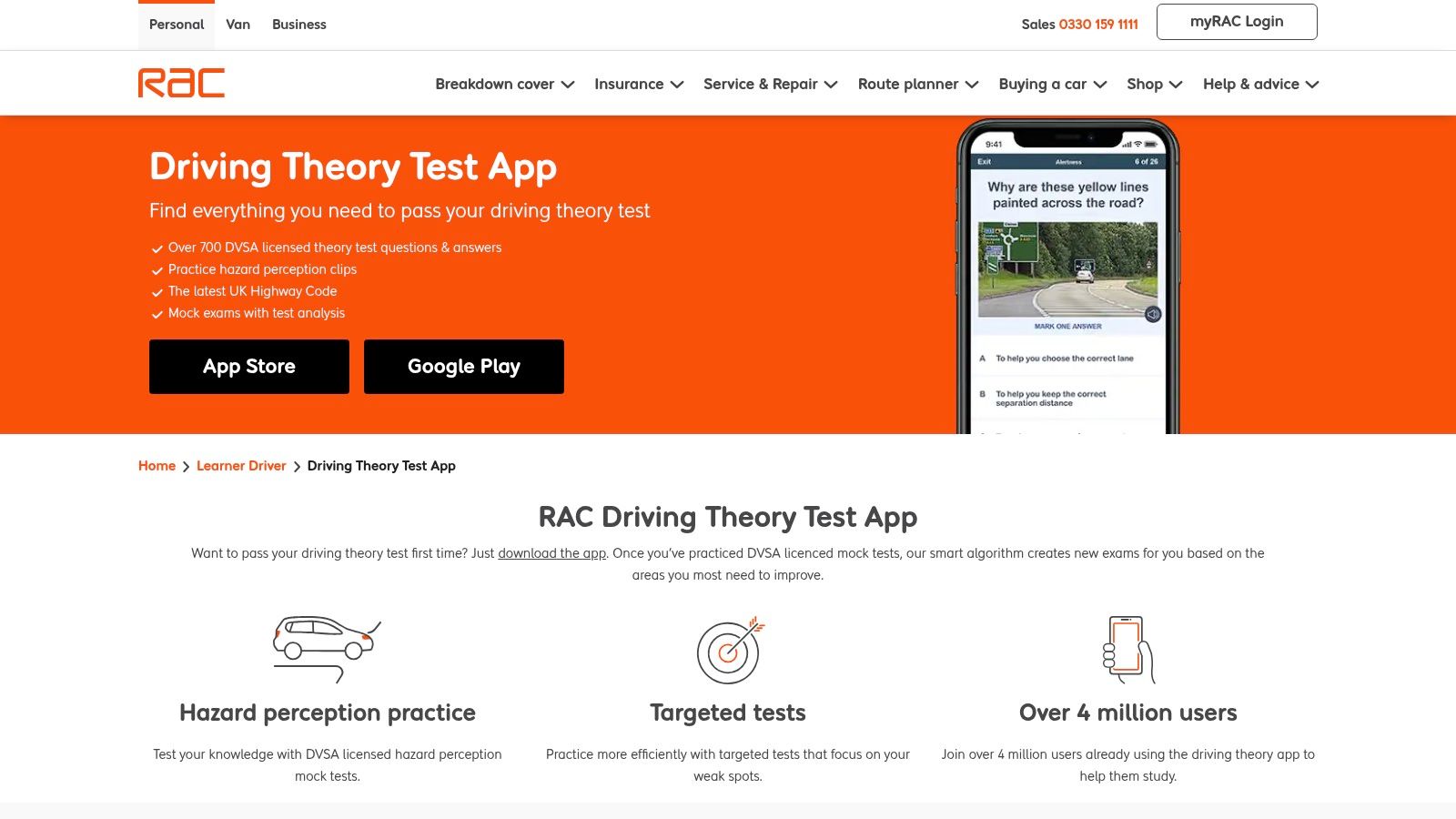
How well does the RAC Driving Theory Test App support different revision stages? Its mobile format combines DVSA-licensed questions, hazard-perception clips, topic mini-tests and timed mock exams. That range lets learners move from focused practice to assessment-style sessions without changing apps.
The format suits short revision windows. A mini-test can target road rules or signs, while a timed mock tests whether knowledge remains reliable under pressure. Hazard clips also add a visual element, although they cannot reproduce every part of supervised practical training.
Short sessions, incomplete pathway
The app-only design limits how it fits into a wider study plan. Learners who prefer a browser or larger screen will need another resource. Features and pricing can vary by platform or app version, so check the current listing before purchase. The RAC name may aid recognition, but it does not provide instructor feedback or practical observation.
Use it for deliberate drills rather than answer memorisation. Complete a topic, read the explanation and record recurring errors. Revisit those concepts later, then test them in a different question or scenario. This method gives a clearer indication of understanding than repeating a familiar set until the answers become predictable.
Professional-vehicle learners should confirm category coverage and scoring before buying. Northern Ireland guidance on taking the theory test explains that LGV and PCV tests use different arrangements, including a 100-question section with an 85-point pass mark. A car-focused app may therefore be unsuitable for that preparation.
The app works best as a quick-drill supplement, not a complete course or theory-to-practical pathway.
Driving Theory Practice: Top 10 Resource Comparison
| Product | Core features | User experience / Authenticity | Value & pricing | Best for | Unique selling point |
|---|---|---|---|---|---|
| Theory - Practice (Fast Track) | DVSA-style MCQs & hazard clips; step-by-step guides; local mock tests; PracticalTest Assist | High, integrated with instructors and local test-route mocks | Free in Learner Hub; ties into paid tuition (£61.23/hr) | Intensive/semi‑intensive learners preparing for practical courses | Instructor-integrated theory-to-practice with live test‑slot alerts |
| Official DVSA Theory Test Kit (app) | Official DVSA question bank; hazard clips; Highway Code; progress tracking | Very high, official content and test-like interface | Paid app (store price varies) | Learners wanting the most authentic, official practice | Only app produced end-to-end by DVSA |
| Safe Driving for Life (DVSA) | Free official practice tests; paid e-learning kits; official guidance | High, direct DVSA guidance, comprehensive but content-rich | Free core content; paid time-limited e-learning kits | Learners wanting official resources across vehicle categories | DVSA/TSO official hub and signposting for categories |
| Driving Test Success (DTS) | 4-in-1 app + DTS Anytime web; timed mocks; learning plans | Reliable, established brand; app/web feature differences | App purchase or web subscription; some plans with guarantees | Learners wanting both app and browser access and structured plans | Long-established brand with cross-platform study plans |
| Theory Test Pro | Full MCQ & hazard practice; library/instructor integrations; progress tracking | Very authentic, widely used by schools and libraries | Often free via libraries/instructors; direct purchase/subscription possible | Learners with library access or through driving schools | Commonly provided free via UK libraries and instructors |
| Driving Theory 4 All | Picture-based teaching; topic notes; voiceovers; app & web | Course-focused, guided, step-by-step learning | Paid access with limited free material | Learners who prefer visual, structured courses (incl. vocational/ADI prep) | Picture-based lessons and voiceover guidance for stepwise learning |
| TopTests.co.uk | Free unlimited mock tests; marathon & topic drills; Premium DVSA Qs | Very accessible, mobile/desktop, no install | Free tier; Premium for DVSA-licensed Qs | Learners wanting quick daily drills without installs | Free, no‑install mock tests and marathon practice modes |
| The AA Driving Theory App | DVSA-based Qs; hazard clips; flashcards; offline access | Branded, user-friendly with good progress stats | Paid app with clear pricing | Learners wanting a straightforward app backed by a major motoring org | AA-backed app with offline flashcards and tailored review |
| Deep River – Driving Theory Test Kit | DVSA-licensed content; topic drills; mock exams (iOS/Android) | Simple, fast interface for rapid drills | Paid app; price/version varies by platform | Learners preferring app-only, no-frills practice | Mature, popular app with a simple drill-focused UI |
| RAC Driving Theory Test App | DVSA-licensed Qs; hazard clips; mini-tests & timed mocks | Bite-sized, app-focused experience; RAC branding | Paid app; may include in-app purchases/upgrades | Learners who prefer short topic quizzes and quick revision | RAC-branded app with section mini-tests for focused practice |
Build a Revision Routine That Reflects the Test
The right resource depends less on brand recognition than on the gap between your current habits and the actual assessment. If you're starting from scratch, begin with official guidance or a structured course that explains the rule behind each answer. A learner who repeatedly memorises question patterns may perform well inside one app but struggle when the wording, image or situation changes.
Use topic drills to diagnose weaknesses. Keep a short record of errors by subject, then revisit the relevant rule before attempting another mixed quiz. This is more useful than chasing a large completion count because it tests whether you've understood the reason for an answer.
Hazard perception needs its own practice block. The official test doesn't reward constant clicking. It requires you to recognise when a potential problem becomes a developing hazard, respond promptly and avoid a patterned sequence. DVSA's free practice route includes practice hazard-perception clips, including three free test clips, so use the official material as a reference point even if your main revision product is different.
Then introduce timed mocks. The car multiple-choice section allows 57 minutes for 50 questions, and the required score is 43, so practise making decisions without relying on unlimited reflection. Don't treat a familiar mock score as proof of readiness if you've memorised the answer order. Mix providers where access allows, and explain every incorrect answer aloud or in your notes.
Your final choice should also reflect category, access and device. App-only products suit mobile learners, browser services suit larger-screen study, and library access may reduce the cost where Theory Test Pro is available locally. Paid products can add structured learning, licensed material or richer tracking, but confirm subscription duration, renewal terms, platform compatibility and whether hazard perception is included.
Car learners should also avoid applying car thresholds to LGV or PCV preparation. Official guidance records 100 multiple-choice questions with an 85-pass mark for those higher categories, alongside a hazard-perception threshold of 67 out of 100, so category-specific material is essential. Always check current government guidance before booking because test content and product inclusions can change.
Finally, connect theory progress with practical learning. Fast Track Driving Lessons' free Learner Hub, step-by-step driving guides, local-route mock-test preparation and instructor matching can help learners turn rules into examiner-ready behaviour. That's particularly relevant for intensive and semi-intensive learners, who need theory knowledge to support concentrated time behind the wheel rather than remain a separate online task.
Fast Track Driving Lessons offers a free Learner Hub with DVSA-style theory questions and step-by-step driving guides, alongside intensive and semi-intensive lessons, local-route mock tests and PracticalTest Assist. If you want theory practice questions connected to practical test preparation, visit Fast Track Driving Lessons and explore the available learning routes.
Written by Fast Track editorial team.