
The most popular advice about reading driving test routes is also some of the least reliable: find a route map, drive it repeatedly, and hope the examiner follows the same sequence. That approach can make a learner feel prepared while leaving the important weaknesses untouched. UK car test routes aren't fixed circuits that candidates can memorise, and a familiar road doesn't make a safe decision for you.
The useful question isn't, “Which streets will I drive on?” It's, “What hazards and decisions could this area present, and can I deal with them when the situation changes?” That shift matters whether you're preparing in Reading, Birmingham, Cardiff or a rural test centre. Local knowledge helps, but transferable observation, planning and control are what carry you through the test.
Table of Contents
- Why Memorising Test Routes Is a Dangerous Myth
- How to Map a Test Area Like a Hazard-Reader
- Navigating the Independent-Driving Section Safely
- Urban Versus Rural Test Environments Explained
- Turning Route Familiarity Into Fault-Free Driving
Why Memorising Test Routes Is a Dangerous Myth
The idea of an official route survives because learners see route lists online and instructors often practise around the same test-centre roads. But the DVSA's published car-test data is organised by test centre, not by named routes. The agency assesses driving across roads and traffic conditions around an approved centre, rather than testing candidates on one publicly published circuit.
The DVSA stopped publishing official routes in October 2010, and current routes remain unpublished. That means a route map found online may be useful as an independent practice guide, but it isn't a promise about what you'll drive on test day. This is especially important in Reading, where publicly circulated road lists can look definitive even though the examiner may select different roads, encounter roadworks or adjust the independent-driving section.
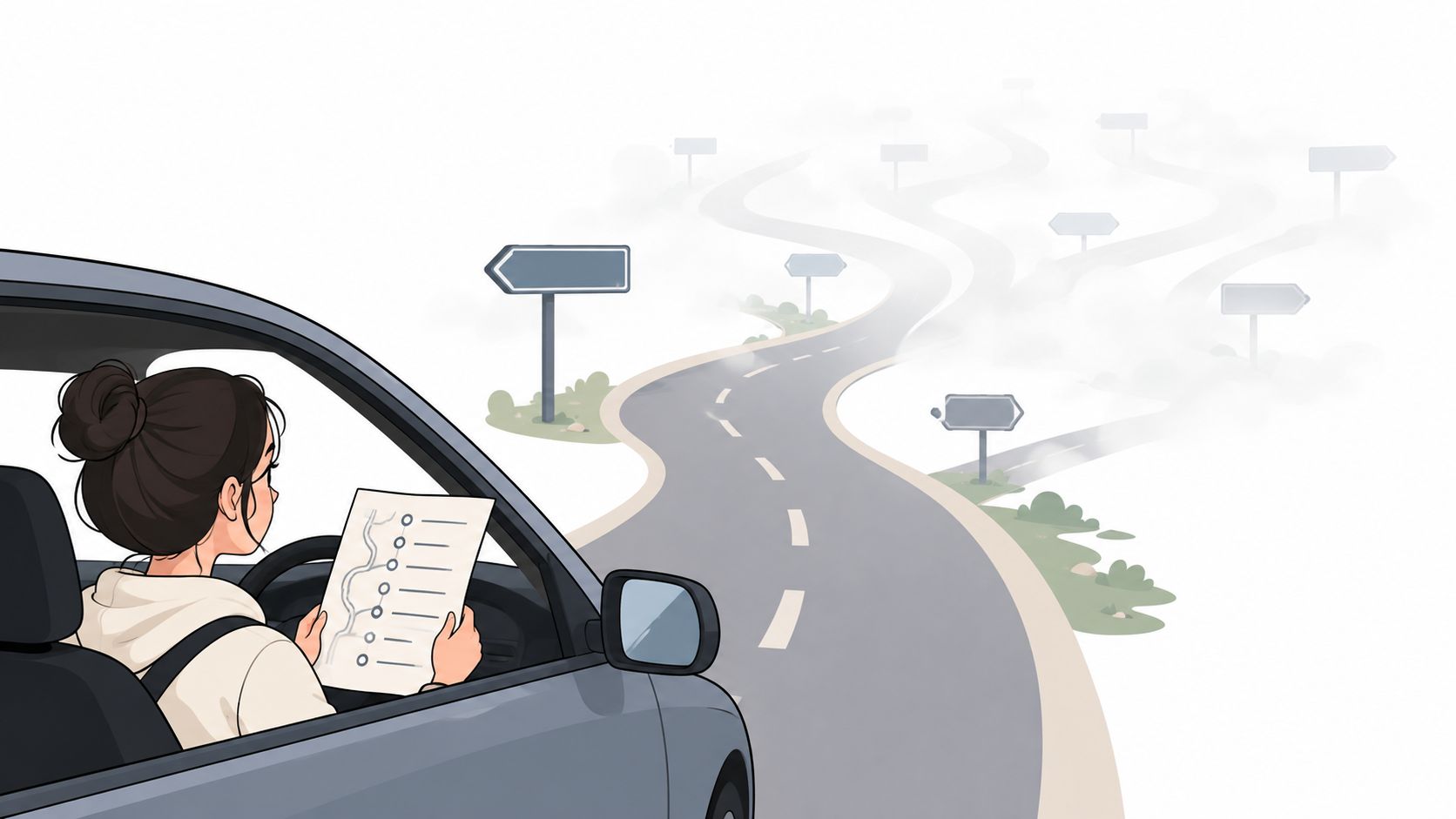
Recognition can hide weak driving
A learner who knows that the next junction bends left may still approach too quickly, choose the wrong lane or miss a pedestrian waiting to cross. Familiarity can reduce active scanning. The road feels safe because it's recognisable, not because the driver has properly assessed it.
That false confidence is why route memorisation doesn't survive changes in traffic, weather or road layout. The DVSA's 2016 “Improving the driving test” research involved 32 centres across England, Scotland and Wales, including urban, suburban and rural locations such as Cardiff, Edinburgh, Birmingham, Norwich, Oxford, Plymouth and Swansea. The geographical spread reflects the reality of UK driving. Preparation has to work across different environments, not just one rehearsed chain of turns.
Practical rule: Learn the decision points, not the order of the streets.
Local practice still earns its place. You should understand likely speed-limit changes, roundabout lane markings, one-way systems, junction layouts and difficult meeting situations near your chosen centre. But treat those roads as a training ground for observation and judgement. A useful guide to common driving-test myths should leave you more adaptable, not more dependent on a supposed official route.
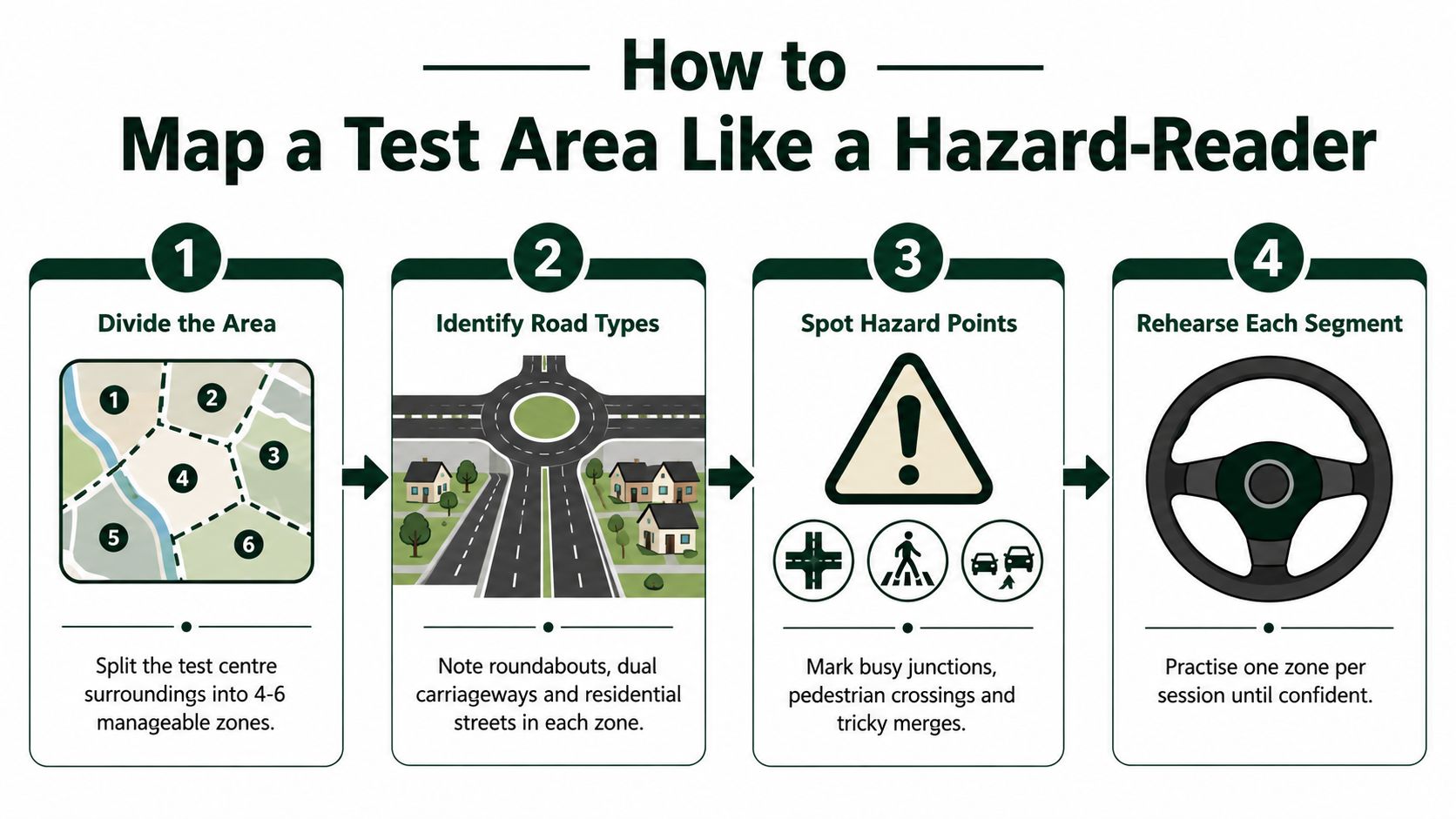
How to Map a Test Area Like a Hazard-Reader
Start by treating the test centre area as a set of hazard zones, not as a route to memorise. Choose manageable sections around the centre and practise each one in both directions. Driving a road only one way can hide important problems, such as a difficult right turn, a different approach lane or a junction that looks simple from the opposite direction.
Vary the conditions too. Quiet roads can make a learner look polished, while congestion exposes late planning and poor lane discipline. Quieter periods reveal different weaknesses, including excessive speed, weak meeting-traffic judgement and poor control near parked vehicles.
Build a route matrix
Use a notebook, printed map or digital planning tool. At each junction, record what the driver must notice before acting.
- Approach lanes: Note lane arrows, road markings and whether the correct lane needs to be chosen well before the junction.
- Speed changes: Mark transitions near built-up areas, schools, bends and open roads. Read the signs and road environment rather than assuming the previous limit continues.
- Visibility: Identify parked-car pinch points, pedestrian crossings, bus lanes, cyclists and entrances that can remain hidden until late.
- Roundabouts: Record likely exits, lane discipline and how road markings guide the approach.
- Meeting situations: Mark narrow roads, parked vehicles and places where waiting or passing requires early judgement.
- Signal timing: Observe traffic lights, filter arrows and how pedestrians affect the sequence.
This turns route familiarisation into a repeatable hazard-mapping exercise. For additional thinking on identifying risks around unfamiliar places and transport settings, Waymap's resource on hazard awareness for venues and transit offers useful context, although the driving decisions still have to come from your own observation.
Rehearse decisions, then remove prompts
Use four passes for difficult segments. First, make a reconnaissance drive and identify the hazards without trying to perform a mock test. Next, complete a coached drive where you talk through lane choice, speed and observations. Then drive independently with minimal prompts. Finish with a debrief that labels each error as observation, judgement, control or compliance.
The best benchmark isn't recognising every road. It's completing several mock drives without examiner intervention, while explaining hazards and decisions clearly. If you miss a turn, continue safely and recover. That response tells you far more about readiness than a perfect memory of the next street.
Keep a separate list of recurring errors. If you repeatedly look late at lane arrows, rehearse the visual scan before the junction. If you approach roundabouts too quickly, practise speed reduction earlier rather than just repeating the same circuit. Good route work changes what you do behind the wheel.
Navigating the Independent-Driving Section Safely
The independent-driving section lasts 20 to 35 minutes, and you may follow sat-nav directions, traffic signs or a combination of both, as set out in the DVSA's guidance for examiners. The examiner provides a DVSA-approved sat-nav. You won't bring or choose your own device.
The sat-nav is only one source of information. The examiner guidance warns candidates not to rely on displayed speeds because they may be inaccurate. Read the road signs and use the road environment to judge the correct speed. If the sat-nav suggests a turn that doesn't match the signs or safe road position, safety takes priority.
Use a fixed scan routine
Practise independent drives with a simple sequence:
- Look well ahead for signs, lane arrows, crossings and junction shape.
- Check mirrors before changing speed, direction or position.
- Adapt speed early enough to keep time for decisions.
- Choose road position from markings, signs and the direction you need.
- Signal when appropriate, without treating the sat-nav prompt as a substitute for observation.
- Complete the manoeuvre safely, even if that means continuing beyond the intended turn.
This routine keeps navigation in its proper place. The test isn't checking whether you can obey a voice prompt at any cost. It's checking whether you can make decisions without continuous examiner instruction while maintaining normal observation, signalling, positioning and control. The independent-driving guidance for learners is useful as a reminder that navigation should support safe driving, not replace it.
Recover without drama
A missed turn doesn't automatically create a fault. If you continue safely, the examiner can help you rejoin the route, and the sat-nav may automatically redirect. The danger comes when a learner reacts emotionally and tries to repair the mistake at the last moment.
Don't brake sharply, cut across a lane, ignore a give-way line or turn where the road position isn't safe. Continue ahead, maintain control and wait for a suitable opportunity. During practice, deliberately miss an instruction occasionally and rehearse the recovery. That removes the panic that causes otherwise avoidable faults.
Urban Versus Rural Test Environments Explained
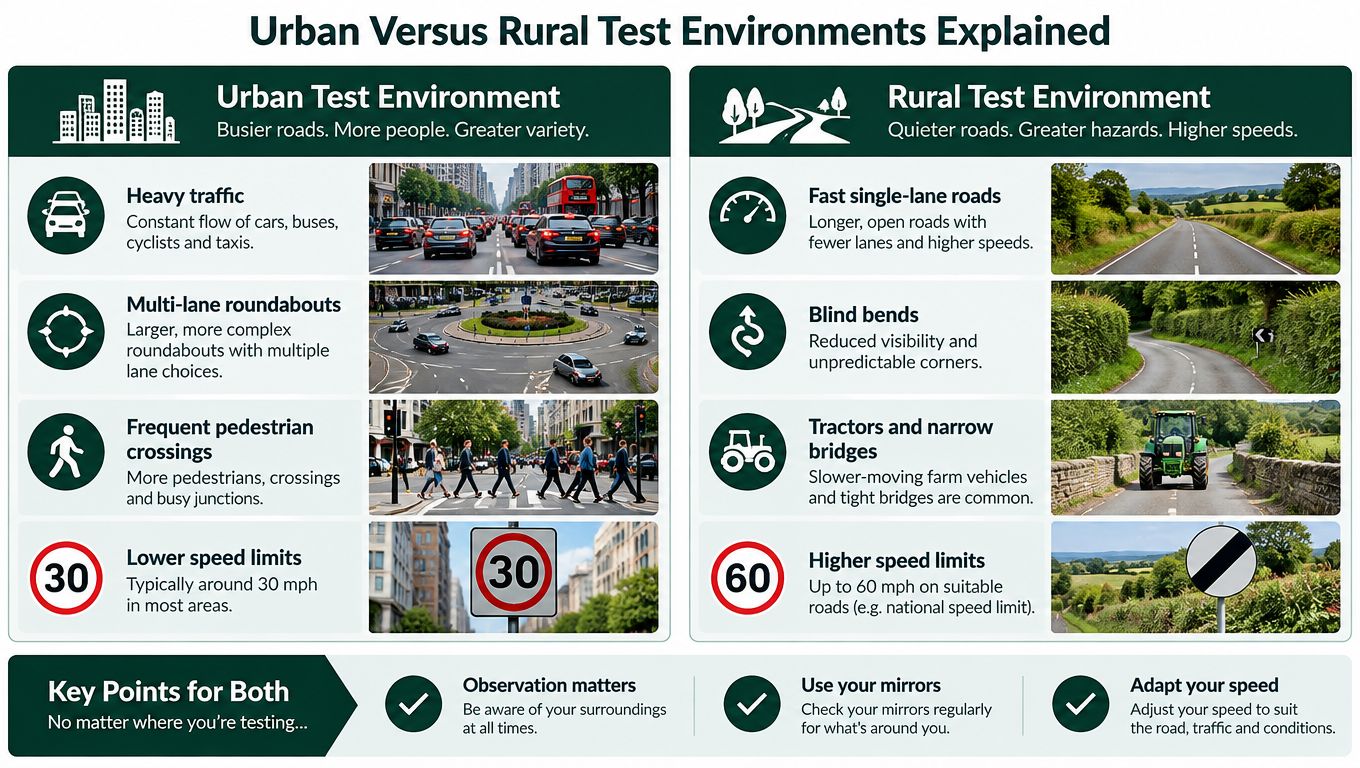
A test centre's road environment should dictate your practice priorities. Urban preparation often demands more rapid reading of markings, traffic movements and vulnerable road users. Rural preparation usually gives you more time between hazards but less margin for late decisions, limited visibility and speed errors.
Urban centres reward early planning
Around a busy urban centre, build practice around:
- Multilane roundabouts: Read arrows early, select the correct lane and hold your position through the roundabout.
- Signal-controlled junctions: Watch filter arrows, pedestrian phases and vehicles that may block your view.
- Bus lanes and restrictions: Read signs before entering, especially where restrictions change during the day.
- One-way systems: Look well ahead for lane arrows and avoid late movements caused by following sat-nav instructions blindly.
- Pedestrian-heavy streets: Reduce speed and prepare for crossings, parked vehicles and cyclists.
- Yellow-box restrictions: Plan whether the exit is clear before entering rather than relying on traffic to move.
A quiet suburban circuit can make these skills appear stronger than they are. Include congestion in your practice where possible. Slow traffic tests patience and planning, while busy junctions reveal whether you're looking far enough ahead.
Rural roads punish late reactions
Semi-rural and rural centres need a different route matrix. Include narrow roads, bends, meeting traffic, hidden entrances, changes to higher speed limits and places where visibility disappears over a crest. You also need to anticipate vehicles approaching from behind a bend or emerging from an entrance you couldn't see earlier.
The basic scan remains the same, but the timing changes. On an open road, don't let the absence of immediate traffic make you accelerate without checking the speed limit, road shape and forward visibility. On a narrow road, ease off early and decide whether a passing place or waiting position gives both vehicles enough room.
Don't choose a centre as a shortcut
Published centre statistics can help you understand the workload of an area, but they don't prove that a centre with a higher pass rate offers a guaranteed advantage. One independent compilation reports centre-level outcomes ranging from roughly 34% to 81%, while another reports a recent national average near 50%. These figures reflect route complexity, candidate mix and local conditions as well as driving skill, so use them as context rather than as a promise. The centre-level comparison is best read with that limitation in mind.
Turning Route Familiarity Into Fault-Free Driving
Route knowledge matters only when it improves the quality of your decisions. A familiar junction still needs mirrors, appropriate speed, correct positioning, effective observation and compliance with signs and markings. If you're relying on memory to carry you through, you're preparing for a performance that may disappear as soon as the examiner changes direction.
The DVSA pass rule is clear: you need no more than 15 driving faults and no serious or dangerous faults, according to the official explanation of car-test results. A driving fault is commonly called a minor. A serious fault involves a potentially dangerous situation, while a dangerous fault involves actual danger to the driver, examiner, public or property.
Navigation errors are not all equal
Continuing safely after missing a turn may be an ordinary navigation mistake. Braking sharply, changing lanes without proper observation, ignoring a stop or give-way line, or making a sudden unsafe turn can turn that mistake into a serious or dangerous fault. The road you expected to take is never more important than the people and vehicles around you.
Use route practice to test your response to change. Ask your instructor to give an unexpected direction, use a different approach to a familiar junction or let you continue after a missed turn. Then review whether you kept the scan routine, adjusted your speed early and made a defensible decision.
Measure readiness by behaviour
A candidate is ready when they can perform consistently on varied local roads, not when they can recite a route. Your preparation should include:
- Independent mock drives: Complete them with minimal prompts and no examiner intervention.
- Hazard commentary: Explain what you've seen, what may change and why you're choosing a speed or position.
- Recovery practice: Miss an instruction safely and continue without a rushed correction.
- Error review: Classify problems as observation, judgement, control or compliance, then practise the weak category directly.
For further work on reducing examiner-marked faults, see this guide to passing with zero minors. The aim isn't to produce a mechanically perfect route performance. It's to make safe observation and sound judgement dependable, even when the roads, traffic or instructions differ from rehearsal.
Fast Track Driving Lessons matches learners with DVSA-approved instructors for intensive and semi-intensive manual or automatic tuition, including mock tests on varied roads near the chosen test centre. If you need structured route preparation rather than another memorised map, visit Fast Track Driving Lessons and arrange practice built around your actual weaknesses.
Written by Fast Track editorial team.