
You're waiting at a roundabout or sitting behind traffic on a busy high street, and the pressure builds fast. One missed mirror check, one indicator too early, and suddenly a cyclist, scooter, or fast-moving car is exactly where you didn't expect it. That's why MSM in driving matters so much, it gives you a calm sequence to follow when the road feels busy and your nerves start to rise.
The routine is simple to say and much harder to do well under pressure. Mirror, Signal, Manoeuvre helps you make cleaner decisions, protect vulnerable road users, and keep your driving smooth enough for the test and for real life. The official UK learner guidance places MSM within observation, signalling and planning, alongside position-speed-look, and says learners should use these routines consistently as part of test preparation and road-safety teaching, not as an optional extra (official learner guidance, Ready to Pass observation, signalling and planning).
Table of Contents
- Why Every Learner Driver Needs the MSM Routine
- Breaking Down Mirror Signal Manoeuvre Step by Step
- How Examiners Mark MSM on Your Driving Test
- Real Road Scenarios Where MSM Keeps You Safe
- Adapting MSM for Modern Traffic and Personal Conditions
- Practice Drills to Make MSM Second Nature
- Building Confident Driving Habits Beyond the Test
Why Every Learner Driver Needs the MSM Routine
A learner can drive for several minutes feeling settled, then one small mistake appears at the wrong moment. They check the road ahead, start signalling right, and begin to turn, only to find a cyclist already alongside the car. On busy UK roads, that kind of near-miss is common when observation happens on instinct instead of through a clear routine.
Why the routine exists
The UK examiner guidance sets out MSM as mirrors first, then signal, then manoeuvre, with the manoeuvre carried out using PSL (DVSA examiner guidance). The order matters because it keeps your attention where the risk is. You check what is behind you, tell others what you plan to do, then carry out the move only when the road picture still makes sense.
That routine becomes even more useful on roads with mixed traffic, where a driver may need to respond to cars, cyclists, pedestrians, and changing lane positions all at once. It also helps when nerves are high, because a fixed sequence gives your mind something simple to follow instead of forcing you to improvise under pressure.
The practical test result guidance says mirrors are expected when signalling and when changing direction or lanes (driving test result guidance). So this is a marked driving habit, not just classroom theory. Learners sometimes believe they have “done the check” because they glanced vaguely in the mirror. Examiners look for purposeful observation that fits the move you are about to make.
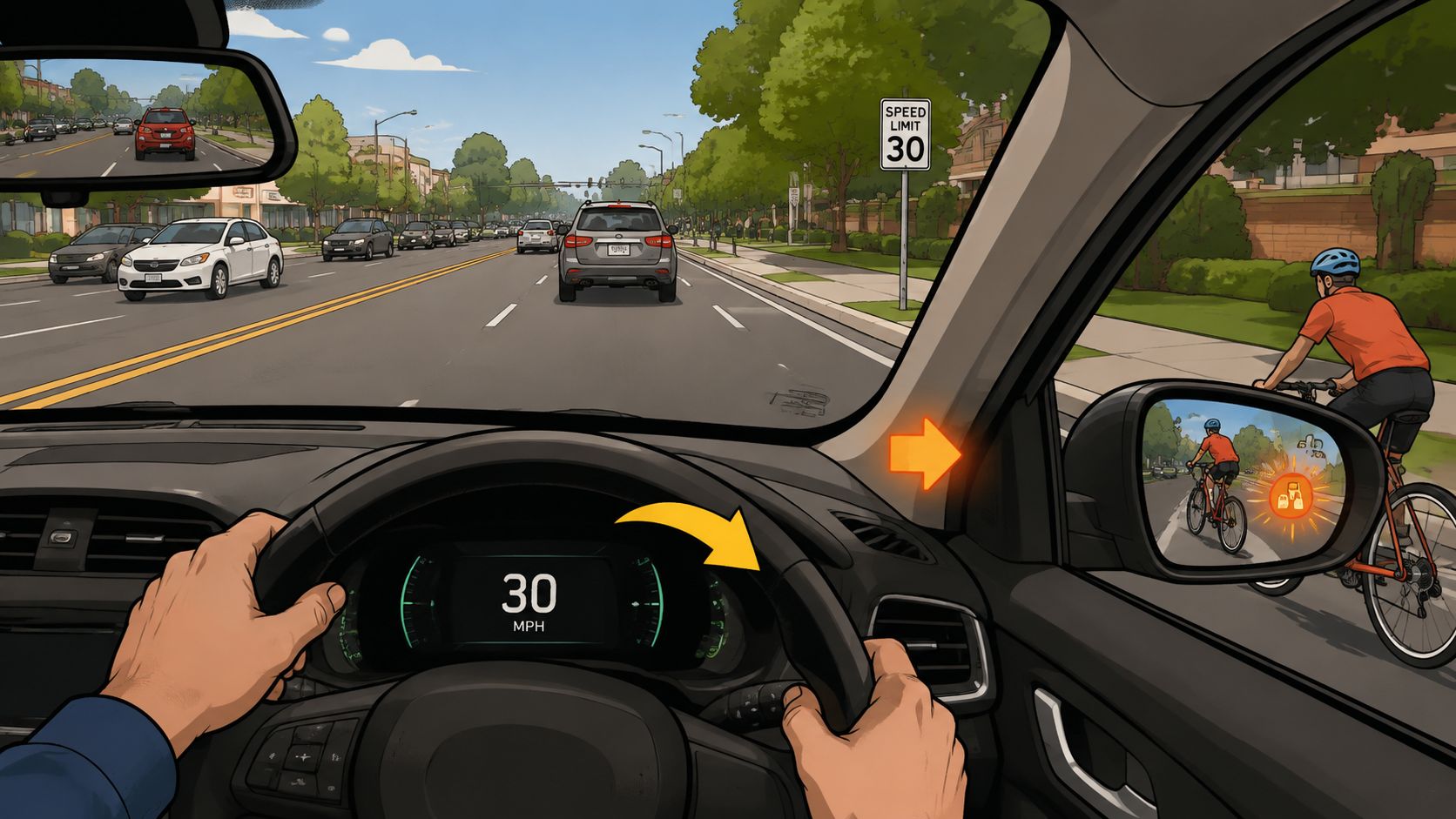
Practical rule: before your hands start the move, your eyes should already know what is behind you and beside you.
Why learners fail when they skip it
Many learners do not fail because they do not know the rule. They fail because they rush the order. They signal first, then look, or they look once and assume that is enough for the whole manoeuvre. On roads with cyclists, pedestrians at side roads, and drivers who change pace without warning, that shortcut leaves no margin for error.
MSM also reduces mental load. Instead of asking yourself, on the spot, whether it feels safe, you follow a repeatable check that tells you what to assess first. Like the checklist a pilot uses before takeoff, it keeps the important steps in a fixed order, which is exactly why it becomes more useful as the traffic gets busier.
Breaking Down Mirror Signal Manoeuvre Step by Step
Mirror first, because the road behind changes fast
A learner pulls out to pass a parked car, and a cyclist appears in the blind spot. Another driver is closing in from behind on a smart motorway, or a pedestrian steps off the kerb near a side road. These are the moments when MSM has to work in real time, not as a classroom chant.
The first job is to know what is around you before you act. Mirrors need to be checked carefully before signalling, changing direction, or changing speed (DVSA examiner guidance). In practice, that usually means a proper glance at the interior mirror first, then the relevant door mirror or mirrors, so you build a clear picture of traffic behind and beside you.
If the mirror shows a vehicle closing quickly, or a cyclist sitting close to your side, delay the move. Good mirror work decides whether the manoeuvre is still safe.
Signal second, but only after you know what you are telling
A signal is communication. It tells other road users what you intend to do, but only if the timing makes sense. Signal too early, and you can confuse people at side roads or oncoming traffic. Signal too late, and you do not give anyone enough warning to react.
Instructor's habit: check first, then signal, then keep scanning. Reverse that order, and you can warn the very hazard you have not noticed yet.
The common error is to treat the indicator as if it makes the move safe. It only explains your plan. You still need a clear gap and a stable road position before you proceed. If you are unsure about timing, a practical guide like when to signal can help you picture the right moment, but the skill comes from doing it in motion until it feels natural.
Manoeuvre third, with LADA in mind
Once the mirrors and signal are in place, the manoeuvre begins. Many instructors pair MSM with LADA, Look, Assess, Decide, Act, because the decision does not end when the indicator clicks. You still need one last look, a quick assessment of space, and a clean action through the wheel, brake, or accelerator.
That matters most when the road changes underneath you. A manoeuvre that looked easy from a distance can become tight when a pedestrian moves into view, a driver behind closes the gap, or mixed traffic crowds the space you thought you had. On busy urban roads, near schools, or on multi-lane routes, the safe driver keeps the sequence alive until the move is finished.
Personal factors matter too. If you are tired, anxious, unfamiliar with the route, or dealing with glare, rain, or a heavy traffic flow, your mirror checks need even more attention. The routine works like a short safety loop, because every step answers a different question, what is behind me, what will others think I am doing, and is the space still mine to use?
| Step | What to do | What learners often get wrong |
|---|---|---|
| Mirror | Check behind and beside you before any change | Glancing too late or too quickly |
| Signal | Indicate in good time after confirming the road is clear | Signalling before observing, or leaving it too late |
| Manoeuvre | Move smoothly only when the space is still safe | Jerky steering, hesitation, or assuming the signal did the job |
How Examiners Mark MSM on Your Driving Test
A learner can drive a whole test route without ever seeing a box labelled “MSM”, yet the examiner is still watching the routine in action. Every time you approach a junction, change lane, turn, or alter speed, your mirror use and signal timing show whether you are reading the road properly. MSM is marked as part of normal driving, because that is how it appears on UK roads.
The examiner is looking for safe, timely observation. If you check the mirrors late on a quiet street, it may only register as a minor fault. If the same lapse happens while another road user is closing in, the mistake can quickly become more serious. The official driving test result guidance sets out how faults are judged in the practical test, and the same principle applies here. The test rewards drivers who stay predictable to others.
Fault type and what it usually means
The level of fault depends on risk, timing, and who else is nearby. A missed glance before a simple direction change is usually less serious than a rushed move near a cyclist, a pedestrian, or a vehicle approaching from behind. The examiner is asking one clear question throughout, did your observation protect everyone around you?
| Fault Type | Example Scenario | Test Impact |
|---|---|---|
| Minor fault | Late mirror check before a simple direction change with no conflict | Usually not a fail on its own |
| Serious fault | Pulling out when a cyclist is approaching and no effective mirror check was made | Likely a fail |
| Dangerous fault | Acting in a way that puts another road user at immediate risk | Automatic fail |
The mark sheet style can feel mysterious at first, so it helps to see how faults are recorded in plain language. This mark sheet guide is useful because it shows how small mistakes can build into a bigger picture across the test.
Where MSM matters most
Roundabouts, junction exits, and independent driving often expose weak MSM habits because the road changes quickly and the decision window is short. Examiners want to see consistent observation, not one careful moment followed by rushed driving. If you only check the mirrors when you remember, rather than each time the car is about to change speed or direction, that inconsistency stands out.
A learner who stays calm and checks at the right moment gives the examiner confidence. It also shows that the decision is based on what is happening around the car, not on guesswork or habit alone.
Real Road Scenarios Where MSM Keeps You Safe
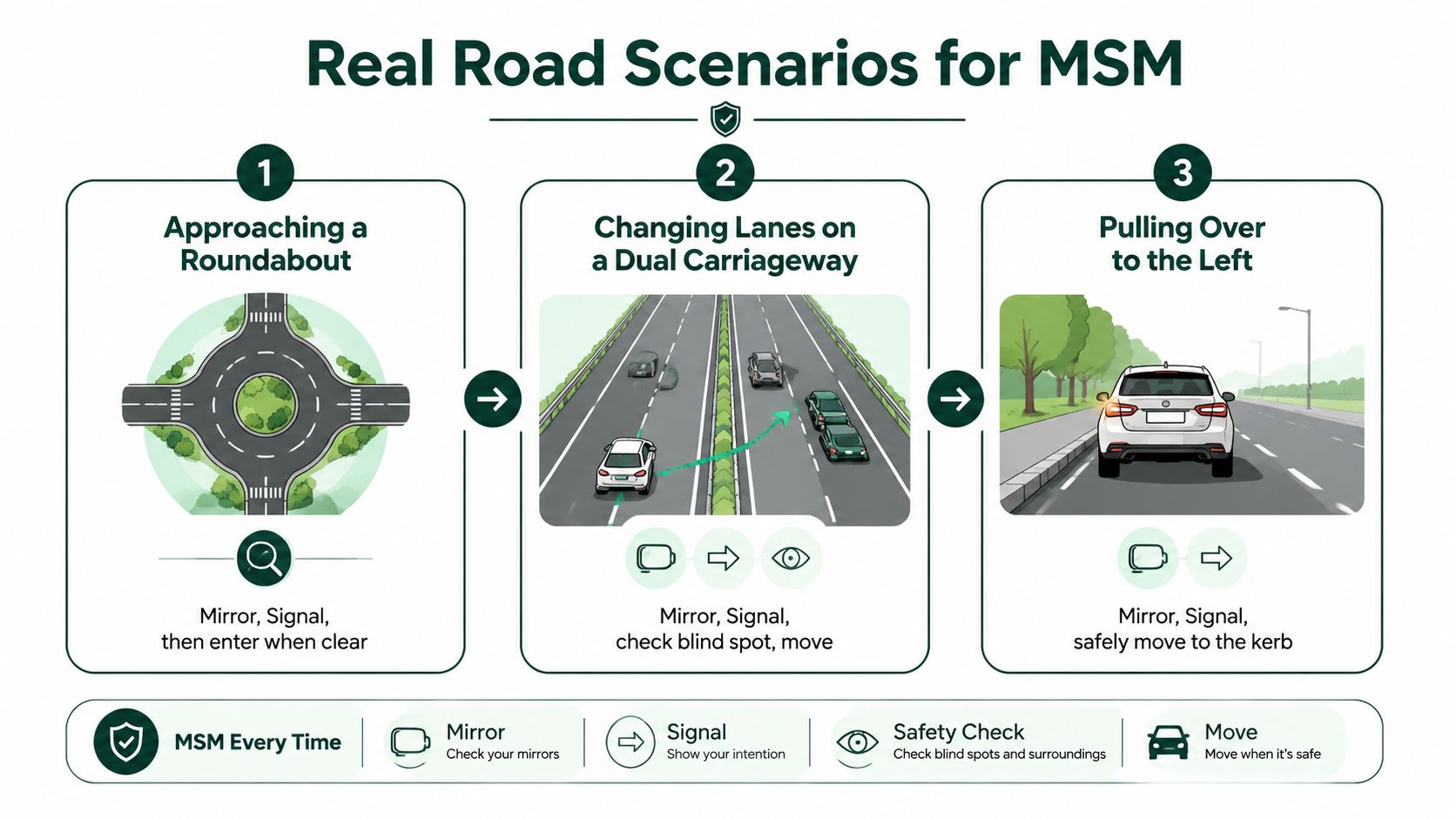
A roundabout, a dual carriageway, and a kerbside pull-in all ask for different timing, but the logic stays the same. The mirrors tell you what's behind, the signal tells others what you mean to do, and the manoeuvre only starts when the space is still yours.
At a roundabout
Approaching a roundabout, you first check the interior mirror, then the relevant side mirror depending on whether you're leaving left or moving right around the flow. That helps you understand whether someone is closing in behind or whether a vehicle is already overlapping your side. Once the picture is clear, you signal at the right point and adjust speed and position before entering.
The common learner error is signalling too early, then drifting through the approach while still deciding what to do. That creates confusion for drivers waiting to join and for pedestrians watching the traffic pattern. A safer habit is to keep the road picture alive right up to the point you commit.
On a dual carriageway lane change
Lane changes on faster roads demand extra care because the closing speeds are higher and the gap disappears quickly. After the mirrors and signal, you still need the over-the-shoulder check before moving sideways, because a vehicle or cyclist can sit in the blind spot where mirrors won't show them clearly. The routine becomes a sequence, not a single glance.
Learners often signal, then freeze because they're waiting for the perfect opening. That hesitation can unsettle other drivers. Clear mirror work, a timely signal, and a decisive but smooth move usually read far better than half-committed steering.
When pulling over to the left
Pulling in sounds simple, yet it's one of the easiest places to miss a vulnerable road user. Start with the interior mirror to see what's following, then the left mirror to check for cyclists, pedestrians, or parked vehicle doors. Signal left, reduce speed, and steer in smoothly when the side space is safe.
The mistake here is treating the curb as the only hazard. In reality, the danger is often the moving traffic behind or alongside you. If you're unsure about mirror checking around blind spots, the guide on checking blind spots is worth reading alongside in-car practice.
Adapting MSM for Modern Traffic and Personal Conditions
MSM still works on today's roads, but it has to fit what is happening around you. On a smart motorway, in mixed traffic, or near a cyclist filtering past queues, the routine needs a broader scan and a calmer pace.
Modern roads need earlier scanning
Faster roads give you less time to react, so mirrors need checking earlier. The signal also needs to stay on long enough for other road users to understand what you mean, rather than guessing from a late flick of the indicator. Urban junctions ask for the same discipline, because cars, bikes, buses, scooters, and pedestrians can all be moving at once.
Vulnerable road users change the pattern again. A cyclist can be in a place a driver has not been watching, and an e-scooter can arrive from a gap that looked clear a moment before. Before moving sideways, the over-the-shoulder check closes that blind spot.
Your condition matters as much as the traffic
A learner who is tired, stiff, or unable to turn their head freely will not use the routine in quite the same way every time. That does not rule out safe driving. It means the setup has to fit the driver as well as the road. Seat position, mirror position, and breaks all affect how well the checks can be done.
The government's guidance for drivers with multiple sclerosis covers the need to tell the DVLA if a medical condition affects driving, and failing to disclose can carry a fine of up to £1,000 (official guidance on multiple sclerosis and driving). The point is simple. Safe driving depends on honest fitness-to-drive decisions, not just tidy technique. If fatigue, pain, vision, or concentration makes mirror checks or gap judgement less reliable, that has to be taken seriously.
A useful rule is this. If your body is slowing the observation, slow the plan to match. A careful check is better than a rushed move that only looks confident.
Practice Drills to Make MSM Second Nature
Commentary MSM
Say the routine out loud while you drive, or while you rehearse with a supervising driver. “Mirror. Signal. Manoeuvre.” Then add detail, “Interior mirror, left mirror, signal left, move in.” Speaking it forces you to slow down your thinking and makes the sequence harder to skip.
This works especially well for anxious learners, because it gives your mind a script when nerves start to rise. After a few sessions, the words begin to disappear and the habit stays.
Mirror sweep intervals
On straight roads where you're not changing direction, build a habit of checking mirrors regularly rather than waiting for a hazard. A rough rhythm every 10 to 15 seconds can help you stay aware of what's behind without staring at the glass. The point is not to count obsessively, it's to stop driving as if nothing changes behind you.
Use this drill to notice traffic building, motorcycles closing in, or vehicles preparing to overtake. Once you can spot those changes early, your MSM timing improves naturally.
Passenger quiz
Ask a passenger or supervising driver to call out a random action, such as “roundabout left” or “pull over.” Before you move, say the exact mirror and signal sequence you'll use. Then carry it out slowly and accurately.
A simple progress tracker can help too.
- Note missed checks: mark down any time you forgot a mirror glance before a move.
- Record weak moments: write down where you felt rushed, such as roundabouts or lane changes.
- Mix road types: practise on quiet streets, busier urban roads, and faster routes so the habit transfers.
These drills work because they turn MSM into something you can repeat under pressure instead of something you hope to remember on test day. If you want structured instruction and live correction while you practise those habits, Fast Track Driving Lessons can match learners with DVSA-approved instructors for lessons that focus on practical test routines, observation, and manoeuvres.
Building Confident Driving Habits Beyond the Test
MSM is bigger than a test checklist. It's a reliable way to stay aware of what's behind you, tell others what you plan to do, and move only when the road still gives you room. Mirrors first, signal second, manoeuvre third is simple enough to remember, but strong enough to support everyday safe driving.
That consistency is what matters. A perfect check once doesn't make you safe, but a steady habit of looking, signalling, and acting in the right order builds the kind of calm judgement that carries into junctions, roundabouts, lane changes, and busy town driving. Over time, MSM becomes part of your wider defensive driving style, alongside anticipation and hazard awareness.
If you're preparing for your test or trying to clean up old habits, book lessons with a DVSA-approved instructor who can watch your mirror use in real traffic and correct mistakes before they stick. The sooner you practise MSM in a structured way, the sooner it starts feeling automatic when the roads get complicated.
Book structured driving lessons with Fast Track Driving Lessons if you want guided practice on MSM, mirror timing, and test-day habits with a DVSA-approved instructor. Their lesson support can help you spot blind-spot errors, sharpen observation, and build steadier routines for the UK roads you'll drive on.
Written by Fast Track editorial team.