
You've answered practice questions correctly at home, but the first time you sit in the driver's seat under assessment conditions, the answer doesn't arrive as neatly. A cyclist moves out, a junction tightens, the sat-nav gives an instruction late, and you have to choose a safe response while controlling the car. Knowing a rule is useful. Applying it consistently is what matters.
These mock driving test questions and scenarios are arranged around the way UK learners are assessed. They include official-style theory questions, hazard perception, local-route practice, manoeuvres, vehicle-safety questions, independent driving and remedial review. Each set uses the same practical format: a prompt or scenario, a model response, an examiner-focused coaching note, a common mistake and a drill to use in your next lesson.
Treat the answers as explanations, not scripts. You shouldn't memorise words and repeat them without understanding, and you can't assume that knowing a familiar test route guarantees a pass. The DVSA practice theory test guidance confirms that mock questions use the same topics as the test, although the questions aren't reused word for word.
Fast Track Driving Lessons is relevant for learners who want DVSA-style theory practice, structured mock tests and feedback near their chosen test centre. You can also view assessment questions on MEDIAL for a broader approach to assessment preparation.
Table of Contents
- 1. DVSA Official Theory Test Question Bank
- 2. Theory Test Mock Exam Simulators
- 3. Hazard Perception Practice Test Sets
- 4. Route-Specific Local Mock Driving Tests
- 5. Manoeuvre-Focused Practice Question Sets
- 6. Show Me and Tell Me Question Practice Sets
- 7. Independent Driving Practice Scenario Sets
- 8. Mock Test Score Analysis and Remedial Learning Plans
- Mock Driving Test Questions, 8-Point Comparison
- Build a Practice Plan From Your Weakest Answers
1. DVSA Official Theory Test Question Bank
A zebra crossing can turn a familiar rule into a quick judgement. You see a pedestrian waiting at the kerb, check your mirrors and decide whether to ease off early or stop. The official DVSA practice resource gives the test structure and subject areas, while your practice should connect each answer with a safe, repeatable driving action.
The car theory test contains 50 multiple-choice questions, must be completed in 57 minutes, and requires at least 43 correct answers to pass.
Prompt: You're approaching a zebra crossing and a pedestrian is waiting at the kerb. What should you do?
Model response: Reduce speed and be prepared to stop, allowing the pedestrian to cross safely.
Coaching note: The assessment checks anticipation and priority. A sound response links the rule to what you would do: check mirrors, ease off the accelerator and stop smoothly if the pedestrian crosses or is about to cross.
Common mistake: Choosing an answer because it contains a cautious-sounding keyword, without identifying when stopping is necessary. Treat the question like a road scene, not a vocabulary test.
Turn incorrect answers into driving habits
The official practice material contains 770+ revision questions for car drivers. Review wrong answers rather than counting correct ones. Sort errors into areas such as alertness, attitude, road signs, vulnerable road users, vehicle handling and environmental driving. This shows whether a weak result reflects missing knowledge, rushed reading or difficulty applying a rule.
Use Fast Track's DVSA-style theory questions for focused practice, then take relevant errors into your next lesson. Ask your instructor to recreate the situation on the road and give feedback on observation, mirrors, speed, position and response.
Practice action: After each incorrect answer, explain aloud what the safest driver would do and why. Name the mirror check, speed change or road position involved. Repeat the drill until you can give the reason and demonstrate the behaviour, rather than reciting a memorised sentence.
2. Theory Test Mock Exam Simulators
A timed mock exam should feel different from relaxed revision. The clock is running, the wording may include plausible distractions and each answer requires careful reading. Official guidance explains that practice questions cover the same subject areas as the test, while the wording may differ. Use the full timed theory mock test to rehearse that process under realistic time pressure.
Prompt: You're travelling on a wet road and the car ahead brakes sharply. Which response is safest?
Model response: Increase the following distance, reduce speed smoothly and prepare to brake progressively, avoiding harsh inputs.
Coaching note: Wet roads can increase stopping distance. Apply that knowledge early, before urgency forces a reaction. A sound response brings together observation, planning and vehicle control, just as it should on the road.
Common mistake: Choosing an answer that focuses only on braking harder. That overlooks the time gained by reducing speed and increasing the gap before the vehicle ahead brakes again.
After the simulator marks your answers, review every error, including guesses that happened to be correct. Read the explanation, then identify the source of the mistake. You may have missed a rule, misread a qualification such as “must” or “should”, or spent too long on earlier questions.
Use performance information carefully
A low result does not automatically mean that every topic needs equal revision. Group mistakes by subject and cause. Errors about signs need targeted sign practice. Repeatedly changing answers suggests that you should read the complete question and all options before deciding. Rushed answers near the end point to a pacing problem, so use shorter timed sets before attempting another full simulation.
Connect each theory error with practical feedback. If a question concerns following distance, ask your instructor to assess your gap and speed during a lesson. If it concerns signs, practise identifying them early and explaining the action they require.
Practice action: Keep an error log with three columns: question topic, reason for the mistake and real-road behaviour to practise. Take one example into your next lesson, then repeat the exercise until you can explain the safe response and demonstrate it consistently.
3. Hazard Perception Practice Test Sets
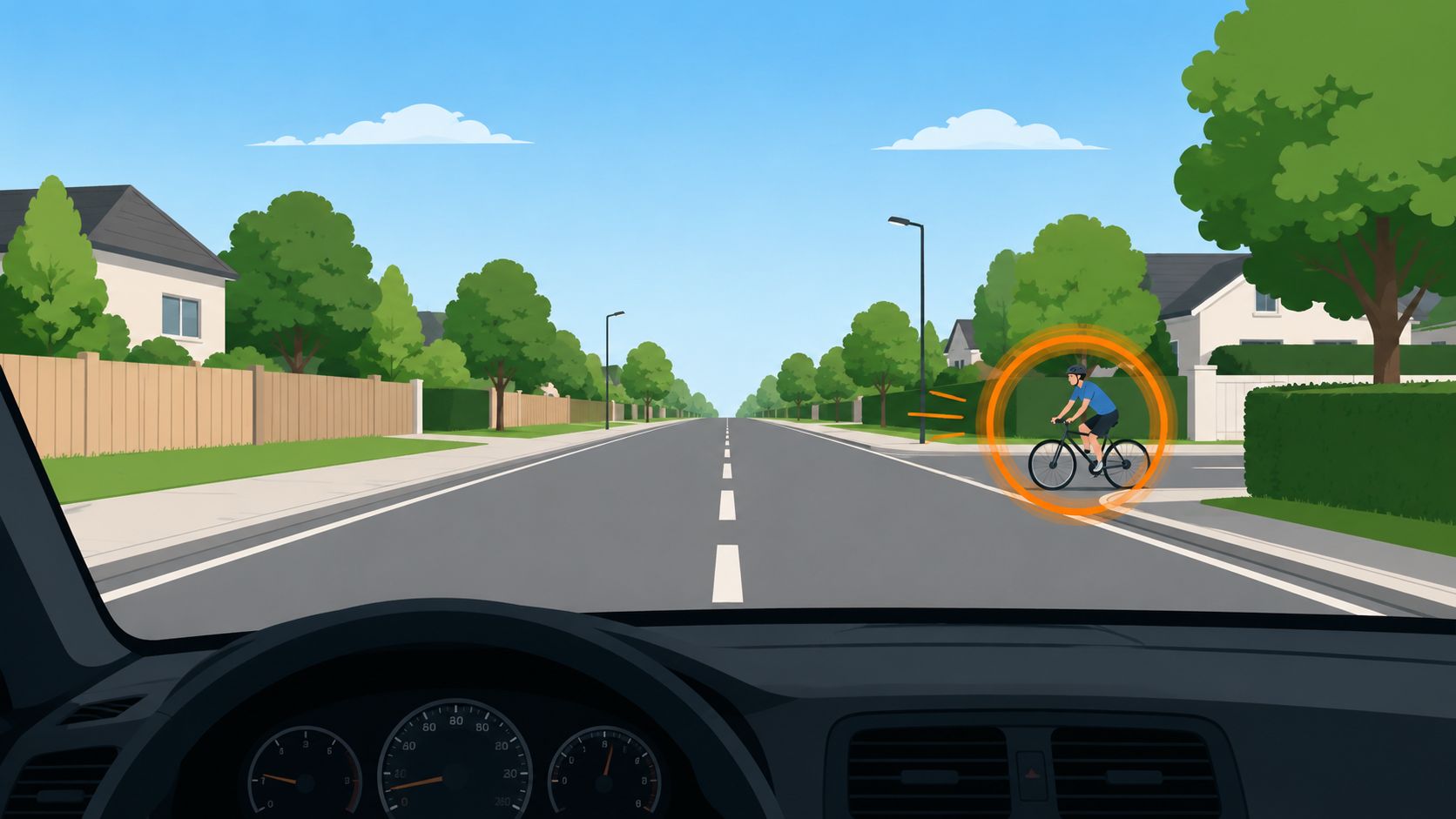
Hazard perception asks you to notice developing danger before it becomes an emergency. A learner who can define a hazard in revision may still miss the moment when a parked vehicle, pedestrian or cyclist begins to affect the road ahead.
Prompt: You're driving along a residential road. A parked van blocks part of your view, a cyclist is travelling ahead and a side road is approaching. What should you do?
Model response: Ease off the accelerator, scan beyond the obstruction, check mirrors and prepare to stop or alter position if the cyclist or another road user creates a conflict.
Coaching note: The developing hazard isn't just the parked van. It's the changing relationship between the obstruction, the cyclist, the side road and anything hidden from view. Your practice should train you to identify what could require action, not click or react to every ordinary feature.
Common mistake: Waiting until the cyclist swerves or an oncoming vehicle appears. That leaves too little time for a controlled response.
The hazard perception explanation from Fast Track Driving Lessons can help you connect video practice with real observation. Watch a clip once without clicking, describe what's changing and then repeat it while identifying the point at which you'd need to alter speed or direction.
Practise anticipation, not button timing
Use the same sitting position and screen setup you expect for the test. Review clips you misread and explain why the hazard developed. This is more useful than clicking randomly in the hope of scoring.
Practical rule: If your eyes are only searching for something to click, you're practising a game. If you're asking what may force you to change speed or position, you're practising driving.
Practice action: During a real lesson, ask your instructor to say “hazard” whenever they see a developing risk. You must then name it, state what could happen and describe the response you're preparing.
For additional event and training context, explore driving simulators in the UK.
4. Route-Specific Local Mock Driving Tests
Familiar roads can reduce uncertainty, but they can also create overconfidence. A local mock test should test how you make decisions on real layouts, not whether you've memorised a sequence of turns.
Prompt: The examiner asks you to follow road signs towards the test centre. You approach a multi-lane roundabout and the lane marking isn't immediately clear. What should you do?
Model response: Reduce speed early, read the signs and lane markings, check mirrors and choose the correct lane without making a sudden movement. If the route becomes unclear, continue safely rather than cutting across traffic.
Coaching note: Examiners assess safe planning, observation, positioning and response to instructions. They don't expect you to know every road in advance. A familiar route may contain temporary traffic restrictions, unusual congestion or a different traffic flow on the day.
Common mistake: Focusing so intensely on the expected route that you miss a lane marking, signal or vulnerable road user.
Arrange a mock test near your chosen centre, then request feedback on specific weaknesses from previous lessons. Use the report as the agenda for remedial practice rather than treating the score as a final verdict.
Make feedback route-independent
A useful local mock test might include a narrow residential road, a busy junction, a roundabout, independent directions and a manoeuvre. The exact roads matter less than the decisions you make on them. Ask whether the same issue would appear elsewhere, such as late mirror checks, weak speed adjustment or poor lane discipline.
You can use the following video as a discussion prompt before a lesson. Pause at decision points and explain what you'd observe, what could change and what action you'd take.
Practice action: Complete one local mock test, write down every repeated fault immediately afterwards and spend the next lessons correcting behaviours rather than only driving the route again.
5. Manoeuvre-Focused Practice Question Sets
Manoeuvres test control, observation and safety together. The required task can vary, so learners need a method that adapts to the road, rather than reference points that only work in one car or one location.
Prompt: You're asked to parallel park behind a parked vehicle. What should guide your decisions?
Model response: Choose a safe starting position, check all around the vehicle, use effective observation throughout, control the car slowly and stop to reassess if the position or surrounding traffic changes.
Coaching note: The examiner isn't looking for a fast performance. They're looking for safe control and appropriate observation. Reference points can help you begin, but they shouldn't replace checking the kerb, mirrors, blind spots and nearby road users.
Common mistake: Continuing the manoeuvre after losing awareness of what's around the car.
Build a repeatable routine
Practise reversing around a corner, parallel parking and an emergency stop as separate skills. Start in a quiet setting, then introduce realistic traffic, tighter spaces and unfamiliar surroundings. For an emergency stop, your instructor should control the exercise and explain how to respond promptly while maintaining control.
Use these coaching prompts:
- Observation: What can you see before moving, and what could enter the area?
- Control: Can you move slowly enough to stop smoothly?
- Position: Is the vehicle placed safely for the road layout?
- Recovery: If the position isn't right, can you stop, secure the car if needed and reassess?
Practice action: Once each manoeuvre feels familiar, ask your instructor to vary the starting position and surrounding conditions. Your goal is safe decision-making, not reproducing one memorised sequence.
6. Show Me and Tell Me Question Practice Sets
Vehicle-safety questions connect verbal knowledge with the controls in the car. You may know the correct explanation but hesitate when asked to identify a control while driving, so practise both the words and the physical action.
Prompt: Tell me how you'd check that the brakes are working before driving.
Model response: The brakes should be tested as you move off, checking that the vehicle doesn't pull to one side and that the pedal feels firm rather than spongy.
Coaching note: A good answer describes a safe check, not a dramatic test. The examiner wants to hear what you'd do and what warning signs would cause you to stop and investigate.
Common mistake: Giving a vague answer such as “I'd press the brake” without explaining when the check happens or what you're looking for.
Practise in the actual vehicle
Controls vary between manual and automatic cars, and even similar models can place switches differently. Sit in the vehicle you're likely to use and identify the controls without looking away from the road during a moving exercise. Ask your instructor to test you randomly rather than asking questions in a predictable order.
Fast Track Driving Lessons' tuition uses dual-control vehicles that meet DVSA test requirements, while its theory resources can support knowledge revision before you practise in the car. The essential transfer is from explanation to action. You should know not only what a control does, but when using it would be safe.
Practice action: At the start or end of a lesson, answer one safety question aloud, point to the relevant control and explain how you'd use it without compromising vehicle control. Never operate a control during a moving exercise unless the situation is safe and your instructor has approved it.
7. Independent Driving Practice Scenario Sets
Independent driving tests whether you can plan while continuing to observe and control the vehicle. The examiner may use a sat-nav or verbal directions, but the standard remains the same. You're responsible for making safe decisions when instructions arrive late, a sign is unclear or the road layout changes.
Prompt: The sat-nav tells you to turn left, but you're already beside the junction and moving into the wrong lane would be unsafe. What should you do?
Model response: Continue safely in the current lane, avoid a sudden turn or lane change and wait for the next safe instruction.
Coaching note: Missing a direction isn't automatically the central problem. An unsafe response to recover can create a serious fault. Examiners want controlled planning, effective observation and sensible reactions to uncertainty.
Common mistake: Staring at the sat-nav or making a last-second movement instead of keeping attention on the road.
“If you miss a turn, drive safely first and correct the route later.”
Make planning visible through behaviour
You don't need to provide a running commentary throughout the test, but you should develop a habit of looking ahead and preparing early. On practice routes, identify signs, lane changes, junction priorities and likely hazards before they arrive. Then ask yourself what information would change your plan.
Use both verbal directions and sat-nav practice. Start on familiar roads, then introduce busier junctions and less predictable traffic. Your instructor can observe during a section and note whether you plan early, maintain suitable speed and respond safely when the route changes.
Practice action: During your next lesson, take responsibility for a route without asking for confirmation at every turn. At the end, identify one decision you made early and one situation where you reacted too late.
8. Mock Test Score Analysis and Remedial Learning Plans
A mock test only becomes useful when its feedback changes what you practise. A result alone can't tell you whether a problem came from observation, judgement, control, knowledge or nerves. Your instructor should help turn each fault into a specific action.
Prompt: Your mock report records repeated late mirror checks before changing direction, plus one poorly controlled junction approach. What should your remedial plan prioritise?
Model response: Address the repeated observation issue first, then practise approach speed and planning at suitable junctions. Review the situations together and retest both behaviours under varied conditions.
Coaching note: Prioritise faults that affect safety and those that repeat across different situations. A minor isolated error may need attention, but repeating the same observation weakness can undermine otherwise competent driving.
Common mistake: Trying to fix every note at once, then leaving the lesson without enough repetition to make one improvement reliable.
Convert feedback into a drill
Use a simple sequence:
- Record: Write the exact situation, road feature and action that caused concern.
- Classify: Decide whether the issue involved knowledge, observation, planning, control or response.
- Prioritise: Choose the safety-critical or repeated issue first.
- Drill: Create a focused exercise with clear feedback.
- Reassess: Test the same skill in a different location or traffic condition.
The DVSA car theory-test dataset shows that Great Britain's car theory pass rate fell from 65.4% in 2007/08 to 44.8% in 2025/26, a decrease of 20.6 percentage points. The same official data records 2,924,430 theory tests in 2025/26, showing sustained demand for preparation. That context supports a diagnostic approach, but it doesn't replace instructor judgement or safe practice.
Practice action: Book a feedback review immediately after your mock, choose the highest-impact behaviour, practise it deliberately and arrange another assessment only when your instructor can observe whether the change holds.
Mock Driving Test Questions, 8-Point Comparison
| Item | Implementation complexity | Resource requirements | Expected outcomes | Ideal use cases | Key advantages |
|---|---|---|---|---|---|
| DVSA Official Theory Test Question Bank | Low, straightforward access via official sources | Minimal (DVSA platform/app or printed materials) | High alignment with real test questions; builds factual recall | Core theory study and baseline revision | Authoritative, comprehensive, regularly updated |
| 2024 Theory Test Mock Exam Simulators (Digital Platforms) | Medium, platform setup and selection | Moderate (stable internet, device, time for timed tests) | Improved exam readiness, timing and topic analytics | Full timed practice and pre-test simulation | Realistic exam simulation, instant feedback and metrics |
| Hazard Perception Practice Test Sets | Low–Medium, video-based practice, learning to spot developing hazards | Moderate (video-capable device, responsive screen, repetition time) | Better hazard recognition and reaction timing | Preparing for hazard-perception component and situational awareness training | Engaging video format that mirrors DVSA hazard scenarios |
| Route-Specific Local Mock Driving Tests | High, coordination with instructor and local test routes | High (vehicle, qualified instructor, on-road time, possible fees) | Familiarity with test-centre routes and authentic examiner feedback | Final-stage preparation close to booked test at a specific centre | Real examiner-style assessment and reduced test-day uncertainty |
| Manoeuvre-Focused Practice Question Sets | Medium, structured step-by-step practice plus demonstrations | Moderate (vehicle, safe practice area, instructor or video aids) | Improved manoeuvre execution and fewer manoeuvre faults | Targeted practice for reversing, parking and emergency stop | Concentrated, repeatable training with clear correction strategies |
| Show Me/Tell Me Question Practice Sets | Low, simple Q&A and practical checks | Low (flashcards, short practice sessions, vehicle for demonstration) | High likelihood of correct responses when practiced | Quick preparation integrated into practical lessons | High ROI; easy to master with minimal time |
| Independent Driving Practice Scenario Sets | Medium, requires route planning and varied on-road practice | Moderate (instructor, diverse roads, navigation tools like sat‑nav) | Improved decision-making, navigation and independent driving skills | Preparing for independent driving section and real-world autonomy | Develops planning and real-time decision skills under real conditions |
| Mock Test Score Analysis and Remedial Learning Plans | Medium, data capture and targeted planning | Moderate (reporting/analytics tools and instructor review time) | Data-driven, prioritised remediation and measurable progress | Learners with recurring faults or on intensive timelines | Targets high-impact weaknesses and optimizes study time |
Build a Practice Plan From Your Weakest Answers
Start with the official-style theory questions. Use them to establish the rules, signs, responsibilities and risk principles behind safe driving. Don't stop when you can recognise the correct option. Explain why the other options are unsafe, then ask how the same knowledge would appear in a real car.
Add hazard perception practice consistently. Watch for developing hazards such as concealed junctions, cyclists near parked vehicles, pedestrians close to the kerb and traffic that may stop suddenly. Your target is anticipation. You should notice the risk early enough to adjust speed or position smoothly, not wait until the danger becomes obvious.
Next, rehearse vehicle-safety answers in the actual car. Say the response aloud, locate the control and connect the check with a safe situation. This prevents a learner from passing a revision quiz while becoming uncertain when asked to demonstrate knowledge in the vehicle.
Move from isolated skills to complete decisions
Use the practical scenario sets during ordinary lessons. Practise manoeuvres in varied locations, take responsibility for independent routes and ask your instructor to introduce realistic distractions without compromising safety. A manoeuvre that works only with one kerb, one starting point or one set of reference points isn't yet dependable.
Then complete a realistic local mock test. Treat the route as a testing environment, not a prediction of the official drive. The latest DVSA driving-test statistics report a car theory pass rate of 44.8% for April 2025 to March 2026, so preparation needs to address both knowledge gaps and exam technique. More broadly, the result should help you identify what you do repeatedly under pressure.
After the mock, categorise every fault. Separate knowledge errors from observation, judgement, control, positioning and planning issues. Select the highest-impact remedial priorities, practise the matching drill and repeat the assessment when your instructor can test the improvement in a different situation.
Fast Track Driving Lessons offers a free Learner Hub with DVSA-style theory questions and step-by-step driving guides, intensive and semi-intensive course options, mock tests on routes near a chosen test centre and PracticalTest Assist for monitoring DVSA test alerts. Those tools can complement, but not replace, feedback from a qualified instructor. When a question exposes a behaviour gap, take it into the car and practise the decision until it becomes safe and repeatable.
If you want structured support with mock driving test questions, local-route practice and practical feedback, visit Fast Track Driving Lessons. Its Learner Hub, mock tests, intensive and semi-intensive tuition and PracticalTest Assist can help you organise the next step around your preparation needs.
Written by Fast Track editorial team.