
You've booked your practical test, but the date still feels more like a deadline than a plan. You can drive familiar roads comfortably, yet you're unsure whether one rushed junction, missed mirror check or poorly judged right turn would turn a promising drive into a fail. That uncertainty matters more when test availability is limited and each appointment carries real pressure.
The DVSA's official car test data records 1,836,558 category B practical tests carried out in 2024–25, with 893,609 passes and a national pass rate of 48.7%. Fewer than half of candidates passed in Great Britain during that period. A mock driving test practical session won't guarantee a pass, but a properly run one can show whether your problems are isolated slips, repeated driving faults or risks that would fail you immediately.
Waiting times make that diagnosis more valuable. The National Audit Office reported an average wait of 22 weeks for a car practical test in Great Britain in September 2025, compared with just over five weeks in February 2020. It also said 70% of DVSA's 240 permanent test centres were operating at the 24-week maximum wait. Booking too early can leave you test-ready long before your appointment, while booking too late can leave no time to correct a recurring fault.
A good mock therefore does more than answer, “Would I pass?” It identifies the fault category, explains why it happened, tests whether it repeats and gives you a sensible booking decision. The sections below show what a realistic mock should include, how to interpret examiner-style feedback and how to turn the result into focused practice rather than another unfocused block of lessons.
Table of Contents
- Introduction Why a Mock Practical Test Changes Everything
- What to Expect From a Proper Mock Practical Test
- How Examiner Style Feedback Really Works
- Route Practice and Independent Driving Without Memorising Roads
- Turning Mock Results Into Real Progress Before Your Test
- Your Next Mock Made to Count
Introduction Why a Mock Practical Test Changes Everything
A learner often arrives for a first mock saying they want a pass or fail result. That's understandable, especially when the actual test is booked and nerves are increasing. The more useful question is whether the drive reveals a pattern that can still be corrected.
Consider a typical situation. The learner handles the vehicle smoothly, completes a manoeuvre without a serious problem and follows the sat nav well. At three separate junctions, however, they approach slightly too quickly and look only after beginning to turn. The drive may feel broadly competent, but the repeated observation issue is more important than the comfortable parts. A mock gives the instructor enough structure to record that pattern rather than relying on a general impression.
Why a rehearsal alone isn't enough
A casual practice drive can build familiarity, but it often contains too much support. The instructor may prompt early, choose roads the learner knows well or prevent a difficult situation from developing. That can make the drive feel successful while leaving the underlying decision-making untested.
A realistic mock removes much of that cushioning. The instructor gives directions in an examiner-style manner, allows the learner to make decisions independently and records faults as they occur. The purpose isn't to create anxiety. It's to reveal what happens when the learner must manage observation, speed, position, signs and hazards without coaching.
Practical rule: A mock is valuable when it produces a clear next lesson plan, even if the result isn't a pass.
The national figures support that approach. With a 48.7% pass rate in 2024–25, many learners need more than route familiarity before they're ready for the examiner. The result should be treated as a diagnostic snapshot, not a judgement on the learner's potential.
The timing problem
The backlog changes how learners should use mocks. If a test date is already booked, a mock can establish whether the date is realistic and whether cancellation chasing is worthwhile. If no test is booked, the result can help decide whether booking now would create useful structure or add pressure.
A learner who is consistently safe but still collecting repeated observation faults may need targeted junction work before taking an appointment. Someone whose driving is broadly sound but affected by nerves may benefit from a formal mock, a structured debrief and another drive under similar conditions. In both cases, the mock saves time because it separates the actual weakness from the learner's general feeling of being “not quite ready”.
What to Expect From a Proper Mock Practical Test
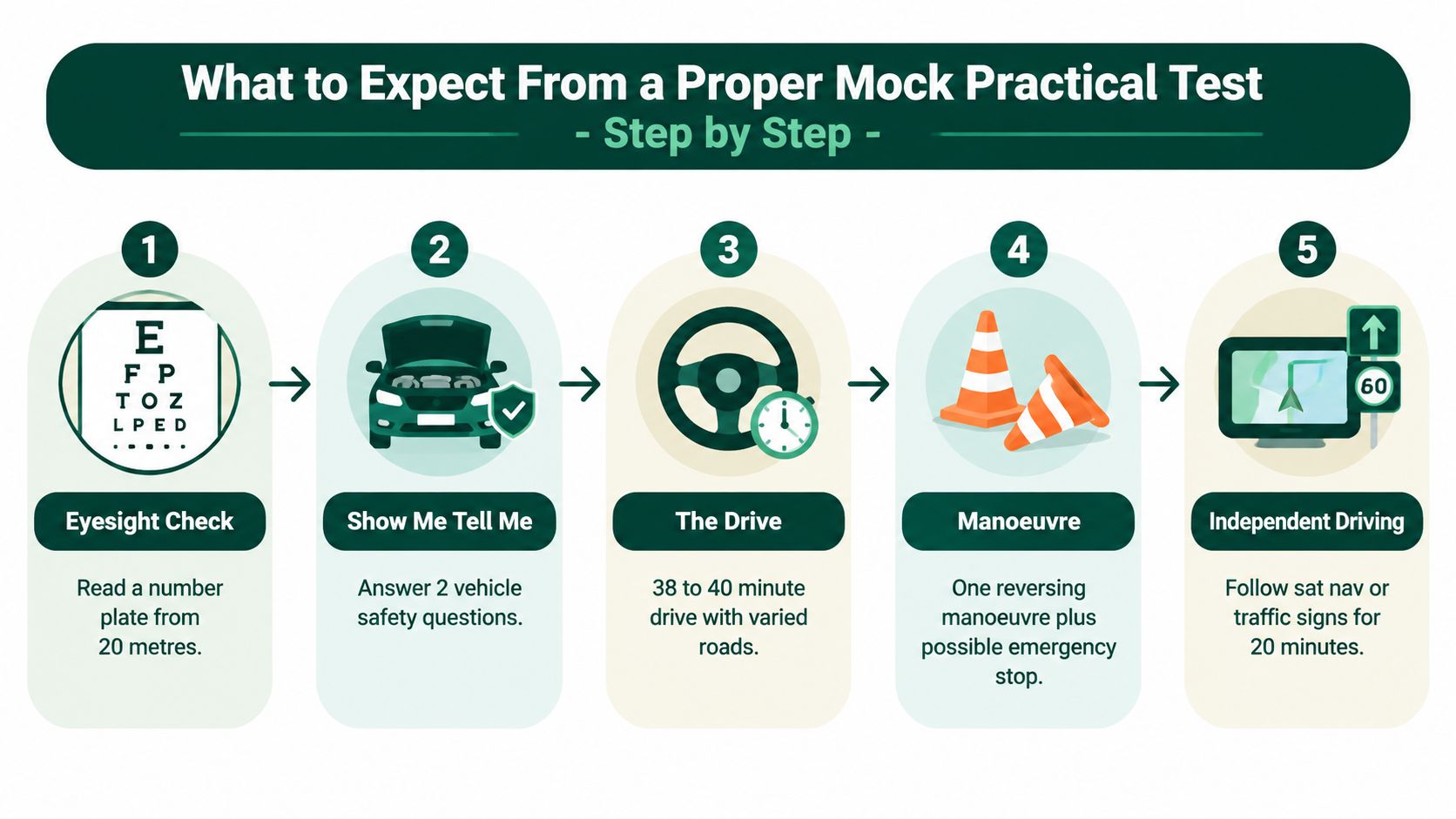
A proper mock should feel familiar enough to be useful and formal enough to expose how you'll drive on the day. It normally uses the learner's usual vehicle or a suitable dual-control car, begins with a clear briefing and takes place on roads around the chosen test centre. The instructor shouldn't coach through every decision, because the point is to observe independent performance.
The opening checks
The session starts with the eyesight check, followed by show me tell me questions. The learner should arrive able to read a number plate from the required distance and answer vehicle safety questions without turning the opening minutes into a memory test.
The briefing should explain how directions will be given, when independent driving will take place and how the instructor will handle safety. Treat this part seriously. The examiner's formal tone can feel different from a normal lesson, so practising that change of atmosphere helps reduce surprise.
The drive itself
The main drive should include varied roads and the decisions that commonly expose weaknesses. Expect junctions, roundabouts, changes in speed, lane choices, parked vehicles and opportunities to demonstrate appropriate planning. Independent driving should involve following a sat nav or traffic signs, rather than merely being led along a route you've memorised.
A realistic session also includes a reversing manoeuvre, with an emergency stop where appropriate and safe to do so. The instructor records faults during the drive rather than waiting until the end, because accurate timing matters. A missed mirror check before a lane change has a different context from a hesitation caused by an unclear instruction.
Allow enough time to settle before the mock begins and enough time afterwards for a proper debrief. Bring your provisional licence, wear comfortable footwear and avoid treating the session as an ordinary lesson. If you want a route-based mock, mock driving tests near the test centre can provide a useful model of how that preparation is organised.
The video below offers another way to familiarise yourself with the practical test format before your session.
The instructor should finish with a fault sheet and a calm explanation of what each mark means. You should leave knowing which faults occurred, where they happened, whether any were serious, and what needs to change before the next mock.
How Examiner Style Feedback Really Works
A mock drive can end with a pass on paper and still expose a weak habit that may fail under pressure. A fail can also come from one decision that is straightforward to correct. The value of examiner-style feedback is fault triage: identify the category, seriousness, location and repetition, then decide what to fix before booking the actual test.
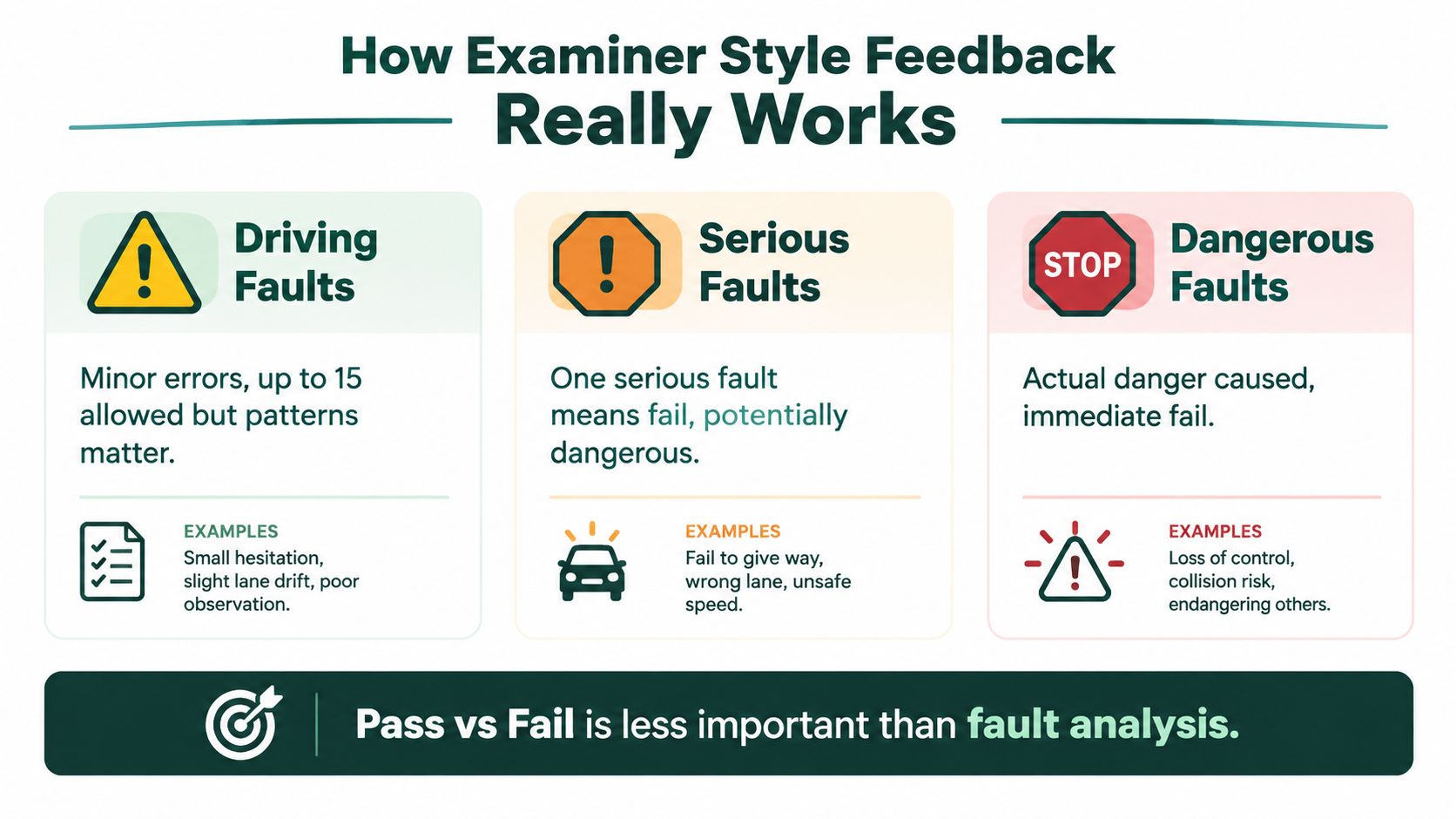
The DVSA's marking guidance sets the pass threshold at no more than 15 driving faults, with zero serious or dangerous faults. Sixteen or more driving faults means a fail, and one serious or dangerous fault is enough to fail. Repeated faults in one area can also become more serious before the numerical limit is reached.
Three categories, three different responses
A driving fault falls below the standard expected of a safe, competent driver, but does not automatically mean failure. A late mirror check, inconsistent steering or imperfect control may be recorded this way when it creates no serious risk.
A serious fault is a significant safety problem or shows that the required standard was not maintained. A dangerous fault, as defined in DVSA examiner guidance, creates actual danger to the examiner, candidate, public or property.
The correction must match the category. Several minor faults may need repeated practice and refinement. A serious or dangerous fault requires examination of the decision that caused it, including what was seen, what was missed and why the driver continued.
Read the pattern, not just the total
UK DVSA-based summaries report that successful tests average about 5.3 minor faults, while failed tests average about 9.7 in the published benchmark. Those figures are not a target or a promise. They warn against celebrating a low total when one recurring area is becoming unsafe.
Four observation faults at junctions may deserve more attention than a higher total of unrelated, low-impact slips. Record:
- Where did it happen? Junctions, lane changes, manoeuvres and independent driving demand different responses.
- What caused it? The cause may be late observation, excessive speed, weak positioning or uncertainty.
- Did it repeat? Repetition shows that competence may not yet be consistent.
- What risk followed? Concern rises when another road user had to react.
Use the DVSA's explanation of faults and results during the debrief, then record the location, fault type, consequence and corrective action. For practical guidance on presenting the same calm, safe standard to an examiner, see how to impress your examiner on test day. The pass or fail label comes after that analysis. It should guide the next practice session and, where necessary, the decision to delay booking until the highest-risk fault has been controlled.
Route Practice and Independent Driving Without Memorising Roads
Knowing the streets around a test centre helps, but memorising a particular route is a weak form of preparation. The examiner can take you along a different road, ask you to turn where you didn't expect or present a familiar junction from an unfamiliar approach. Your method must transfer.
Recent fault-order summaries place junction observation first, followed by mirrors and change of direction, then junction right turns. Signs, steering, move-off safety and road-marking interpretation also feature prominently in the published fault statistics. That ordering supports a practical routine, not a route-learning strategy.
Use the area as a training ground
Practise the test-centre surroundings, but vary the roads and approaches. Find different junction layouts, roundabouts, road markings, speed changes and parked-car situations. Ask yourself what information you need to identify, rather than trying to remember where the instructor previously told you to turn.
Before a junction or lane change, use a consistent sequence:
- Check mirrors early.
- Signal when it helps other road users.
- Adjust speed before the turn or move.
- Choose the correct position.
- Scan the hazard area and act only when safe.
The sequence isn't a script to recite. It's a prompt that keeps observation and planning ahead of the steering input. If you wait until the turn begins to look properly, you've left too little time to respond.
Make independent driving genuinely independent
Sat nav practice should include unfamiliar destinations and occasional missed instructions. If the sat nav tells you to turn but the road layout doesn't allow it safely, continue appropriately and let the system recalculate. The correct response isn't to force the turn or panic. It's to maintain control, follow the road and make a safe decision.
Traffic-sign following needs the same approach. Look well ahead, identify the instruction, confirm the lane and check whether road markings change your options. Independent driving practice should test how you process information while driving, not how accurately you recall a particular sequence of roads.
Route knowledge should reduce workload, not replace observation.
A useful drill is to have the instructor stay quiet through a series of junctions, then ask afterwards what you saw, what you expected and why you chose your speed and position. That conversation reveals whether you're scanning early or reacting at the last moment.
Turning Mock Results Into Real Progress Before Your Test
A mock result becomes useful only when it changes what happens in the next lesson. The quickest way to create that change is to sort faults by cause rather than copying every mark into a long practice list.
Start with four broad groups: observation, positioning, speed control and nerves. These categories overlap, but they help identify the right intervention. A learner who misses a cyclist while turning needs a different lesson from one who sees the cyclist but turns too quickly, and both differ from someone who drives safely until the formal setting causes hesitation.
From Mock Fault Pattern to Next Lesson Focus
| Top Fault Pattern | What It Signals | Targeted Fix Before Next Mock |
|---|---|---|
| Junction observation | The learner may be looking too late or failing to assess hazards before moving. | Use quiet junction drills, verbalise the developing hazard and repeat varied approaches without prompts. |
| Mirrors and change of direction | The learner may be checking mirrors too late or not acting on what they see. | Practise a mirror, signal, speed and position routine before lane changes and turns. |
| Right-turn errors | Position, speed or gap selection may be inconsistent. | Rehearse right turns from different roads, focusing on approach speed, centre lines, meeting traffic and final observations. |
| Signs and road markings | The learner may be reading instructions after committing to a lane or direction. | Use unfamiliar roads and ask for the next sign, lane and speed change before reaching it. |
| Speed control | The learner may not be planning far enough ahead for hazards or changing limits. | Link forward observation to early lifting, braking and appropriate gear selection where relevant. |
| Nerves and hesitation | The core skill may be present, but pressure disrupts decisions. | Repeat formal briefings, silent drives and short examiner-style sessions, then review decisions rather than offering constant reassurance. |
Decide when to book
Booking strategy depends on both readiness and local availability. DVSA-linked reporting cited by the BBC describes a median wait of 11.1 weeks in Great Britain in August 2026, while the same reporting said learners were still waiting around 20 weeks on average in early September 2026. The difference matters because a headline average doesn't describe every learner's local experience. Scotland and London can have materially higher waits, while Wales can be much shorter.
Use the mock to choose a position:
| Mock outcome | Booking decision |
|---|---|
| Safe drive, no serious or dangerous faults, and manageable driving faults | Book if local availability gives enough time to maintain the standard. |
| One repeated fault pattern, but no immediate safety issue | Book only if you can schedule focused lessons and another mock before the test. |
| Serious or dangerous fault | Delay the test and address the decision-making problem before chasing an appointment. |
| Good local drive but weak independent driving or nerves | Keep practice varied and use a formal mock before assuming route familiarity means readiness. |
Check the cancellation rules before changing plans. For car tests in Great Britain, DVSA requires 10 full working days' notice to change or cancel without losing the fee. Monday to Saturday count as working days, while Sundays and public holidays don't. That rule makes flexibility useful, but it also means you shouldn't book a date casually and assume you can change it at short notice.
Your Next Mock Made to Count
The next mock should have a defined purpose before you start the engine. Don't ask only whether you passed. Ask which fault category you're testing, what evidence will show improvement and what result would make you book, keep or delay the actual test.
A strong preparation cycle is simple:
- Set the target: Choose one or two priority areas from the previous debrief.
- Practise under variation: Use different junctions, road layouts, traffic conditions and directions.
- Drive without rescue: Let the instructor observe before giving help, unless safety requires intervention.
- Review precisely: Record the location, decision, fault category and safer alternative.
- Retest the weakness: Don't assume one successful repetition proves the pattern has gone.
The pass threshold remains a useful boundary, not a score to chase blindly. You need no more than 15 driving faults and no serious or dangerous faults, but repeated faults can still undermine the evidence that you're consistently competent. A mock that keeps you inside the numerical limit while exposing a serious risk is doing its job by stopping you from booking too early.
Final readiness check
Before the test, you should be able to:
- Complete the opening eyesight and vehicle-safety questions calmly.
- Manage varied roads without prompts.
- Use mirrors before changes of direction.
- Approach junctions with controlled speed and early observation.
- Follow signs or sat nav instructions without memorising the route.
- Complete the required manoeuvre with safe observations.
- Recover sensibly when an instruction or road layout surprises you.
- Explain your main fault pattern and the routine you use to prevent it.
Arrive with the same vehicle controls, footwear and preparation you used during successful mocks. Don't add last-minute tricks. Your aim is a calm, repeatable standard that survives unfamiliar roads and examiner pressure.
Book a mock when its feedback can still influence your plan. Use the result to choose the next lesson, then take the driving test when your driving is consistently safe, not just when you've had one comfortable drive.
Fast Track Driving Lessons offers mock tests on routes near the chosen test centre, examiner-style fault feedback, manual and automatic tuition, and support with suitable DVSA test cancellations through PracticalTest Assist. Visit Fast Track Driving Lessons to match with an instructor and turn your next mock into a focused plan for test day.
Written by Fast Track editorial team.