
Automatic cars now account for 29.4% of practical car tests in Great Britain, compared with around 4% in 2007/08, according to DVSA-linked figures reported by the AA. That changes the question. Manual vs automatic driving lessons aren't just about whether you want to operate a clutch. Your choice affects the licence you receive, the vehicles you're allowed to drive and whether you'll need another practical test later.
For most learners, manual remains the safer choice for maximum flexibility. Automatic is often the better route for a nervous learner, a city-only driver or someone whose coordination makes clutch control a serious barrier. The right answer depends on the next several years of your driving life, not just which first lesson feels easier.
Table of Contents
- Why Transmission Choice Matters More Than UK Learners Realise
- How Manual and Automatic Lessons Actually Differ
- UK Pass Rates by Transmission and What the Gap Means
- Licence Entitlement, Code 78 and Long-Term Limitations
- Cost, Scheduling and Instructor Availability
- Which Transmission Suits Different Learner Profiles
- The Verdict and Practical Next Steps Before You Book
Why Transmission Choice Matters More Than UK Learners Realise
Automatic tuition has moved decisively into the mainstream. In 2025/26, automatic tests represented 29.4% of practical car tests, while the overall Great Britain pass rate was 50.0%, according to the latest DVSA analysis reported by the AA. A learner choosing an automatic isn't taking an unusual shortcut. They're selecting a major route through the UK training market.
The important point is that the transmission appears on the licence entitlement. Pass in a manual car and you receive full Category B entitlement. Pass in an automatic and your licence is restricted to automatic vehicles, with the restriction recorded through code 78 or code 106 depending on the licence record, as shown in the GOV.UK driving licence codes guidance.
The decision starts before the first lesson
Think through four consequences before booking:
- Vehicle access: A manual pass lets you drive manual and automatic cars. An automatic pass doesn't give you permission to drive a manual.
- Future retraining: If your job, family circumstances or vehicle access changes, upgrading from automatic to manual means taking further tuition and passing another practical test.
- Daily workload: Automatic tuition removes clutch and gear management, leaving more attention for mirrors, junctions, speed and planning.
- Training logistics: Your local supply of suitable instructors and test-ready vehicles can influence how quickly you maintain consistent progress.
The practical test isn't a softer exam for automatic candidates. The theory test, road rules, manoeuvres, show me, tell me questions and fault-marking framework remain the same. The mechanical difference is the car used on test day and the entitlement that follows the pass.
| Test Type | Total Practical Tests | Share of All Tests (%) |
|---|---|---|
| Automatic | 479,556 | 26% |
| Manual | About 1.3 million | About 74% |
| All car tests | About 1.8 million | 100% |
The BBC's report on the 2024/25 figures records 479,556 automatic tests out of about 1.8 million total tests, with automatic tests making up 26% of all car tests. The same long-run data shows the share rising from 6.12% in 2012/13, so this is a licensing decision that an increasing number of UK learners must make.
How Manual and Automatic Lessons Actually Differ
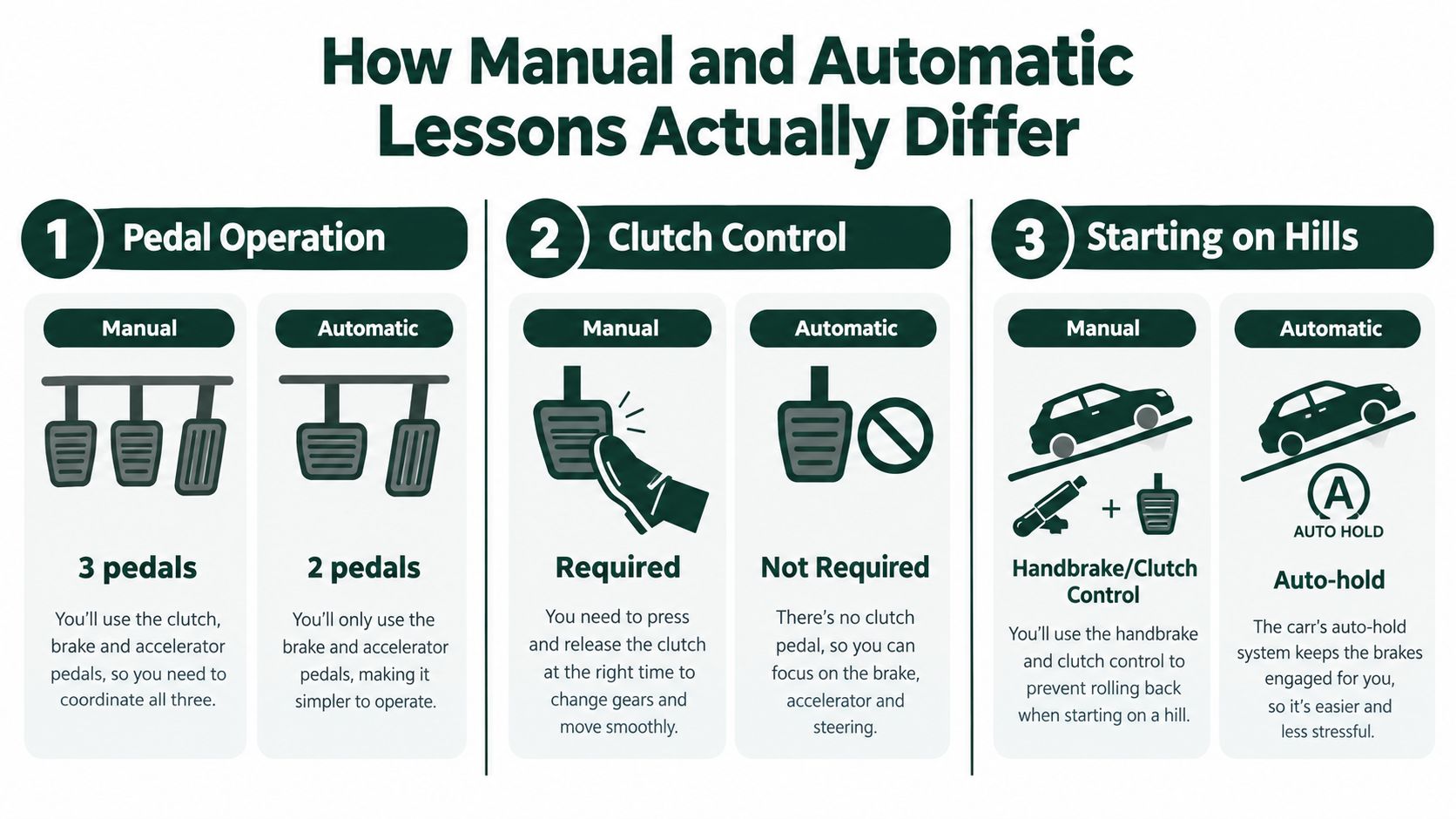
A manual lesson asks you to coordinate more controls at the same time. You operate a clutch, select gears, manage the accelerator and use the foot brake, while still observing traffic and making safe decisions. An automatic lesson removes clutch and gear selection from that workload, but it doesn't remove the need for accurate judgement or disciplined observation.
What you practise in each car
| Skill area | Manual lessons | Automatic lessons |
|---|---|---|
| Pedals | Clutch, brake and accelerator | Brake and accelerator |
| Moving off | Bite point, gas and clutch balance | Brake release and controlled acceleration |
| Hills | Clutch control, handbrake and timing | Brake control and vehicle systems |
| Speed management | Braking, gear choice and downchanges | Braking, acceleration and road position |
| Junctions | Gear selection alongside observation | Observation, speed and position |
| Manoeuvres | Clutch control at low speed | Precise braking and steering |
| Test standard | Same road rules and fault framework | Same road rules and fault framework |
Manual learners need to master moving off without stalling, selecting a suitable gear before a junction and changing down when descending or slowing. Hill starts demand reliable clutch control and an understanding of how the handbrake supports a safe move-off. Those skills can become automatic with practice, but they create more early-stage decisions.
Automatic learners still have to deal with complex traffic. The instructor will focus more heavily on mirror checks, meeting traffic, lane discipline, roundabouts, speed control and anticipation because the gearbox no longer occupies as much of the learner's attention. Low-speed manoeuvres can feel calmer, although accurate braking remains essential.
What doesn't change
The Highway Code syllabus applies to both routes. You'll still need to demonstrate safe observations, appropriate signalling, effective use of mirrors, controlled manoeuvres and independent driving. The examiner isn't judging whether the car has a clutch. They're judging whether you can drive safely and make sound decisions.
Lesson duration also depends on the learner, not only the transmission. A learner who progresses quickly in a manual may need less tuition than a hesitant automatic learner. Mock tests should use the same test-centre roads, examiner-style instructions and fault standards in either vehicle.
The manual driving lessons programme is one example of a structured route for learners who want to develop those additional control skills. Before booking, ask any school how it builds clutch work, hill starts and gear selection into the wider roadcraft plan.
The visual explains the controls. This video gives another practical way to see how the two lesson formats differ:
UK Pass Rates by Transmission and What the Gap Means
The latest UK figures show a clear pass-rate gap. In 2024/25, automatic candidates recorded a 43.9% pass rate, compared with 50.5% for manual candidates, a 6.6 percentage-point gap, according to DVSA-linked figures reported by the BBC.
That gap does not prove that manual learners are better drivers. The practical test assesses the same road skills, while the groups choosing each transmission are different. Automatic candidates may include nervous learners, older returners and drivers who have already found manual coordination difficult. Those factors can affect the overall result.
| Transmission | Male Pass Rate (%) | Female Pass Rate (%) | Overall Pass Rate (%) |
|---|---|---|---|
| Manual | Not provided in the verified figures | Not provided in the verified figures | 50.5% |
| Automatic | Not provided in the verified figures | Not provided in the verified figures | 43.9% |
The verified DVSA-linked figures provide overall rates only. They do not provide a reliable male and female split for this comparison, so unsupported figures should not be added.
Why automatic is not automatically the easier pass route
An automatic removes clutch-related faults and gear-selection mistakes. That can free attention during busy junctions, hill starts and stop-start traffic. It does not prevent serious faults caused by poor observation, unsuitable speed, weak planning or ineffective mirror use.
The year matters when comparing figures. The 43.9% figure covers 2024/25, while 44.6% reflects 2025/26. In 2025/26, the automatic pass rate was 44.6%, while the overall Great Britain rate was 50.0%, according to the AA analysis of DVSA figures. The figures describe different reporting periods, not two interchangeable results. Automatic may be simpler to operate, but the learner still needs reliable roadcraft and independent decision-making.
Planning rule: Use pass-rate data as a test-preparation benchmark, not as a ranking of manual and automatic drivers.
Choose your transmission with the licence outcome in mind, not only the first few lessons. Automatic can remove coordination problems, while manual may offer a broader licence entitlement. Either route still demands consistent independent driving before you book the test.
Allow for the possibility of another attempt. A failed test can mean another booking, extra lessons, a mock test and a delay before a suitable appointment becomes available. Your instructor should judge readiness from repeatable performance on varied roads, not from how straightforward the gearbox feels.
Licence Entitlement, Code 78 and Long-Term Limitations
The licence restriction is the biggest difference between the two routes. A manual practical test gives full Category B entitlement, allowing you to drive cars with either transmission, subject to the vehicle and licence rules. An automatic practical test gives an automatic-only entitlement.
The GOV.UK guidance on driving licence categories explains the practical distinction learners need to understand before booking. The automatic restriction is recorded on the photocard as code 78 or code 106, depending on the record format identified in the verified licensing guidance.
| Entitlement | Manual Pass | Automatic Pass |
|---|---|---|
| Drive a manual car | Yes | No |
| Drive an automatic car | Yes | Yes |
| Full Category B flexibility | Yes | Restricted |
| Upgrade to drive manuals later | Not required | Further tuition and a manual practical test |
What an automatic pass means later
You don't lose the right to drive the automatic vehicle you trained in. You can drive automatic cars legally, but you can't assume that a manual family car, employer's van or hired vehicle is covered. If your circumstances change, you'll need to prepare for and pass a manual practical test.
That matters for people who share cars, accept jobs involving mixed vehicle fleets or expect to drive older vehicles. It also matters when travelling, because an automatic-only licence may reduce the vehicles available to you through a hire company. The exact policy depends on the firm, country and insurance arrangements, so check before travelling rather than relying on assumptions.
The same caution applies to towing and other vehicle categories. Don't treat an automatic Category B pass as permission to drive every car, van or trailer combination you might encounter. Check the categories and restrictions on your photocard and use the official rules for the vehicle you intend to drive.
The UK used-car market is changing, but you shouldn't make a legal decision from a rough estimate of how many cars are manual. A manual licence gives you broader access; an automatic licence gives you a narrower, deliberate entitlement. Choose automatic only when that limitation is acceptable, not because someone says you'll never need a manual.
Cost, Scheduling and Instructor Availability
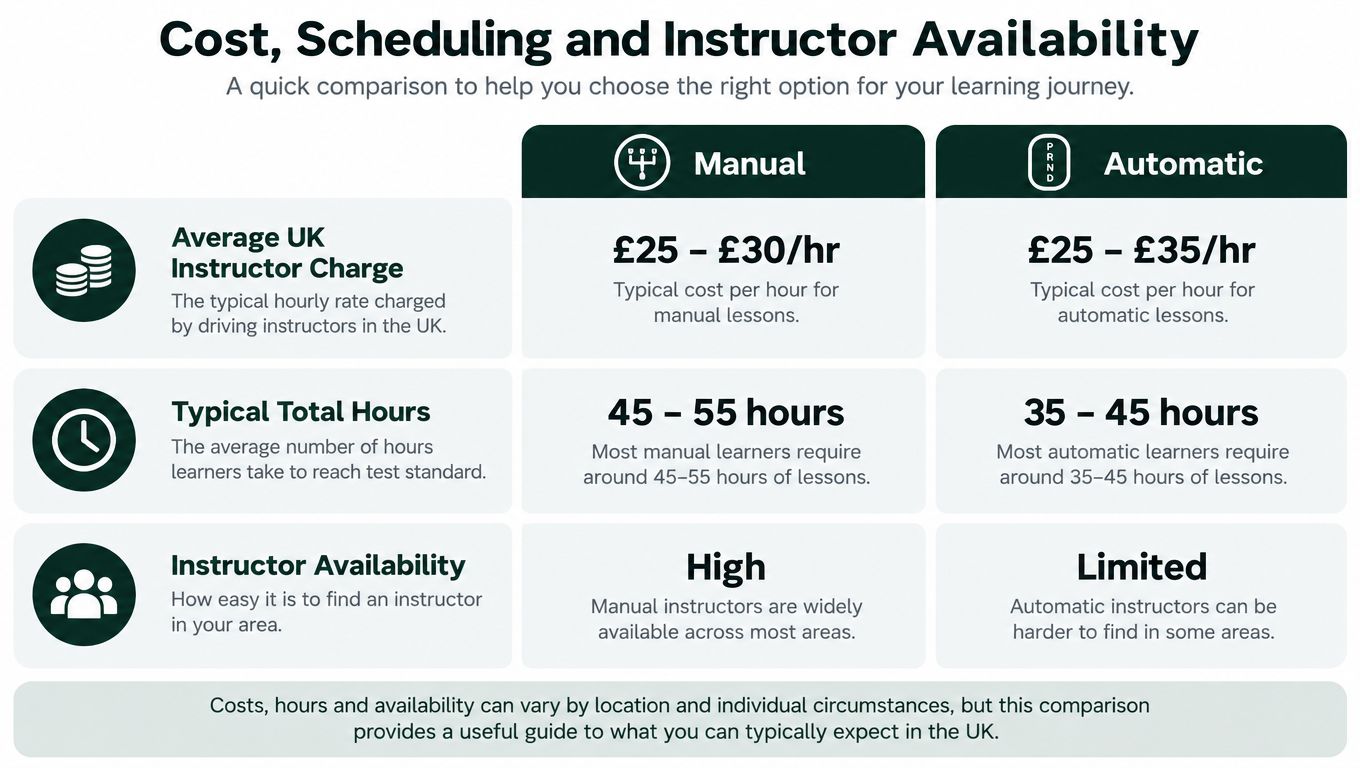
Hourly price alone gives a poor guide to the cost of earning a full licence. Your final bill depends on how quickly you progress, how often you take lessons, your test preparation, vehicle access and any tuition needed after an unsuccessful test. Manual lessons can require more early coordination, while automatic lessons may reduce the mechanical workload.
Before choosing, review our complete guide to driving lesson costs in the UK. Then compare the full package:
- Lesson rate: Check whether weekday, evening and weekend sessions have different prices.
- Total training: Ask how the instructor estimates your hours and when that estimate will be reviewed.
- Test preparation: Confirm whether mock tests, route practice and manoeuvre sessions cost extra.
- Test rebooking: Ask what help is available if you need another appointment.
- Course terms: Read the cancellation policy, payment stages and block-booking conditions.
Availability can change the calculation
Automatic lessons are in strong demand, so automatic appointments are not automatically easier to secure. Local test-centre demand, instructor capacity and the supply of suitable training cars all affect your timetable.
Manual instructors are generally easier to find across the UK. Automatic provision can be less even, particularly outside larger urban areas. Choosing a transmission your preferred instructor does not teach can delay your start, while finding a good local match may reduce waiting time.
The legal standard applies to both types of tuition. DVSA's ADI code of practice requires training vehicles to meet test requirements, display the correct markings and carry compliant equipment such as dual controls. The car must be fit for purpose and insured for driver training and, where relevant, testing. The instructor must also hold a current valid licence.
Check the person as carefully as the car
A paid driving instructor in Great Britain must appear on the Approved Driving Instructors register and pass the required suitability checks. The qualification includes a theory test, a driving ability test and an instructional ability test, as explained in the ADI register guide.
Ask to see the instructor's badge. Confirm whether you are learning with a fully qualified ADI or a trainee. A dual-control automatic does not guarantee better teaching, and a manual car does not guarantee a better learning environment. The instructor's planning, feedback and availability will influence your progress more than the gearbox alone.
Which Transmission Suits Different Learner Profiles
There isn't one correct answer for every learner. I recommend looking at the vehicles and situations you're likely to face over the next several years, then choosing the transmission that supports that life.
Match the car to the driver
Complete beginner with no family car access: I normally recommend manual if you don't yet know what you'll drive after passing. It gives you the widest licence entitlement and protects you from needing another test if your first car, family car or work vehicle is manual.
Nervous learner: Automatic is often the sensible option when clutch work causes overload. You still need to learn every roadcraft skill, but removing stalling anxiety can leave more attention for junctions, mirrors and hazards.
Older returner: If you've driven before and are rebuilding confidence, automatic can make the return less demanding. If you already know you'll be using a manual vehicle, however, returning in an automatic may postpone rather than solve the skill you need.
Urban commuter: Stop-start traffic in London, Birmingham or Manchester can make constant clutch work tiring. If your everyday driving will remain urban and your available car is automatic, automatic lessons fit the actual task better.
Rural or motorway-heavy driver: Manual is usually the stronger long-term choice when you expect varied vehicles, rural gradients, longer journeys or work-related driving. It keeps more options open when the car available to you changes.
Ask yourself before choosing
Write down honest answers to these questions:
- Will you drive abroad, and could the available hire cars be manual?
- Will you share a car with relatives, partners or housemates?
- Could an employer provide a manual car, van or mixed fleet vehicle?
- Do you expect to tow or use vehicles with different transmission types?
- Will you rely on car-share fleets where your vehicle choice changes?
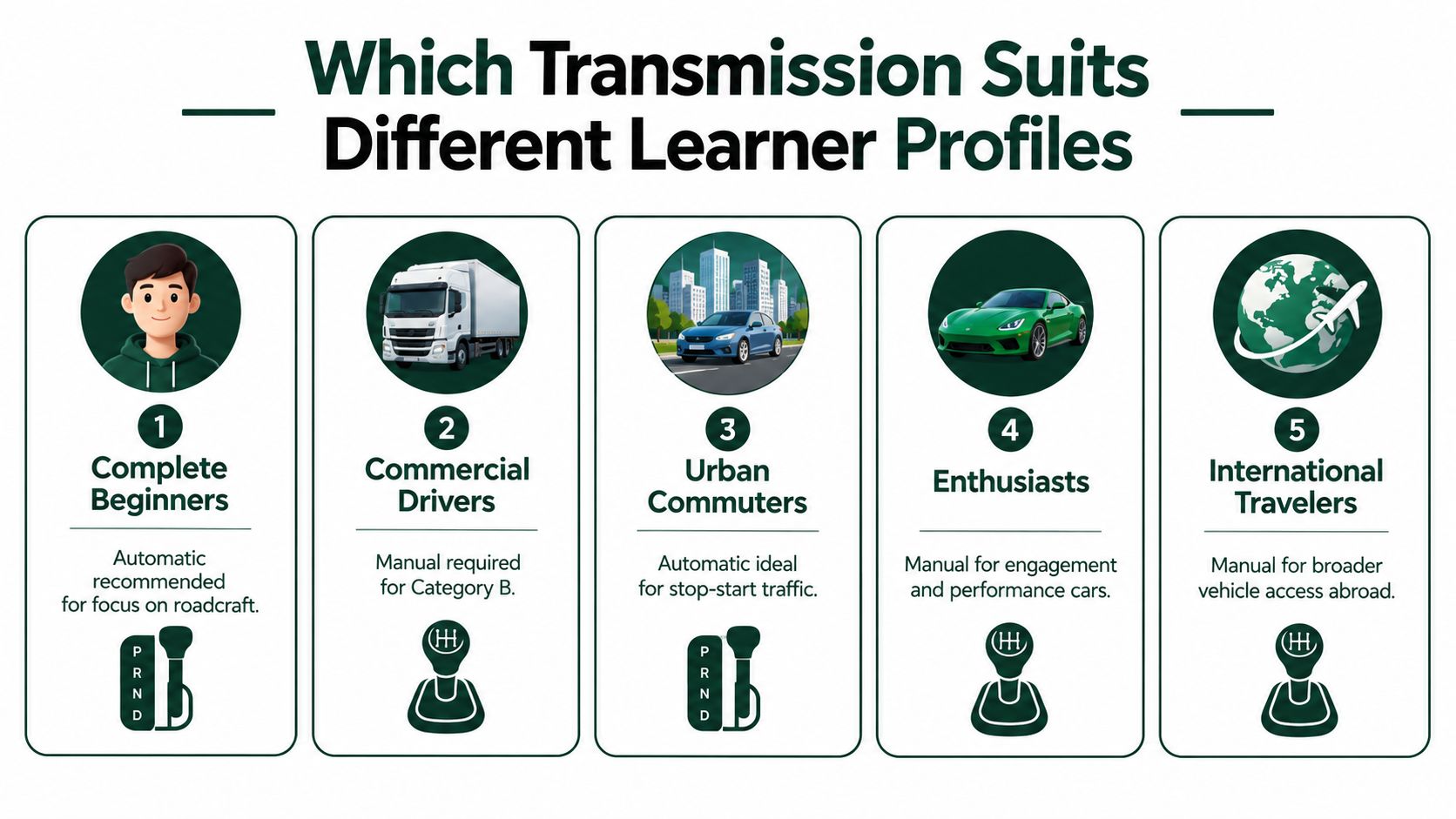
The infographic lists commercial drivers, enthusiasts and international travellers among the profiles that may favour manual, while urban commuters and learners who want to concentrate on roadcraft may prefer automatic. Those are useful prompts, not legal rules.
The decision should follow your expected driving life, not the first lesson's difficulty. A difficult manual first session doesn't mean you're incapable. An easy automatic first session doesn't mean the licence restriction won't matter later.
The Verdict and Practical Next Steps Before You Book
Choose manual if you want full Category B flexibility, may drive older cars, expect to use varied vehicles, might travel abroad or want the broadest choice when buying your own car. You'll have more to coordinate during training, but you won't need to return for a manual test just because your circumstances changed.
Choose automatic if you drive mainly in city traffic, want to reduce the initial mechanical workload, have a disability or medical condition affecting left-foot coordination, have failed through clutch anxiety, or expect to use automatic vehicles only. The restriction is acceptable when your planned driving life already fits it.
Questions to take to a driving school
- Can you confirm the instructor's DVSA registration status? Ask for the badge and clarify whether they're an ADI or PDI.
- Is the training car suitable for the practical test? Check its dual controls, insurance, condition and whether the same make and model will be used on test day.
- What is the hourly rate at different times? Confirm weekday, evening and weekend pricing in writing.
- Who books the test? Find out whether the school supports booking, monitors cancellations or expects you to handle it alone.
- What happens after a cancellation or failed test? Ask about notice periods, mock-test charges, rebooking support and lesson availability.
- Are discounts tied to lesson blocks? Read the refund and cancellation terms before paying.
My advice is simple: don't commit to a large course based on a theoretical argument. Take one taster lesson in a manual and one in an automatic, ideally with instructors who assess your roadcraft as well as your comfort with the controls. Then choose the route that gives you both a realistic path to passing and a licence you'll still value when the car, job or journey changes.
Fast Track Driving Lessons offers manual and automatic tuition through DVSA-approved instructor matching, with intensive and semi-intensive courses, mock tests and support with practical test cancellations. Compare the two options and book a suitable taster through Fast Track Driving Lessons before choosing your full course.
Written by Fast Track editorial team.