
Manual gives you the broader licence because a manual pass lets you drive both manual and automatic cars, while an automatic pass leaves you restricted to automatics only. Automatic lessons usually carry a lower mental load, but the claim that automatic is easier to pass isn't backed by national figures, with manual pass rates at 48.4% and automatic at 43.9% in Great Britain's 2024/25 DVSA practical car-test data.
Most advice on this topic is too soft. It treats transmission choice like picking between tea and coffee. It isn't. For a UK learner, this decision affects what you can legally drive, how many cars you can choose from later, and whether you might need another practical test down the line.
If you want the blunt answer to manual or automatic which is better, the default choice is manual. Automatic is the right choice for a smaller group of learners with a clear reason to trade licence scope for a simpler learning experience.
Table of Contents
- Why the Manual vs Automatic Question Is More Than Personal Preference
- What Each Transmission Actually Feels Like in a UK Lesson
- Comparing Manual and Automatic Across the Five Decisions That Matter
- What DVSA Pass Rates and Test Volumes Actually Show
- How the Automatic-Only Licence Restriction Works
- The Full Cost Picture for Manual and Automatic Learners
- Which Transmission Fits Which Type of UK Learner
- The Verdict and Questions UK Learners Still Ask
Why the Manual vs Automatic Question Is More Than Personal Preference
Treating this as a personality choice is bad advice. For a UK learner, manual versus automatic is a three-layer decision about what licence you leave with, what the pass-rate evidence shows, and how much freedom you keep once lessons are over.
Plenty of learners get pushed into the wrong question. They ask which car feels easier in week one. They should ask which option leaves them with the fewest restrictions in year five.
Those are not the same thing.
The first layer is legal. Your test result decides what you can drive afterwards, not just how you learn now. An automatic pass gives you a Category B licence with code 78, which restricts you to automatics. A manual pass covers both manual and automatic cars. That affects ordinary, boring, expensive real-life decisions: borrowing a parent's car, taking a job that involves driving, buying whatever is available locally, or avoiding the cost and hassle of another practical test later.
The second layer is evidence. Learners are often told that automatic is the easier route, full stop. That claim falls apart once you look at the national picture. The headline many people repeat is based on pedals, not outcomes. Fewer tasks in the car do not automatically produce better test results.
The third layer is long-term access. A restricted licence narrows your options for years. It can rule out a cheap manual runaround, a courtesy car, a work vehicle, or a friend's spare car when you need one. That matters far more than whether your first few lessons feel calmer.
Practical rule: pick the transmission that gives you the licence you want to hold after you pass, not the one that only feels easier at the start.
The myth learners hear first
The usual sales line is simple: automatic is easier, so it must be the smarter choice. That is too shallow. It confuses lower workload in lessons with better odds on test day.
As noted earlier, recent DVSA practical car-test figures for Great Britain show manual candidates passing at a higher rate than automatic candidates. That does not mean manual feels simpler. It means the popular shortcut conclusion is wrong.
A more useful question to ask
Use these questions instead:
| Question | Why it matters |
|---|---|
| What will I be allowed to drive after I pass? | Licence restrictions last longer than lessons |
| Am I choosing from evidence or from first-lesson nerves? | A calmer car does not guarantee a better test result |
| Will losing access to manual cars annoy me later? | Changing your mind means another practical test |
That is the frame most UK comparisons miss. This is not just about comfort or preference. It is about licence scope, pass-rate reality, and whether you keep your options open.
What Each Transmission Actually Feels Like in a UK Lesson
A learner doesn't care how a gearbox works on paper. You care about what your hands and feet are doing at a mini-roundabout in traffic while your instructor says, “mirror, signal, position.”
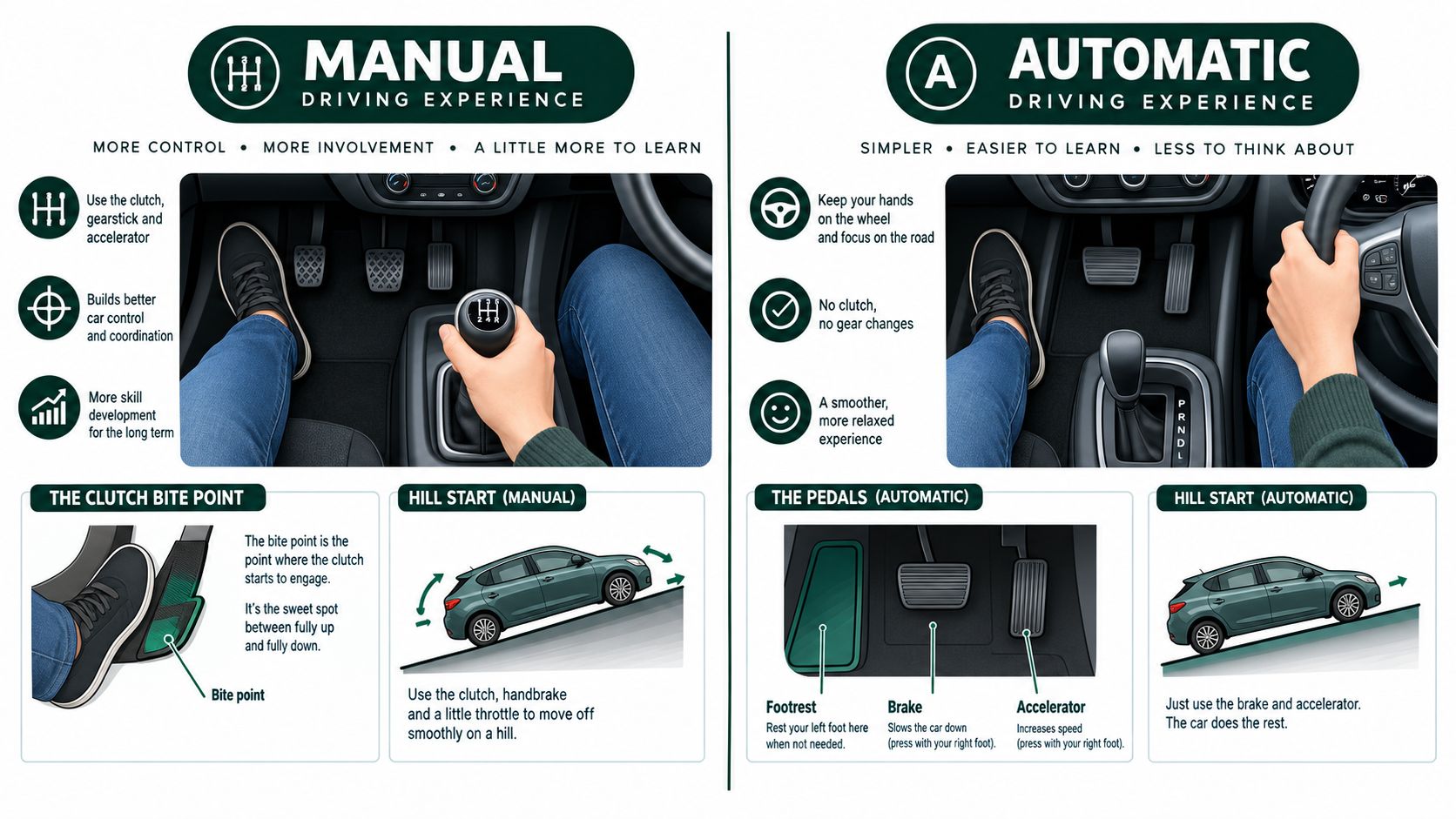
In a manual, your left foot works the clutch, your right foot swaps between brake and accelerator, and your left hand leaves the wheel to change gear. You learn clutch bite, moving off cleanly, selecting the right gear before a bend, and balancing the car on hill starts without rolling.
In an automatic, your left foot does nothing except rest on the footwell. Your right foot handles brake and accelerator. There's no clutch bite to find and no gear selection to time, so your attention stays on steering, speed, spacing and planning.
What changes in the first few lessons
With a manual pupil, the early script is usually repetitive for a reason. Clutch down. First gear. Set gas. Find bite. Release handbrake. Steer. Build speed. Clutch down again. Second gear. Smoothly off the clutch. Every one of those steps can go wrong.
With an automatic pupil, the first lessons often move more quickly into road reading because the car itself demands less choreography. That can be especially useful for adults restarting after a bad experience, or for anxious learners who freeze when too many tasks pile up at once.
If you want a simple way to understand how reduced control complexity helps confidence in another setting, this automatic dirt bike guide makes the same point in a different vehicle category.
Where the mental load peaks
The hard bits aren't identical.
- Manual pressure points: moving off under stress, hill starts, stalling in traffic, selecting the wrong gear, rushing clutch release
- Automatic pressure points: speed control downhill, creeping too fast in queues, relying on the car and under-planning ahead
- Common pressure points: mirrors, judgement at junctions, lane discipline, meeting traffic, manoeuvres, independent driving
In a manual lesson, the car asks more from you. In an automatic lesson, the road asks more from you sooner.
The physical difference between the cars is small. The cognitive difference on lesson day is real. That's why some learners settle faster in automatics even though the national pass figures don't show an automatic advantage overall.
Comparing Manual and Automatic Across the Five Decisions That Matter
Here's the side-by-side view most learners need before anyone starts arguing from habit.
Manual vs Automatic Five Decisions Side by Side
| Criterion | Manual | Automatic |
|---|---|---|
| Learning curve | Harder at the start because you must master clutch control and gear changes | Simpler early learning because you focus on road use, speed and planning |
| DVSA pass rate | Higher in national 2024/25 data | Lower in national 2024/25 data |
| Total lesson cost | Hourly pricing can be the same, but progress depends on the learner | Hourly pricing can be the same, but licence limits may create later costs |
| Licence scope | Covers manual and automatic cars | Covers automatic cars only |
| Post-test vehicle access | Broadest choice | Narrower choice unless you later pass in a manual |
That's the clean comparison. Now the weighting matters.
Learning curve and test performance are not the same thing
Manual is usually tougher in the first stage. Learners need to coordinate limbs properly, listen for engine note, feel clutch bite and change gear without dropping observations. Automatic strips out that layer.
But difficulty in the lesson car doesn't automatically translate into a better test result. National pass data says the opposite. So if someone tells you automatic is definitely easier to pass, they're talking from instinct, not evidence.
Cost only matters if you count the whole route
A lot of schools now charge similar hourly rates for both transmissions. Some, including Fast Track Driving Lessons, publish the same rate for manual and automatic tuition, which is the sensible way to price a lesson when the instructor's time is the main thing you're paying for.
The mistake is only comparing the lesson hour. The bigger cost question is what happens after you pass. If an automatic-only licence later blocks you from using an available manual car, that “easier” route can become inconvenient and expensive.
Licence scope is the biggest divider
The debate stops being emotional.
- Manual wins on access: one pass, broader entitlement
- Automatic wins on simplicity: less task overload while learning
- Manual wins on flexibility: no later upgrade needed
- Automatic loses on options: you're boxed into one transmission category until you retest
Bottom line: If two options cost roughly the same to learn, the one that gives you broader legal access is the stronger default.
Post-test life matters more than pre-test nerves
A learner often chooses based on the next month. An instructor should advise based on the next few years.
If you're likely to borrow family cars, shop widely in the used market, or want zero licence restrictions, manual is the practical choice. If your future is clearly automatic only and you know that won't change, the automatic route becomes easier to justify.
What DVSA Pass Rates and Test Volumes Actually Show
Drop the lazy assumption that automatic means an easier pass. The national picture does not back it up.
DVSA Pass Rates and Test Volumes Manual vs Automatic
| Metric | Manual | Automatic |
|---|---|---|
| Pass rate in Great Britain 2024/25 | 48.4% | 43.9% |
| Share of car tests in 2024/25 | Majority of tests | 479,556 of 1,839,815, about 26% |
| Long-term trend in test volume | Still dominant overall | Rose from 87,844 tests in 2012/13 to 479,556 in 2024/25 |
As noted earlier, those figures come from DVSA practical car-test reporting summarised by the AA. The numbers matter because they cut through a myth that gets repeated by learners, parents, and even some instructors.
Automatic test volume has surged. The pass-rate advantage still sits with manual.
That does not mean manual cars are simpler to drive. It means the national results do not support the claim that choosing automatic gives the average candidate a better shot at passing. If that claim were true at scale, automatic candidates would be passing at a higher rate. They are not.
Candidate mix matters, and this is the main reason people misread the figures. Automatic candidates often include older learners, nervous returners, and people choosing automatic for mobility, confidence, or accessibility reasons. That pool is different from the manual pool, so pass rates are not a pure measure of gearbox difficulty.
Still, the headline point stands. If your only reason for choosing automatic is “it's easier to pass in,” the current DVSA pattern does not support your decision.
Why automatic test numbers keep rising
The rise in automatic tests is real, and it reflects demand rather than pass-rate superiority. BBC reporting on the shift shows how fast learner behaviour has changed, especially as more drivers expect their next car to be electric or hybrid, and therefore automatic by default: BBC coverage of the shift toward automatic tests.
That growth has two practical effects. More instructors now offer automatic lessons because enough learners want them. More first-car searches also start in the automatic market, especially for EVs and hybrids. If you want to see how that market is changing, compare used automatic EV listings.
One more reality check. A lower pass rate in automatics does not make automatics a bad choice. It means this decision should be made in the right order: licence scope first, pass-rate reality second, future car access third. If you are trying to judge how many test attempts learners typically need overall, this guide on average attempts to pass the practical test adds useful context.
How the Automatic-Only Licence Restriction Works
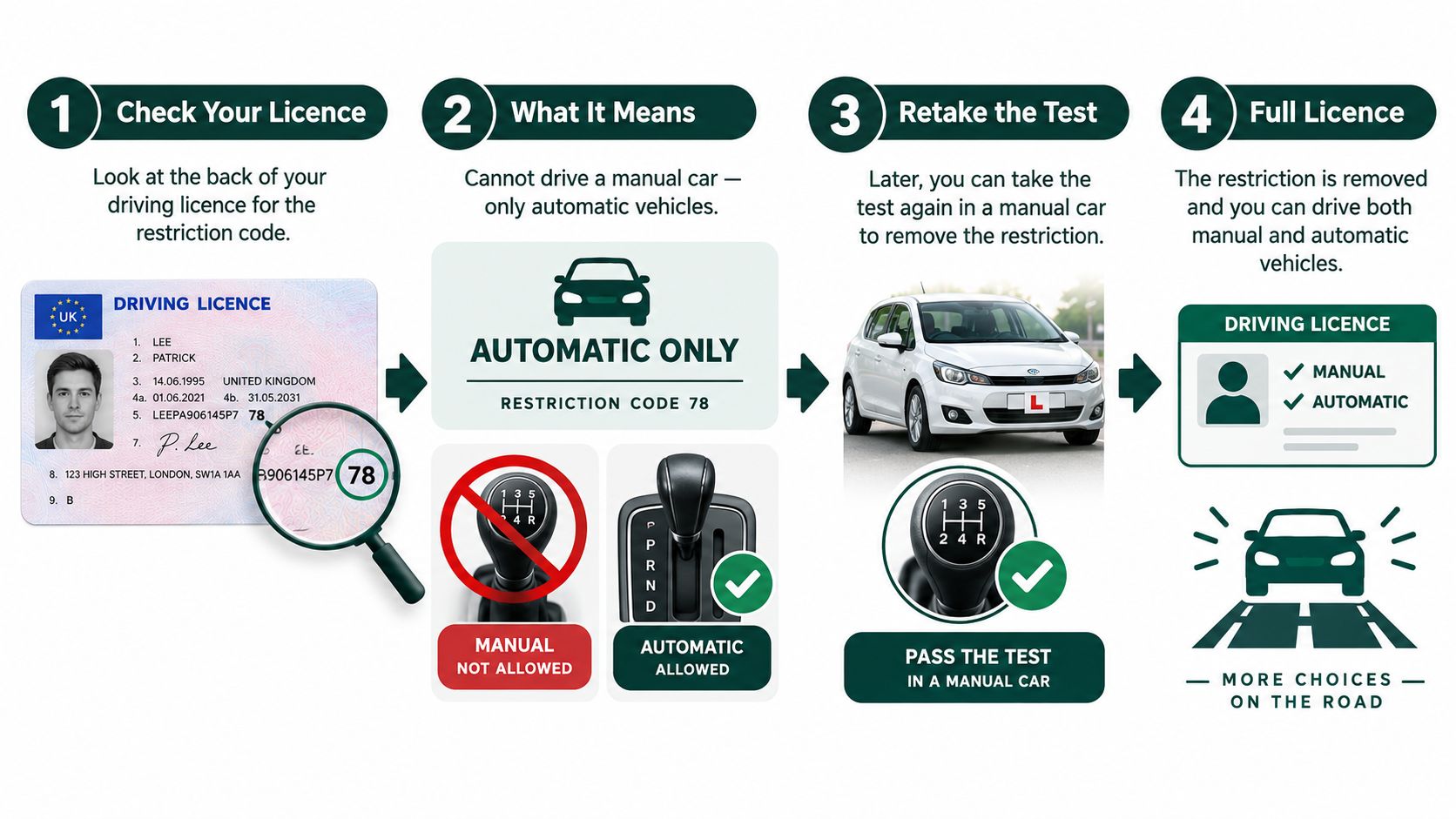
The licence rule is blunt. If you pass your practical test in an automatic, you get a Category B licence with code 78. In plain English, that means you can drive automatic-transmission vehicles only. You cannot legally drive a manual car until you pass a manual practical test and remove that restriction, as explained in this guide to automatic licence restrictions.
That single code changes the whole argument.
What you can and can't drive
If you hold code 78:
- You can drive: automatic cars within the licence category
- You can't drive: manual cars in that category
- You'll need another practical test: if you later want full manual entitlement
That's why an automatic pass is not a smaller version of a full licence. It is a restricted licence.
How the upgrade works
The good news is that you're not stuck forever. If you already hold an automatic-only licence and later want manual entitlement, you take a practical test in a manual car. Once you pass, the restriction is removed and your licence covers both.
You don't need to reframe this as a disaster. It's just an extra hurdle. The problem is that many learners choose automatic without really pricing in the hassle of another test, more lessons in a new transmission, and another wait for a slot.
Check your licence goal first: if you already know you may need to drive a manual later, taking the manual route from the start is usually the cleaner decision.
If you're unsure how licence categories work more broadly, this guide to driving licence categories is worth reading before you book anything.
The Full Cost Picture for Manual and Automatic Learners
Cost gets mangled in this debate because too many learners look only at the hourly lesson price. That is lazy maths. The smarter question is what your choice costs from first lesson to the car you drive after you pass.
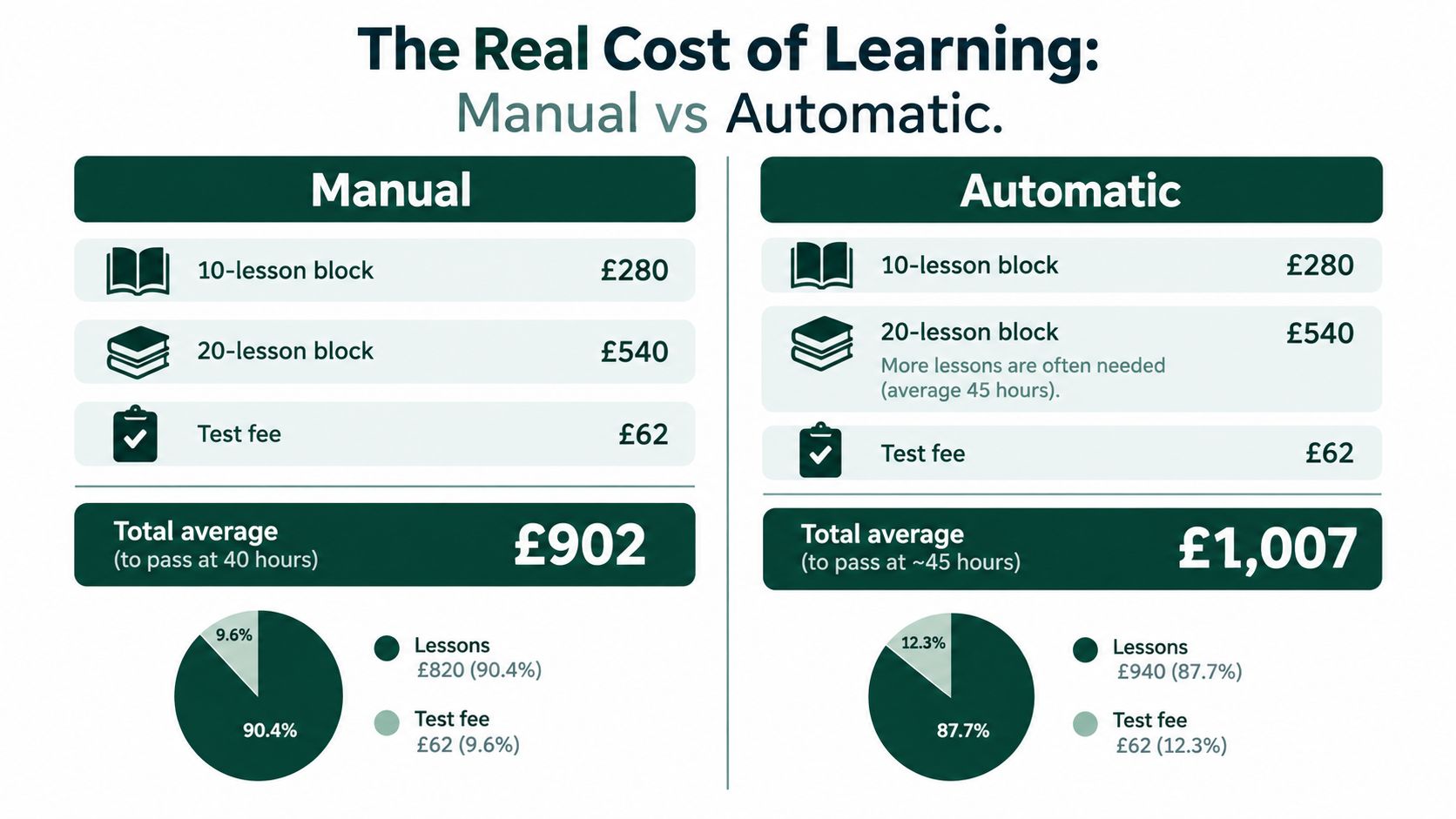
The hourly rate is not always the decider. Some schools charge the same for both, and Fast Track Driving Lessons is one of them. It publishes a single hourly rate of £61.23 for manual and automatic, with no automatic premium.
Where your money usually goes
The cost split is straightforward:
- Lesson fees: often similar by hour, depending on the school
- Time to test standard: some learners waste fewer paid minutes in automatic because they are not fighting clutch control
- Vehicle choice after passing: a manual licence usually gives you a wider, often cheaper used-car pool
- Licence upgrade later: automatic-only learners who later need manual face more lessons, another practical test, and more waiting
That is why the usual line, “automatic is cheaper because it's easier”, falls apart so quickly. Automatic can cost less for a learner who settles faster, passes, and will only ever drive automatic. It can cost more for the learner who passes in an automatic, then finds the family car, work van, or affordable first car is manual.
If you want a wider breakdown of test fees, lesson spend and running costs, read this guide to the complete cost of learning to drive.
This video gives a practical look at how learners weigh cost against convenience.
Price the licence you need, not just the test you want
The cheapest path to a pass can be the more expensive path to actual motoring.
Manual usually wins on long-term flexibility. If you expect to buy whatever decent, affordable first car turns up locally, manual keeps more doors open. If you already know you will drive an automatic or electric car and you have no likely need to borrow a manual, automatic is a sensible choice.
My advice is simple. Count the full chain of costs. Lessons, test, future car options, and the risk of paying to upgrade later. Once you do that, manual is often the better-value route, and automatic only pulls ahead when your future car access is already clearly automatic.
Which Transmission Fits Which Type of UK Learner
Good advice changes with the learner in front of you. Not every pupil should make the same choice.
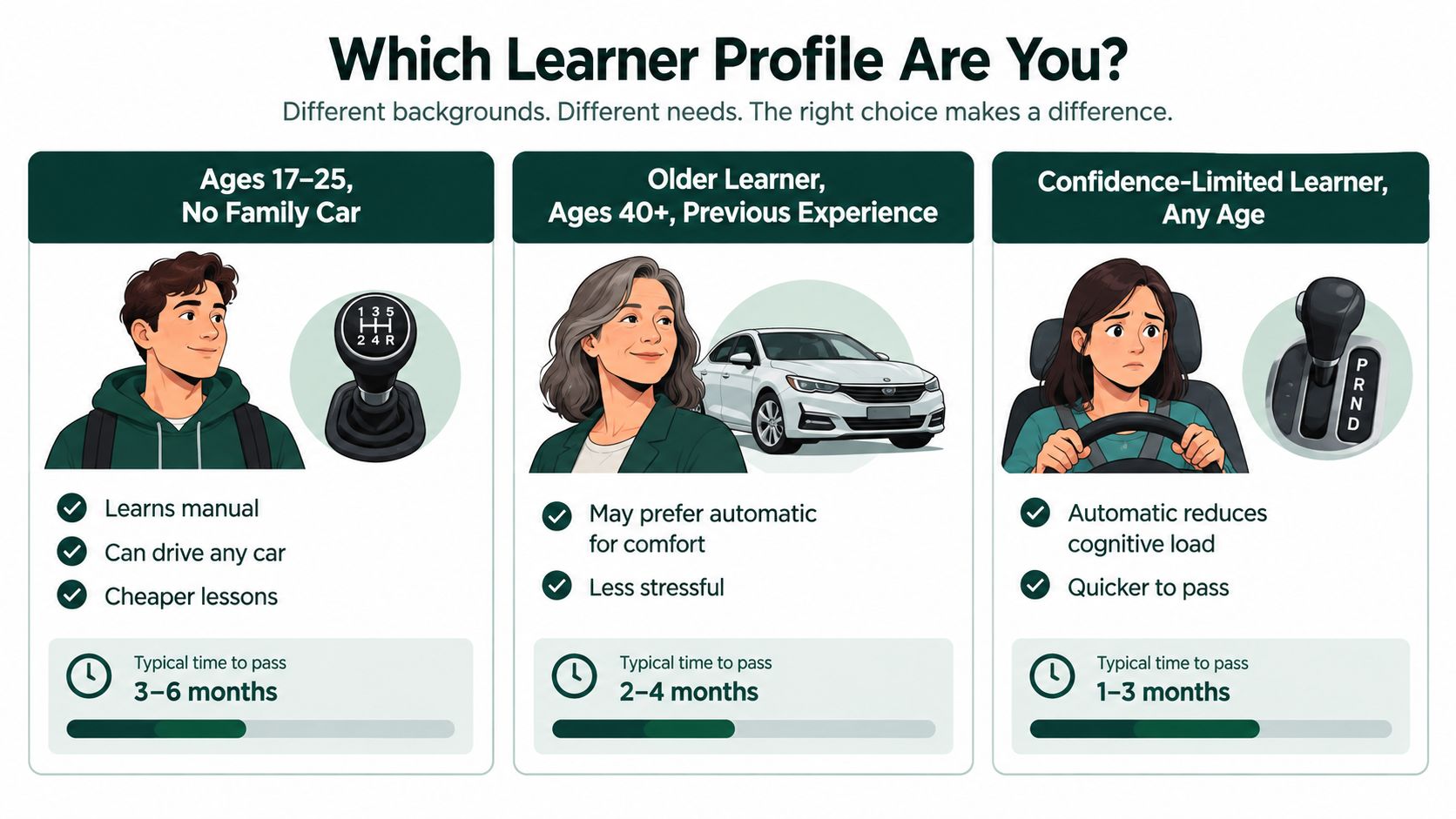
The complete beginner with no family car access
This is the classic 17 to 25 learner starting from scratch, no practice car at home, no fixed idea what their first car will be. For this person, manual is the stronger option.
Why? Because they need the broadest possible pass. If they later borrow a relative's manual hatchback, buy a cheaper used manual, or move for work and just need whatever car is available, they won't be blocked by their licence.
Recommendation: pick manual.
The nervous returner
This is the learner who stopped before, failed before, or took a long break and now dreads stalls, hill starts and that horrible rushed feeling at junctions. For this person, automatic often removes the exact layer that used to cause the spiral.
That doesn't mean automatic suddenly becomes easier in the national data. It means the lower in-car mental load can help this specific learner settle, rebuild routine and get back to test standard without fighting the clutch every lesson.
Some learners don't need more resilience. They need one less task at the wrong moment.
Recommendation: pick automatic.
The busy professional with limited time
This learner usually has money, not spare evenings. They want clean scheduling, quick progress and no nonsense. Automatic can suit them well because it cuts the mechanical workload and often helps them focus faster on the road itself.
But there's a catch. If they might later want the freedom to drive any available vehicle, they should still go manual now and get it done once. If they already know they'll only ever drive automatics, then the automatic route is perfectly rational.
Recommendation: automatic if your future cars will be automatic only. Otherwise manual.
The Verdict and Questions UK Learners Still Ask
Here's the verdict.
Default to manual. It gives you broader legal access after the test, avoids the code 78 restriction, and the national pass-rate data does not support the popular claim that automatic is easier to pass. If you can cope with the extra learning layer, manual is the better long-term licence.
Automatic is still the right choice for a defined group of learners. It makes sense if you have mobility needs, serious test-related anxiety tied to clutch and gear control, or a very clear future where you'll only drive automatic vehicles. Outside those cases, too many learners choose automatic to solve a short-term problem and create a longer-term limitation.
The candid version of the trend
The rise in automatic tests tells you demand is moving. It doesn't prove automatic is a better training route. A lot of that shift reflects the changing car market and the growth of automatic-only driving paths, not some secret DVSA advantage.
That's the point people skip. Market direction and learning efficiency are not the same thing.
Common questions with straight answers
Can I upgrade an automatic-only licence later
Yes. You can later take a practical test in a manual car and remove the restriction. The problem isn't whether you can. The problem is whether you want the extra test, extra lessons and extra delay.
Do automatic lessons cost more per hour
Not always. Some schools charge the same for both. The right question is the full cost of the route, not just the hourly price on a booking page.
Is automatic actually easier to pass
National pass-rate data says no. It may feel simpler during lessons because there's less to do physically, but the DVSA figures don't show an automatic pass-rate advantage.
Do insurers treat manual and automatic exactly the same
Not always. The issue for a learner is accuracy. If your licence only covers automatics, your insurance details must match what you're legally entitled to drive.
If you want help choosing the right route, Fast Track Driving Lessons matches learners with DVSA-approved manual and automatic instructors across England, Scotland and Wales and publishes the same hourly rate for both. If you're torn between licence flexibility and lesson simplicity, that's exactly the sort of decision worth settling before you book your first block.
Written by Fast Track editorial team.