
You're halfway through a practice session when the car stalls during a reverse. Your hands are fixed on the steering wheel, a cyclist is approaching from behind, and you suddenly wonder what the examiner would write on the marking sheet. Would one untidy movement mean an automatic fail?
Usually, no. A manoeuvre in driving is judged as a controlled driving task, not as a performance of perfect steering choreography. The examiner is looking at how you observe, plan, control the car and respond to other road users. That's why a slow, safe correction can be acceptable, while a technically neat manoeuvre completed without proper observation can end the test.
Table of Contents
- What a Manoeuvre in Driving Actually Means
- The Core Skills Behind Every Manoeuvre
- The Main DVSA Test Manoeuvres Step by Step
- Turn in the Road and Reversing Around a Corner
- The Emergency Stop Explained
- Common Faults That Cause Manoeuvre Failures
- Practising Manoeuvres in Real Road Conditions
- Manoeuvre Questions Learners Ask Most
What a Manoeuvre in Driving Actually Means
You are easing into a parking space on a busy UK street when a cyclist appears behind you. The steering may be correct, yet the manoeuvre becomes unsafe if you have not checked what is happening around the car. That is the skill an examiner wants to see.
A driving manoeuvre is a low-speed, controlled change in the position or direction of the vehicle. It combines clutch, accelerator, brake, steering and observation. Parallel parking, bay parking, pulling up on the right, reversing and an emergency stop use different actions, but they rely on the same transferable ability: place the car safely while conditions change.
Ordinary driving follows traffic flow, lanes and junctions. A manoeuvre is more deliberate. You are positioning the car near a kerb, parked vehicles or a marked bay, often with limited visibility. Low speed gives you more time, but it does not remove danger. The car can still enter a cyclist's path, touch another vehicle or mount the pavement.
The DVSA learning-to-drive syllabus groups manoeuvring around reversing, turning the car around, parking and emergency stopping. It also requires control of the vehicle while you remain aware of blind areas and other road users. In practical terms, each exercise tests a common weakness. A learner who rushes may lose control, someone who relies only on mirrors may miss a cyclist, and a driver focused on steering may fail to notice a pedestrian.
What the examiner is actually assessing
Since 4 December 2017, the modern practical test has used real-world options rather than routinely requiring the old “turn in the road” and “reverse around a corner” exercises. The examiner selects from the current list, so you will not necessarily perform every exercise on one test, as set out in the official examiner guidance.
The selected exercise may be parallel parking, bay parking, or pulling up on the right and reversing for around two car lengths before rejoining traffic. An emergency stop is a separate possible request. The exact exercise matters less than the decisions made before and during it.
A safe correction can lead to a driving fault rather than failure. The DVSA test-result guidance says a candidate can pass with no more than 15 driving faults, provided there is no serious or dangerous fault. The examiner is asking whether you kept control and prevented real danger, not whether the car followed a perfect steering pattern.
The useful mindset: You are showing that you can move a car safely when space, visibility and traffic make the decision harder.
For practical ideas, use this guide to manoeuvres for learner drivers alongside instruction. A written sequence can support practice, but it cannot replace checking a real street before moving.
The Core Skills Behind Every Manoeuvre
Every manoeuvre begins before the car moves. On a suburban road, you might be preparing to pull over, reverse beside a kerb or enter a side road. The road may look quiet, but parked cars can hide pedestrians, rear pillars can block a child or cyclist, and another vehicle can appear while you're concentrating on steering.
Use MSM/PSL as one connected routine:
- Mirrors: Check the interior mirror and relevant door mirrors. Look for vehicles, cyclists and pedestrians, not just cars.
- Signal: Communicate your intention when a signal would help another road user understand what you're doing.
- Manoeuvre and position: Choose a safe position before you begin moving.
- Speed: Reduce the car to a pace that gives you time to stop.
- Look: Keep scanning throughout the movement, including the blind spots that mirrors can't show.
PSL is often taught as Position, Speed and Look, while MSM means Mirrors, Signal and Manoeuvre. In practice, they work together. You may check mirrors, signal, position the car, reduce speed and look again before moving. If circumstances change, repeat the checks rather than continuing because the original plan seemed safe.
Make the controls do less
A manual car should creep at a pace you can manage. Select first gear where appropriate, find the clutch biting point and use gentle brake control to regulate movement. A small amount of accelerator may help on a slope or when the engine needs support, but speed should come from deliberate control rather than releasing everything and hoping the car settles.
Release the handbrake smoothly once the car is ready to move. A sudden release can create a judder, while lifting the clutch too quickly can cause a stall. Neither is automatically dangerous, but both can show that your control has become rushed.
Progressive braking is equally important. If you need to stop, apply the brake firmly enough to act but smoothly enough to keep the vehicle stable. During reversing, keep checking the direction of travel. Your steering may point one way while the rear of the car moves another, and the rear pillars can conceal hazards.
The DVSA guidance on manoeuvres and reversing makes clear that cameras and parking sensors can assist you, but they don't replace all-round observation. Turn your head where needed and check blind spots before changing direction or beginning a reverse.
Treat the routine as portable
A fixed reference point can help you learn, but it won't work identically in every car. Bonnet length, seat position, mirror adjustment and steering response all change the view. Learn what the reference point represents, then confirm it with the kerb, bay lines and all-round checks.
Cancel the signal once it no longer communicates your intention. A forgotten indicator can confuse a following driver, particularly after a pull-up or when leaving a bay. The transferable skill is not memorising where to turn the wheel. It's controlling the car while continuously updating your picture of the road.
The Main DVSA Test Manoeuvres Step by Step
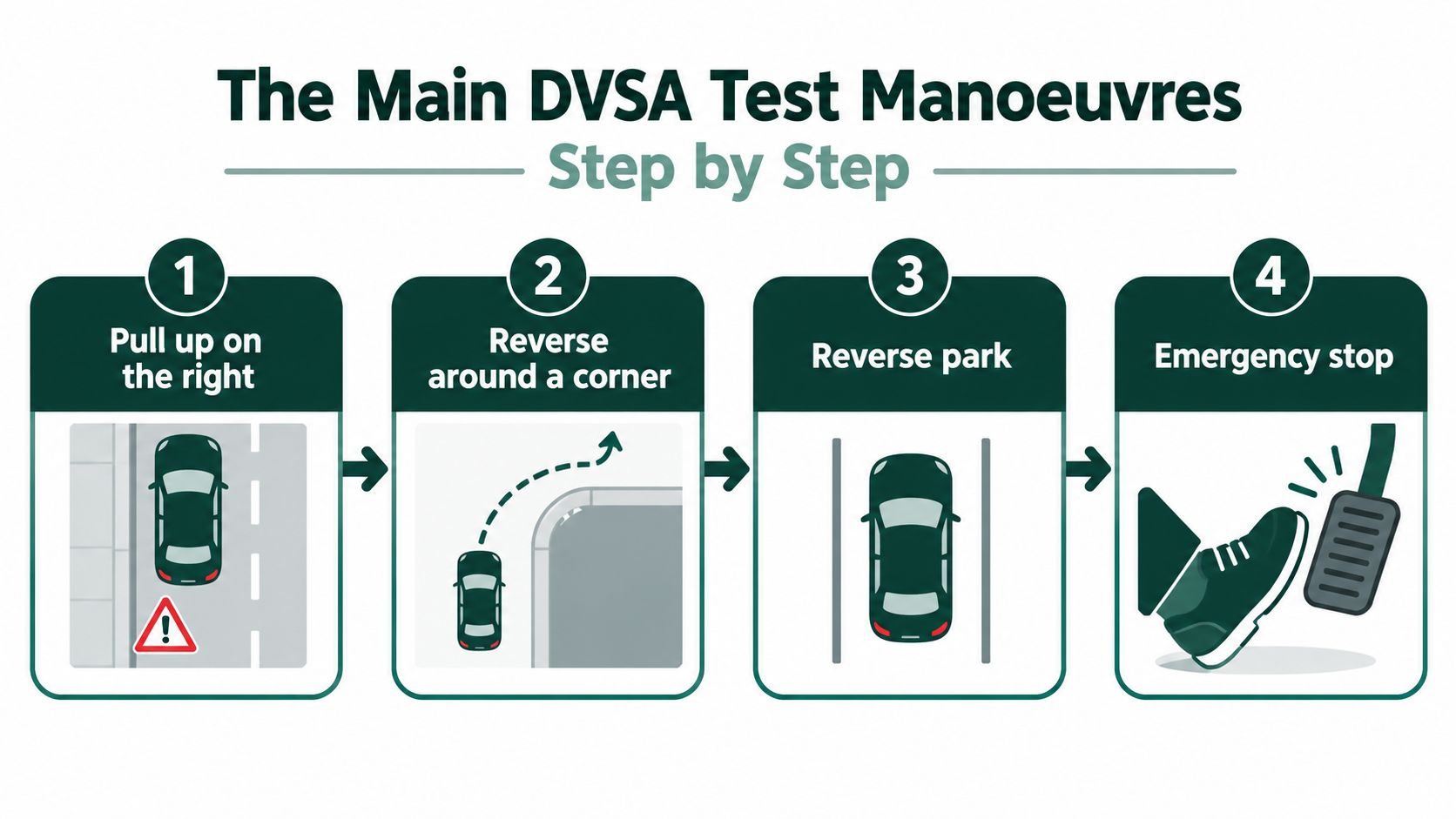
The examiner may ask for one of the current parking or roadside exercises. The DVSA mock-test guidance lists parallel parking, bay parking in either direction and pulling up on the right before reversing for around two car lengths and rejoining traffic.
Pulling up on the right
First, check the interior and right-hand mirror. Signal right when it helps other road users, then choose a safe position without cutting across approaching traffic. Look over your right shoulder before moving towards the opposite side of the road, and keep checking as you stop.
Once stationary, secure the car and select reverse. Check all around again before reversing. Move back slowly for around two car lengths, continuing to monitor the road, pavement and blind spots. When it's safe, check before rejoining the traffic flow.
The serious risk here is not being slightly far from the kerb. It's moving into the path of an approaching vehicle, cyclist or pedestrian because you relied on one mirror check and stopped looking.
Parallel parking
For a parallel park on the left, approach at a controlled speed and stop alongside the vehicle or reference point you've been taught to use. Check mirrors and blind spots before selecting reverse, then begin moving only when the space and surrounding road remain clear.
Steer towards the kerb at the appropriate point, then straighten the wheels as the car enters the space. Use small adjustments rather than chasing the kerb with rapid steering. Your aim is a safe, controlled position, not a single uninterrupted movement.
The observation moments matter at every pause. If you stop to change steering direction, check around the car again. The most serious error would be reversing when a road user has entered the area behind you, especially on a public road.
Reversing into a bay
Approach the bay slowly and use the bay lines, door mirrors and your instructor's reference point to judge the angle. Before reversing, check all around, including the spaces beside and behind the car. Begin with controlled clutch movement and keep the steering input measured.
As the car enters the bay, look for whether you're staying between the lines. If you need to correct, stop if necessary, reassess and make the adjustment safely. A small correction is more sensible than continuing while the car drifts towards another vehicle.
Driving into a bay and reversing out
When driving into a bay, select a position that leaves you able to exit safely. Before reversing out, check behind and to both sides, looking for pedestrians and vehicles travelling through the car park. Reverse only when the area is clear, and stop if a person or vehicle appears.
A common serious mistake is treating a car park as private space where observation matters less. Low-speed areas can be busy and unpredictable. The examiner is watching whether you pause, look and give way when the situation requires it.
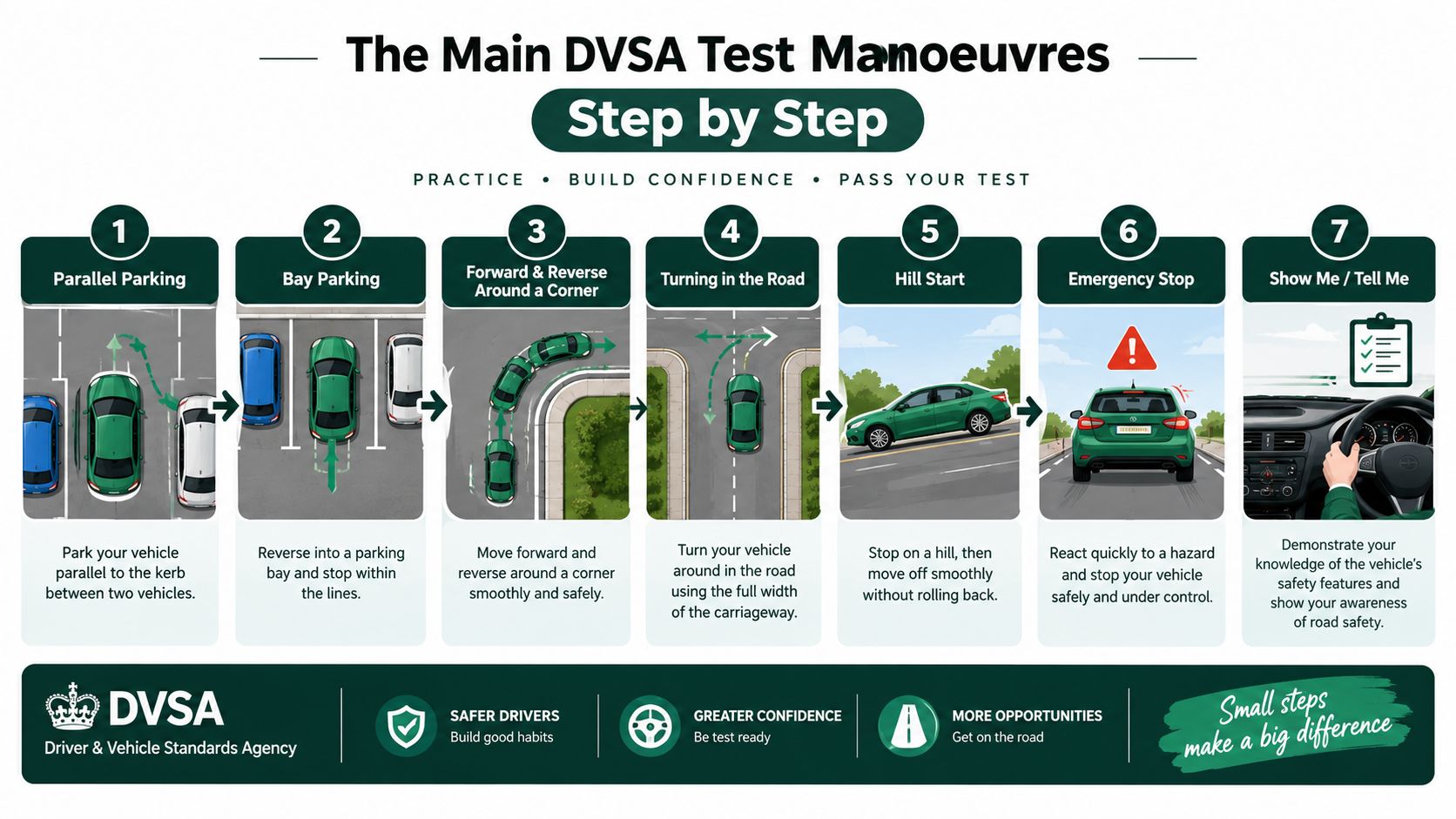
In every exercise, the sequence is flexible because the road is changing. If another car arrives, stop the manoeuvre, secure the car if needed and wait. That decision can demonstrate better judgement than forcing the original plan to its conclusion.
Turn in the Road and Reversing Around a Corner
The DVSA removed turn-in-the-road and reversing-around-a-corner exercises from the standard practical test in 2017. They're still useful teaching exercises because they develop the same transferable skills, including slow-speed clutch control, steering accuracy and all-round observation.
For a turn in the road, instructors commonly use a quiet cul-de-sac. Signal where appropriate, select first gear and check all around before moving. With the clutch at the biting point, steer fully clockwise while keeping the car slow enough to stop. Straighten as you reach the opposite side, then select reverse after another set of checks.
Use opposite lock to reverse into the remaining space, looking in the direction the car is travelling and checking mirrors and blind spots. Select first gear again, straighten the car and pull away only when the road is clear. The exercise isn't about completing the turn in one sweep. It's about making safe, controlled changes of direction.
Reversing around a corner usually involves moving left into a side road while keeping the kerb as a reference. Check the road behind, the junction and the blind spot before starting. As the rear approaches the corner, use the kerb and the junction point to guide steering, but keep looking rather than allowing the reference point to take over.
Some instructors still include these tasks in mock tests or lessons. You can find a fuller explanation of the technique in this guide to turning in the road. Even when an exercise isn't formally graded, the observation and control it develops remain valuable on narrow UK roads.
The Emergency Stop Explained
You are driving along a UK road when a child's ball rolls into your path. The examiner gives the stop command, and your job is to react promptly while keeping the car under control. The exercise tests one transferable skill set: applying MSM/PSL thinking and observation when the situation changes suddenly, rather than following a memorised parking routine.
The exercise may be selected at random, and the exact frequency differs between an ordinary learner test and instructor assessment contexts. Keep those contexts separate. The examiner will give a clear instruction and check that the road is suitable before asking you to stop. A quick response matters, but panic is the mistake that can turn a controlled stop into a serious or dangerous fault.
A controlled response
Use this sequence:
- Check the mirrors as the situation requires.
- Release the accelerator and keep both hands ready to control the steering.
- Press the footbrake firmly and progressively.
- Press the clutch down as the car is coming to a stop, where appropriate.
- Keep the vehicle straight and avoid unnecessary steering.
- Once stopped, select neutral and apply the handbrake.
The footbrake should provide the main response. Modern braking systems help prevent wheel lock, but they do not remove the need for stable steering. On a slippery surface, smooth control matters even more. Braking hard while turning can make the car less predictable, so keep the vehicle straight unless steering is needed to avoid danger.
The examiner may use dual controls as a safety back-up, but your response is being assessed. After stopping, wait for the instruction to continue. Check around the car, select a suitable gear and pull away safely. If the road rises, this can resemble a short hill-start, so clutch and brake control still matter.
An aggressive pedal application can show poor control, while hesitation delays your response. Aim for firm, immediate and controlled. For a fuller explanation, see this guide to the emergency stop manoeuvre.
Common Faults That Cause Manoeuvre Failures
Many learners fear the parallel park because it feels exposed and precise. Independent analysis of UK test-fault data found that the right reverse was requested least often but produced faults for 96.3% of learners, with more than a quarter receiving a serious or dangerous fault, as reported in this analysis of manoeuvre faults. The same analysis found that the controlled stop was requested most often but had a relatively low fault rate.
That contrast changes how you should practise. The manoeuvre you discuss most isn't necessarily the one that causes the most trouble. Learners often need more work on speed, clutch and vehicle positioning than on memorising a steering sequence.
Control faults
Control errors include moving too quickly, lifting the clutch too far, stalling, striking the kerb or mounting the pavement. A light kerb touch during a controlled bay park may be recorded as a driving fault if no danger is created, but contact becomes more serious when it places another road user at risk.
For example, touching a kerb while entering a quiet bay isn't equivalent to reversing into the path of a cyclist on a public road. Severity depends on the circumstances, the level of control and the danger created.
Observation faults
Observation faults include missing a mirror check, failing to check a blind spot before reversing, overlooking a pedestrian or continuing while approaching traffic has priority. These are often skipped steps rather than mysterious weaknesses.
| Manoeuvre | Most Common Fault | Typical Severity | Quick Fix |
|---|---|---|---|
| Pull up on the right | Moving across without a complete road check | Can become serious if another road user is affected | Check mirrors, right blind spot and oncoming traffic before positioning |
| Parallel parking | Reversing too quickly or losing sight of the surrounding road | Minor for a safe correction, serious if danger is created | Use slow clutch control and pause for fresh observations |
| Reverse bay parking | Focusing on the bay lines while missing people or vehicles | Often a driving fault, potentially serious where danger develops | Look around before moving and during every correction |
| Drive-in, reverse-out parking | Reversing out without checking both sides | Can be serious in a busy car park | Stop, check all around and give way when needed |
| Emergency stop | Braking late, too gently or with poor vehicle control | May be serious if the response creates danger | Brake firmly, keep straight and secure the car after stopping |
For the right reverse, think in stages: establish the reference point, steer with purpose, straighten as the car enters the space, then complete the reverse under control. At each stage, return to MSM/PSL. The steering matters, but observation decides whether the steering is safe.
Practising Manoeuvres in Real Road Conditions
A manoeuvre learned in an empty car park can feel completely different beside parked cars, pedestrians and moving traffic. The solution isn't to abandon the routine. It's to practise the same routine in progressively less predictable places.
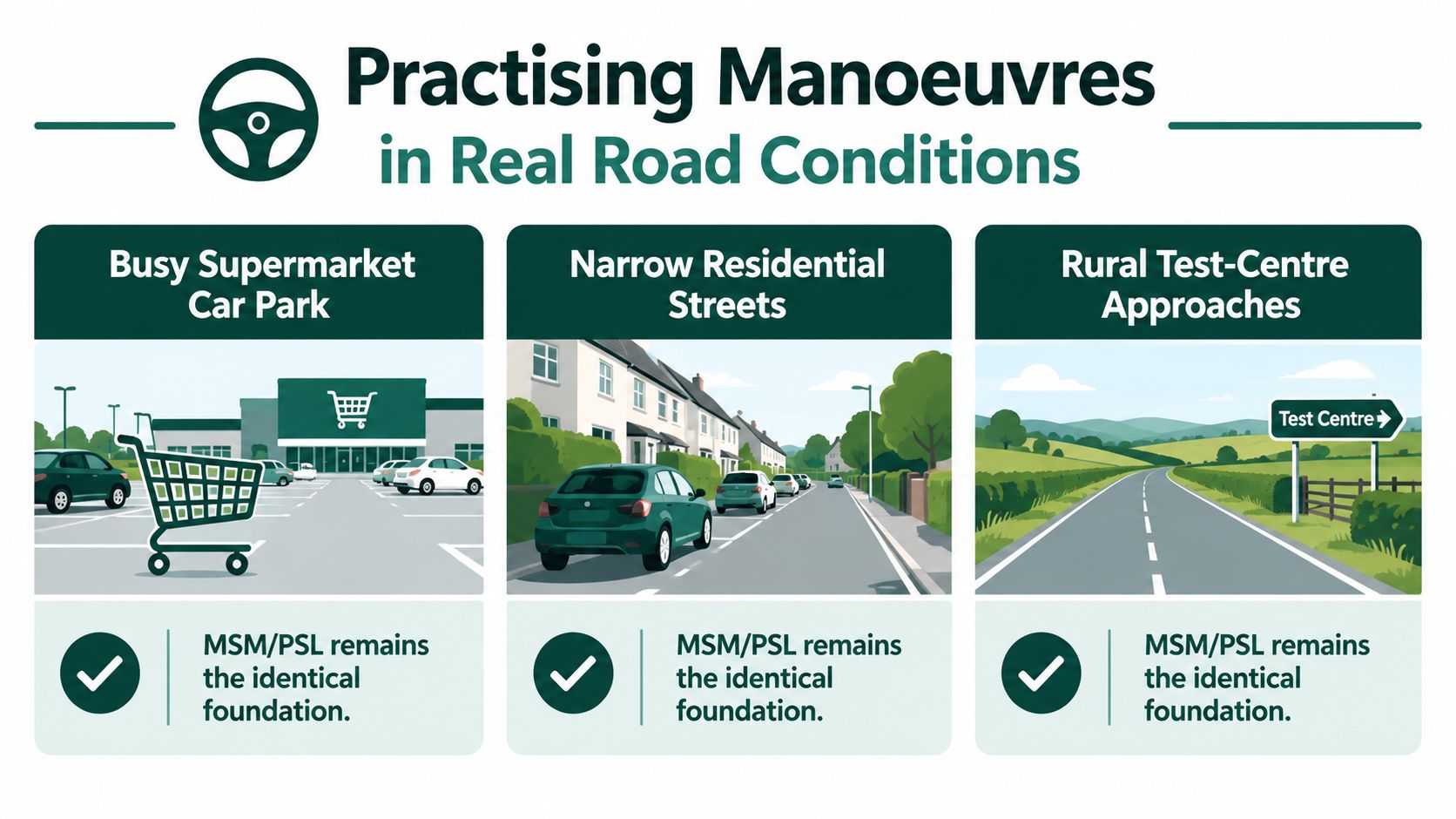
Start on a quiet estate road where you can learn the clutch bite, slow movement and observation rhythm. Then vary the setting:
- Busy supermarket car parks: Practise bay parking while watching for pedestrians, shopping trolleys and vehicles crossing behind you.
- Narrow residential streets: Work on kerb judgement, meeting oncoming traffic and deciding when to stop rather than squeezing through.
- Rural test-centre approaches: Prepare for fewer markings, different road widths and changing visibility near bends or parked vehicles.
The parallel park process stays recognisable when the gap is shorter, but your decision may change. You might decide not to use a space if it leaves too little room to manoeuvre safely. An angled bay changes your visual references, but it doesn't remove the need for all-round checks.
A different car also changes the feel of the exercise. The clutch bite point, steering weight, bonnet position and mirror view may not match the car in which you first learned. Before beginning, take time to adjust the seat and mirrors, locate the controls and establish how slowly the car can move under clutch control.
Practice principle: Keep the method stable, but let the road determine the speed, position and timing.
An intensive or semi-intensive plan can be useful when practice is organised rather than compressed into repeated attempts in one location. A learner can rehearse one exercise on quiet roads, then repeat it near a test centre, in a different vehicle or alongside a mock-test route. The point is not to collect memorised routes. It's to make the decision process portable.
Before booking, ask your instructor to watch for patterns. Do you rush when reversing? Do you forget a shoulder check after changing gear? Do you focus on the bay and stop scanning? Correcting one repeated habit can be more valuable than completing another dozen identical parking attempts.
Manoeuvre Questions Learners Ask Most
How many manoeuvres will the examiner ask for?
The examiner selects a current test exercise, rather than requiring every parking format. An emergency stop is a separate possible request.
Is bay parking harder than parallel parking?
Neither is automatically harder. Bay parking may demand stronger positioning and line judgement, while parallel parking places more emphasis on kerb awareness and traffic observation.
Does one mistake end the test?
No. A safe, minor error may be recorded as a driving fault. A serious or dangerous fault can cause failure.
Is reversing around a corner still tested?
It isn't one of the standard practical-test manoeuvres introduced under the current framework, but instructors may still use it for training or mock tests.
How is the emergency stop signalled?
The examiner gives a clear verbal instruction. You don't use an indicator to announce an emergency response, but you must secure the vehicle and check around before moving off again.
How long should I practise each exercise?
Practise until you can complete the movement safely in more than one location and can explain what you're checking. Book when your instructor sees consistent control, observation and decision-making, not just when you can repeat a sequence in one familiar car park.
Fast Track Driving Lessons matches learners with DVSA-approved instructors for manual or automatic tuition, including intensive and semi-intensive courses, mock tests and manoeuvre practice near the chosen test centre. If you want structured help with parking, reversing and observation under test conditions, visit Fast Track Driving Lessons to explore the available options.
Written by Fast Track editorial team.