
You've found a space at the supermarket, but a queue has formed behind you. The bay looks wide enough until you turn in, the steering feels late, and suddenly you're correcting while watching pedestrians, trolleys and nearby cars. On a residential road, a tight gap creates a different kind of pressure. You know the space is usable, yet the kerb seems to move closer every time you reverse.
That reaction is common. A 2022 UK survey found that just over 20% of drivers couldn't parallel park, while 16% couldn't reverse bay park. By comparison, 94% said they could forward bay park without issue, making forward bay parking the most accessible of the three core techniques for many UK motorists. More than four in ten respondents disliked parallel parking, and 73% had abandoned a space because it was too challenging. The survey results show why parking can feel like a confidence barrier rather than a simple low-speed task.
The answer isn't to steer faster or memorise a single magic point. Parking is controlled movement combined with continuous observation. This guide covers forward and reverse bay parking, parallel parking, and angle parking, then explains how UK examiners assess faults. You'll learn reference points that can be repeated in different cars, along with the safety decisions that matter beyond the test centre.
Table of Contents
- Introduction Why Parking Feels Harder Than Driving
- Before You Park What to Check Every Time
- How to Bay Park Forward and Reverse With Control
- How to Parallel Park and Angle Park on UK Roads
- What Examiners Look For and Mistakes That Cost Marks
- Practice Drills and Next Steps to Park With Confidence
Introduction Why Parking Feels Harder Than Driving
Driving along a clear road gives you time to make small adjustments. Parking removes that spare space. You're working close to painted lines, kerbs, parked vehicles and people, often while looking in several directions at once. The car may be moving slowly, but your decisions still need to be accurate.
Learners often treat parking as a steering exercise. That's why they turn their attention to the wheel and forget what the car is doing around them. A better approach is to divide the manoeuvre into three jobs: choose a suitable space, control the car at walking pace, and keep checking the whole environment.
Forward bay parking usually feels easiest because the vehicle follows a familiar forward arc and the entrance is visible. Reverse bay parking demands more patience because the rear of the car moves towards the space before the driver can see its full position. Parallel parking adds kerb distance, traffic awareness and a narrower margin for steering errors.
Practical rule: If you're unsure, stop. A stationary car gives you time to observe, reassess and continue safely.
UK learner guidance has long used fixed reference points, such as door mirrors, window lines and kerb position, to make parking repeatable rather than dependent on guesswork. RAC guidance on bay parking also stresses suitable space size and clearance, because a manoeuvre isn't successful if you can't enter or leave the vehicle safely.
The same principle works in everyday car parks. Don't aim merely to fit the car. Aim to finish where the car is protected, other drivers have room to pass, and you can open the doors without striking the neighbouring vehicles.
Before You Park What to Check Every Time
Every parking manoeuvre should begin before the steering wheel turns. First, assess the space. Check its length and width, the position of adjacent vehicles, the presence of posts or shopping trolleys, and whether another driver or pedestrian could enter your path. A space that technically fits the car may still be a poor choice if it leaves no room to open a door or correct your alignment.
Next, set up the approach. Reduce speed early, select the appropriate gear, and position the car so you've got room to turn without cutting across another bay or kerb. Use the mirrors to understand your position, but don't rely on them alone. Check over your shoulders and blind spots before the car changes direction.
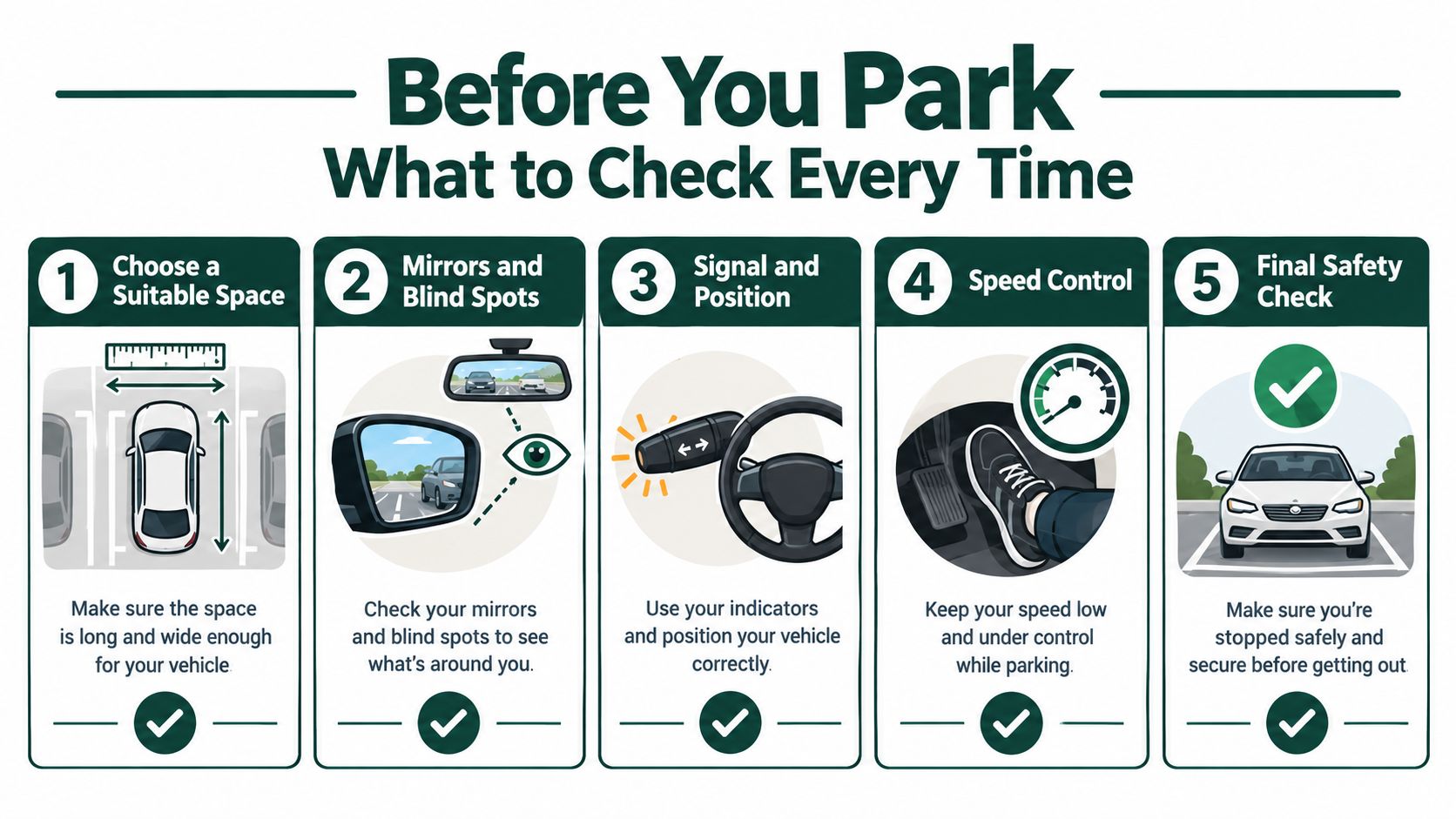
The universal preparation routine
Use this sequence before moving into a bay or roadside gap:
- Choose a suitable space. Confirm that the car can fit with safe clearance on each side.
- Check mirrors and blind spots. Look for pedestrians, cyclists, children, trolleys and moving vehicles.
- Signal when it helps others. An indicator should communicate your intention, not replace observation. Don't signal in a way that could confuse another road user.
- Control speed gently. Use clutch and brake control in a manual car, or smooth brake pressure in an automatic. Walking pace gives you time to stop.
- Complete the final safety routine. Once positioned, select neutral or park as appropriate, apply the handbrake, switch off the engine and check around before opening a door.
The Highway Code says drivers should use off-street parking or marked bays wherever possible. If roadside parking is necessary, park with the direction of traffic, stop close to the side, switch off the engine and lights where required, apply the handbrake, and check carefully before opening the door. The Official Highway Code provides the full roadside safety guidance.
Avoid double yellow lines at all times, and don't stop or park opposite or within 10 metres, or 32 feet, of a junction unless you're in an authorised parking space. Rule 243 of The Highway Code gives that distance as a practical reference near side roads.
How to Bay Park Forward and Reverse With Control
Bay parking works best when you use the lines and mirrors as reference points, not when you turn at an arbitrary place in the car park. Approach slowly and look well ahead. Keep enough space from the row of bays to create a clean turning path, while checking that no pedestrian or vehicle is entering the area.
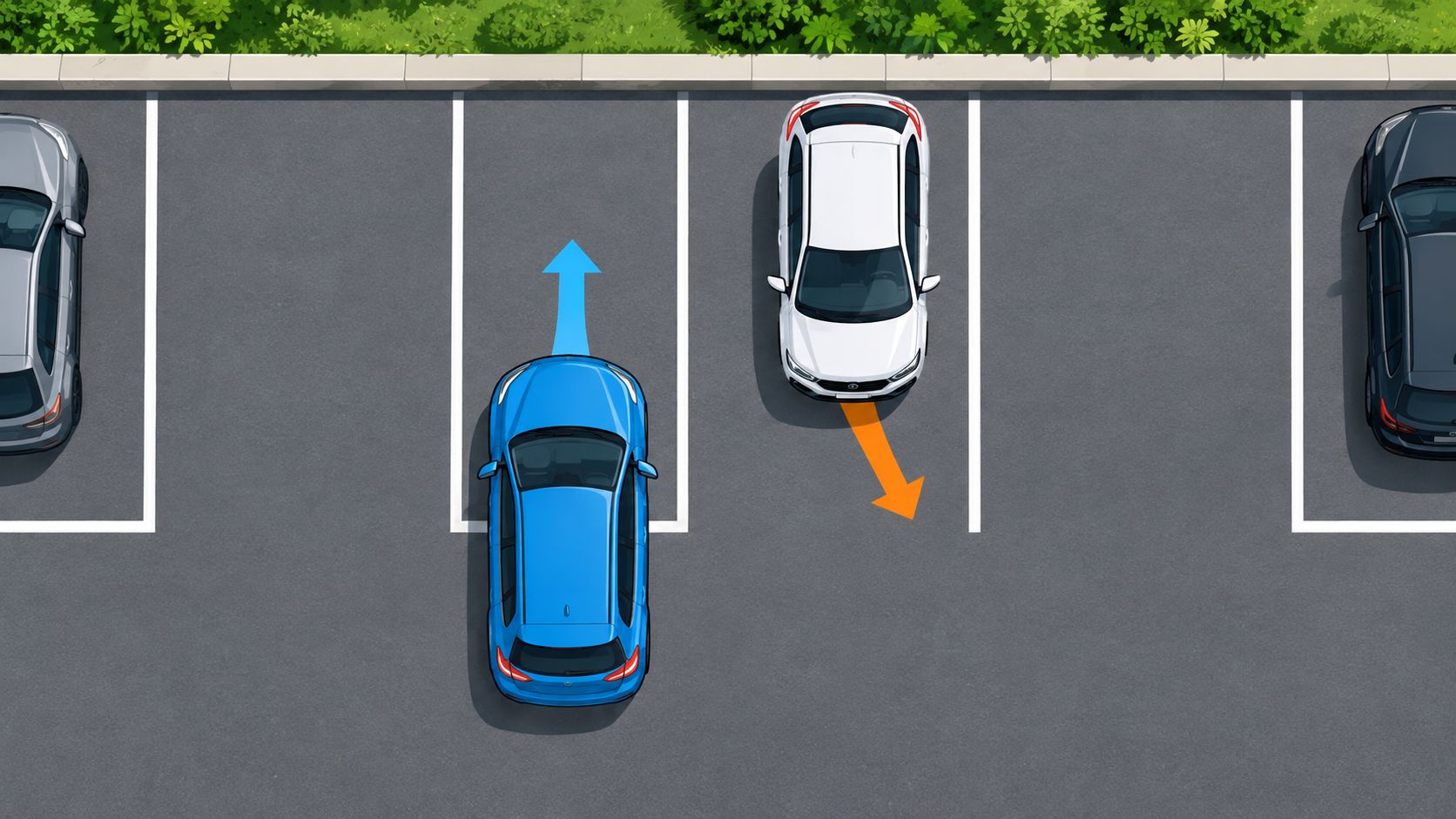
Forward bay parking
Choose the bay before beginning the turn. As the front of your car reaches the appropriate alignment point, steer smoothly towards the centre of the space. Your door mirror and the bay lines should become useful visual guides. Avoid staring at one line, because the opposite side can drift away while you're concentrating.
As the car enters, reduce the steering input and straighten the wheels. Look forwards, use both mirrors, and stop once all four tyres are fully inside the marked lines. If the car is too close to one side, don't force a correction while moving quickly. Stop, select reverse if safe, make a measured adjustment, and check all around again.
For a detailed reference-point method, use this forward bay parking guide. It's particularly useful when practising how the front of the car swings during the turn.
Reverse bay parking
Begin parallel to the row and leave enough room to turn into the chosen bay. Before reversing, check the mirrors, blind spots and the space behind. Reverse at walking pace, steering towards the bay when your chosen reference point, such as a bay line or window alignment, tells you the rear of the car is ready to enter.
Keep checking both sides as the vehicle moves. The rear of the car may be inside the bay while the front swings towards a neighbouring vehicle, so observation must include the whole car's path. Once the vehicle is straight, unwind the steering and continue back carefully until the car is fully within the lines.
Don't keep adding steering if the car is already turning. That creates a sharper angle and often leads to overcorrection. One controlled stop and adjustment is safer than repeated shunts made without observation.
The principles are demonstrated in this practical parking video:
Busy retail parks need extra care because spaces aren't the only hazard. Watch for reversing vehicles, pedestrians walking between rows and drivers cutting across empty bays. A technically neat park still needs effective all-round observation.
How to Parallel Park and Angle Park on UK Roads
Parallel parking and angle parking require different steering plans. Parallel parking places the car alongside the kerb, while angle parking directs the vehicle into a marked space at an angle. Treating them as the same manoeuvre causes rushed steering and poor positioning.
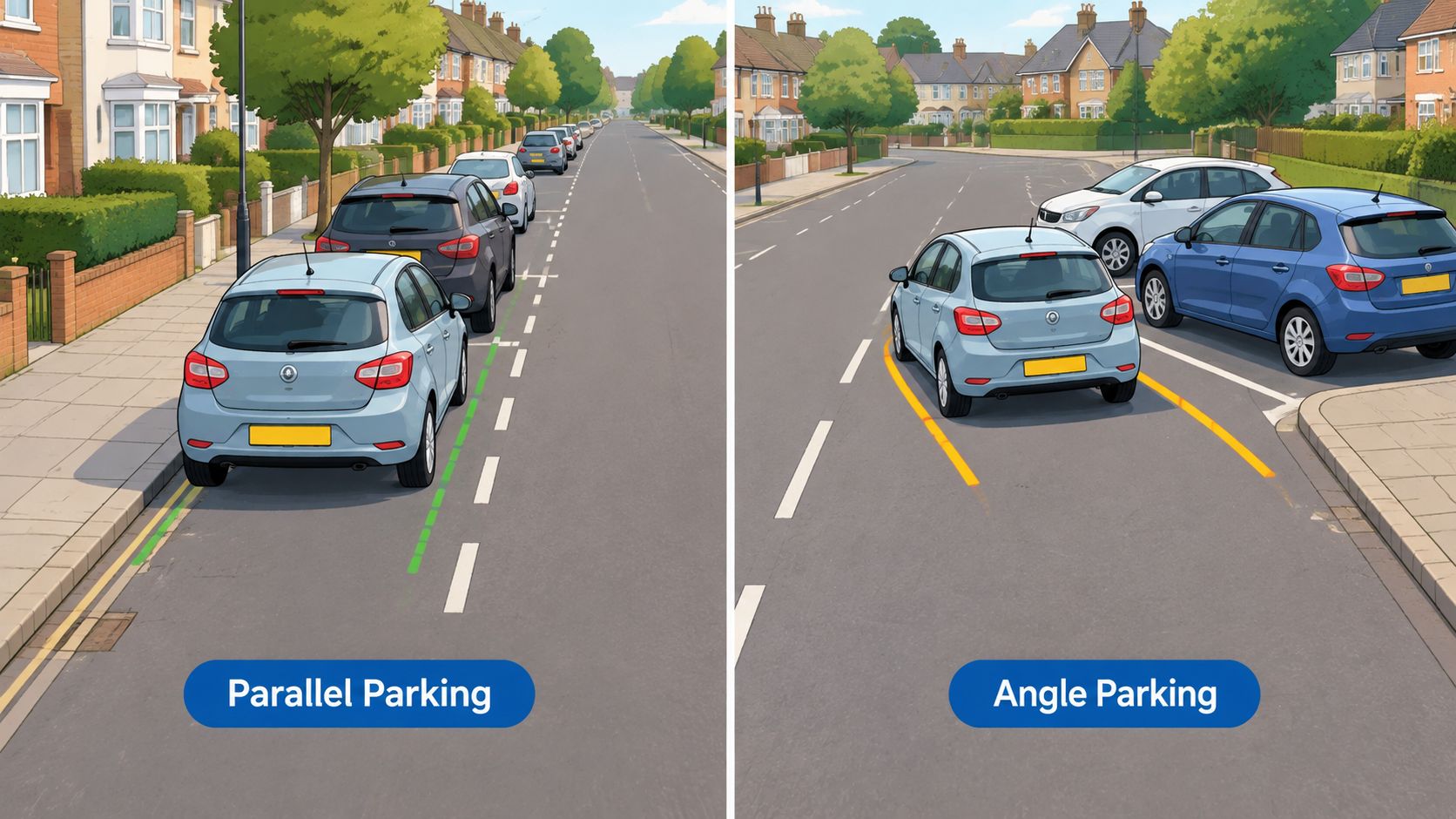
Parallel parking
Look for a gap of roughly two car lengths, then pull up alongside the parked vehicle with about a car's width between you and it. Keep the car straight and stop in a position that gives you room to reverse without contacting the vehicle ahead.
Select reverse and carry out a full observation routine. Check the interior mirror, both door mirrors, over both shoulders and the blind spots. Reverse slowly while steering towards the kerb at your chosen reference point. As the rear enters the gap, allow the front of your car to swing out, but keep watching for passing traffic, cyclists and pedestrians.
Straighten the steering when the car reaches the correct angle, then steer the opposite way as needed to bring the front into the space. Finish parallel to the kerb and within about 30 centimetres. Government guidance for driving examiners describes the expected slow pace, observation routine and finishing position.
A common error is trying to complete the manoeuvre in one continuous movement. Stopping to reassess is acceptable when it's safe. Mounting the kerb, striking another vehicle or failing to check behind creates a much greater problem than taking an extra careful adjustment.
Angle parking
Angle or echelon bays need a wider view before entry. Check for oncoming vehicles and pedestrians, then approach at the angle indicated by the markings. Turn smoothly into the bay and keep the car centred, using the lines and mirrors to judge clearance.
Because the vehicle enters diagonally, the front corner can swing close to another car or pedestrian. Don't cut across the adjacent bay, and don't assume the marked angle makes observation unnecessary. Finish within the markings and secure the car before leaving.
This parallel parking guide provides a structured method for the roadside version, including steering adjustments and final kerb position.
What Examiners Look For and Mistakes That Cost Marks
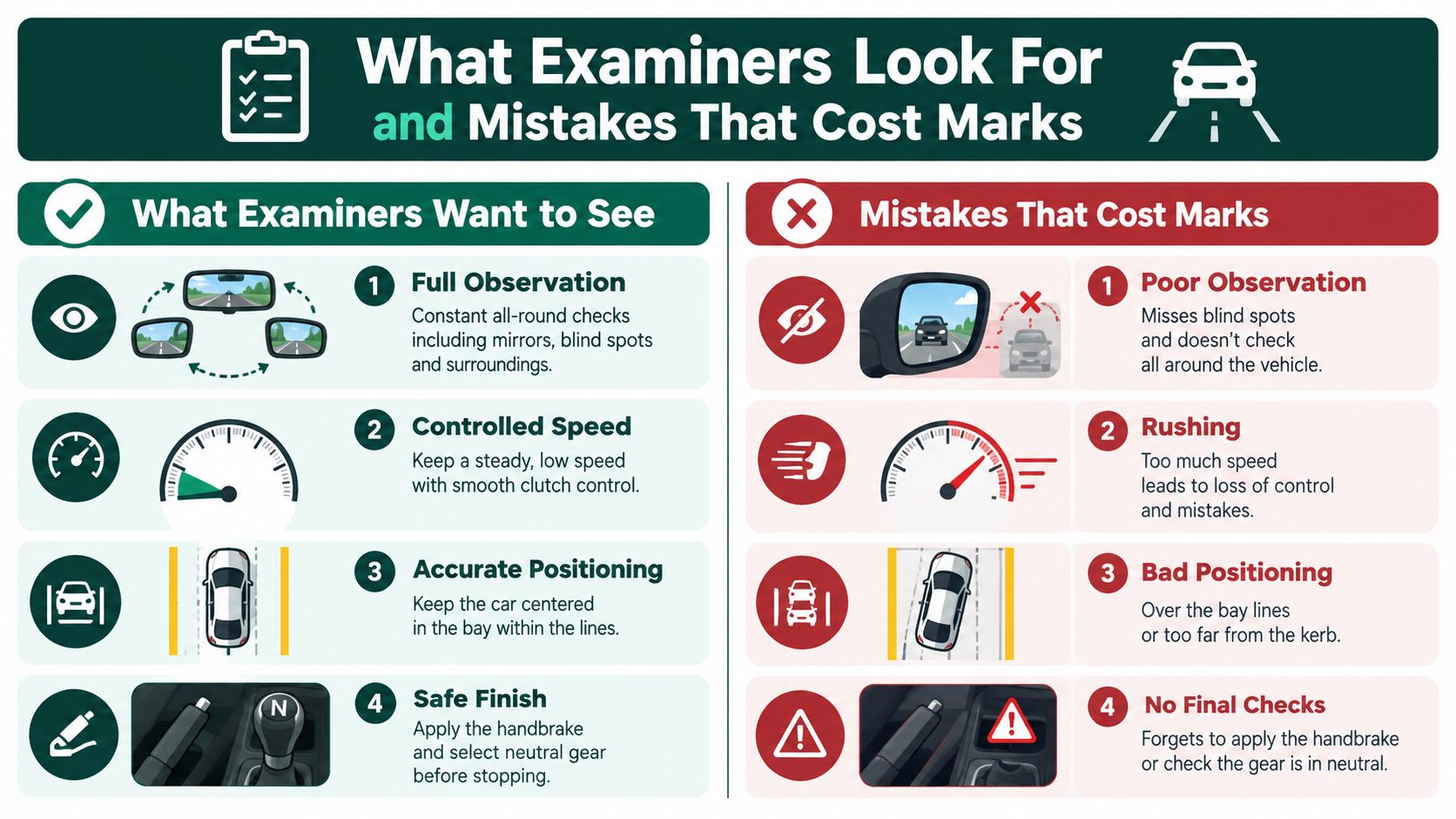
A driving-test parking exercise isn't marked on appearance alone. The examiner wants to see safe control, effective observation and accurate positioning. A car that finishes neatly can still receive a serious fault if the driver failed to check a blind spot or created a risk for another road user.
The modern test expects parking at walking pace with full observation. For parallel parking, the candidate should identify a suitable gap, pull alongside the parked vehicle, reverse smoothly, correct the steering and finish in the required position. In a bay exercise, all four tyres should end within the marked lines.
Minor, serious and dangerous faults
A driving fault, often called a minor, can reflect an isolated error that doesn't create significant danger. A forward park ending with one or two wheels on a line can be marked as a driving fault. If the car finishes fully in the wrong bay, or the driver shows unacceptable loss of control, the result can become a serious fault.
Poor observation and unsafe positioning carry more weight because they expose other people to risk. Mounting the kerb, making poor rear observations, using too much space or taking too many shunts are recurring problems in parking practice. The learner-driver fault analysis identifies control and observation as dominant fault categories, with 510,394 control faults compared with 317,819 observational faults in the analysis it reports.
What fails a test: A tidy finish cannot compensate for missing an important observation check.
The 2017 test changes also mean candidates shouldn't practise only one bay-parking script. The DVSA evaluation found that pulling up on the right-hand side of the road was the most commonly assigned manoeuvre, reported by 38.8% of respondents, while each individual parking manoeuvre appeared less often than 30%. The DVSA evaluation supports balanced preparation across bay parking, parallel parking and pull-up or reverse tasks.
For a clearer breakdown of how faults are assessed, see this guide to driving-test faults. Practise the observation routine until it remains reliable even when the manoeuvre itself feels familiar.
Practice Drills and Next Steps to Park With Confidence
Good parking comes from repeating the decisions, not repeating the steering. Practise in a quiet, legal car park with a supervising driver or instructor, and start with spaces that give you room to stop and assess.
Use a different drill for each weakness:
- Forward bay accuracy: Enter a bay slowly, stop, check both mirrors, and decide whether all four tyres are inside the lines. Reverse out only after checking behind and to both sides.
- Reverse bay control: Use a clear reference point, then repeat the entry while keeping the steering slow. Stop whenever you lose sight of a hazard.
- Parallel parking: Practise beside cones or other safe markers, concentrating on the gap, the kerb distance and the final straightening phase rather than speed.
- Observation discipline: Say the checks as you perform them. Mirrors, blind spot, movement, stop and final check should become a routine rather than an afterthought.
Night parking needs extra care. On roads with a speed limit above 30 mph, parked vehicles must display parking lights. On roads with a 30 mph limit or less, a vehicle may be parked without lights only in the circumstances set out by the Highway Code, including being at least 10 metres from a junction, close to the kerb, facing the traffic flow, or in a recognised parking place or lay-by. The Highway Code's night-parking guidance explains these conditions.
Before you leave the car, ask yourself:
- Is the vehicle secure and correctly positioned?
- Have I checked for traffic and pedestrians?
- Are the wheels, bay lines and kerb position acceptable?
- Can another person open a door or pass safely?
- Have I avoided restrictions such as double yellow lines and junction clearance?
Fast Track Driving Lessons offers manual and automatic tuition through DVSA-approved instructors, with intensive and semi-intensive courses, manoeuvre-focused lessons, mock tests on local routes and a free learner hub containing theory questions and driving guides. Visit Fast Track Driving Lessons to match your parking practice with structured tuition and test preparation.
Written by Fast Track editorial team.