
Free does not always mean exam-ready. That's the mistake behind most advice on free mock exams for the UK theory test. Plenty of sites offer a few sample questions, but far fewer recreate the multiple-choice paper properly, and fewer still give you useful hazard-perception practice. If you treat all free theory resources as equal, you can end up feeling prepared while still being under-rehearsed for the actual test.
The theory test has two separate parts. The multiple-choice section contains 50 questions, allows 57 minutes, and requires at least 43 correct answers to pass. The hazard-perception section uses 14 video clips and is scored out of 75, with 44 needed to pass. A mock that covers only one half can still be useful, but it isn't a full exam substitute.
So the right way to judge free mock exams is practical. Does the site mirror the official format closely enough to test timing and stamina? Does it cover hazard perception or only question drilling? Does it explain mistakes properly? Can you use it quickly on mobile without logging in? And if you outgrow the free version, is there a sensible upgrade path?
The list below includes Fast Track Driving Lessons' Learner Hub alongside government, partner, commercial and library-access options. Some are best for realism, some for repetition, and some for patching weak areas between lessons. The useful part isn't choosing one. It's combining the right ones, then knowing when paid tools or instructor feedback become worth it.
Table of Contents
- 1. Free Mock Theory Test | 50 Questions, 57 Minutes
- 2. GOV.UK – Take a practice theory test
- 3. Safe Driving for Life
- 4. Driving Theory 4 All
- 5. Mock-Theory-Test.com
- 6. TopTests.co.uk
- 7. The AA – Theory test resources
- 8. RAC – Driving Theory Test App
- 9. Theory Test Pro via UK public libraries
- 10. MyTheoryTest.com
- Top 10 Free Driving Theory Mock Exam Resources, Comparison
- Build a Free Study Plan That Reflects the Test
1. Free Mock Theory Test | 50 Questions, 57 Minutes
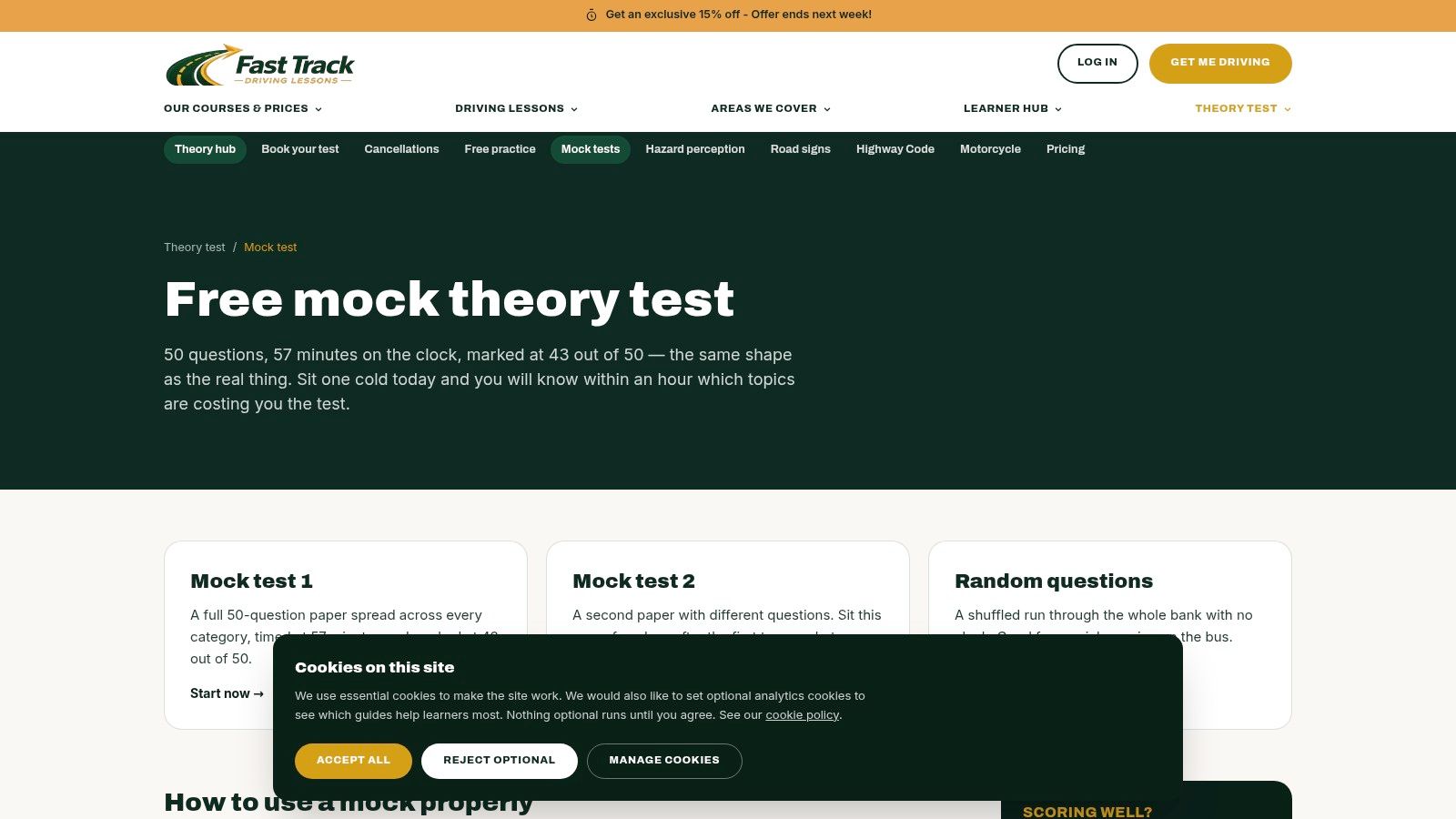
Fast Track Driving Lessons gets the core exam simulation right. Its free mock theory page uses the car theory structure for the multiple-choice section, so you're working with a full-length timed run rather than a watered-down taster. You get two proper mocks plus a random-questions mode, which is a better mix than many free tools offer.
That matters because exam realism isn't just about seeing DVSA-style wording. It's about whether you can hold concentration through a complete sitting, keep pace under the clock and still read carefully near the end. You can try the Fast Track mock theory test without sign-up, which makes it easy to repeat under stricter conditions each time.
Where it works best
This is the free option I'd use near a test date or before booking more structured tuition. It mirrors the official standard on the multiple-choice side, so the score means something. If you pass here comfortably and consistently, that's more useful than doing endless untimed topic quizzes.
It also sits inside a wider learner ecosystem. If your theory revision problem is tied to practical driving issues as well, Fast Track can connect that mock-test result to local instructor matching, intensive courses and route-specific mock practical prep.
Practical rule: Use a realistic timed mock to judge readiness. Use topic drills to improve readiness.
Trade-offs to know
The main limitation is simple. This is a multiple-choice mock, not a complete theory-test package. You'll still need separate hazard-perception practice, because no score from a question-only mock tells you whether your clicking technique and anticipation are good enough for the second section.
The feedback is also functional rather than personalised. That's normal for free mock exams. You'll see whether you passed and how you performed, but it won't replace an instructor who can spot patterns in your mistakes or build a revision routine around them.
- Best for: Learners who want a quick, realistic readiness check.
- Less useful for: Anyone who still needs heavy topic teaching or full hazard-perception coverage.
- Worth upgrading when: You're repeatedly failing on the same knowledge areas or need practical support alongside theory prep.
2. GOV.UK – Take a practice theory test
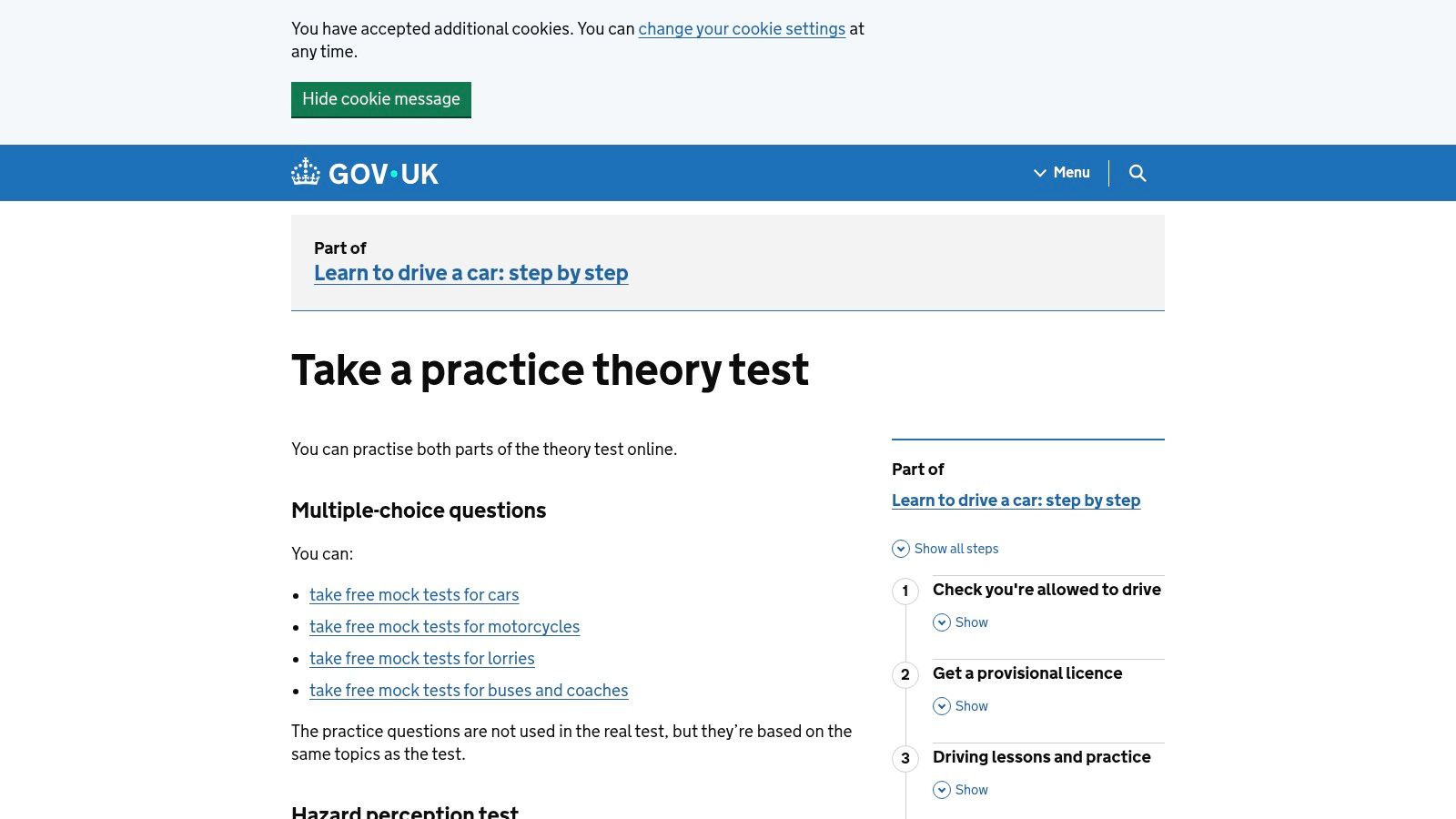
If you want the cleanest official starting point, use GOV.UK first. It's the government gateway to free practice for the theory test, and that official alignment is the main reason to keep it in your rotation even if you later move to broader revision platforms.
The strength here is trust. You're not guessing whether the layout or wording is drifting away from exam style. You also get links out to official study material, which is useful if you're trying to stop mixing accurate revision with recycled web summaries. For learners building a base, Fast Track's guide to theory revision tools pairs well with this official practice route.
Where it falls short
Official doesn't always mean complete. GOV.UK is excellent for a straightforward practice run and for pointing you towards the right materials, but it isn't built like a full coaching system. You won't get the kind of detailed progress tracking, large free question variety or extensive analysis that some commercial tools use to keep learners engaged.
Hazard perception is the other limitation. GOV.UK links to official practice, but free hazard coverage is still much thinner than a paid app or a library-backed premium platform.
Use GOV.UK to calibrate your standard, not to do all your revision.
That's the difference many learners miss. It's a benchmark and a reliable reference point. It's not the only thing they need.
3. Safe Driving for Life
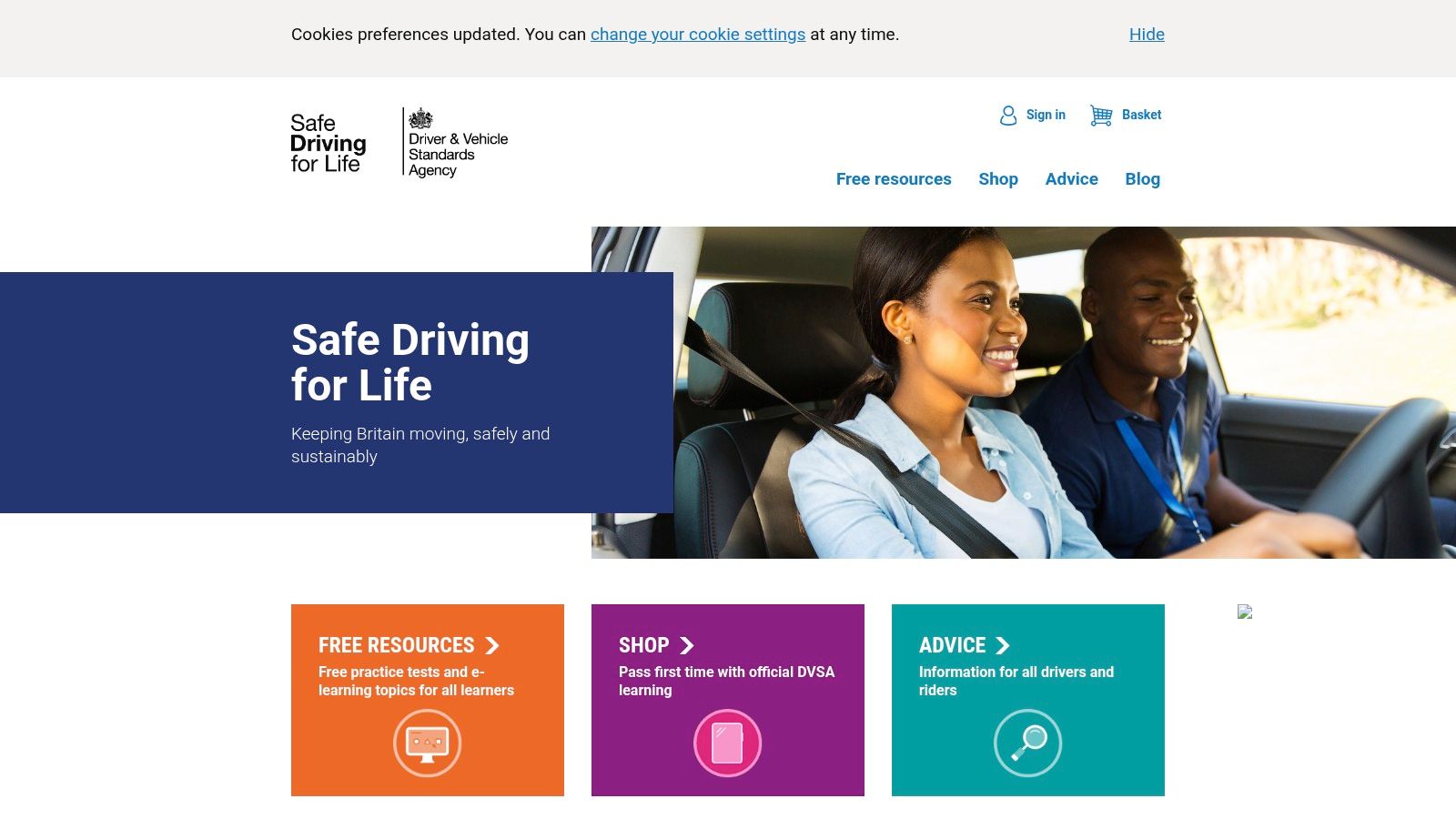
Safe Driving for Life sits in a useful middle ground. It isn't just a random third-party practice site, and it isn't as stripped-back as the government entry page. As the DVSA partner portal, it works well when you want free tasters that still feel anchored to official expectations.
The free material is best treated as a primer. You can sample multiple-choice questions, try hazard-perception tasters and dip into topic-based learning before deciding whether you need a paid DVSA learning kit. For cautious learners, that's a sensible progression because it lets you test the interface and style before spending money.
Best use in a routine
I wouldn't rely on Safe Driving for Life alone unless your revision needs are very light. The free elements are intentionally limited. They're useful for orientation, not for endless repetition.
That said, the site does a good job of introducing structure. If you've been hopping between free mock exams with no plan, its cleaner progression can help you settle into a more methodical routine.
- Strong point: Close alignment with official teaching material.
- Weak point: The best depth sits behind paid access.
- Best moment to use it: Early revision, especially before buying a full official kit.
This is the sort of resource that stops beginners from revising in a scattered way. It won't carry the whole load, but it often improves the quality of what you do next.
4. Driving Theory 4 All
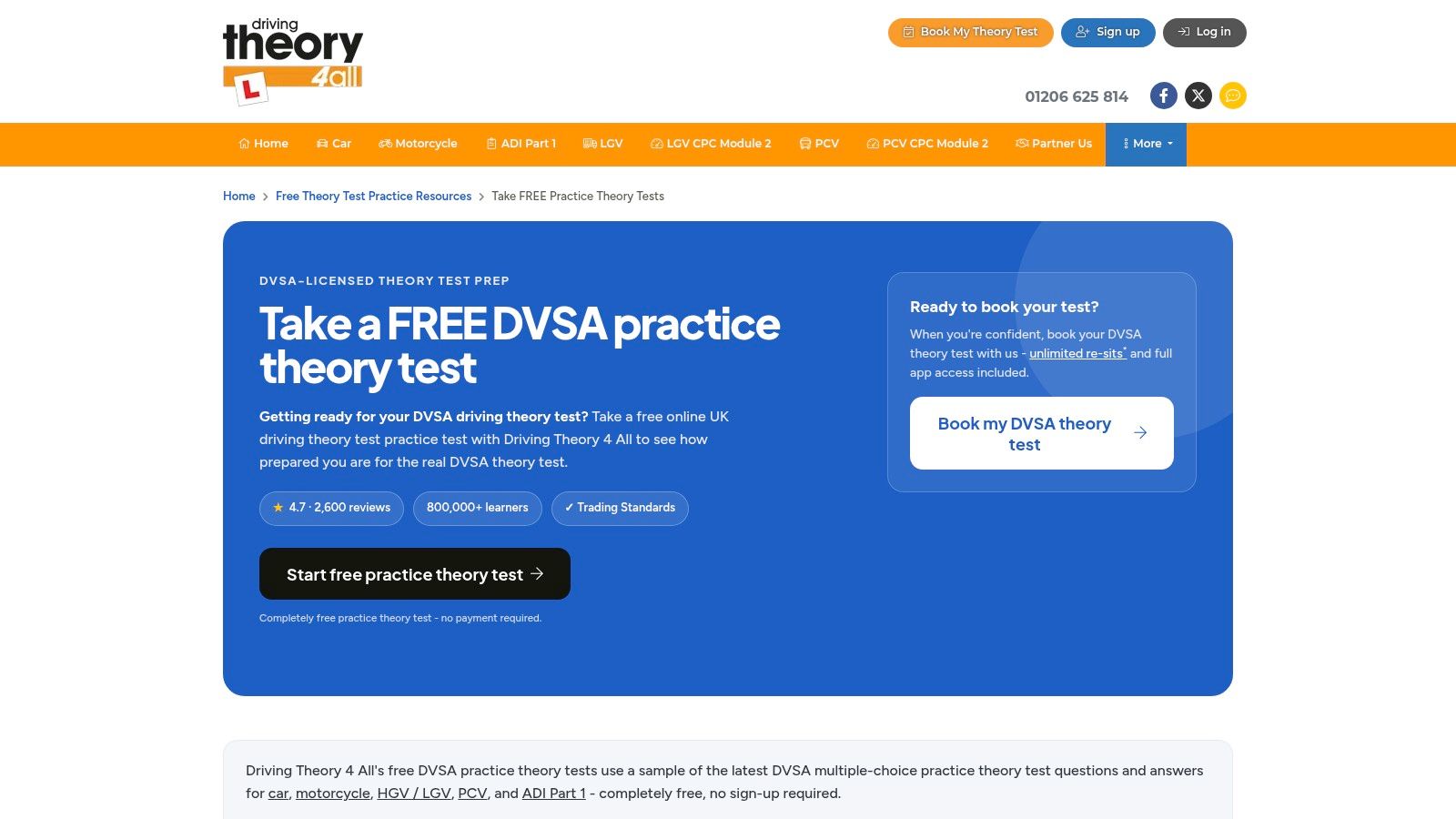
Driving Theory 4 All has been around long enough that many instructors and learners have crossed paths with it at some stage. Its biggest practical advantage is breadth. If you're not only looking at car theory, or you want one place that also touches bikes, HGV, PCV or ADI Part 1, it's one of the more convenient free starting points.
For car learners, the free content works best as a browser-based revision layer. You can start quickly, get sample mock practice and read explanations. That matters because explanation quality often separates useful mock work from simple score-chasing.
Realism versus range
Its free offering is broader than some rivals, but not all of that breadth equals full exam realism. The interface is functional rather than polished, and the free mock content is still a sample compared with the subscription side. That's fine if you know what you're using it for.
Where it's helpful is in targeted brushing-up. If road signs or a certain topic family keeps tripping you up, this kind of site can help you isolate and repeat that area without friction.
One thing worth remembering is that the wider UK assessment system now takes mock exams more seriously than it used to. In England, mocks became formal evidence during the 2020 appeals process for GCSE, AS and A-level grades under criteria set out by the Department for Education and Ofqual, which raised expectations around supervised conditions, marking quality and record keeping across schools and colleges, as reported by Schools Week's coverage of the valid mock grades policy. The theory-test world isn't the same system, but the lesson carries across. A mock is most useful when it resembles the thing closely.
5. Mock-Theory-Test.com
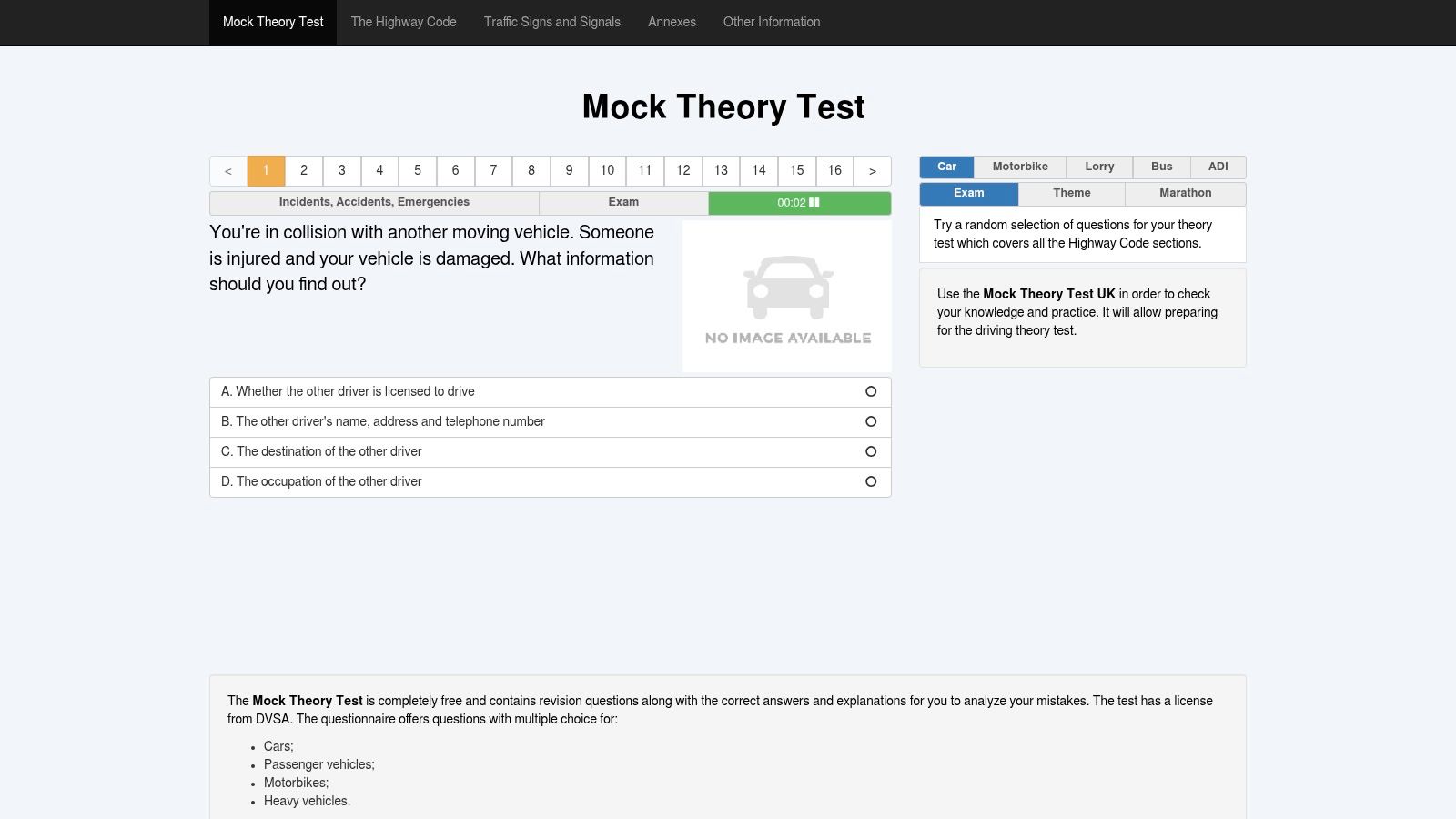
Some learners don't need a polished learning environment. They need repetition. That's where Mock-Theory-Test.com earns its place. It gives you straightforward browser-based drilling with repeated mock attempts, answers and explanations, without trying to turn revision into a membership funnel at every click.
That simplicity is a genuine advantage if you're revising in short bursts. Open tab, answer questions, check errors, repeat. For learners with busy schedules, low-friction access often beats feature-heavy dashboards that slow down the actual work.
What it does and doesn't solve
The site is strong on repetition and decent on answer feedback. If your weak point is recalling rules, signs or road situations under light pressure, repeated use can help settle those basics. It also gives you variation in wording, which can stop you memorising one source too narrowly.
Its weakness is obvious. There's no proper hazard-perception practice built into the core experience. So while it can support the knowledge side, it won't tell you if your second-section performance is test-ready.
The fastest free tool isn't always the best one. It's the best one for the job you're doing right now.
Use this when you need volume and quick review. Stop using it as your main tool once your issue becomes exam realism or hazard timing rather than simple recall.
6. TopTests.co.uk
TopTests.co.uk is one of the better free browser options for learners who revise by topic rather than by full paper. Its structure is tidy, mobile-friendly and easy to dip into when you've only got a short gap between lessons, work or college.
This matters more than people think. Theory revision often fails because learners wait for a perfect study block that never arrives. A topic-sorted site works well when you can do a focused round on junctions, signs or rules on your phone, then come back later for a fuller mock.
Good for patching weak areas
TopTests is especially useful if your scores fluctuate because of one or two stubborn weak spots. Topic drills let you isolate those areas faster than repeating full mocks every day. The road-signs section is also handy for learners who know the Highway Code in broad terms but still mix up visual recognition under time pressure.
The trade-off is that unofficial wording can sometimes drift slightly from the style learners will meet in DVSA-linked materials. That doesn't make it bad. It just means you should use it for practice breadth, not as your final authority on exact phrasing.
- Use it for: Structured short sessions on weak topics.
- Don't rely on it for: Full hazard-perception preparation.
- Best pair-up: An official mock source for realism, plus this for patch work.
When a learner says, “I know the material, but the same areas keep catching me out,” this sort of site is often more useful than another full test.
7. The AA – Theory test resources
The AA's theory resources feel like what they are. A reputable motoring brand's learner hub rather than a dedicated revision engine. That's not a criticism. It shapes how you should use it.
The free material works best as a starter set. You can access mock tests, read practical guidance and sample some hazard-perception content without much friction. If you're new to the process and want a trusted name before branching out, it's a comfortable place to begin.
Why it suits some learners
Some people revise better when the tone is calmer and less exam-heavy. The AA does that well. Its surrounding articles and guidance can reduce early confusion, especially for complete beginners who haven't yet separated the multiple-choice section from hazard perception in their minds.
The downside is depth. Free content here doesn't usually satisfy learners who need sustained mock volume or deeper diagnostics. Navigation can also feel more like moving around a content hub than working through a tightly designed test platform.
Useful distinction: Trusted brand doesn't automatically mean strongest mock simulator.
The AA is credible and helpful. It just isn't the one I'd choose as a main revision base once the test date gets close.
8. RAC – Driving Theory Test App
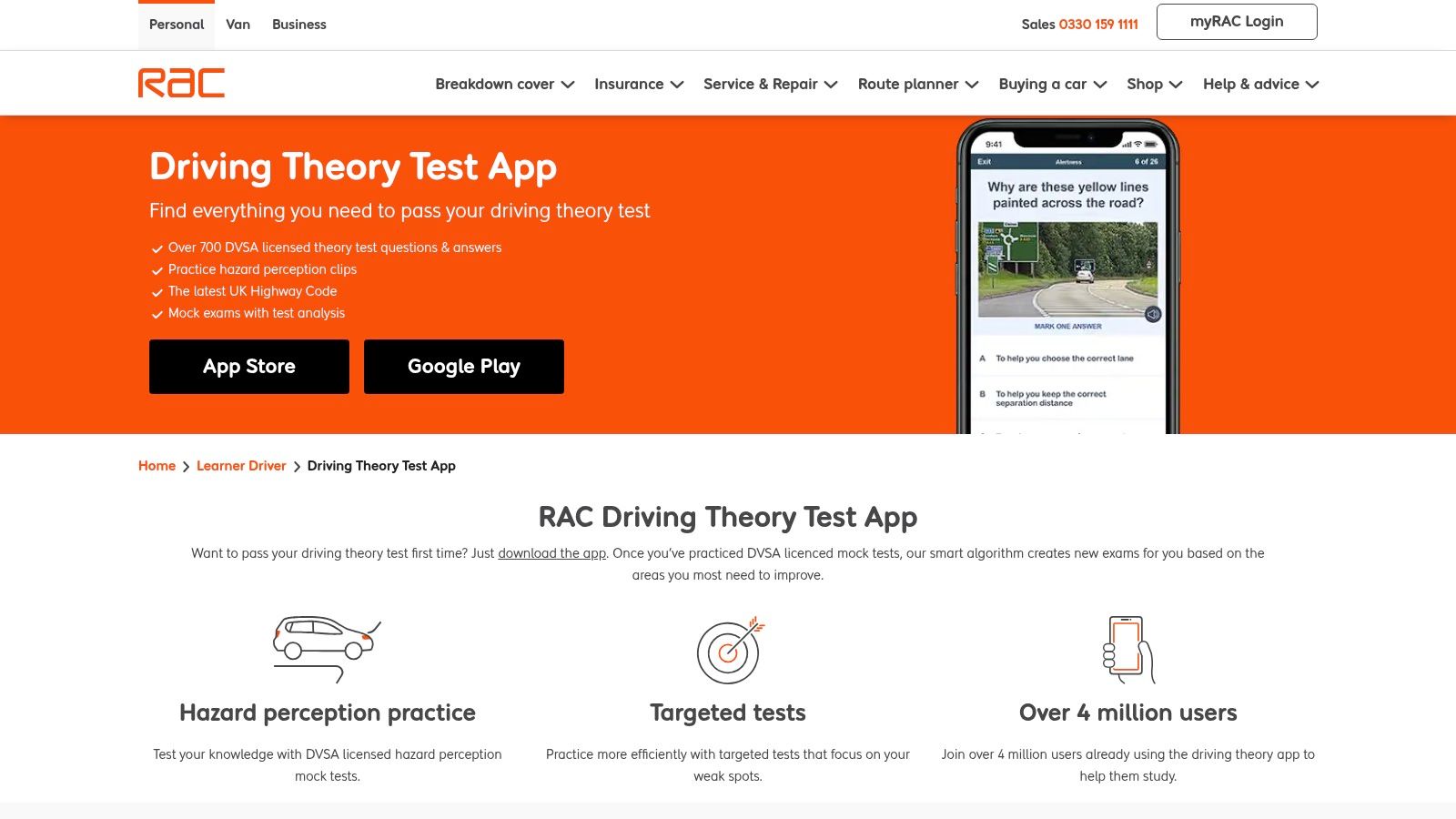
If you revise almost entirely on your phone, RAC's theory app deserves a look. The free sample gives you a mobile-first way to test the app before paying, and that matters because some learners stick to revision better when it lives on the device they already use daily.
App-based revision has one clear strength. It reduces setup friction. You're more likely to fit in short question sets while travelling or waiting around, and that consistency often matters more than having the fanciest dashboard.
When the free sample is enough
For some learners, the sample is just that. A trial run. It helps you decide whether the interface suits you and whether you'd use a mobile revision app regularly enough to justify paying for the full bank.
If hazard perception is your weaker half, don't judge your readiness from a small free app taster alone. A broader understanding of how hazard perception is marked and what catches learners out will do more for your score than collecting isolated question attempts.
A wider practical issue also affects how people use free mock exams. Long waits between practical booking and test day can stretch revision badly. Recent UK data showed the median wait between booking and sitting a practical car test was 11.1 weeks in August 2026, which is long enough for theory recall to go stale if your routine is casual. Mobile tools help most when they keep knowledge ticking over during those gaps.
9. Theory Test Pro via UK public libraries
Theory Test Pro is the best free option many learners never check. If your local library or council subscribes, you can get access to a realistic online simulator with licensed content, mock exams, hazard-perception clips and progress tracking without paying retail app prices.
That combination matters because most free web tools make you choose between realism and cost. Library access can remove that trade-off altogether. It's one of the first things I'd check before buying any premium theory package.
Why library access is worth the effort
You do need a participating library and some account setup, so it isn't as instant as opening a free browser quiz. But the payoff can be much better coverage than the average free site offers, especially on hazard perception and full mock conditions.
This also suits learners who want to study in a more documented, systematic way. The broader UK exam system has moved in that direction. In a 2023 government consultation on qualifications resilience, schools and colleges were told to ensure students sat mock exams in exam conditions before formal exams, with one full set of mocks considered sufficient and papers retained for contingency purposes. Different exam, same principle. A well-structured mock under realistic conditions is more valuable than piles of casual practice.
- Biggest advantage: Close-to-real simulation without direct cost, if your library provides it.
- Main limitation: Availability depends on local authority access.
- Best move: Check your library card options before paying for an app subscription.
For learners on a tight budget, this can be the smartest resource on the whole list.
10. MyTheoryTest.com
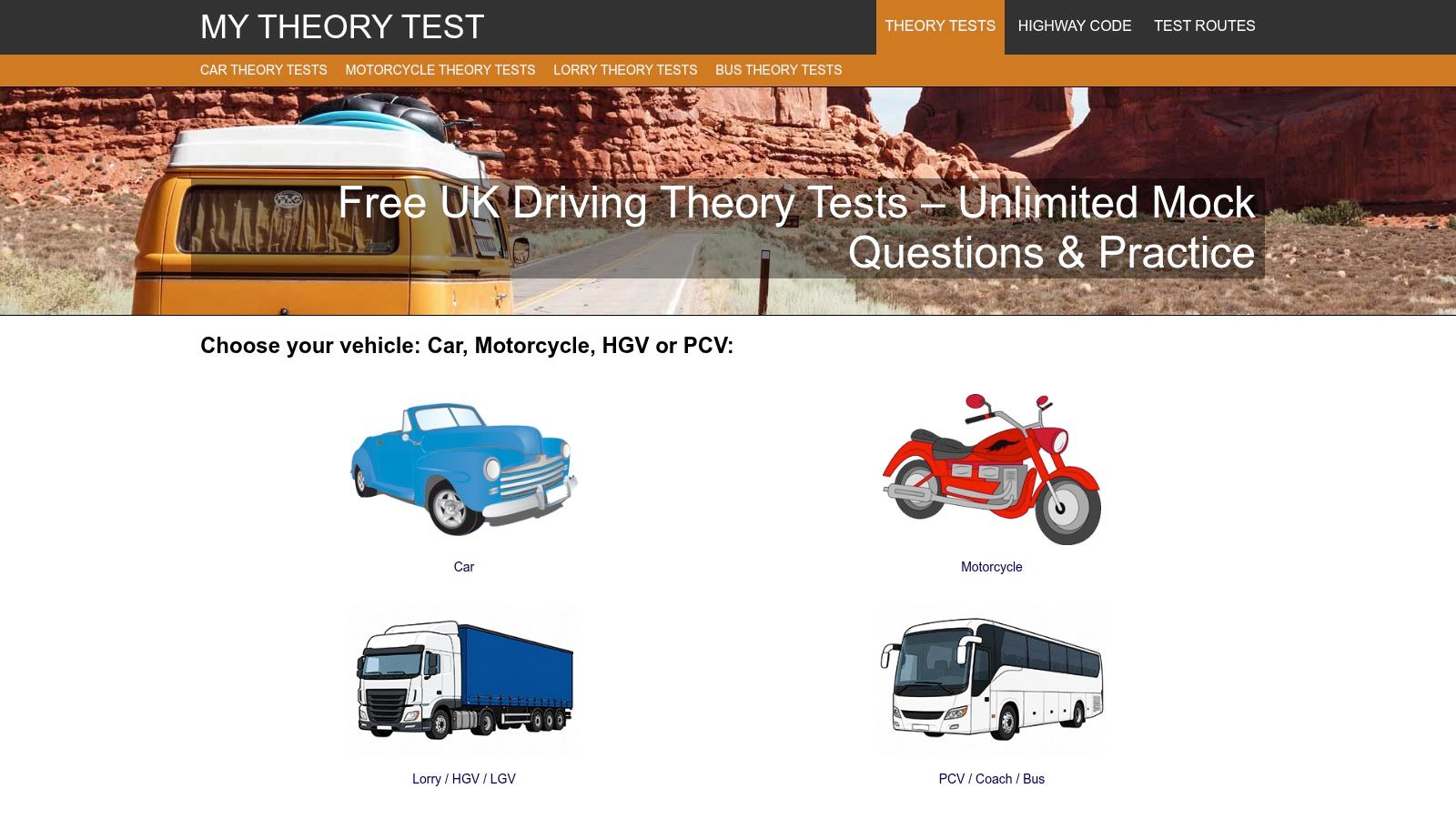
MyTheoryTest.com is a useful supplementary bank, especially if you've become too familiar with one site's wording and want extra variation. It offers browser-based free theory tests, topic practice and road-signs work without putting too many barriers in front of the learner.
That makes it handy in the middle phase of revision. You know the basics, but you aren't fully test-ready, and you need more question exposure without necessarily upgrading yet.
Best as a supporting resource
I wouldn't build an entire plan around MyTheoryTest.com alone. Like several free options, it's more convincing on multiple-choice practice than on hazard-perception depth. Still, it can add useful breadth and stop your revision becoming too narrow or repetitive.
That matters because broad UK learner-facing platforms often improve through large-scale feedback loops rather than one tutor's preference alone. The Department for Education's Learner Satisfaction Survey collected 312,683 responses in 2018–19, including 18,656 paper questionnaires, which is a reminder that high-volume user feedback can shape digital practice tools well when providers pay attention to it.
For free mock exams, that's the right expectation. Use them where they're strong. Keep them in a mixed routine. Don't ask one unofficial free site to do the job of a complete training system.
Top 10 Free Driving Theory Mock Exam Resources, Comparison
| Resource | Coverage & format | Key benefits / USP | Limitations | Best for | Price |
|---|---|---|---|---|---|
| Free Mock Theory Test (Fast Track) | Two full DVSA‑style 50‑question mocks; random mode; multiple‑choice only | Authentic timing & pass standard; instant; integrates with Fast Track courses & PracticalTest Assist | No hazard‑perception; limited personalised feedback | Last‑minute checks; prep before intensive courses | Free |
| GOV.UK – Take a practice theory test | Official timed multiple‑choice mocks; links to hazard clips & Highway Code | 100% official content and layout; no sign‑up | Limited hazard clips; basic progress tracking | Learners who want the official test format | Free |
| Safe Driving for Life (DVSA partner) | Free multiple‑choice & hazard‑perception tasters; topic tasters from DVSA kit | DVSA‑aligned primers; study guidance hub | Short tasters; full banks behind paywall; some sign‑in required | Beginners seeking a structured intro | Free (paid upgrades) |
| Driving Theory 4 All | Free full car mock + sample tests for bikes/HGV/ADI; explanations included | Wide vehicle‑category coverage; no sign‑up | Full banks need subscription; utilitarian UI | Learners covering multiple licence categories | Free sample; paid for full access |
| Mock‑Theory‑Test.com | Unlimited DVSA‑style multiple‑choice mocks with explanations | Fast, repeatable drilling; clear right/wrong feedback | No hazard‑perception videos; basic analytics | High‑volume question practice | Free |
| TopTests.co.uk (Elegant E‑Learning) | Topic‑sorted drills, full mocks, road‑sign quizzes; mobile‑friendly | Strong topic practice; generous free content; good mobile UX | Wording can differ from DVSA; limited free hazard clips | Topic‑focused mobile revision | Free |
| The AA – Theory test resources | Free mock tests + three free hazard clips; articles; companion app | Trusted motoring brand; helpful guides & app option | Free content limited; full question banks in paid app | Learners preferring established motoring brands | Free starter; paid app subscription |
| RAC – Driving Theory Test App | Free sample questions in app; annual content updates; iOS/Android | Credible brand; mobile convenience; up‑to‑date content | Full content requires subscription; app install needed | Mobile learners wanting an app experience | Free sample; subscription for full access |
| Theory Test Pro (via libraries) | DVSA‑licensed question bank + hazard videos; progress tracking | Very close to real test format; full mocks & analytics | Availability depends on local library subscription; library registration | Learners with library access seeking official bank | Free via participating libraries; otherwise paid |
| MyTheoryTest.com | Unlimited mock questions, road‑signs, topic practice; mobile/desktop | No cost; varied question wording for broader exposure | Not an official DVSA property; limited hazard videos | Supplementary practice alongside official resources | Free |
Build a Free Study Plan That Reflects the Test
The best free study plan usually looks less exciting than the advice learners want. Start with official material. Learn the rules properly, use official or DVSA-linked practice to fix your baseline, then bring in broader free tools to increase repetition. That sequence works better than jumping straight into random mock scores and hoping repetition alone will sort out weak understanding.
After that, shift to topic drills only where they solve a specific problem. If signs keep dragging your score down, use a site like TopTests or Driving Theory 4 All for concentrated repair work. If your overall pacing is the problem, go back to full timed mocks. A proper mock should test whether you can stay calm and accurate through the whole sitting, not just whether you can answer familiar questions when there's no pressure.
Hazard perception needs separate treatment whenever the free resource is thin on video practice. That's where a lot of learners misjudge readiness. They pass question mocks and assume they're nearly there, even though they've barely rehearsed the second half of the test. If your chosen free tool is weak on hazard clips, add official practice, a library-access platform or a paid app that fills that gap directly.
Before paying, check for library access. Theory Test Pro through a participating public library can be a far better value move than rushing into the first subscription app you see. Also treat unofficial sites as supplementary rather than definitive. They're useful for extra wording, added repetition and convenience, but your final confidence should come from realistic mocks and official-aligned material.
One pass on one day doesn't mean much. Look for a pattern. You want repeated pass-ready results under timed conditions, ideally across more than one platform, with mistakes becoming narrower and more predictable rather than random. If your results swing wildly, your revision probably isn't settled yet.
Paid question banks, app access or tuition become worthwhile in a few situations. First, when free tools leave a hazard-perception gap you can't close properly. Second, when you keep repeating the same mistakes and need stronger explanations or progress tracking. Third, when your theory problem is tied to practical driving confidence, timing or route awareness as well.
That's where Fast Track Driving Lessons fits neatly. It isn't only a theory page. It can add structured theory training, intensive or semi-intensive tuition, instructor matching, and mock practical preparation for learners who need the knowledge and the driving side to progress together. If you need a sensible framework for your revision week, this exam study planner that works is a good companion.
Fast Track Driving Lessons does more than give you a free mock. It also matches learners with DVSA-approved instructors for intensive and semi-intensive courses, supports theory preparation, and offers mock practical help when you need your study and driving plan to work together. If you want one place to move from free theory practice into structured learner support, visit Fast Track Driving Lessons.
Written by Fast Track editorial team.