
You've spent weeks preparing for the UK practical test, and your instructor has covered roundabouts, manoeuvres, meeting traffic and independent driving. Then there's the emergency stop, a manoeuvre that might not appear at all, but could arrive without warning while you're driving normally. That uncertainty makes some learners over-practise panic braking and under-practise the control the examiner needs to see.
The emergency stop driving test exercise is less about stopping in the shortest possible distance and more about responding promptly while keeping the car stable, straight and fully under control. The manoeuvre is now sampled less often, but it remains a formal assessed skill when the examiner asks for it. The right preparation is deliberate, calm and closely matched to the DVSA procedure.
Table of Contents
- What the Emergency Stop on Your Driving Test Is
- How to Carry Out the Emergency Stop Step by Step
- How DVSA Examiners Mark the Emergency Stop
- Common Mistakes That Cost Learners Marks
- Safe Drills to Practise the Emergency Stop
- Test-Day Checklist and Quick Questions
What the Emergency Stop on Your Driving Test Is
You are driving normally when the examiner checks the road, raises a flat palm and says, “Stop!” The command can come at an unpredictable point on a suitable stretch of road. Your response must be immediate, controlled and safe.
The emergency stop driving test assesses hazard response, braking control, steering stability and recovery after the stop. Examiners are looking for decisive braking while the vehicle stays straight and under control. Freezing, swerving or using the controls in the wrong order can undermine an otherwise sound response.
Practical rule: React to the examiner's signal first. Mirrors are not the priority during a genuine emergency stop.
The exercise is not included on every test. Older learner materials described it as being carried out on about one-third of normal tests. Current DVSA examiner guidance says, “An emergency stop exercise should be conducted in 1 out of every 7 driving tests”, as reported in this guide to carrying out an emergency stop in the DVSA driving test. That sampling rule should change your practice. Do not rehearse it as though it will appear on every test. Instead, practise the response often enough that an occasional exercise feels familiar, while keeping normal driving, observation and recovery in focus.
Why controlled deceleration matters
A good stop combines a quick reaction with firm, smooth control. Apply the brake strongly enough to stop promptly, keep the steering steady and hold the vehicle straight. Stopping a little later while maintaining the line of travel shows safer control than stopping sooner after the car veers.
The official procedure also keeps the exercise controlled. The examiner briefs you while stationary, checks that the road and traffic conditions are suitable, then gives the verbal instruction “Stop” with a raised right hand. You must wait for that signal before starting, as set out in the DVSA guidance for car driving tests.
Treat it as a sudden hazard response within a managed test setting. Do not guess the command, anticipate it or brake merely because the examiner has moved a hand. Listen for the instruction, confirm the signal and act. Your practice should build that sequence, not encourage panic braking.
How to Carry Out the Emergency Stop Step by Step
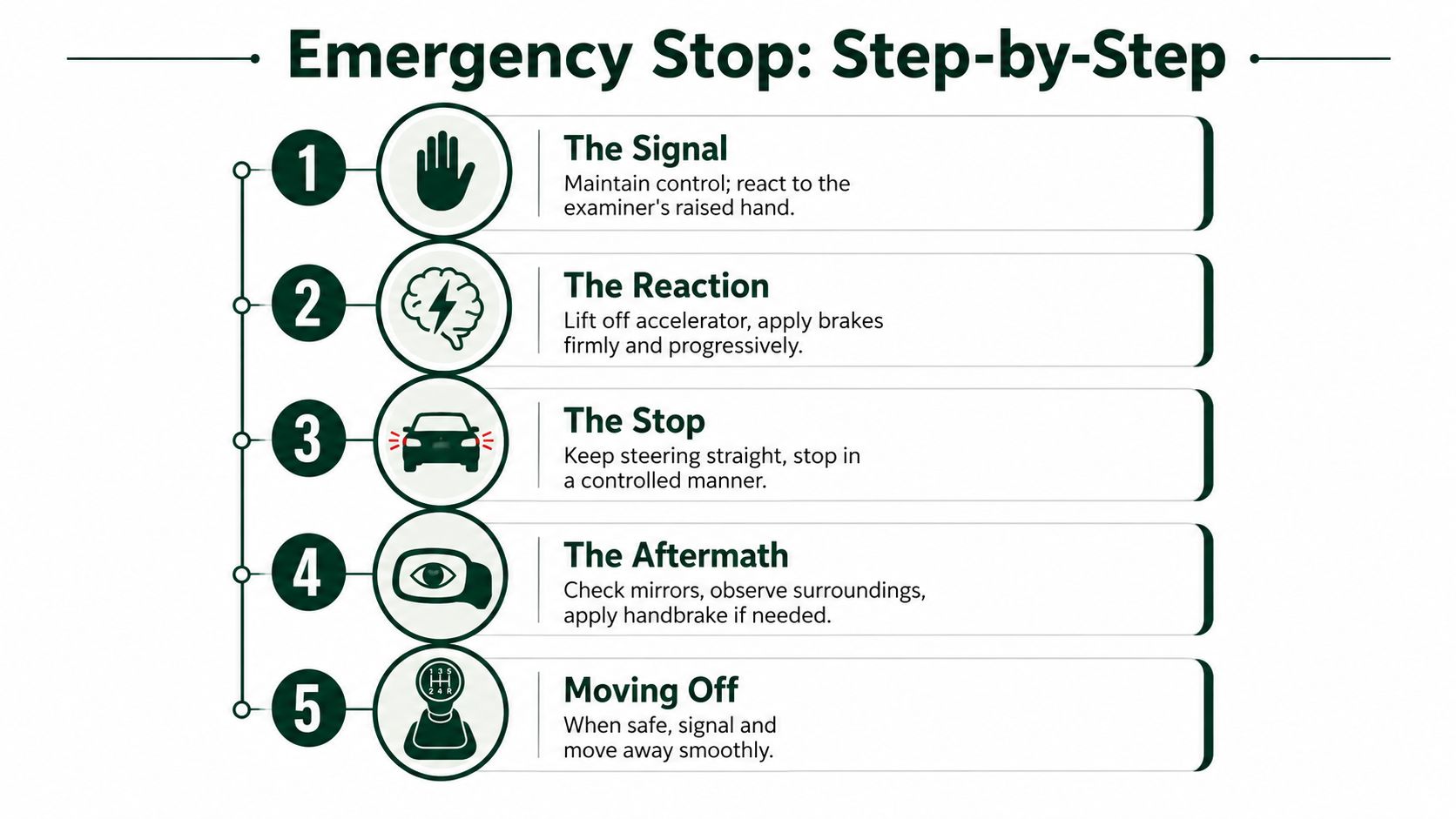
The sequence is simple, but manual-car learners need to time the clutch correctly. Braking comes first. The clutch follows just before the engine would otherwise stall.
Start with the signal
Keep both hands on the steering wheel, look ahead and continue normal driving until the examiner gives the command. When you hear “Stop” and see the raised hand, lift off the accelerator and move your braking foot promptly to the brake pedal. Don't check the mirrors before braking, because a genuine emergency requires an immediate response.
Brake firmly and progressively
Press the brake firmly, building pressure quickly rather than stabbing at the pedal. Keep the steering wheel secure and hold the vehicle in a straight line. The aim is maximum controllable deceleration, not an exaggerated movement that makes the car veer or lose grip.
If the car has ABS, you may feel pulsing through the brake pedal. Keep firm pressure and continue steering. Don't pump the brakes, release pressure repeatedly or reach for the handbrake.
Time the clutch in a manual car
As the car slows and the engine approaches the point where it would stall, press the clutch fully to the floor. Don't dip it at the same instant as the brake unless your instructor has identified a particular vehicle issue that requires a different approach.
Delaying the clutch preserves engine braking during the early part of the stop. Pressing it just before the car comes to rest prevents an unnecessary stall and leaves you ready to secure the vehicle.
Secure the car after stopping
Once the car has stopped completely, keep your foot on the brake. Apply the parking brake, select neutral and wait for the examiner's instruction. The official guidance on what happens during the driving test confirms that the vehicle should be secured before you move away again.
The stop itself isn't finished just because the wheels have stopped turning. The examiner still needs to see that you can regain your normal driving routine safely.
Observe before moving off
Before moving away, check the mirrors and blind spots as appropriate. Signal if it would help other road users, select first gear, release the parking brake and move off smoothly when it's safe.
In an automatic, use the brake firmly with your right foot, keep the car controlled as it stops and hold it securely. Once the examiner tells you to move off, complete your observations, select drive if needed and resume normal driving safely. There's no clutch timing to manage, but the observation and rejoin procedure still matters.
How DVSA Examiners Mark the Emergency Stop
The examiner gives the command only after explaining the exercise and checking that the road is suitable. The manoeuvre may happen at any point in the test when conditions allow. If a genuine emergency has already occurred during the test, the examiner may not require the separate exercise, as noted in the official examiner guidance.
Your expression does not affect the result. The marking focuses on what your actions achieve, how quickly you respond, whether you keep control and how safely you resume driving.
What separates a clean stop from a fault
A clean emergency stop normally shows four things:
- Prompt reaction: You brake as soon as the signal is given.
- Firm braking: You apply enough pressure to stop effectively, without making a panicked or poorly controlled input.
- Stable direction: The car stays on a safe line and remains under steering control.
- Safe recovery: You secure the vehicle, complete the required observations and move off safely.
The examiner assesses the circumstances, not an isolated detail. Failing to react, continuing after the instruction or creating a risk to another road user could result in a dangerous fault. A serious fault may follow if the braking causes loss of control, the car veers significantly or you cannot recover safely. An imperfect observation that creates no immediate danger may be recorded as a driving fault.
| What the candidate did | DVSA assessment |
|---|---|
| Braked promptly, kept the vehicle straight and secured it correctly | Controlled response with no obvious fault |
| Braked firmly but made a small post-stop observation error without creating danger | Possible driving fault |
| Reacted late, missed the command or continued in a way that created risk | Potential dangerous fault |
| Stamped on the brake, lost the line or failed to recover control | Potential serious fault |
The DVSA driving test mark sheet guide from Fast Track Driving Lessons explains how faults are recorded across the practical test. Use that wider context when reviewing practice drives. The emergency stop is not judged by stopping distance alone. The examiner watches the complete sequence, from the first response through to the point where you rejoin normal driving.
Because the exercise is sampled rather than guaranteed on every test, practise the full sequence instead of chasing one perfect stop. Your drills should cover the response, control, vehicle security and recovery, so the manoeuvre remains reliable whenever it is tested.
Common Mistakes That Cost Learners Marks
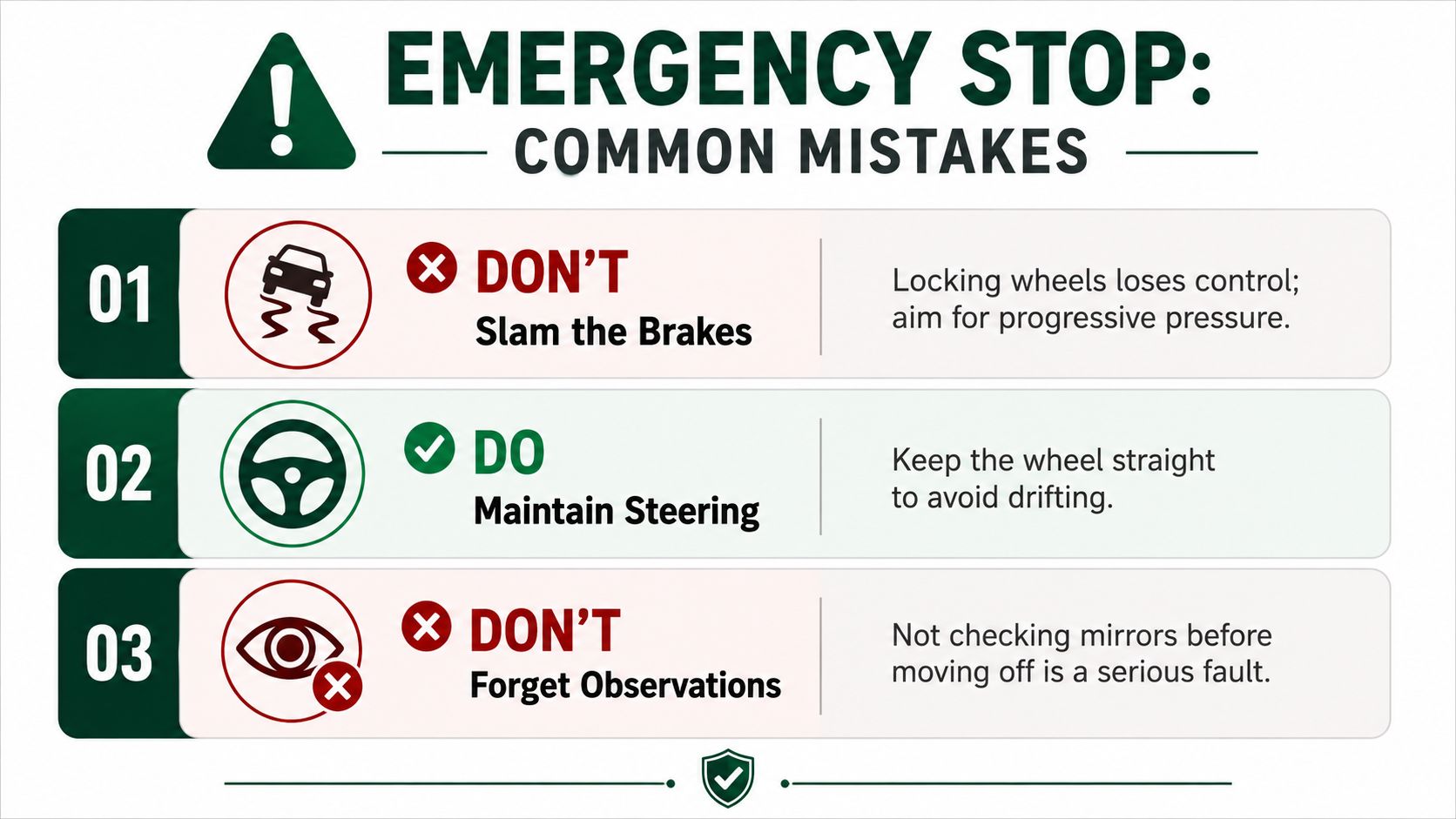
The most persistent misconception is that hardest braking equals the best result. It doesn't. The emergency stop assesses a rapid, controlled response, so stamping on the pedal can create more problems than it solves.
The mistakes behind the nerves
Learners commonly make one of these errors:
- They wait for a safe mirror routine: In ordinary driving, mirrors help you plan before braking. During the examiner's emergency command, delaying the brake to check mirrors can produce a late response.
- They stab at the pedal: A sudden, unmeasured movement can unsettle the car and lead to wheel lock or a loss of direction.
- They dip the clutch too early: Pressing the clutch as soon as braking starts removes engine braking and can make the stop less controlled.
- They grab the handbrake: The parking brake isn't part of the initial stop. Using it before the car is stationary can unsettle the vehicle.
- They forget the recovery: The learner stops successfully, then moves off without proper mirror and blind-spot checks.
Wheel lock on dry tarmac is usually a control problem, not a sign that you weren't travelling fast enough. ABS may activate when you brake heavily, but you should maintain firm pressure and keep steering control rather than reacting to the pedal vibration.
What a minor and serious fault can look like
Suppose you stop cleanly, but your final mirror check before moving away is incomplete and no other road user is affected. That may be treated as a driving fault. By contrast, if you fail to observe and move into the path of another vehicle, the same part of the sequence becomes much more serious because it creates actual danger.
The same principle applies to braking. A slightly longer stop with the car straight and stable can show better control than a shorter stop followed by a skid, a sharp swerve or an inability to recover. The UK guidance on emergency-stop frequency and technique describes the benchmark as rapid but progressive braking, straight-line stability and controlled recovery rather than a panic stop.
Safe Drills to Practise the Emergency Stop
Emergency-stop practice needs more planning than just asking a friend to shout while you drive. The safest method starts under an instructor's supervision, at a low speed and in a place where the exercise can be stopped immediately if conditions change.
Build the sequence gradually
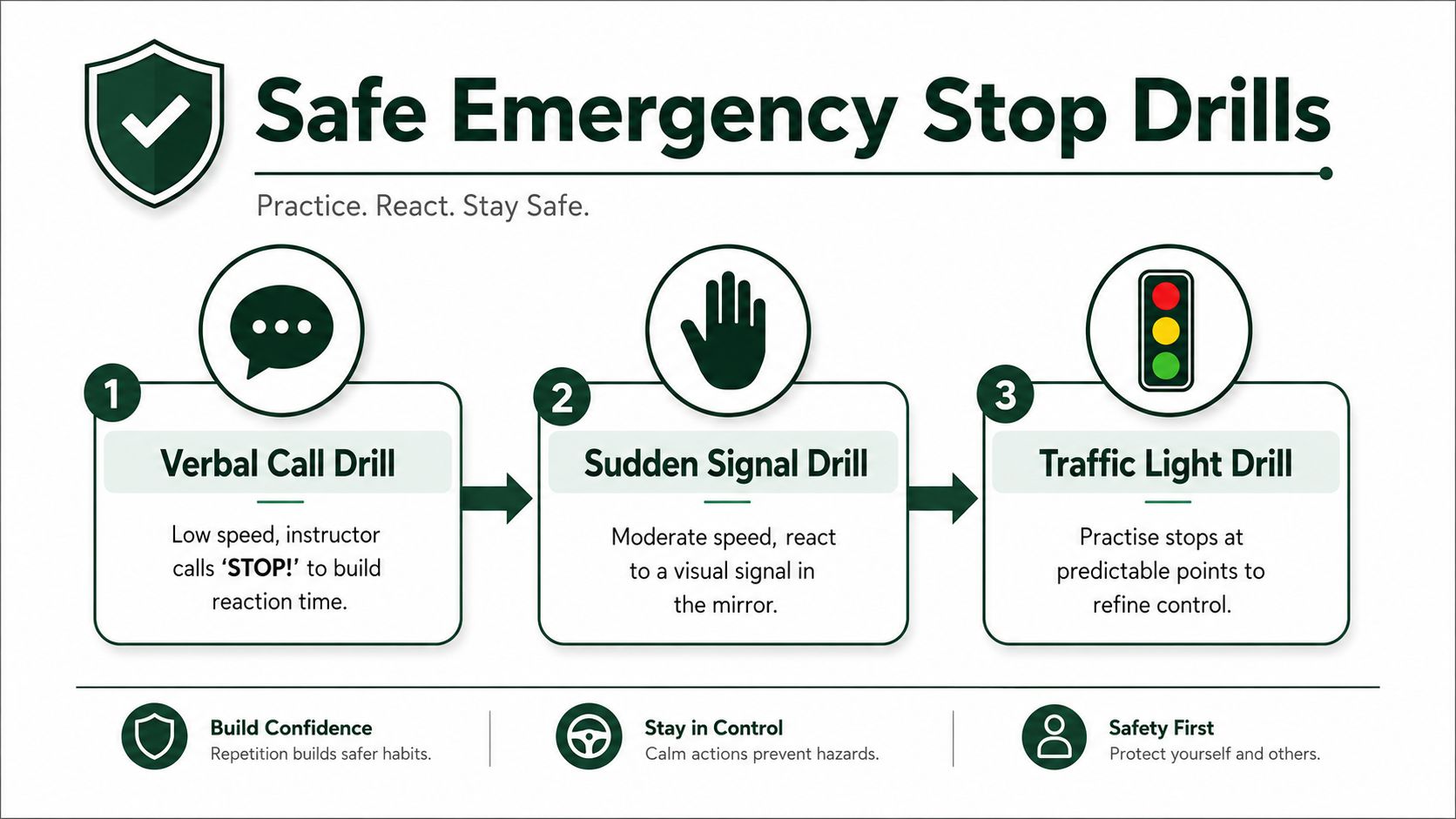
Begin with a verbal-call drill in a dual-control lesson. Drive slowly on a quiet, suitable road while your instructor calls “Stop!” in a clear voice. Concentrate on the order: respond, brake firmly, keep the steering straight, press the clutch near the stall point, secure the car and observe before moving off.
Once that sequence is reliable, your instructor can introduce a visual signal, such as a raised hand in your peripheral vision or mirror area. The purpose isn't to surprise you into panic. It's to make your eyes and feet work together while you retain a calm steering response.
A third exercise is a predictable stopping drill, using agreed locations such as a safe, quiet road position or a suitable traffic-light stop. This isn't an emergency-stop simulation, but it refines pedal control, clutch timing and the ability to keep the car straight.
Use independent practice carefully
Independent practice should only happen after your instructor says your timing and control are consistent. Choose a quiet residential street with good visibility and suitable road conditions. Don't practise on a hill, in wet or icy conditions, with passengers, or without an instructor present. A dual-control car gives your instructor a safety net, and a friend or family member can't replace that control or judgement.
The anti-lock braking guidance for stopping quickly in an emergency is useful alongside practical tuition, particularly if ABS activation makes you want to release the brake.
After every drill, use the same debrief:
- Stopping distance: Did the braking feel firm and prompt?
- Line: Did the car remain straight?
- Clutch control: Did you press it just before the engine would stall?
- Vehicle security: Did you apply the parking brake and select neutral?
- Observations: Did you check properly before moving off?
Stop drilling and tell your instructor if the exercise triggers anxiety, causes you to freeze or makes you anticipate the signal so much that normal driving deteriorates. More repetition isn't always the answer. Your instructor may need to reduce the speed, return to verbal calls or work on braking confidence separately.
Test-Day Checklist and Quick Questions
Before the test, keep one short mental script rather than trying to remember every possible mistake:
- Listen and look: Wait for the examiner's clear “Stop” instruction and raised hand.
- Brake first: Apply the brake firmly and progressively.
- Stay straight: Keep both hands on the wheel and maintain control.
- Clutch late in a manual: Press it fully just before the car would stall.
- Secure the vehicle: Use the parking brake, select neutral and wait.
- Rejoin carefully: Check mirrors and blind spots, signal if needed, then move off safely.
The exercise is conducted in 1 out of every 7 driving tests, according to current DVSA examiner guidance, as explained in this UK emergency-stop procedure guide. Treat that as a reason to practise intelligently, not as a reason to gamble on avoiding it.
Common questions answered
Do automatic cars follow the same sequence?
The response is the same, but there's no clutch. Brake firmly with your right foot, keep the car straight, secure it when stopped and complete full observations before selecting drive and moving away.
What if the examiner doesn't ask for an emergency stop?
Carry on with the test normally. The exercise is sampled, not guaranteed, so don't anticipate it or create your own stop.
What should I do if the car skids?
Keep your steering controlled, maintain awareness of your direction and follow your instructor's vehicle-specific advice. Don't make a sudden steering movement or grab the handbrake. Tell the examiner what has happened through your actions, by regaining safe control and completing the recovery correctly.
Will failing this manoeuvre automatically fail the whole test?
There isn't a simple automatic rule based on the word “emergency stop”. The result depends on the fault's seriousness and the risk created. A controlled response with a minor lapse is different from a dangerous loss of control.
For wider preparation, review the show me, tell me questions and practical test topics. The strongest preparation leaves you with a calm physical routine, not a fear of one particular command.
Fast Track Driving Lessons matches learners with DVSA-approved instructors for manual and automatic tuition, including dual-control lessons, mock tests and structured intensive or semi-intensive courses. If you want focused help with the emergency stop driving test and the wider practical test, visit Fast Track Driving Lessons to find suitable tuition.
Written by Fast Track editorial team.