
You've booked your practical test, but the closer it gets, the less confident you feel. You can manage clutch control during a normal lesson, yet the thought of an examiner sitting beside you makes every mirror check, junction and manoeuvre feel harder than usual.
That reaction is common. A DVSA driving test mock gives you a controlled opportunity to experience the test environment before the actual appointment. It also shows whether your mistakes are isolated lapses or repeatable faults that need targeted practice. With test waiting times uneven across the UK, a mock should form part of your preparation plan well before test day, not be treated as a last-minute rehearsal.
Table of Contents
- Why a DVSA Driving Test Mock Changes Everything
- Understanding the Official DVSA Fault Hierarchy
- The Anatomy of a Proper 40-Minute Mock Test
- Navigating Long UK Test Waiting Times Strategically
- Integrating Mock Tests with Intensive Learning Paths
- Interpreting Your Mock Test Feedback Effectively
- Booking Your Mock Test and Next Steps
Why a DVSA Driving Test Mock Changes Everything
A DVSA driving test mock works by removing routine instructor prompts and recording faults as an examiner would. That change exposes decision-making gaps that relaxed lessons can hide. You may handle the car well, yet rush at a junction, miss an observation before reversing or lose track of mirror checks while concentrating on where the road leads.
The purpose is not to memorise a familiar route. It is to show whether your driving process remains safe when conditions change and support is limited. A mock gives you a controlled way to practise that independence before your practical test.
From instructor support to independent decisions
During an ordinary lesson, an instructor might prompt you before a developing mistake becomes serious. In a mock, the instructor limits unnecessary help and records what happens. You then see whether the core weakness involves steering or gear selection, or whether you are failing to make and check decisions early enough.
That distinction matters because the practical test examines how you respond to traffic, junctions, manoeuvres and changing situations. Following a known route from memory cannot prove that you can deal with an unfamiliar problem safely. A useful mock therefore includes varied roads, reversing, independent driving and manoeuvres, rather than repeating one comfortable circuit.
The official GOV.UK guidance for carrying out mock driving tests describes this realistic approach, including independent driving, reversing and manoeuvres.
Practical rule: A mock should feel slightly uncomfortable, while remaining safe and constructive. The pressure should come from reduced support and formal assessment, not from situations beyond your current ability.
Use the fault pattern to plan further practice
The result matters, but the pattern behind it matters more. Three junction faults may indicate one weakness in early observation and planning. A missed mirror check before changing direction may show that your routine breaks down when traffic becomes busy. A mock makes those connections easier to see because the instructor records faults in context, rather than relying on a general impression after the drive.
You should leave knowing which habits to practise, which situations trigger errors and whether you can recover calmly after a mistake. That information gives each later lesson a clearer purpose. It also helps you judge readiness over time, instead of treating one reassuring drive as proof that every part of your driving is reliable.
A mock can be particularly useful while you are waiting for a test appointment. UK waiting times vary between test centres, so preparation may need to continue for longer than expected. The DVSA's published national testing system includes test volumes, pass rates and waiting-time data for test centres, with the statistics collection maintained since 2013. The DVSA driving and theory test data provides that wider context.
Recent DVSA campaign reporting found that 92% of learners who took a mock said it helped them prepare, 87% said it increased confidence and 94% would recommend one. Those figures support using mocks as part of a longer readiness plan, not only as a final rehearsal.
Understanding the Official DVSA Fault Hierarchy
The DVSA doesn't treat every mistake as equal. A candidate may receive a driving fault, often called a minor, for an error that doesn't create immediate danger. A serious fault is potentially dangerous, while a dangerous fault involves actual danger to the examiner, another road user or property.
A serious or dangerous fault means a fail, even if the rest of the drive is calm. A candidate can also fail by accumulating more driving faults than the permitted threshold. The official DVSA fault and result guidance explains this hierarchy and the difference between potentially dangerous and actual danger.
Why repeated faults matter
A single minor may be a lapse. Repeating the same minor shows that the underlying process hasn't become reliable. For example, one late mirror check could happen because you're distracted. Several late mirror checks before changing direction suggest that your observation routine isn't yet automatic.
That's why mock scoring should record fault type, location, frequency and severity, rather than just adding marks. A learner who collects several faults around junctions may need to work on scanning and planning well before the turn, not spend another lesson practising steering on an empty road.
The DVSA's published fault hierarchy identifies junction observation as the most common fault category, followed by mirrors when changing direction, turning right at junctions, responding to signs and traffic lights, control and steering, and moving off safely. The DVSA driving tests and instructors statistics collection provides the official source for this hierarchy and related test information.
The skills your mock should expose
An effective instructor will deliberately include situations that test:
- Early observation: Can you identify developing hazards before you arrive at a junction?
- Mirror, signal and position routines: Do you check the correct mirrors early enough, then signal and position appropriately?
- Right turns: Can you select a safe gap, maintain position and respond to oncoming traffic?
- Signs and lights: Do you recognise and act on information without harsh braking or hesitation?
- Moving off: Can you complete effective observations and move away without creating risk?
A mock isn't designed to catch you out. It's designed to reveal which parts of your routine disappear under pressure. You can also review this explanation of driving test faults before your session, so the terminology on the result sheet feels familiar.
Here's a useful visual overview of the test experience:
The Anatomy of a Proper 40-Minute Mock Test
A proper mock follows the broad sequence of the practical test. The DVSA says it should last about 40 minutes and cover licence checks, eyesight, vehicle safety questions, general driving, reversing, independent driving and an emergency stop. That structure matters because a learner may perform well during ordinary road driving but become unsettled when the instructor introduces a manoeuvre or stops giving directions.
Start with the checks
The session should begin with the administrative and safety elements rather than jumping straight into traffic. You'll normally need to show your licence, complete an eyesight check and answer vehicle safety questions in the “show me, tell me” format.
These questions aren't a separate revision exercise. They form part of the examination experience, so the mock should check whether you can explain or demonstrate the relevant safety actions without becoming flustered. Your instructor can then identify whether you need more practice before moving off.
Build varied general driving
The general driving phase should include more than the roads you know best. Your instructor may use residential streets, busier routes, junctions, roundabouts, changes in speed and areas where signs or lane markings require quick decisions.
You're being assessed on your process. Keep scanning, choose a suitable speed, maintain a safe position and respond to developing hazards. If you make a mistake, don't abandon the rest of the drive. A safe recovery often demonstrates better judgement than a panicked attempt to correct an insignificant error.
Include the manoeuvre and independent driving
The practical test can include manoeuvres such as reverse parking into a bay, driving forward into a bay and reversing out, pulling up on the right and reversing back, or turning into a side road. The DVSA guidance for examiners on the practical driving test sets out the defined manoeuvre options.
Independent driving is just as important. You may follow traffic signs or directions from a sat-nav, making decisions without a running commentary from your instructor. Skipping this part creates a serious blind spot because route familiarity can hide weak planning and poor sign reading.
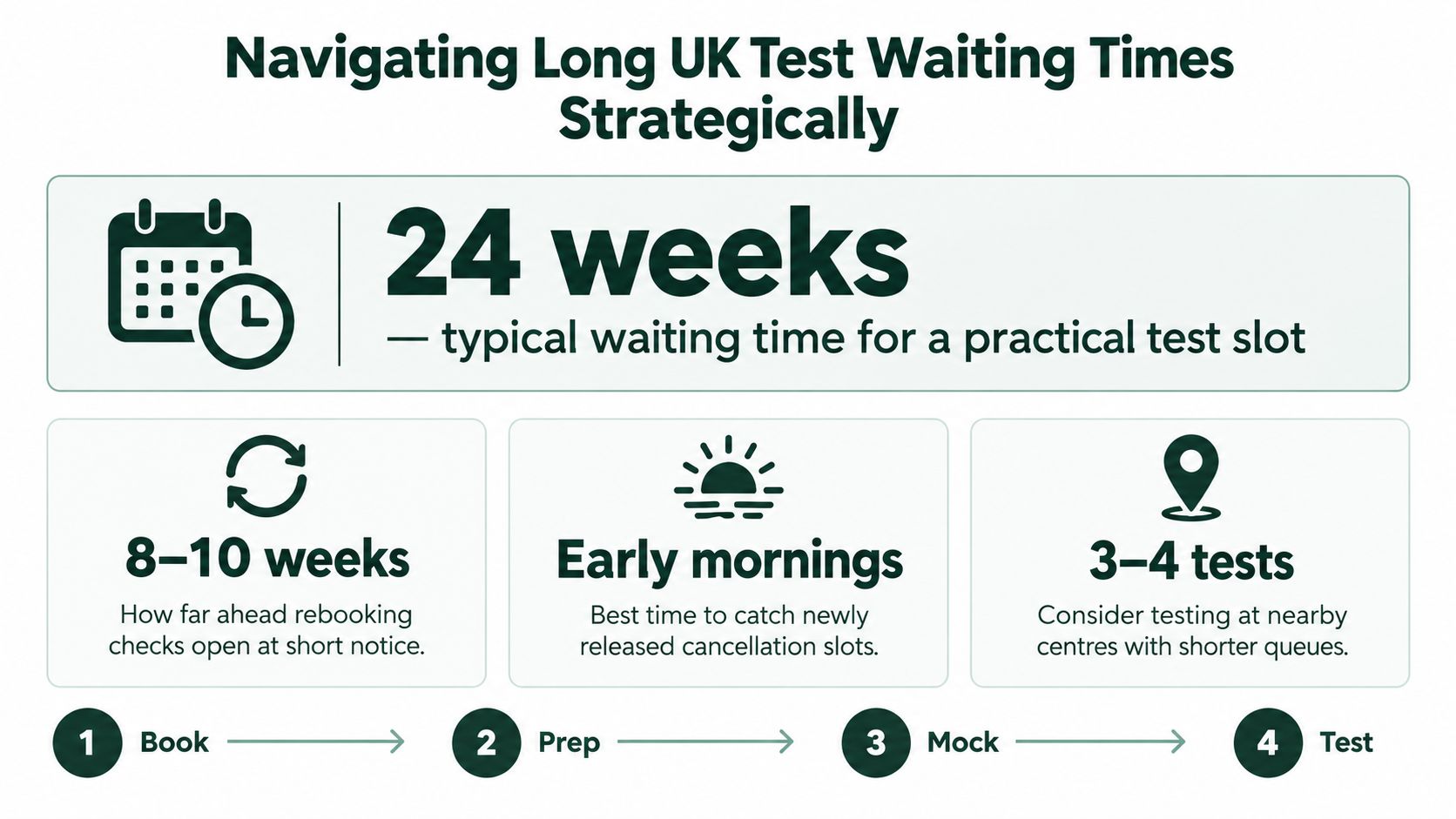
Use this mock test checklist to confirm that your practice session includes each major stage rather than becoming an informal drive with a few questions added.
The emergency stop should also be handled as a distinct exercise where appropriate and safe. Your instructor will explain the procedure and make sure you understand how to respond promptly while retaining control.
Navigating Long UK Test Waiting Times Strategically
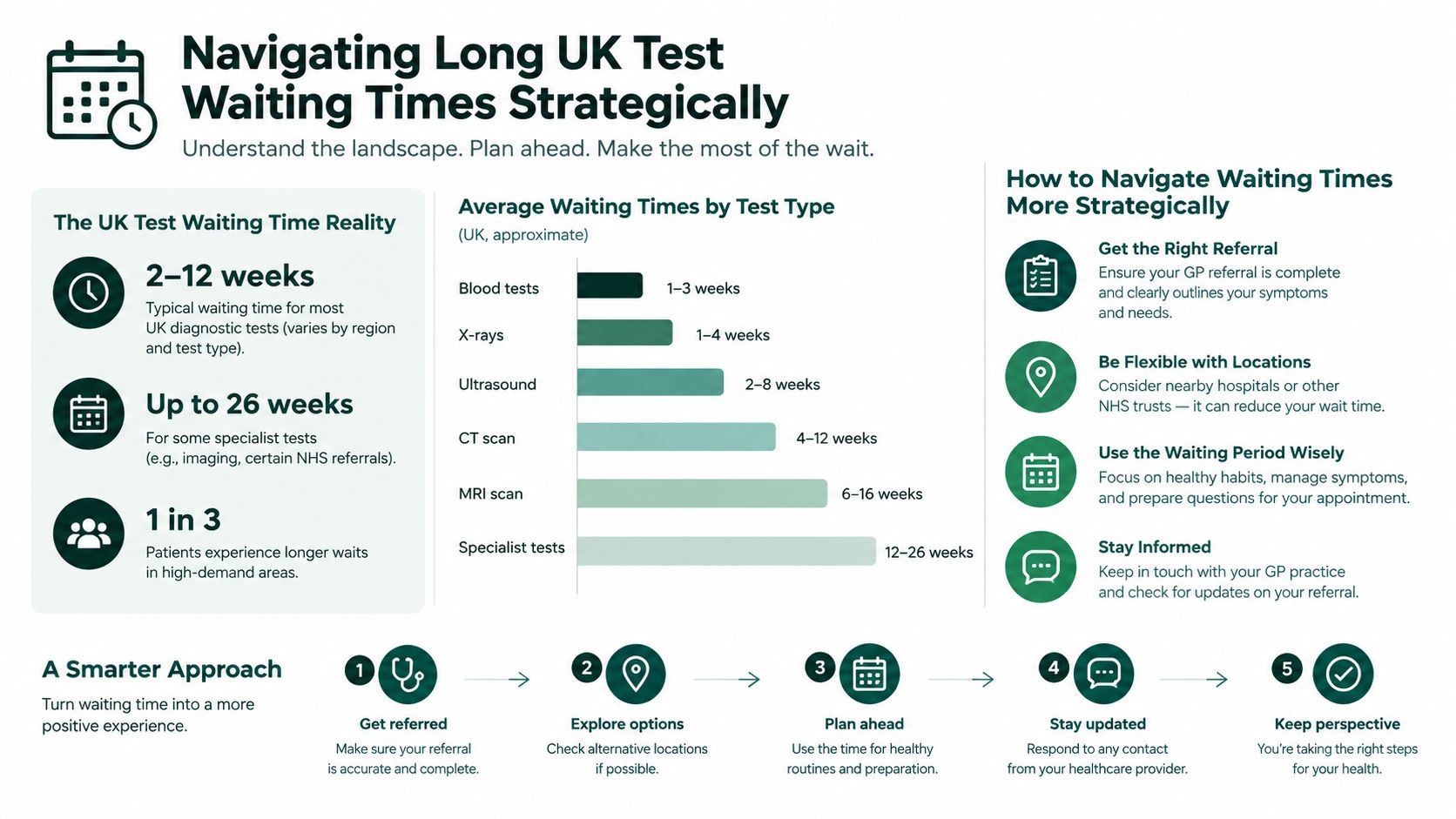
A mock taken immediately before your practical test can be useful, but it shouldn't be your first meaningful assessment. Waiting periods can be long enough for your driving to improve, deteriorate or change between the mock and the appointment.
DVSA data for August 2026 shows that the median wait between booking and taking a car test was 11.1 weeks, while the separate 10% availability measure was 20 weeks. The same official guidance reports regional figures of 22.7 weeks in England, 22.9 weeks in Scotland and 17.3 weeks in Wales in April 2026. These measures don't describe every learner's experience in the same way, so treat them as evidence of uneven availability rather than a guaranteed personal wait. The figures come from the DVSA guidance on driving test appointments and earlier tests.
Treat the mock as a readiness benchmark
Suppose your mock identifies inconsistent mirror checks and hesitation at right turns. Those aren't problems you should try to repair in a single final lesson. You need time to practise the routine across different roads, receive feedback and demonstrate that the improvement holds when traffic becomes demanding.
That makes an early mock valuable. Take it during the waiting period, use the result to set a small number of practice priorities, then arrange a later assessment to check whether the faults have reduced. You're turning the queue into a training window rather than allowing it to become dead time.
A second mock close to the appointment can confirm current readiness, but it shouldn't replace ongoing practice. If the test date moves, your instructor can help you decide whether to maintain regular lessons, schedule a focused refresher or reassess your readiness.
Connect each fault to a practice task
Don't write “improve observation” at the top of a notebook and leave it there. Convert the feedback into actions:
- Junction observation: Name the information you need to gather before changing speed or direction.
- Mirror routines: Practise the relevant mirror sequence before every planned change of direction.
- Independent driving: Follow signs in unfamiliar areas and explain your decisions afterwards.
- Manoeuvres: Repeat the observation and control routine, not just the steering movements.
- Test pressure: Complete sections with fewer prompts and practise recovering calmly from small errors.
A long wait is frustrating, but it can also give you the time required to replace inconsistent habits with dependable routines. The mock becomes a diagnostic checkpoint, not a prediction made months before the actual drive.
For a practical explanation of how waiting periods can affect preparation, see this guide to UK driving test waiting times.
Integrating Mock Tests with Intensive Learning Paths
A mock works differently depending on how you're learning. Someone taking regular weekly lessons may use it as a progress review. Someone following an intensive course may use it to establish priorities at the start, then repeat targeted work once those weaknesses have been addressed.
A short course for a nearly ready learner
A 10-hour Test Booster suits a learner who already controls the car reliably and needs polishing rather than foundational tuition. The mock can identify whether the remaining issues involve local junctions, independent driving, manoeuvres or fault recovery.
The instructor can then allocate the available time to the highest-impact weaknesses. That might mean a concentrated session on right turns and lane positioning, followed by a final mock that checks whether the routine survives a formal drive.
A broader semi-intensive route
A 20-hour Semi-Intensive plan gives a learner more room to combine assessment, skill development and consolidation. It may suit someone who has experience but still needs consistent observation, better planning or greater confidence across unfamiliar roads.
The comparison is straightforward:
| Learning situation | Useful role for a mock |
|---|---|
| Nearly test-ready | Locate the final repeatable faults |
| Some experience, inconsistent performance | Establish a structured practice plan |
| Returning to driving | Check current habits before test-focused tuition |
| Manual or automatic learner | Assess control, observation and decision-making in the chosen vehicle |
Local instructor matching can make the feedback more relevant because practice may take place on roads near the chosen test centre. That doesn't mean memorising a route. It means working on the types of junctions, roundabouts, speed changes and road layouts that demand the same decisions you'll make during the examination.
Keep momentum while waiting
An intensive plan can lose momentum if the learner finishes tuition but has no suitable test appointment. PracticalTest Assist monitors real-time DVSA test alerts and supports learners seeking appropriate cancellations, helping connect preparation with a workable appointment.
Fast Track Driving Lessons offers intensive and semi-intensive tuition, including the Test Booster and Semi-Intensive options, with local instructor matching, manual and automatic lessons, mock tests and PracticalTest Assist. Learners comparing administrative tools for structured education businesses may also find test prep center software useful for understanding how course scheduling and learner records can be organised.
The key comparison isn't just intensive versus weekly lessons. It's whether the plan gives you a clear feedback loop: assess, practise, reassess and maintain the standard until test day.
Interpreting Your Mock Test Feedback Effectively
A result sheet can look harsher than the drive felt because it records every fault, even the small ones. Read it as a diagnostic sheet, not as a judgement on your driving.
Start by sorting each note into four questions:
- What happened?
- Where did it happen?
- What risk did it create?
- Can I repeat the correct process without prompting?
A late mirror check on a quiet road may be a one-off lapse. The same mistake before several changes of direction points to a habit that needs work. A manoeuvre that still needs repeated prompts usually means the issue is not the final steering movement, but the observation and decision-making behind it.
Use the official pass standard properly
With the threshold already defined, use the sheet to sort faults by pattern. Group them by location and frequency before you count the total. The official mock-test benchmark is no more than 15 driving faults, with any serious or dangerous fault still a fail, and the GOV.UK mock driving test guidance sets out that standard.
That figure should not become the only goal. A serious or dangerous fault still overrides everything, while repeated driving faults can show a weakness that becomes more obvious under pressure.
Feedback principle: Count the marks, then study the pattern. The pattern shows what to practise next.
Turn notes into a targeted lesson plan
If the sheet points to junction observation, practise the full sequence before adding harder roads. Work out what you should check, when you should check it, and how that information changes your speed or position. If moving off is the issue, repeat the observation routine until it stays consistent after stops on different roads.
After each practice block, ask your instructor to reduce prompts. You need to know whether the improvement belongs to you, or whether you are still leaning on reminders. A later mock can show whether the change holds in a test-style setting.
Do not try to fix everything at once. Choose the faults that appear most often or create the greatest safety risk, then work through them methodically. Confidence usually follows evidence. Once you can explain what went wrong, demonstrate the correct routine, and repeat it without help, the next mock becomes a useful progress check.
Booking Your Mock Test and Next Steps
Choose an instructor who can deliver more than a casual drive and general encouragement. A proper session should use the DVSA-style structure, include examiner-style marking, cover the relevant manoeuvres and finish with a clear debrief.
Ask before booking:
- Who will assess me? Confirm that the instructor is a DVSA-approved driving instructor, or understand clearly if a trainee instructor is involved.
- What will be covered? Check that the session includes eyesight, vehicle safety questions, general driving, independent driving, reversing and the appropriate emergency-stop practice.
- How will faults be recorded? You should receive specific notes rather than a broad opinion about confidence.
- What happens afterwards? Make sure the instructor will explain priorities and suggest practical exercises for your remaining lessons.
- Is the vehicle suitable? It should be a dual-control vehicle that meets the requirements for the practical test.
Fast Track Driving Lessons validates ADI badges, carries out annual re-checks and uses enhanced DBS, insurance, MOT and vehicle-standard checks. It also offers mock tests near the chosen test centre alongside intensive and semi-intensive tuition, so learners can combine a formal assessment with a wider preparation plan.
A mock isn't a demand for perfection. It's a safe way to find the habits that still break down, understand the DVSA marking hierarchy and build reliable decisions before the examiner gets into the car.
Book a structured mock with Fast Track Driving Lessons to practise the full DVSA test format, receive examiner-style fault feedback and connect your result to intensive or semi-intensive tuition. Use the session to identify your priorities early, then keep practising until your driving remains safe, independent and consistent under pressure.
Written by Fast Track editorial team.