
Most UK instructors charge between £31 and £45 per hour, so a 40-hour intensive package typically lands between £1,240 and £1,800 before any DVSA test fees. You're probably staring at several course adverts on your phone, wondering why one hourly rate looks manageable while another makes the whole licence feel expensive.
That question, “how much will this really cost me?”, deserves a better answer than a single headline price. Your final bill depends on the hours you need, the instructor's availability, whether you choose manual or automatic tuition, how quickly you can book a test, and whether you need extra lessons or a retest.
Table of Contents
- What UK Learners Actually Pay for Driving Lessons
- How Hourly Rates Translate into Course Prices
- Intensive Versus Semi-Intensive Course Structures
- What Is Included and What You Still Pay Separately
- Building a Realistic Total Budget for Each Learner Stage
- Checking Your Instructor's Credentials Before You Pay
- Why the Cheapest Hourly Rate Is Not Always the Cheapest Route
- Your Practical Pricing Checklist Before Booking
What UK Learners Actually Pay for Driving Lessons
You may find a £30 lesson advertised nearby, then discover that regular slots are unavailable or the session lasts less than a full hour. UK instructors set their own charges, and there is no government-set minimum or maximum tuition rate. The DVSA's guidance on taking driving lessons advises learners to choose a properly authorised instructor, but it does not set lesson prices.
The strongest national benchmark is the UK government's 2025 survey of approved driving instructors. Of 3,342 instructors who answered the pricing question, 50.3% charged £36 to £40 for a standard one-hour lesson. Another 22.5% charged £41 to £45, while 18.2% charged £31 to £35. Smaller groups charged £46 to £50, £51 or more, £26 to £30, or £25 or less. You can review the full figures in the 2025 instructor survey results.
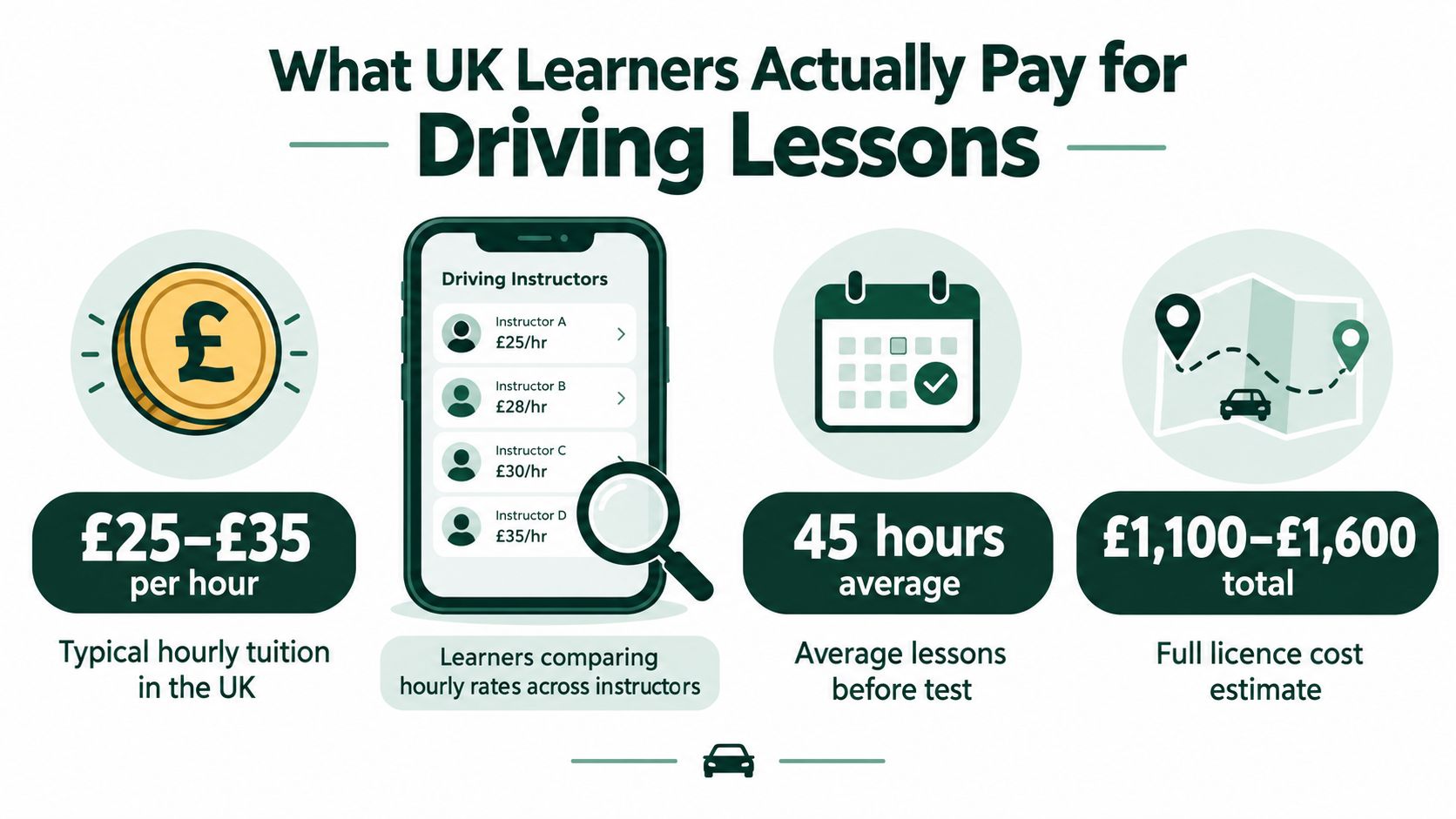
The main UK price bands
| Hourly rate band | Share of instructors | What it usually signals |
|---|---|---|
| £25 or less | 0.4% | Exceptionally low rate, check what's included |
| £26 to £30 | 2.0% | Budget pricing, often limited availability |
| £31 to £35 | 18.2% | Lower end of the established market |
| £36 to £40 | 50.3% | Mainstream national pricing |
| £41 to £45 | 22.5% | Upper mainstream or high-demand area |
| £46 to £50 | 5.0% | Premium local pricing |
| £51 or more | 1.6% | Highest advertised hourly band |
Use £31 to £45 as the practical shopping range, with £36 to £40 the clearest mainstream reference point. Prices are still changing: 48.0% of instructors said their average one-hour price had increased in October 2025, while 47.7% said it had stayed unchanged and 1.9% reported a decrease.
Capacity can matter as much as the rate. 55.1% of instructors charging £36 to £40 said they had no capacity for new pupils, rising to 68.5% among instructors charging more than £51, according to the same government survey. A cheaper instructor is a poor choice if irregular availability stretches your training and delays your test.
For the wider bill, read this guide to the real cost of learning to drive. Tuition is only one cost. Your required hours, test timing, retest risk and waiting time determine the final amount.
How Hourly Rates Translate into Course Prices
A package price is the hourly rate multiplied by the tuition hours, unless the provider clearly adds or removes something. That sounds obvious, but learners often compare a 10-hour course with a 20-hour course without first reducing both to the same hourly figure.
For example, using the national mainstream range:
- 10 hours at £31 to £35 costs £310 to £350.
- 10 hours at £36 to £40 costs £360 to £400.
- 10 hours at £41 to £45 costs £410 to £450.
- 40 hours at £31 to £35 costs £1,240 to £1,400.
- 40 hours at £36 to £40 costs £1,440 to £1,600.
- 40 hours at £41 to £45 costs £1,640 to £1,800.
Those are tuition calculations only. They don't include the theory test, the practical test, test-day vehicle hire, travel, or any extra lessons after the booked hours run out.
What counts as cheap, typical and premium
A very low hourly rate deserves questions rather than instant approval. Ask whether the price applies to every lesson, whether the instructor is available at the times you need, and whether the provider adds collection, booking or vehicle charges. You should also check whether the advertised rate is for a full hour of driving or a shorter session described loosely as a lesson.
The £36 to £40 band is the clearest mainstream reference point because it covers the largest share of surveyed instructors. A higher rate can still be sensible if the instructor offers suitable times, knows the local test area and can keep your lessons consistent. A lower rate can become poor value if long gaps force you to buy more tuition later.
Automatic tuition deserves a separate conversation. Some schools charge different amounts for manual and automatic lessons, while others don't. The price alone won't tell you how quickly you can progress because local instructor availability may be tighter for one transmission than the other.
My rule: compare the hourly rate, then compare the number of hours you're likely to need and the dates you can actually book.
The RAC estimates that the average learner needs approximately 45 hours of professional instruction and 22 hours of private practice before the practical test. Its indicative tuition range of £35 to £50 per hour puts professional instruction at about £1,575 to £2,250, before test fees and other costs. That's why an intensive course should be judged by its total hours and realistic outcome, not by a large-looking package discount. The RAC's cost of learning to drive guidance sets out the broader calculation.
Intensive Versus Semi-Intensive Course Structures
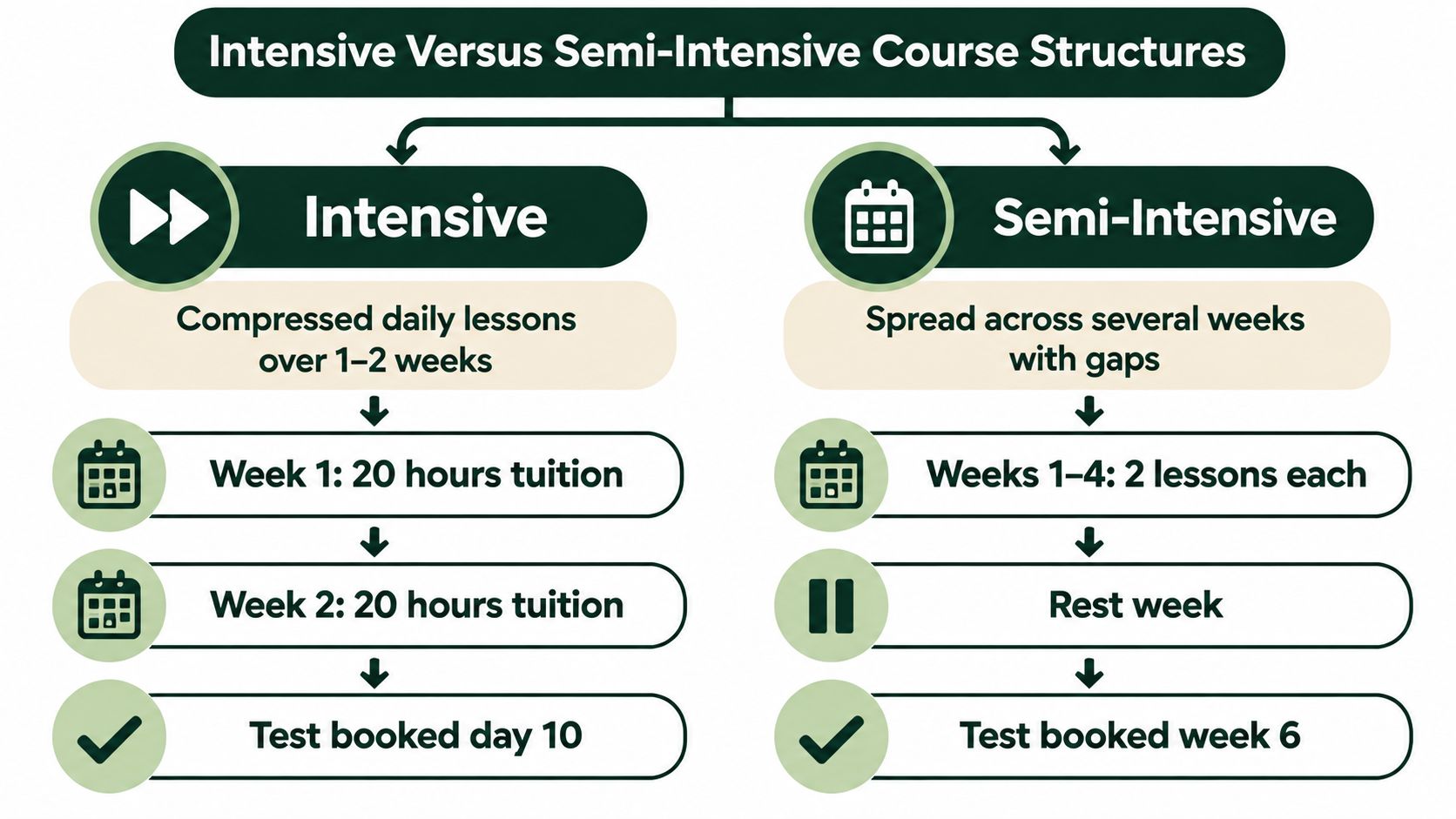
An intensive course compresses lessons into a short run of frequent sessions. It suits a learner who can protect several days for tuition and wants to reach test standard without spreading progress over a long period.
A semi-intensive course uses the same principle but leaves more space between sessions, commonly across a few weeks. That gap can help a beginner practise privately, absorb feedback and fit lessons around work, college or childcare. It isn't automatically cheaper. You're mainly paying for a different schedule.
Example packages at one clear rate
To make the arithmetic easy, use £40 per hour as a worked example. Replace it with your own quoted rate before booking.
| Course shape | Hours | Tuition at £40 per hour | Suitable for |
|---|---|---|---|
| Test Booster | 10 | £400 | Nearly test-ready learner needing polishing |
| Semi-Intensive | 20 | £800 | Partly experienced learner building consistency |
| Fast-Track | 30 | £1,200 | Learner with a foundation who needs structured progress |
| Complete Beginner | 40 | £1,600 | New learner starting with basic vehicle control |
A 10-hour Test Booster isn't a shortcut for someone who still struggles with junctions, clutch control or observation. It's better suited to someone who can already drive independently but needs local-route practice, manoeuvre work and mock-test feedback.
A 20-hour semi-intensive course gives a learner room to practise between sessions. That can be useful if private practice is available and supervised, because professional lessons can target the weaknesses that practice exposes.
The 30-hour option is a practical middle ground for someone who has driven before but lacks test consistency. You'll have enough time to address several areas without committing to a full beginner programme.
The 40-hour course is the honest starting point for many complete beginners, especially those without access to private practice. It can build a strong base, but no provider should promise that a fixed number of hours guarantees a pass.
Manual and automatic choices
Manual and automatic lessons can carry the same hourly price, or they can be priced differently by the provider. Don't choose a transmission solely because one advert looks cheaper. Ask how soon you can start, how often lessons are available and what type of car you expect to drive after passing.
For a detailed comparison of weekly and compressed formats, read this guide to intensive versus weekly driving lessons. The useful comparison is not “Which package has the lowest total?” It's “Which structure lets me practise enough, maintain continuity and reach test standard without buying avoidable top-up hours?”
What Is Included and What You Still Pay Separately
A proper course quote should separate tuition from government test fees. If those figures are blended together, ask for an itemised price before you pay a deposit.
Most driving courses include the instructor's time and the dual-control training vehicle. They may also include progress reviews, mock tests and, depending on the provider, use of the instructor's car on the practical test. Don't assume those last two items are included. Ask specifically.
Usually included in tuition
- Instructor time: The stated number of one-hour lessons or tuition hours.
- Training vehicle: A road-legal dual-control car suitable for learner instruction.
- Progress guidance: Feedback about the skills that need attention before the test.
- Mock-test preparation: Included by some providers, but not guaranteed across the market.
- Test-day car hire: Sometimes included, sometimes charged separately, so get the answer in writing.
Paid separately
The official DVSA test fee information lists the car theory test at £23 and the weekday practical car test from £62. A weekend practical test costs £75. Those are government charges, not instructor tuition, and they're paid for booking the relevant test.
A failed test can create two costs. You may need to pay another DVSA test fee, and you may need additional lessons while waiting for the next appointment. If you need the instructor's car again, check whether test-day hire is included in the original course or charged each time.
Other possible extras include travel to a test centre, lessons taken during a lengthy waiting period, motorway tuition, a post-test Pass Plus course and additional hours when your instructor says you're not ready. None of these should be treated as a surprise. A responsible provider will explain what the course covers and what falls outside it.
Ask for two totals: the tuition total, and the complete expected budget including tests, car hire and a sensible reserve for extra preparation.
That distinction matters most with intensive courses. A short block may take you to the point where you can book a test, but it can't control your readiness, local test availability or the examiner's result.
Building a Realistic Total Budget for Each Learner Stage
Your starting point changes the budget more than the package name. A complete beginner needs to pay for basic control, road positioning, junction work and decision-making. A partly experienced learner may need fewer hours but still require structured correction. Someone nearly ready for the test might need only targeted preparation, provided the assessment is honest.
The RAC's benchmark of approximately 45 professional hours plus 22 hours of private practice is useful for planning, not a promise that every learner needs the same amount. The following examples use a £40 hourly tuition rate and the £23 theory fee plus £62 weekday practical fee. The contingency figures are planning allowances, not official charges.
Three planning scenarios
| Learner stage | Hours needed | Tuition at £40 per hour | DVSA fees | Total with contingency |
|---|---|---|---|---|
| Complete beginner | 40 to 45 | £1,600 to £1,800 | £85 | £1,885 to £2,185 |
| Partly experienced | 20 to 30 | £800 to £1,200 | £85 | £1,085 to £1,585 |
| Nearly test-ready | 10 to 15 | £400 to £600 | £85 | £685 to £1,085 |
The complete beginner scenario assumes a learner who needs a substantial professional foundation. The contingency allows for top-up tuition, a mock test and the possibility that the first attempt doesn't produce a pass. Private practice can reduce the professional-hours bill, but only if the learner has a suitable supervising driver and a safe, insured car.
The partly experienced learner might have driven before, completed weekly lessons or practised privately but still lacks consistency. An instructor assessment matters here. Don't buy 30 hours automatically if a competent assessment shows you need less, but don't book 10 hours just because the price looks attractive.
The nearly test-ready learner should ask for a clear skills audit before paying. Ten to 15 hours can be enough for route familiarity, manoeuvres, independent driving and mock-test correction when the fundamentals are already reliable. It won't replace foundational tuition.
Keep the reserve realistic
A contingency fund should cover more than a possible retest. Waiting time may force you to take maintenance lessons, and a test centre farther away may involve extra travel or car-hire costs. The DVSA says demand for car practical tests remains high and that it can't confidently predict when waiting times will return to seven weeks, as set out in its 2025 to 2026 business plan.
Use the table as a planning framework, then replace the hourly assumption with your actual quote. If the provider won't tell you what happens when the booked hours run out, the budget isn't complete.
Checking Your Instructor's Credentials Before You Pay
A cheap lesson is worthless if the person charging you isn't authorised to provide paid instruction. The DVSA has a simple badge system, and you should check it before the first paid session.
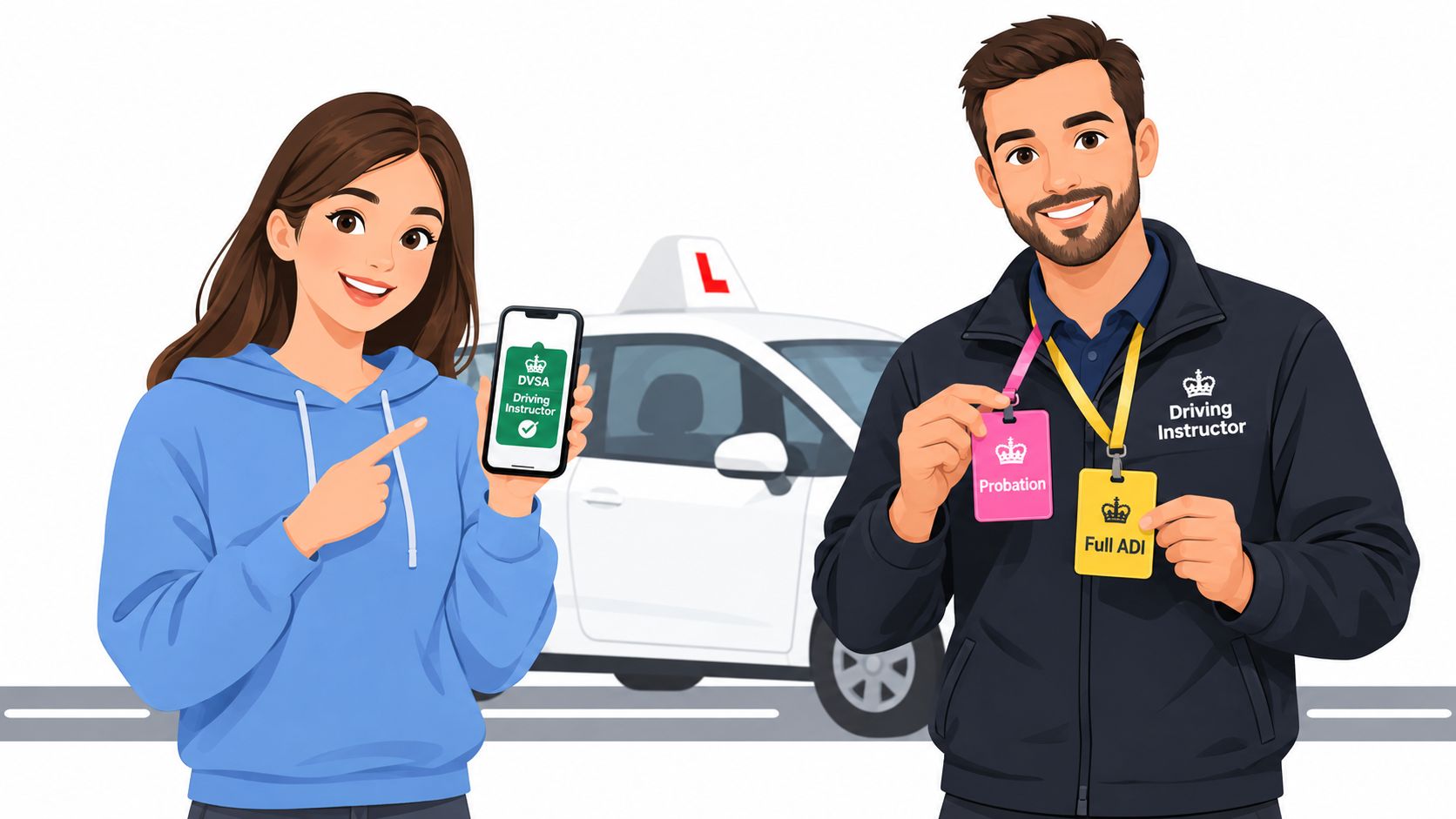
A qualified Approved Driving Instructor, or ADI, must display a green badge in the vehicle windscreen. A trainee instructor, also called a PDI, must display a pink badge. The ADI register guide explains these requirements and the rules around trainee instruction.
What the badge colours mean
- Green badge: The instructor is a qualified ADI.
- Pink badge: The instructor holds a valid trainee-instructor licence.
- No badge: Don't pay for the lesson until the instructor explains and resolves the issue.
A trainee instructor can gain up to six months of on-road teaching experience before taking the ADI Part 3 test, provided the relevant licence conditions apply. That doesn't automatically make a PDI a poor instructor, but you should know who is teaching you and whether the price reflects that status.
Checks I'd make before taking a deposit
Confirm the status. Ask whether your lessons will be delivered by an ADI or PDI, and ask to see the appropriate badge in the windscreen.
Check the vehicle. It should have suitable dual controls, valid insurance and a current MOT where required. The provider should be clear about which vehicle you'll use and whether it meets the practical test requirements.
Ask about cover. If your instructor becomes unavailable halfway through an intensive course, find out whether the provider can offer a replacement instructor without changing the agreed tuition terms.
Read the written terms. Cancellation rules, refunds, deposits and test-day vehicle arrangements should appear before payment, not arrive as a surprise after booking.
The guide to checking whether an instructor is approved is useful, but you should still inspect the badge yourself. A professional provider won't object to a basic verification question.
Why the Cheapest Hourly Rate Is Not Always the Cheapest Route
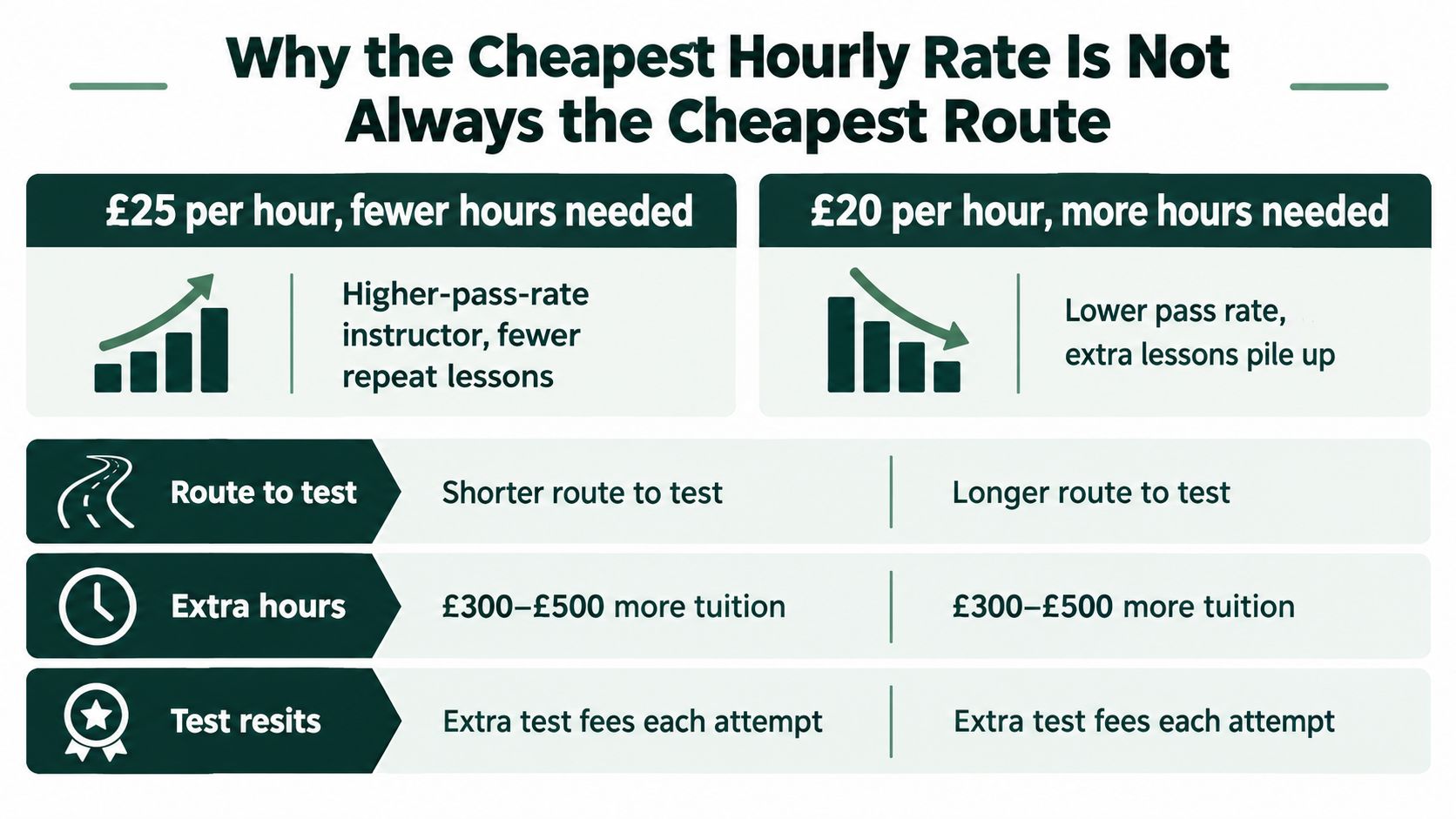
The lowest hourly figure can produce the highest final bill when it comes with poor availability, long gaps or extra travel. Learners often calculate pounds per lesson while ignoring the number of weeks they'll spend getting ready for the test.
Location is a major factor. DVSA evidence shows that learner experiences vary significantly between areas, with published examples of median waits ranging from 6.7 weeks at Darlington to 24.3 weeks at Banbury. A learner facing the longer wait may need maintenance lessons to keep skills fresh, or may travel to another test centre and pay for extra preparation.
Transmission creates a similar trade-off. BBC reporting found that one in four UK driving tests was taken in an automatic car in 2025, while the AA predicted 29% in 2025/26, as reported in the research cited for this guide. Automatic tuition may suit someone prioritising speed and simpler vehicle control, but local automatic-instructor availability and the licence restriction after passing still matter.
Measure value in time as well as pounds
Suppose one instructor charges less but can offer only irregular daytime slots. Another costs more but can provide regular evening lessons and a test-area mock test. The second option may reduce missed work, prevent skill decay and avoid buying scattered top-up lessons.
A higher hourly rate also isn't automatically good value. The instructor still needs to teach clearly, provide regular appointments and give an honest readiness assessment. What matters is the total route from first lesson to licence.
Ask these questions before comparing two prices:
- How soon can I start? A lower rate with no regular slots may delay your progress.
- Where will I take the test? The local test centre can affect waiting time and preparation needs.
- Which transmission fits my plans? Choose the car you can learn confidently and drive after passing.
- What happens during the wait? Ask whether maintenance lessons or test-alert support are available.
- What does test day cost? Confirm car hire, instructor attendance and any separate charges.
Fast Track Driving Lessons is one example of a provider offering fixed-rate manual and automatic tuition, course sizes from 10 to 40 hours, instructor matching and support with test availability. Its published information states a single hourly rate of £61.23, with DVSA fees kept separate. Compare those terms with local independent instructors rather than assuming a fixed rate is automatically cheaper or dearer.
The right question isn't “Who charges the least?” It's “Which option gives me a realistic route to test standard, at a time I can sustain, with no missing costs?”
Your Practical Pricing Checklist Before Booking
Before paying a deposit, put two course offers side by side and ask the same questions.
- Hours included: Is the package based on genuine one-hour tuition sessions?
- Instructor status: Will an ADI or PDI deliver the lessons?
- Vehicle arrangements: Is the dual-control car included, and can you use it for the practical test?
- DVSA fees: Are the theory and practical test charges shown separately?
- Extra hours: What happens if you aren't ready when the booked hours end?
- Retests: Who pays for additional lessons, test bookings and test-day vehicle hire?
- Availability: Can the provider offer regular appointments and cover an unavailable instructor?
- Payment terms: Are instalments, deposits, refunds and cancellation rules written clearly?
A fair price is one you can explain before you pay it. If an advert gives you an hourly figure but won't tell you the likely hours, test-day costs or cancellation terms, keep looking.
Fast Track Driving Lessons offers fixed-rate manual and automatic intensive or semi-intensive courses from 10 to 40 hours, with instructor matching and separate DVSA fee information. Visit Fast Track Driving Lessons to compare course options and plan your driving budget before booking.
Written by Fast Track editorial team.