
The examiner is due soon. You've checked the route, practised the manoeuvres and rehearsed the show-me, tell-me questions, but small oversights can still derail the appointment before your driving is assessed. A missing document, unsuitable car or failed eyesight check can turn careful preparation into a cancellation.
A useful drivers test checklist separates the critical risks from skills that only become reliable through repeated practice. Start with legal and vehicle checks, then assess your junction work, observations, hazard response and manoeuvres under realistic conditions. The GOV.UK guidance on driving test faults and results confirms that you can pass with no more than 15 driving faults, but you must record zero serious or dangerous faults. One serious or dangerous error ends the test, even if everything else has gone well.
Use the eight checks below as a timed readiness system. Complete the administrative checks first, schedule mock-test practice early enough to fix weaknesses, and finish with a calm two-minute scan rather than frantic last-minute cramming.
Table of Contents
- 1. Vehicle Documentation and Insurance Verification
- 2. Eyesight Check Readiness
- 3. Practical Manoeuvres Confidence and Competence
- 4. Knowledge of Key Traffic Signs and Road Markings
- 5. Mock Test Completion on Your Local Test Route
- 6. Mirror Checks and Observation Technique Mastery
- 7. Hazard Perception and Speed Adjustment Competence
- 8. Theory Test Knowledge Reinforcement and Emergency Procedure Awareness
- 8-Point Driver Test Comparison
- The Two-Minute Test-Day Reset
1. Vehicle Documentation and Insurance Verification
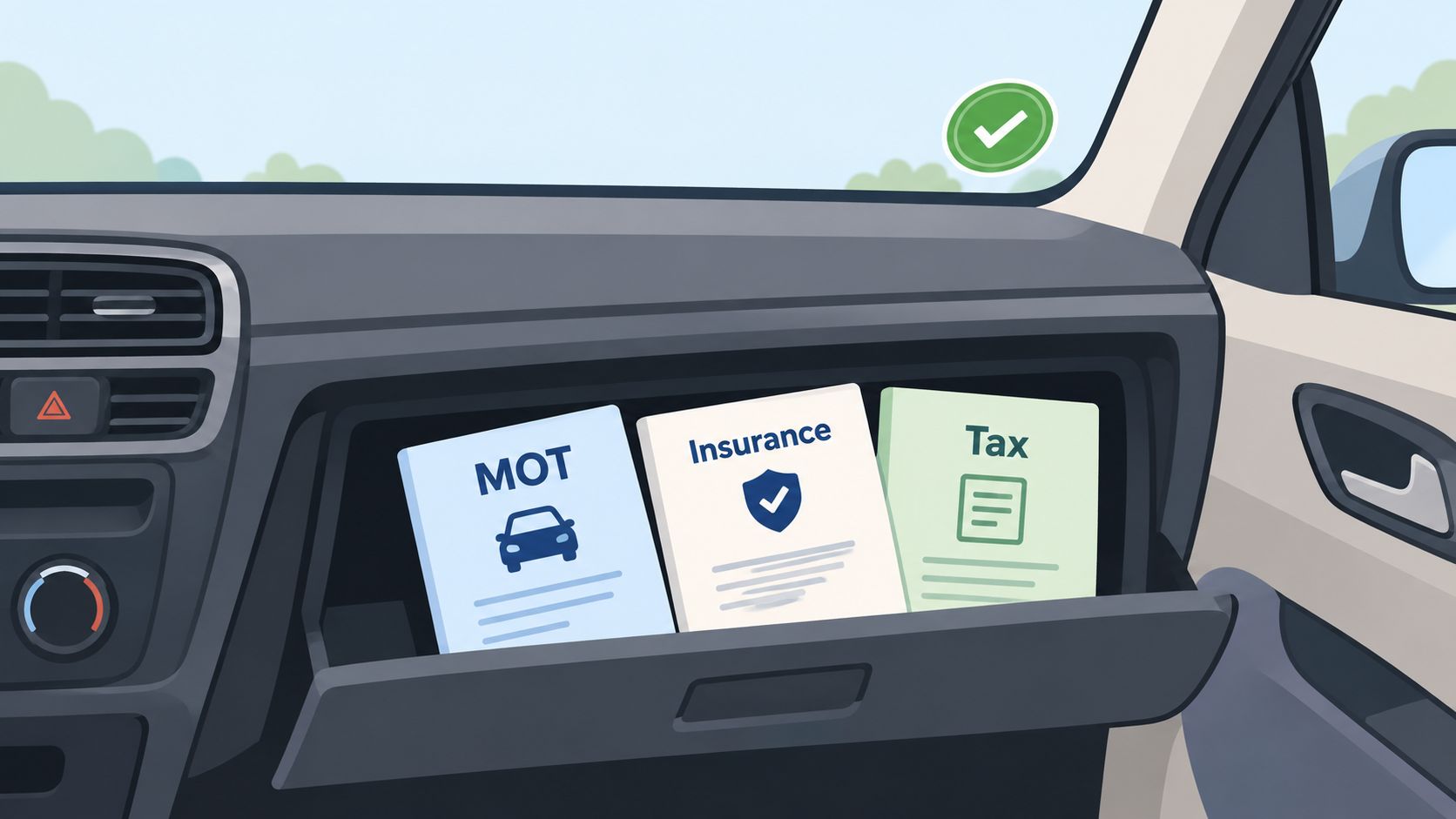
A suitable test car needs more than a clean interior and enough fuel. Before you sit the test, verify that its MOT, road tax and insurance are current and that the policy covers the vehicle being used for the appointment. If the car fails the examiner's initial requirements, the practical test can't proceed, and your preparation and fee may be lost.
Instructor-provided cars can reduce administration. Fast Track Driving Lessons uses dual-control vehicles maintained for learner tuition and designed to meet DVSA test requirements. If you're using your instructor's car, ask them to confirm the vehicle's readiness and insurance position for your specific test date. If you're taking a parent's car, the responsibility sits with you. Don't assume that a vehicle used regularly for lessons is automatically ready for a test.
Complete the paperwork check the day before
Put the documents and confirmation details together before test morning. Keep photographs for your own records, but rely on current, valid documents rather than an old image.
- Check the MOT: Confirm the renewal date and make sure there's no outstanding issue that could affect the vehicle.
- Verify insurance: Ask whether the policy covers learner tuition and the practical test on the exact date.
- Confirm tax status: Check that the car remains legally taxed for road use.
- Check the registered keeper: Make sure the keeper information and insurance details are consistent.
- Inspect the car: Test lights, indicators, tyres, mirrors, seatbelts, horn and wipers before leaving.
If you need ownership evidence for a privately supplied vehicle, keep relevant paperwork organised, including proof of car ownership. The UK guide to what to take to your practical driving test can help you check the appointment details and personal documents alongside the car requirements.
2. Eyesight Check Readiness
The eyesight check happens before you drive. You must read a vehicle number plate from 20 metres away. If you cannot read it, the appointment ends before the practical test starts. Check this requirement during a lesson and bring the glasses or contact lenses you use for driving.
Make the check part of your timed preparation. During the week before the test, arrange an optician appointment if your vision has changed, your glasses feel uncomfortable, or you are using an old prescription. Contact-lens users should carry glasses as a backup. If you wear glasses, take a spare pair where possible.
Use a two-minute vision scan
Two minutes before leaving home, clean your lenses, check your case, and put on the correction you intend to use. This small routine removes avoidable delays and gives your eyes time to settle before the examiner asks you to read the plate.
- Clean your glasses: Wipe them before leaving, rather than at the test centre.
- Check your backup: Pack spare glasses or contact lenses if you have them.
- Allow adjustment time: Put on glasses before the eyesight check, especially if you do not wear them continuously.
- Check comfort: If contact lenses feel dry or irritating, follow your optician's advice and carry suitable rewetting drops.
- Answer accurately: If the plate is unclear, say so. Guessing will not solve a vision problem.
- Plan the correction: If you fail the eyesight check, arrange another test after addressing the problem.
During lessons, tell your instructor about any change in vision. They can help you decide whether your correction works reliably in changing light, while keeping the final decision with your optician. The Fast Track theory question about wearing glasses to read a number plate reinforces that eyesight requirements form part of licensing readiness.
3. Practical Manoeuvres Confidence and Competence
You are halfway through a reverse bay park when the starting position feels wrong, a cyclist appears behind you, and the reference point no longer matches. Test readiness shows in your response. The examiner may ask for a reverse bay park, reverse around a corner or parallel park, so practise controlling the car and recovering safely in changing situations.
Use reference points to support your judgement, not replace it. A wing-mirror alignment or roadside landmark may help, but the same point will not work identically in every vehicle. Rehearse each manoeuvre in different spaces and from varied starting positions, then check around the car before and throughout every reversing movement.
Use a timed recovery routine
During practice, give yourself time to prepare, move, stop and reassess. A small positioning error can be corrected safely. Forcing the car onward because you feel behind schedule creates greater risk.
Ask your instructor to alter the starting position, road layout and surrounding traffic. This builds a repeatable process instead of a memorised script.
Fast Track's Manoeuvre Finisher course provides focused practice over 15 hours, and its mock tests can include manoeuvres on roads near your chosen test centre. Local practice reduces unfamiliarity, while independent observation and control remain your responsibility.
Run this check whenever you practise:
- Prepare: Select the correct gear, secure the car and establish all-round awareness.
- Move slowly: Use clutch, brake and steering smoothly, with enough control to stop promptly.
- Scan continuously: Check mirrors and the areas around the vehicle throughout the manoeuvre.
- Pause early: Stop if a pedestrian, cyclist or vehicle changes the situation.
- Recover calmly: Reassess the position, then make a safe correction rather than rushing to finish.
On test day, make the final two-minute scan before moving off: confirm the seat, mirrors, doors and controls, then settle your breathing and review the observation routine. The aim is controlled decision-making, not a flawless first attempt.
The following demonstration can help you revisit the movement, but your instructor should assess your observation and control in the car used for the test.
4. Knowledge of Key Traffic Signs and Road Markings
A sign can appear seconds before a junction, roadworks area or lane change. Read it early, decide what it requires, then adjust speed, position or direction without rushing. During the practical test, the examiner is assessing your response, not your ability to recite sign names. Missing a road marking can become a driving fault, while ignoring a mandatory instruction can create a serious safety risk.
Use ordinary lessons as revision time. At temporary roadworks, identify the sign, check the new limit or lane arrangement, and act before reaching the restriction. If a sign is partly hidden, combine its visible details with road markings, the road layout and traffic conditions. If an examiner's direction is unclear, ask them to repeat it. Guessing at a junction can lead to a worse decision than requesting clarification.
Make sign recognition a timed driving habit
Give yourself a short check during each drive. Start with the signs you confuse most, then test whether you can turn recognition into a safe action.
- Review difficult signs: Keep a personal list and revisit it before lessons.
- Check temporary signs: Roadworks may alter speed limits, lanes and priorities.
- Read markings early: Arrows, box junctions, hatched areas and lane lines affect where you should position.
- Follow the displayed limit: A quiet road does not cancel a lower speed restriction.
- Explain the response: Ask why a sign changes your speed, lane choice or position.
The common UK road signs guide supports focused revision. Fast Track's Learner Hub also provides DVSA-style theory questions for sign recognition. On a mock route, ask your instructor to identify signs and markings near the test centre, then practise the response rather than memorising their locations.
Before moving off on test day, use the final two-minute scan to confirm the relevant signs, markings and speed limit. This small routine helps replace last-minute nerves with deliberate observation.
5. Mock Test Completion on Your Local Test Route
A lesson can feel comfortable because your instructor gives frequent prompts. A mock test removes that safety net and shows whether you can make decisions independently while following directions. It should reproduce the pressure and flow of the appointment itself, including normal driving, independent driving, manoeuvres and examiner-style feedback.
The DVSA's Ready to Pass checklist says learners should drive consistently, confidently and independently without instructor prompting. It also recommends full mock tests as a readiness benchmark, rather than using lesson count alone. That distinction matters. Calendar time doesn't prove competence, and a learner who still needs reminders at every junction probably needs more targeted practice before taking the test.
Schedule feedback early enough to act
Book a mock test with enough time to address the results. Ask your instructor to mark strictly and record specific faults, not just give a general verdict. If the mock identifies weak observations at junctions, poor lane position or rushed speed decisions, spend the next lessons on those behaviours rather than repeating comfortable routes.
A local route offers useful familiarity, but it isn't a guarantee. Test routes can vary, traffic changes and the examiner may give an unfamiliar direction. Learn the road patterns and hazards, not a memorised sequence of turns.
Practical rule: Treat a mock test as a decision point. If you need prompts, repeat serious errors or lose control under pressure, delaying the test may be wiser than hoping for a quiet route.
Fast Track Driving Lessons provides mock tests near the chosen test centre, with feedback focused on examiner-marked faults. Its PracticalTest Assist service also monitors DVSA test alerts and supports cancellation-based rescheduling, which can help when readiness and appointment availability don't line up.
6. Mirror Checks and Observation Technique Mastery
Observation is visible in the way you prepare for an action. The examiner needs to see that you know what's behind and beside you before slowing, turning, changing lanes or moving away. A mirror glance made after the action has started is too late to support a safe decision.
Make the sequence automatic during ordinary driving. Before changing speed, check the relevant mirrors. Before changing direction or position, check mirrors, signal when needed and confirm the blind spot. The exact routine depends on the situation, but the principle remains consistent: gather information before committing the car to movement.
Practise aloud, then make it natural
Narrating can expose gaps in your routine. Say, “Mirror check, shoulder check, clear, moving left,” during practice, then ask your instructor whether the checks were early enough and directed at the right areas. Don't turn narration into a performance for the examiner. Use it as a training tool until the habit becomes reliable without conscious prompting.
Before every action, ask what could be affected by your next movement.
Use these practical drills:
- Before braking: Check mirrors for following traffic, then brake smoothly.
- Before turning: Check mirrors early, signal where appropriate and scan the road you're entering.
- Before changing lanes: Check mirrors, signal and perform a clear lifesaver glance.
- Before moving off: Check around the vehicle and confirm the road remains clear.
- During manoeuvres: Keep observing rather than staring at one reference point.
The blind-spot guidance for larger vehicles reinforces why mirror adjustment alone isn't enough. During your mock test, ask for separate feedback on mirror timing, blind-spot checks and forward scanning.
7. Hazard Perception and Speed Adjustment Competence
Good hazard perception starts before a situation becomes urgent. Parked cars, pedestrians, cyclists, delivery vehicles, poor road surfaces, weather and animals can all change the space available to you. The examiner wants to see that you identify developing risk, choose a safe speed and leave yourself room to respond.
A common weak pattern is waiting until the hazard is close, then braking sharply. Instead, scan ahead, identify what might affect your path and ease off the accelerator when appropriate. That gives you more time and reduces the need for an abrupt response. You still need to make progress, but progress isn't the same as driving at the maximum permitted speed in every situation.
Use a repeatable scanning pattern
Scan the road ahead, check mirrors, inspect side roads and reassess the space around you. Residential roads often demand careful decisions because parked vehicles, pedestrians and emerging traffic can appear with little warning. Ask your instructor to explain why they slowed or changed position, then apply the same reasoning yourself.
- Scan ahead: Look beyond the vehicle immediately in front.
- Identify risk: Decide what could enter your path or restrict your space.
- Predict movement: Consider what pedestrians, cyclists and other drivers may do.
- Choose early: Adjust speed or position before the hazard becomes urgent.
- Execute smoothly: Steer, brake or pause with controlled movements.
The SIPDE method, Scan, Identify, Predict, Decide and Execute, gives you a useful mental structure. Don't recite it while driving. Use it to review decisions after each lesson and during mock-test feedback.
Fast Track's intensive tuition and Learner Hub resources can support hazard-management practice, while local mock routes expose you to recurring environments such as school crossings and parked delivery vans. If you miss one hazard during the test, recover your attention immediately. Dwelling on a previous mistake can create the next one.
8. Theory Test Knowledge Reinforcement and Emergency Procedure Awareness
Practical readiness includes understanding why you're making decisions, not just repeating vehicle movements. The theory test has two parts for car candidates. The official pass marks are 43 out of 50 for multiple choice and 44 out of 75 for hazard perception, and both sections must be passed in the same sitting, as set out in the published theory-test pass marks. Those thresholds make theory preparation a separate gate from practical skill.
Continue revising rules during driving lessons. You may be asked about vehicle safety or emergency procedures, and the rules you studied also shape your practical decisions around speed, signals, seatbelts, traffic lights and road markings. You should be able to explain what you'd do if the brakes failed, how to respond to a breakdown and when hazard warning lights are appropriate.
Explain the reason behind the action
Ask your instructor questions such as, “Why did we check that mirror before turning?” Understanding the reason helps you transfer the rule to unfamiliar roads. Practise answering aloud so you can respond clearly rather than searching for memorised wording.
- Review emergency procedures: Cover brake failure, steering failure, emergency stops and breakdown safety.
- Revisit seatbelts: Know the practical responsibilities for everyone in the car.
- Practise show-me tasks: Operate controls without losing safe observation.
- Use reliable material: Review the official DVSA learning guidance alongside instructor teaching.
- Admit uncertainty: If you don't know an answer, don't invent one.
Fast Track's Learner Hub provides DVSA-style questions and step-by-step driving guides, while its wider theory training service is aimed at learners who need structured support across the theory process. Revision should strengthen practical judgement, not replace time behind the wheel.
8-Point Driver Test Comparison
| Item | Implementation complexity | Resource requirements | Expected outcomes | Ideal use cases | Key advantages |
|---|---|---|---|---|---|
| Vehicle Documentation and Insurance Verification | Low, administrative task | Valid MOT, tax, physical insurance docs, compliant vehicle | Test proceeds; avoids automatic cancellation | Using instructor vehicle or preparing private car for test | Ensures legal compliance; reduces test-day cancellations |
| Eyesight Check Readiness | Low, single objective check | Optician appointment, corrective lenses/spare pair | Pass/fail eyesight checkpoint before driving begins | Learners who wear or suspect need for glasses/contacts | Quick verification of legal visual standard; prevents test termination |
| Practical Manoeuvres Confidence and Competence | High, repeated supervised practice | Instructor, dual-control vehicle, focused 15-hour course, mock scenarios | Consistent execution of reversing/turning manoeuvres | Learners weak on reversing, parking, or under pressure | Builds precision and confidence for manoeuvres under test conditions |
| Knowledge of Key Traffic Signs and Road Markings | Medium, study + on-road recognition | Theory materials, instructor explanations, Learner Hub questions | Correct compliance with signs and road markings during test | Learners needing sign-recognition reinforcement | Objective, transferable safety knowledge; supports theory and practical tests |
| Mock Test Completion on Your Local Test Route | Medium, logistical planning + strict marking | Instructor time, realistic test route, DVSA-style marking | Reveals weak areas; reduces test-day anxiety; targeted feedback | Near-test preparation to simulate real exam conditions | Familiarises candidate with route and timing; actionable feedback |
| Mirror Checks and Observation Technique Mastery | Medium, habit training over time | Regular lessons, instructor feedback, mock video review | Automatic, frequent mirror/shoulder checks; fewer observation faults | Learners who forget checks under pressure | Directly improves safety and examiner-observable behaviour |
| Hazard Perception and Speed Adjustment Competence | High, ongoing situational training | Instructor guidance, varied driving environments, Learner Hub exercises | Earlier hazard detection; smoother speed/position adjustments | Drivers in residential or variable-traffic areas | Enhances defensive driving and reduces reactive errors |
| Theory Test Knowledge & Emergency Procedure Awareness | Medium, study and verbal practice | DVSA-style theory resources, Learner Hub, instructor Q&A | Ability to explain procedures and apply rules under test | Those who might be asked theory questions during practical | Improves decision-making and readiness for emergency scenarios |
The Two-Minute Test-Day Reset
Run the final scan immediately before the appointment, when the car is parked safely and you have enough time to think. Start with the essentials. Confirm the test centre, date and time, check your licence is with you, and make sure the car's documentation and insurance arrangements have already been verified. If your instructor is supplying the vehicle, ask for a final confirmation rather than carrying the uncertainty into the waiting area.
Next, deal with eyesight. Clean your glasses, fit your contact lenses comfortably and keep a spare option available if you have one. You don't want to discover a smudge, missing case or uncomfortable lens while the examiner is preparing the test.
Settle into the familiar driving position before the examiner arrives. Adjust your seat, steering position and mirrors, then identify the controls you may need. Check that your seatbelt is secure and that you understand how the car's lights, wipers, demisters and warning controls operate. Don't start experimenting with unfamiliar settings at the last moment.
Use the reset in order
- Documents: Licence, appointment details and vehicle confirmation.
- Eyesight: Clean glasses or comfortable contacts, with a spare where possible.
- Position: Seat, steering wheel, mirrors and seatbelt adjusted.
- Controls: Wipers, lights, demisters, indicators and parking brake familiar.
- Mindset: One calm breath, then focus on the next safe decision.
You don't need to demonstrate a flawless drive before the examiner arrives. You need to show consistent, independent driving without instructor prompting, which is the readiness standard highlighted by DVSA guidance. The DVSA practical pass-rate dataset for cars also includes test-centre outcomes and availability information, so preparation may involve choosing a workable centre and planning around appointment demand, not just polishing skills on the day.
The national car practical pass rate was 48.7% in 2024/25, according to the DVSA failure-reasons publication, and it was 50.0% in 2025/26, with 1,998,621 tests and 1,000,043 passes reported for that latter year in the published series at Driving Theory Test. Those figures are a reminder that last-minute polishing can't substitute for dependable junction observations, mirror routines, lane discipline and vehicle control. The official failure-reasons guidance identifies ineffective observations at junctions, incorrect mirror use when changing direction, unsafe moving off, incorrect positioning when turning right and poor steering control among the leading reasons for failure. Prioritise those behaviours in your final lessons.
Follow your instructor's final advice, but don't cram a new technique on the morning of the test. Use this drivers test checklist to confirm that your preparation is in place, not to create another source of anxiety. If you're still receiving prompts or making serious faults in mock tests, consider delaying and using the time to practise deliberately. If you're ready, breathe, listen carefully to the examiner and handle one decision at a time.
Fast Track Driving Lessons offers intensive and semi-intensive manual or automatic tuition, local mock tests, theory resources and support with suitable DVSA test cancellations. Visit Fast Track Driving Lessons to match with a DVSA-approved instructor and turn this checklist into a focused preparation plan.
Written by Fast Track editorial team.