
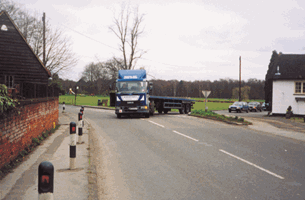
The answer options
- Slow and give wayCorrect
- Report the driver to police
- Speed up and squeeze past
- Sound your horn
Why the other options are wrong
- “Report the driver to police” is a distractor. It does not meet the standard the question is testing, which slow and give way does. Picking it in the real test costs a mark you cannot get back, and with a pass mark of 43 out of 50 you only have seven to spare.
- “Speed up and squeeze past” is a distractor. It does not meet the standard the question is testing, which slow and give way does. Picking it in the real test costs a mark you cannot get back, and with a pass mark of 43 out of 50 you only have seven to spare.
- “Sound your horn” is a distractor. It does not meet the standard the question is testing, which slow and give way does. Picking it in the real test costs a mark you cannot get back, and with a pass mark of 43 out of 50 you only have seven to spare.
Why that is the answer
Large vehicles, buses, and agricultural machinery often need extra time and space to manoeuvre or negotiate narrow roads. You must slow down and give way to allow them to clear the hazard safely. Speeding up or trying to squeeze past is extremely dangerous because of their large blind spots. Sounding your horn is aggressive and unnecessary. The Highway Code advises driver patience and courtesy when sharing the road with larger vehicles.
What other types of vehicle covers
- · Long vehicles swinging wide at junctions and roundabouts
- · Overtaking lorries and the spray and buffeting involved
- · Buses pulling out and priority at bus stops
- · Trams, tram lanes and the surfaces around rails
Mistakes learners repeat on this topic
- · Filling the gap when a lorry moves right to turn left
- · Overtaking a tram on the wrong side or crossing rails at a shallow angle
- · Following a large vehicle closely and losing sight of its mirrors
- · Cutting in too soon after overtaking a long vehicle
Instructor tip: If you cannot see a lorry driver's mirrors, assume the driver cannot see you — that logic answers most of this band.
How this comes up in the real test
Questions from other types of vehicle appear throughout the 50-question multiple-choice section, and the wording changes between versions. Learn the rule rather than the sentence: the DVSA can ask the same point from the opposite direction, and a memorised answer falls over the moment the phrasing moves.
The pass mark is 43 out of 50, so seven wrong answers is your entire margin. If a whole category is shaky, run the topic practice below until you are getting every question right for the right reason, then go back to full mocks under the clock.
More other types of vehicle questions
- It is harder to overtake a large vehicle than a car. Why is this?
- There is a lot of wind. If you're following a motorbike rider who is passing a car with a high side, what should you do?
- What should be your biggest concern when a bus pulls up at a bus stop in front of you?
- What should you do if there is a bus pulled into a bus stop on the road ahead of you?
- What should you do if you see this lorry?
- What should you do when overtaking a cyclist in very windy conditions?