
Roughly rules 159 to 203 cover the everyday mechanics of driving on ordinary roads: which lane to use, how far back to sit from the vehicle in front, how to signal your intentions, and how to position yourself through bends and on single-track roads. It's dense with detail but forms the bulk of what an examiner is checking during a practical test drive.
For the theory test, this section feeds directly into the safety margins and safe distance categories, and it's also where a lot of the two-second and stopping-distance style questions originate. Learners frequently mix up the recommended following gap with the actual stopping distance figures, which are two different things.
Lane discipline
On a multi-lane road, you should normally keep to the left-hand lane unless overtaking or a lane is closed ahead, and you shouldn't sit in a middle or right-hand lane longer than necessary. Undertaking — overtaking on the inside — should be avoided except in slow-moving queues where traffic in the right-hand lane is moving more slowly than your lane.
Following distance
The often-quoted advice is to leave a minimum two-second gap in good, dry conditions, doubling it to at least four seconds in wet weather, and increasing it further in icy conditions. This is a should-guideline based on typical reaction and braking times rather than a fixed legal distance, but the theory test treats it as a firm rule of thumb you're expected to know.
Single-track roads and passing places
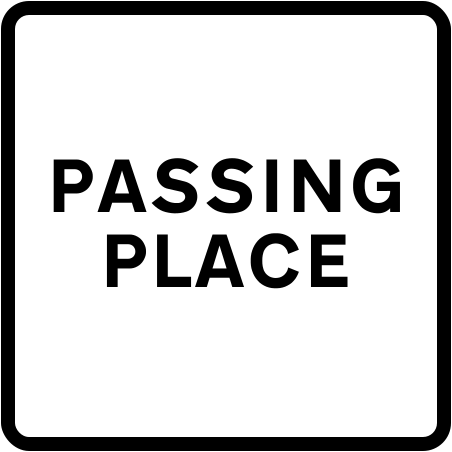
On narrow single-track roads, you should pull into a passing place, or wait opposite one, to let oncoming traffic through, and you shouldn't park in a passing place unless there's no alternative. Give way to any vehicle already committed to a passing place rather than trying to push past.
Signalling and positioning through bends
Signal early enough to give following traffic and pedestrians time to react, but not so early that it could be misread as applying to an earlier junction. Position your vehicle correctly for the direction you intend to take well before reaching a junction, since late positioning is one of the more common faults examiners note in practical tests.
Frequently asked questions
What is the recommended following distance in dry conditions?
At least a two-second gap behind the vehicle in front, measured by picking a fixed point and counting the seconds until you reach it yourself. This should double in wet weather and increase much further on icy roads.
When is undertaking allowed?
Generally you shouldn't overtake on the inside, but in slow-moving queued traffic it's acceptable if the lane to your left is moving faster than the lane to your right, since you're following your own lane's pace rather than deliberately cutting past.
What should I do if I meet another car on a single-track road?
Pull into or wait opposite a passing place to let the oncoming vehicle through, giving way to any vehicle already committed to using one. Don't park in a passing place unless you have no other choice.
Why do theory test questions ask about stopping distance in different weather?
Because braking distance increases significantly on wet or icy roads, and the test checks you understand how much extra room you need to leave. Doubling your gap in the wet and multiplying it further on ice reflects genuine physical stopping differences.
How early should I signal before a turn?
Early enough that following traffic and pedestrians have time to react, but not so early it could be mistaken for an earlier junction. Timing your signal correctly is judged closely on the practical driving test.