
The pedestrian section opens the Highway Code for a reason: people on foot are among the most vulnerable road users, with nothing around them to absorb an impact. Rules 1 to 35 set out how pedestrians should behave, where they should walk, and how they should cross safely, but they matter just as much to you as a driver because you need to anticipate what a person walking might do next.
For the theory test, examiners expect you to recognise pedestrian crossing types, understand priority at junctions, and know how to behave around groups who need extra time or space, such as children, older people, or people with disabilities. Mock tests often catch learners out on crossing-type recognition and on when a pedestrian technically has priority even without a marked crossing.
Where pedestrians are expected to walk
Pavements exist for a reason, and the guidance is clear that people on foot should use them where they're provided, keeping well back from the kerb, especially with children. Where there's no pavement, the advice is to face oncoming traffic so a pedestrian can see what's coming and react, though at a bend this may be reversed to stay visible to drivers.
As a driver, you should expect pedestrians on roads without pavements, particularly on country lanes at dusk. Don't assume a country road is empty just because it looks quiet.
Crossing the road safely
The core message for pedestrians is to find a safe place to cross, look and listen properly, and keep checking while crossing rather than assuming a gap will stay open. Drivers should recognise that pedestrians are permitted to begin crossing between vehicles or away from a formal crossing, and that doesn't make them at fault.
You'll also see guidance on crossing at or near a junction, where a pedestrian who has started crossing has priority over a vehicle turning in or out. This trips learners up because it feels counter-intuitive when you're focused on the turn itself.
Recognising crossing types
The theory test regularly asks you to identify crossings from a photo or description, so it helps to keep the differences straight in your head.
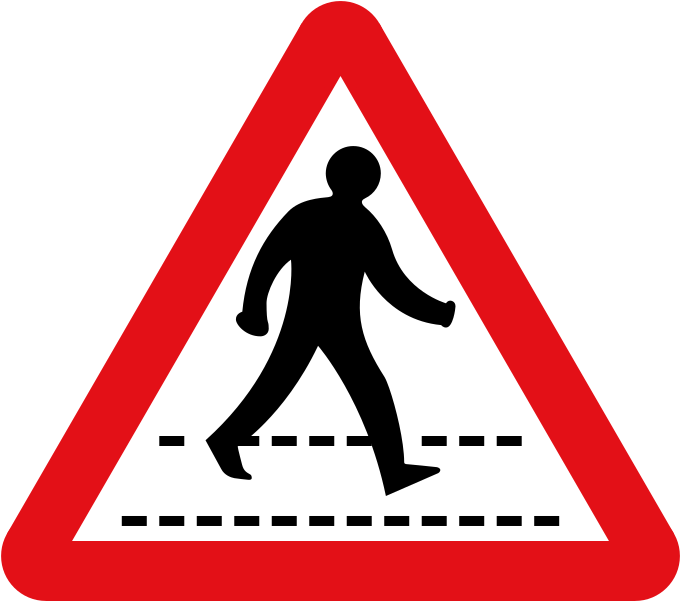
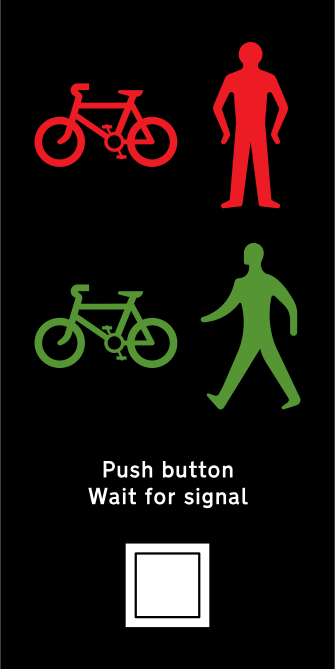
- Zebra crossing — black and white stripes, no lights, give way as soon as someone steps on or waits to cross.
- Pelican crossing — light-controlled, push-button, with a flashing amber phase where you must give way if pedestrians are still crossing.
- Puffer crossing — uses sensors rather than a fixed flashing phase, so timing adjusts to how long people need.
- Toucan crossing — shared by pedestrians and cyclists, so riders may cross rather than dismount.
- Zebra-style crossings with a central island are treated as two separate crossings.
Extra care for certain groups
The Highway Code asks drivers to give extra time and space to children, older pedestrians, people with prams, and anyone who appears to have a visual, hearing, or mobility impairment. A white cane, particularly with a red band, or a guide dog in a burgundy harness signals someone who may not be able to see or hear an approaching vehicle.
Around schools, be ready for a lollipop patroller's stop sign, and treat any signal to stop as absolute — don't try to sneak through before they've fully raised or lowered it.

Frequently asked questions
Who has priority when a pedestrian is crossing at a junction?
A pedestrian who has already started to cross a side road has priority over a vehicle turning into or out of that road. Drivers must give way, even though it can feel like the turning vehicle should go first. This scenario appears often in hazard perception and multiple-choice questions.
What does the flashing amber light on a pelican crossing mean?
It means you may proceed only if no pedestrians remain on the crossing. If anyone is still crossing, you must give way. This differs from a normal amber light, and mixing the two up is a common theory test error.
Do I have to stop for pedestrians waiting at a zebra crossing?
Yes. Once someone is waiting to cross or has stepped onto a zebra crossing, you must stop and let them cross. You should also avoid waving them across, since your view of other traffic may be blocked.
What is the difference between a toucan and a puffer crossing?
A toucan crossing allows cyclists to ride across alongside pedestrians rather than dismounting. A puffer crossing uses sensors to detect how long pedestrians need, rather than a fixed timed sequence, so the light stays red until the crossing is clear.
How should I treat a pedestrian carrying a white cane with a red band?
This indicates the person is both deaf and blind, so they may not react to your engine or horn at all. Give them plenty of time and space, and never assume they've noticed your vehicle.