
Overtaking is one of the higher-risk manoeuvres in driving because it usually involves crossing into the path of oncoming traffic or moving decisively past another road user, and the Highway Code sets out clear conditions for when it's safe and when it's against the rules altogether. This includes distance guidance for passing cyclists, horse riders, and pedestrians as well as rules about lines, signs, and specific locations.
Overtaking questions appear across several theory test categories, including safety margins, hazard awareness, and road and traffic signs, since solid white lines and no-overtaking signs are commonly tested alongside distance-judgement scenarios.
Before you commit to overtaking
You should only overtake if you can see the road ahead is clear far enough to complete the manoeuvre safely, without needing to exceed the speed limit, and without cutting back in too soon. If in doubt, don't overtake — the Highway Code frames this as a should-guideline underpinned by the basic legal duty to drive without endangering others.
Overtaking vulnerable road users
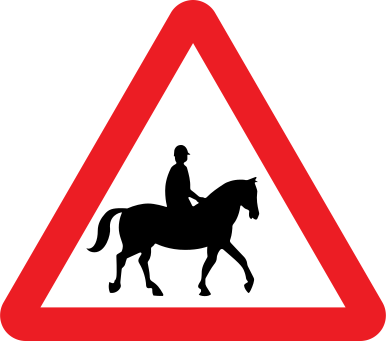
As covered in more detail under cyclists and motorcyclists, you must leave at least 1.5 metres when passing a cyclist at usual urban speeds, and give similar consideration to horse riders and pedestrians in the road, slowing down and being ready to stop. Never overtake a horse rider on a bend or close to a junction where visibility is limited.
Where overtaking is not allowed
Solid white lines down the centre of the road mean you must not cross or straddle them to overtake unless the lane is closed ahead, an entrance is nearby, or the vehicle in front is stationary and obstructing the road. Overtaking is also prohibited approaching or at a pedestrian crossing, and it's generally unsafe near brows of hills, bends, and junctions even where no specific line marking bans it.
- Never overtake where you can't see far enough ahead to be sure it's clear.
- Don't overtake if it would mean exceeding the speed limit.
- Don't overtake just before a junction, roundabout, or pedestrian crossing.
Being overtaken
If someone is overtaking you, the guidance is to maintain your speed and position rather than speeding up, and to allow room for them to complete the manoeuvre and pull back in safely. On a dual carriageway or motorway, move back to a left-hand lane once it's safe rather than sitting in a middle lane unnecessarily, which helps other traffic overtake smoothly.
Frequently asked questions
When is it illegal to overtake using a solid white line?
You must not cross or straddle a solid white line to overtake unless the way ahead is clear, you're passing a stationary vehicle, entering a side road, or a lane is closed ahead. Doing so otherwise is a legal offence, not just poor practice.
How far ahead should I be able to see before overtaking?
Far enough to be certain you can complete the manoeuvre and return to your side of the road safely before meeting any oncoming traffic, without needing to speed. If there's any doubt, the correct answer on the theory test and in real driving is not to overtake.
What should I do if someone is overtaking me?
Maintain your current speed and road position, and don't accelerate, which is sometimes called 'racing' and is unsafe and inconsiderate. Allow the overtaking vehicle room to pull back in safely.
Can I overtake near a pedestrian crossing?
No, overtaking the moving vehicle immediately ahead of you when approaching a pedestrian crossing is not allowed, since it removes your ability to see and react to pedestrians. This is a frequent theory test question.
Why shouldn't I overtake near the brow of a hill?
Because you can't see whether the road ahead is clear of oncoming traffic, so you have no way of judging whether the manoeuvre is safe. The same reasoning applies to bends and the approach to junctions.