
A PDI driving instructor is a trainee who has passed ADI Part 1 and Part 2, holds a valid trainee licence, and can legally charge for lessons while working towards the final Part 3 teaching assessment. For a learner, that usually means a properly checked instructor who is still finishing the last stage of qualification, not someone teaching without oversight.
If you're booking lessons and wondering whether a pink badge in the windscreen means lower standards, that concern is understandable. The structure is more solid than expected, and the rules are there to protect you while the instructor gains supervised teaching experience.
Table of Contents
- Understanding the PDI Driving Instructor Role
- Key Differences Between a PDI and an ADI
- Legal Requirements and Supervision Rules
- Benefits and Considerations of PDI Lessons
- How to Verify Your Instructor Credentials
- Choosing the Right Tuition for Your Test Goals
Understanding the PDI Driving Instructor Role
A PDI, short for Potential Driving Instructor, is already deep into the UK instructor qualification route. The word trainee often sounds like someone who's only just started, but that's not the case here. A PDI has already passed the DVSA Part 1 theory test and Part 2 driving ability test, then completed the required training before applying for a trainee licence, as set out by the DVSA rules for using a trainee licence.
That matters because it changes the way you should think about the lesson. You're not sitting with an untested driver, you're learning with someone who is already an advanced road user and is now proving they can teach safely and clearly. The last stage is Part 3, the instructional-ability test, which is why the PDI stage exists at all.
Why the trainee route exists
The route gives instructors a supervised way to build real teaching experience before they become fully approved. That helps them develop lesson planning, feedback, and risk management in live traffic, rather than only in training sessions.
A PDI isn't a shortcut around qualification, it's the bridge between knowing how to drive well and knowing how to teach well.
For learners, the practical point is simple. A PDI may teach you on the road and may legally charge for that lesson if they hold the correct trainee licence, but they are still completing the process and are not yet a fully approved ADI. The DVSA says that full ADI status only comes after passing all three qualifying tests and registering properly on the ADI register.
Key Differences Between a PDI and an ADI
The clearest difference is status. A PDI is still working towards full approval, while an ADI has completed the whole route and is fully registered. That distinction affects the badge you see, the level of qualification, and what stage of instruction the person is at.
Here's the practical visual check. A PDI uses the pink trainee licence badge, while a fully approved ADI displays the green ADI badge. If you're in the car, that badge in the windscreen is the quickest way to understand who's teaching you and how they're licensed.
| Feature | PDI (Trainee) | ADI (Fully Approved) |
|---|---|---|
| Qualification stage | Passed Part 1 and Part 2, preparing for Part 3 | Passed Parts 1, 2 and 3 |
| Legal status | May teach with a valid trainee licence | May teach as a fully registered instructor |
| Badge colour | Pink trainee licence badge | Green ADI badge |
| Experience level | Supervised route into teaching | Fully approved professional status |
| Learner expectation | Instructor is still developing instructional ability | Instructor has completed full qualification |
What the badges mean for you
The badge isn't just a colour-coded label. It tells you whether the instructor is in the trainee stage or the fully approved stage, which helps you set expectations before the first lesson. That's especially useful if you're choosing between instructors for a test-focused course or a long-term learning plan.
The fastest comparison is often the simplest one, and you can also use this guide on ADI vs PDI differences if you want a school-level explanation alongside the DVSA rules.
Practical rule: if you can't see a badge, or the status isn't made clear before you pay, don't assume everything is in order.
A fully approved ADI has already completed the final teaching assessment. A PDI has not. That doesn't make the trainee route unsafe or invalid, but it does mean you should know exactly who's sitting beside you and what stage they're at.
Legal Requirements and Supervision Rules
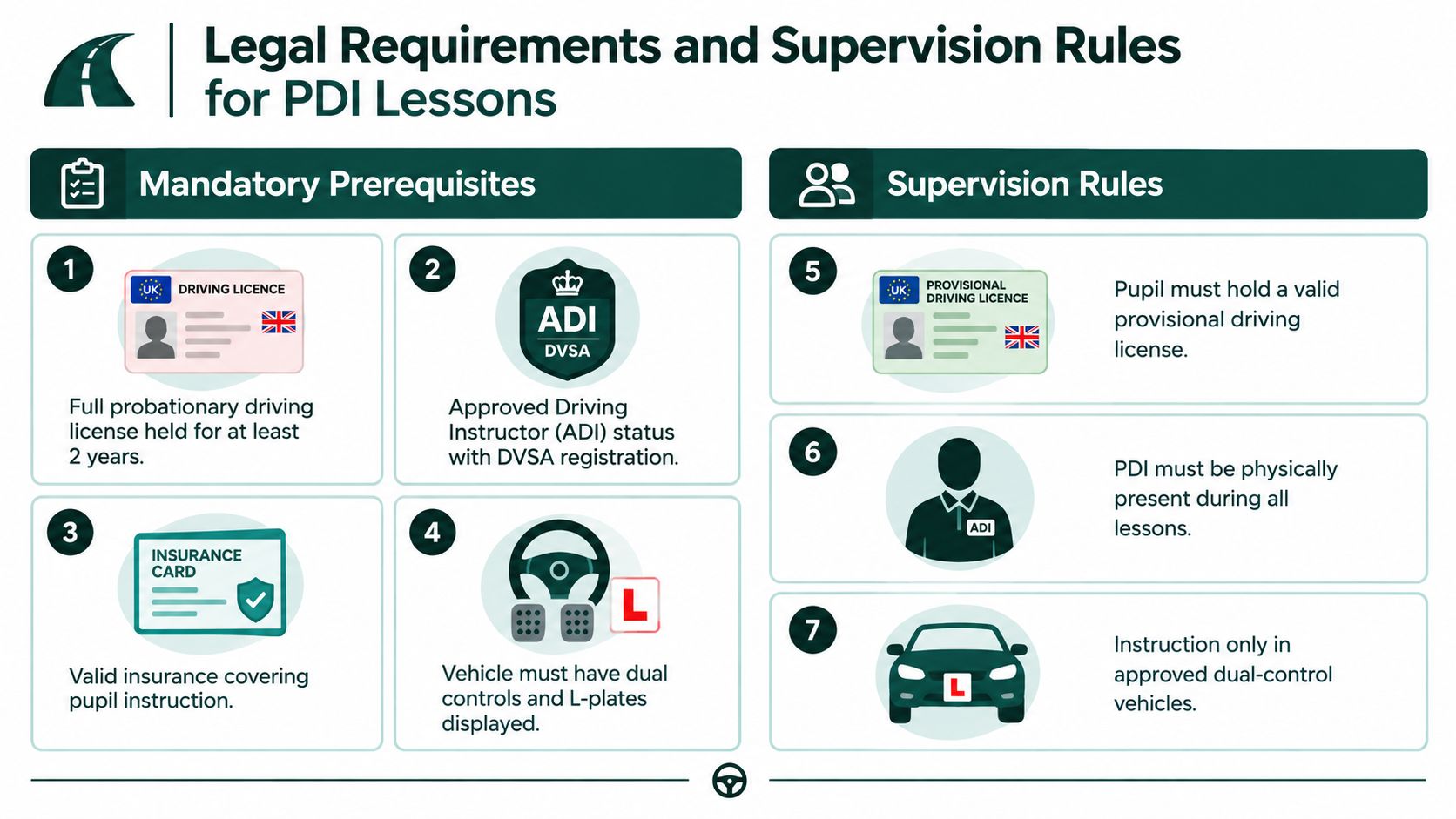
A PDI's legal status is there to protect learners from guesswork. If a trainee is teaching for pay, the route must be properly authorised. That means the trainee has passed ADI Part 1 within the previous 2 years, passed ADI Part 2, completed at least 40 hours of training with a qualified ADI, and recorded at least 10 hours of that training in a car on the official ADI 21T declaration form as required by GOV.UK. The trainee also needs to be eligible for Part 3 and have a new DBS check in place.
What the trainee licence actually covers
A valid trainee licence lasts for up to 6 months and costs £140, as set out in the DVSA licence application guidance. That licence is what allows paid instruction during the trainee period. Without it, or without being on the ADI register, charging money for driving instruction is illegal.
The rule matters because it gives you a clean legal boundary. A school cannot treat paid lessons as informal practice or settle the matter later. Anyone taking money, or money's worth, for car-driving instruction must either be on the ADI register or hold a trainee driving instructor licence before taking payment.
How supervision protects the learner
Supervision is what keeps the trainee route controlled. Under DVSA Part 3 rules, the trainee remains responsible for safety throughout the lesson and must be able to deliver client-centred instruction under DVSA Part 3 rules.
For you, that means the person teaching you is working inside a regulated system, not operating on trust alone. You should know who is supervising the trainee and what happens if the arrangement changes mid-course. Vehicle setup also matters, including the right display and supervision arrangements, which are explained in this guide to L-plates and supervising drivers.
If a school cannot clearly explain who supervises the trainee, treat that as a warning sign.
Benefits and Considerations of PDI Lessons
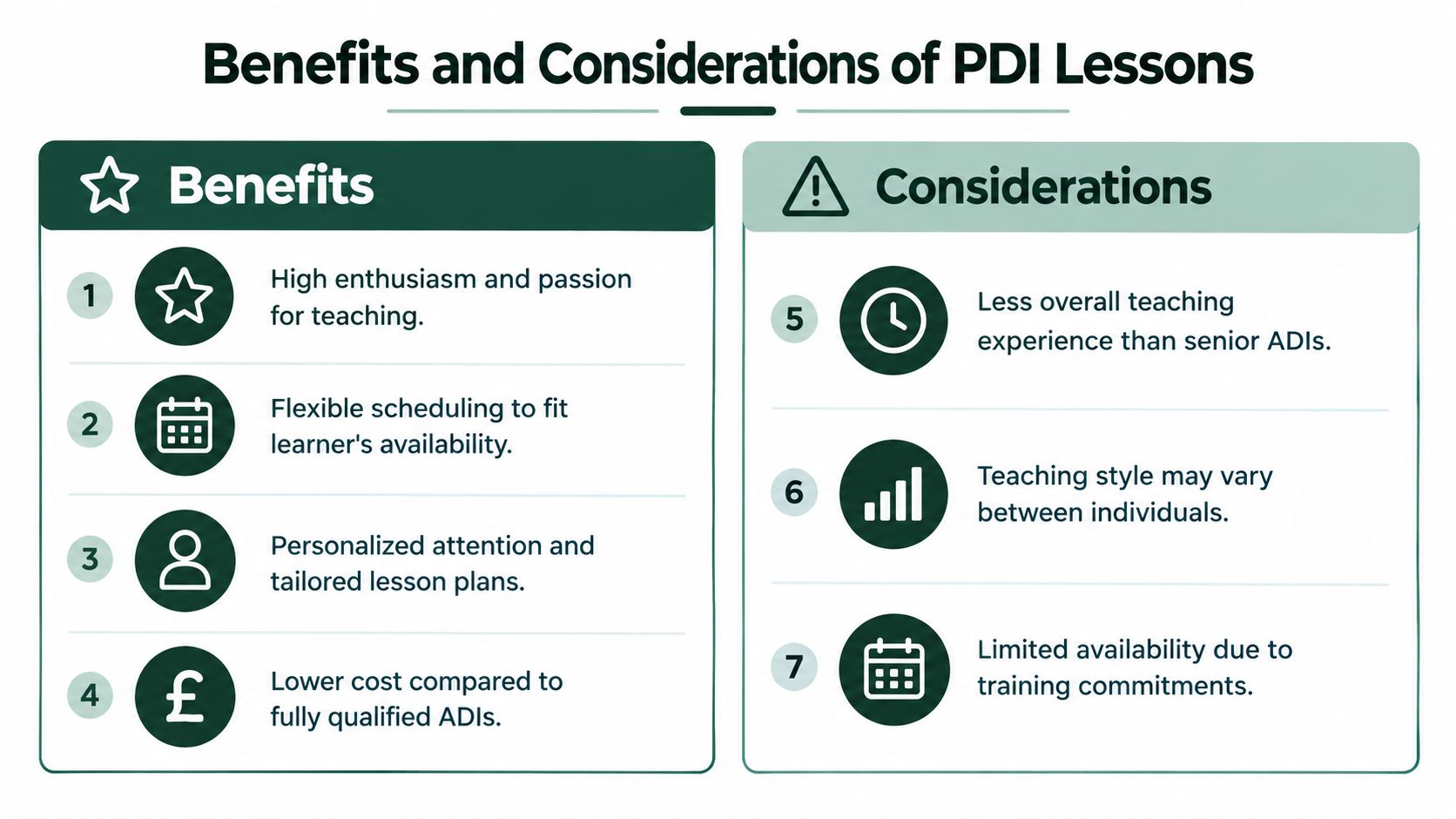
A lot of learners get good value from PDI lessons because the teaching is often fresh and attentive. Trainee instructors are usually thinking hard about how they explain things, how they structure lessons, and how they help people who feel nervous. That can work well if you want a patient instructor who's still very focused on the details.
What often works well
The biggest practical advantage is attention. A PDI is actively shaping their teaching style, so lessons can feel carefully planned and responsive to the learner sitting in the car. That can be useful for beginners who need step-by-step explanations, or for nervous drivers who want a calmer pace.
Another advantage is flexibility. Trainee instructors are often attached to a school rather than working alone, so scheduling can sometimes be easier to organise across a course. Fast Track Driving Lessons, for example, matches learners with instructors and identifies whether tuition is from an ADI or a PDI before booking, which helps remove any ambiguity.
What to keep in mind
The trade-off is experience. A PDI is still refining teaching technique for the Part 3 stage, so their style may feel less settled than that of a long-established ADI. That doesn't mean worse teaching, but it does mean you should expect a trainee who is still learning their craft.
A sensible way to judge the fit is to look at your own goal. If you want structured tuition, a lot of contact time, and clear lesson progression, a PDI can be a very good match. If you want the most established teaching style available, a fully qualified ADI may suit you better.
How to Verify Your Instructor Credentials
A learner can save time and avoid confusion by checking the instructor's status before booking. If someone is charging for lessons, they should be able to show that they are on the ADI register or hold a valid trainee driving instructor licence. If they cannot show that, do not hand over money for tuition.
A simple check list for learners
- Look for the badge: A legal instructor should display the relevant pink trainee badge or green ADI badge while teaching.
- Ask for status upfront: Before paying, ask whether the instructor is a PDI or an ADI and which school they work with.
- Confirm it in writing: A good school tells you in advance whether the lessons are with a trainee or a fully approved instructor.
- Use a verification guide: If anything feels unclear, check an instructor is approved with our guide to checking an instructor is approved.
- Pause if details do not match: If the badge, the explanation, and the booking information do not line up, verify it before the first lesson.
This is about protecting your money and your progress. You should know who is teaching you and whether they are legally allowed to do it. Paid instruction without the correct status is illegal, as noted earlier in the legal requirements section.
Clear disclosure also helps you judge the arrangement properly. If a school separates trainee and fully qualified tuition clearly, that is useful for learners who want no surprises from the start.
Choosing the Right Tuition for Your Test Goals
A learner booking a short test-booster and a beginner booking a longer course don't need exactly the same instructor profile. For some people, the right answer is an experienced ADI who can fine-tune test preparation. For others, a PDI who brings energy and availability can be a strong fit, especially when the school keeps the course structured.
Match the instructor to the outcome you want
A 10-hour test booster usually needs sharp, efficient correction and a clear focus on weak points. A more intensive beginner course, such as a 40-hour route, often benefits from a teaching style that stays consistent and supportive over a longer stretch. In both cases, the quality of the lesson plan matters more than the label alone.
That's why the best driving schools think about continuity. If a booked instructor becomes unavailable or their trainee period ends, a good school should have a replacement option where local coverage allows. That keeps your course moving instead of leaving you stranded between lessons.
What to ask before you book
- Who will teach most of the course? You want a clear answer, not a guess.
- What happens if the instructor changes? Replacement arrangements should be explained in plain language.
- Will the lessons follow a route plan? Mock tests on local roads and test-centre routes help keep progress focused.
- Is the tuition style suited to your confidence level? Nervous beginners and near-test drivers often need different pacing.
A PDI can be the right choice when the school is organised, the licence status is clear, and the lesson structure is strong. An ADI can be the better fit when you want a fully approved instructor with completed Part 3 status. The key is not the badge alone, it's whether the tuition is transparent, legal and matched to your stage.
Fast Track Driving Lessons helps learners find clearly identified instructors, including both ADIs and PDIs, so you know who is teaching before you book. If you want structured tuition with transparent instructor status and course options that suit your test goals, visit Fast Track Driving Lessons and check the options that fit your level.
Written by Fast Track editorial team.