
The lights change, your left foot comes up a touch too fast, and the engine cuts out just as traffic starts moving. If you're sitting there red-faced, glancing in the mirror, and wondering whether you've ruined the lesson, you're in the exact place most learners hate most. The useful thing is that a stall a car moment is usually not a catastrophe, and it's not always a sign that the car is broken.
What matters is learning the difference between technique stalls and mechanical stalls, then recovering calmly enough that the rest of the drive still stays under control. That's what examiners notice, too. They're looking at how you secure the car, how you observe, and whether you move off safely again.
Table of Contents
- Why Cars Stall in the First Place
- Getting Smooth Clutch and Throttle Control
- Hill Starts Without Rolling Back
- What to Do When You Stall Mid-Lesson
- How the DVSA Test Actually Treats a Stall
- When a Stall Is Not Just a Driving Error
- A Realistic Practice Plan to Stop Stalling
Why Cars Stall in the First Place
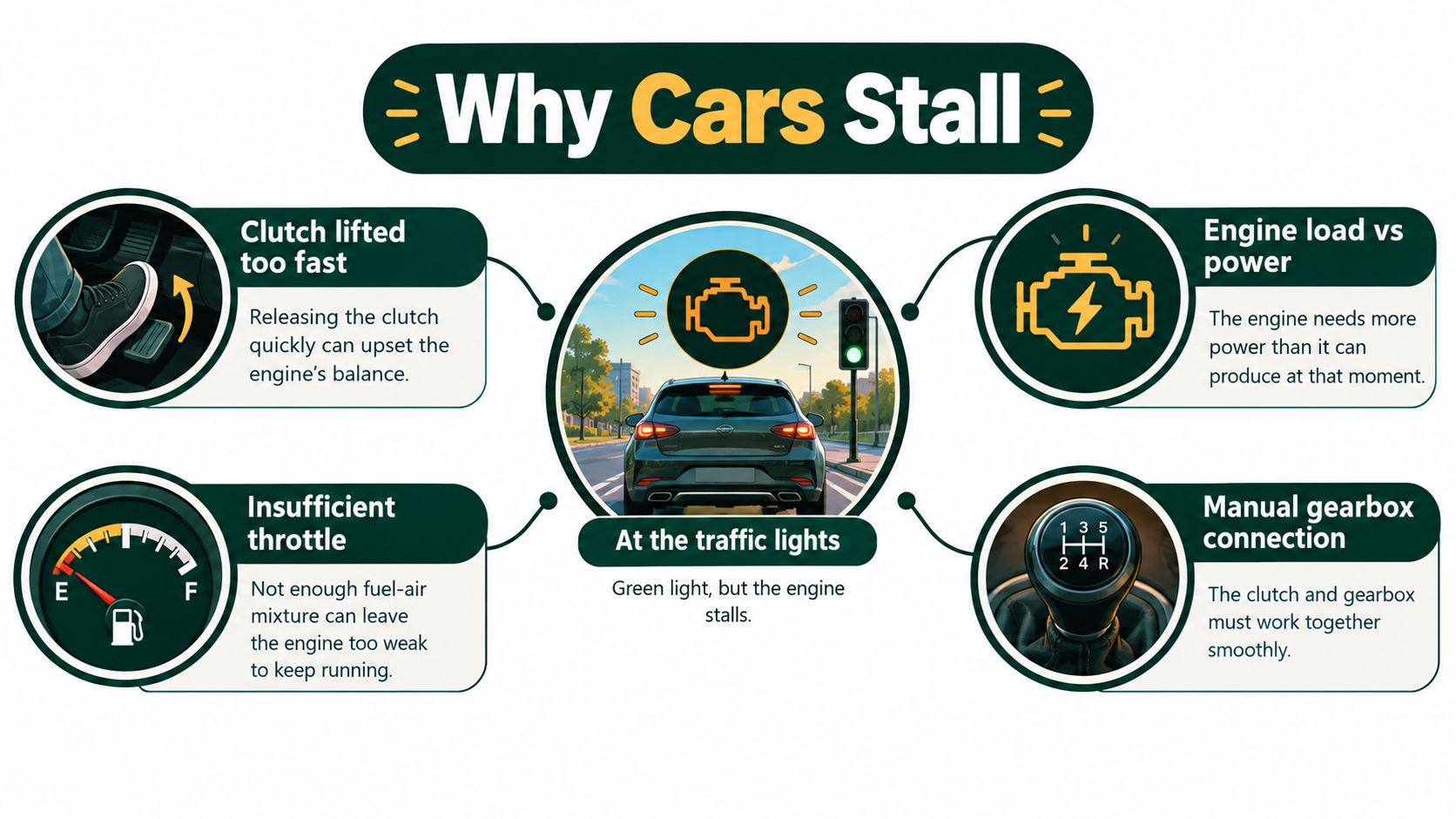
The car usually stalls at the exact moment a learner feels rushed, at a green light, on a roundabout, or as traffic starts to flow again. That moment can feel like a personal failure, but the cause is usually narrower than that. In a manual car, stalling is mostly a coordination problem between the clutch, accelerator, and gear choice, not proof of a defect in the vehicle GOV.UK vehicle recalls and faults guidance.
What your feet and right hand are doing at once
A smooth move off depends on three actions lining up. The clutch rises to the biting point, the accelerator adds enough engine power, and the gear matches the speed you are asking for. If one of those is out of step, the engine cannot keep the car moving.
Practical rule: a stall usually means the engine lost the balance between load and power, not that the car suddenly became unsafe.
Wrong gear choice can do the same thing. Too high a gear, too little throttle, or a clutch released too sharply all make the engine work harder than it can handle at low speed. If you have felt the car start to pull, then hesitated with your left foot or lifted off the throttle too quickly, you have felt the point where that balance tipped.
Mechanical faults can create a different pattern altogether. A useful comparison is troubleshooting rough idle in pickup trucks, where symptoms may point to the engine itself rather than driver input. The same logic helps learner drivers. A repeated stall is not automatically a broken car, but if it keeps happening in different conditions, it needs attention rather than guesswork.
Getting Smooth Clutch and Throttle Control
The cleanest way to stop stalling is to stop treating the clutch and accelerator like separate moves. They work together, and the biting point is the anchor. On a quiet road, hold the car still, bring the clutch up slowly until you feel the nose lift slightly, then add a little accelerator and let the car take up drive without rushing.
Feeling the biting point properly
You'll know you've found it because the engine note changes and the car starts to strain a little against the brake. That's the moment to stop lifting the clutch in a hurry. If you keep going too fast, the engine can die before the wheels have enough drive.
A lot of learners stab the throttle at the same time as dumping the clutch, which only makes the start jerky. Others lift the clutch nicely but forget the engine still needs help, so it runs out of power and stalls anyway. The right move is a steady left foot and a measured right foot, not more force from either side.
Keep your left foot calm and your right foot light. You're aiming for balance, not urgency.
What to do at traffic lights
At the lights, don't hover with your foot half off the clutch and half on the brake. That leads to creeping, shuddering and unnecessary wear. Hold the car properly, then move off in one clean sequence: select first gear, find the bite, add light throttle, and bring the clutch up smoothly once the car is rolling.
A good way to practise is ten quiet minutes on a residential road where nobody's pressing you. Repeating that same movement again and again teaches your legs more effectively than overthinking it at a junction. Fast Track Driving Lessons also publishes practical guidance on moving off and recovering from stalling, which can be a useful reference point when you're trying to connect the feel of the clutch with safe restart habits.
Hill Starts Without Rolling Back
A hill start exposes weak control fast, because gravity adds load the moment you lift off. Many learners feel settled on level ground, then tense up as soon as the road tilts. A repeatable method fixes that better than guesswork.
The handbrake method that stays calm under pressure
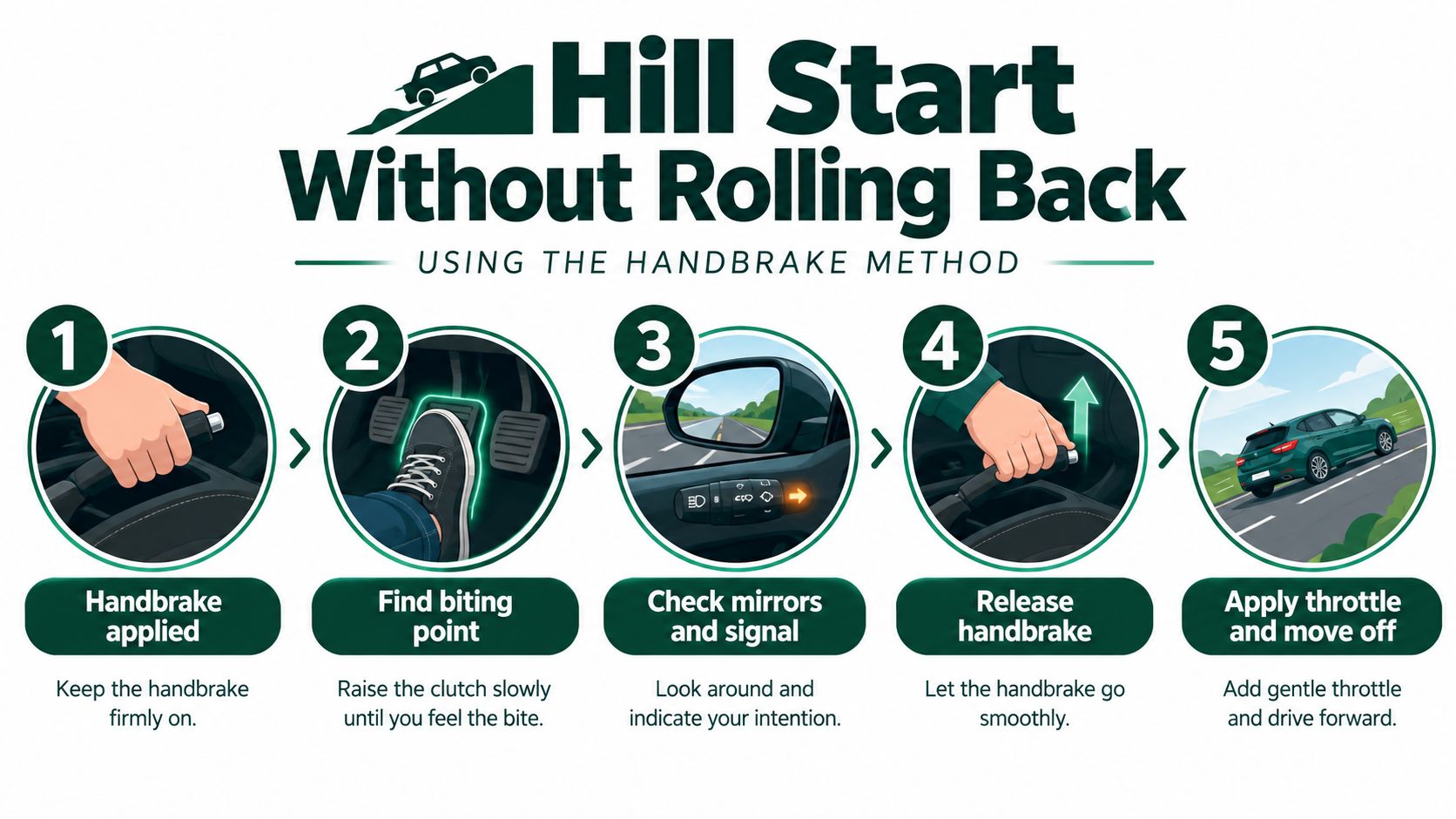
Hold the car with the parking brake, select first gear, then raise the clutch to the biting point in a controlled way. Add enough accelerator to hold the car against the slope, check your mirrors and blind spot, then release the parking brake while you keep the clutch moving up smoothly. That gives the engine time to take the load before the car starts to roll back. Fast Track Driving Lessons hill starts guide
Two habits make hill starts harder. Holding the car on the clutch for too long makes the manoeuvre vague and increases wear. Coasting with the clutch depressed removes engine braking and can reduce steering response, especially on bends. The Highway Code covers that loss of control in its rules on coasting and vehicle control, so it is worth keeping the clutch work deliberate and brief. the Highway Code's rules on coasting and vehicle control (rules 103 to 158)
Practise the sequence on level ground first, then on a gentle slope, then at a junction where you have to stop and restart on an incline. That progression lets your feet learn the timing without the pressure of traffic behind you.
If a car is close behind, do not rush the clutch. A rushed restart usually causes more rollback, not less. If you feel the car start to move back, keep the footbrake on, reset the clutch properly, and begin again with full observation. The handbrake method shown in A five-step guide on how to perform a hill start in a manual car using the handbrake method. is a useful visual reference while you practise.
What to Do When You Stall Mid-Lesson
A stall at a pedestrian crossing feels embarrassing because everyone can see it. That feeling is real, but it doesn't help the car move again. The useful response is to make the vehicle safe, reset your controls, and restart without turning one stall into three mistakes.
The recovery sequence that keeps you in control
If the engine cuts out, keep the footbrake on and stop the car from rolling. If you're in gear, select neutral, then restart only when the car is secure and traffic is still safe around you. After that, recheck mirrors and blind spots before moving off again with the full routine, not a rushed stab at the pedals.
Don't apologise to the dashboard, and don't stare at it. Get the car secure first.
A lot of learners make the next mistake straight after the stall. They stamp the accelerator because they feel under pressure, and that usually makes the restart rougher. Others freeze and forget to look around, which is worse than the original stall because it compromises observation.
The best mental script is short. Brake on, neutral if needed, restart, mirrors, blind spot, first gear, smooth move off. That sequence is steady enough to run in your head even when people are waiting at the lights.
If you want a clearer explanation of why dual-control cars can help a learner recover more safely, the guide on dual control cars explained is worth reading alongside practice in the car.
How the DVSA Test Actually Treats a Stall
A stall on test is not automatically a disaster. The DVSA's fault system is about control and safety, not embarrassment, and a candidate can pass with up to 15 driving faults overall DVSA test result guidance. What matters is how the stall was handled, whether anybody else was put at risk, and whether the car was brought back under control quickly.
Single fault, repeated faults, serious fault
A single stall that doesn't affect other road users may be recorded as a driving fault. Repeated stalls across the drive show a wider control problem and can become a serious issue. If the examiner has to intervene to prevent danger, the outcome can escalate further DVSA examiner fault guidance.
That's why the restart matters more than the embarrassment. The examiner wants to see secure control, clear observation and a sensible return to moving traffic. A quiet stall at a calm junction is one thing. A stall while joining moving traffic, losing observation or rolling back is a different matter.
The practical lesson is simple. Recover cleanly, don't panic, and continue only when the road around you is safe. That's why a learner who handles a stall well can still have a perfectly good test.
If you want a second source of test-focused context, the practical guide on stalling on your driving test matches what examiners are watching for, especially during the recovery after the engine dies.
When a Stall Is Not Just a Driving Error
A stall becomes more worrying when it stops looking like a normal learner mistake. If the car stalls while idling, stalls when cold, jerks on release, struggles to select gears, makes unusual noises, loses power at speed, or keeps misfiring, the problem may be mechanical rather than technique. Those patterns can point to a fuel fault, an ignition issue, a blocked air intake, a worn clutch, or engine-management trouble RAC stalling and fault signs.
A quick decision tree for learners
A stall that happens as you move off and then clears cleanly is usually a control issue. A stall that appears in different situations needs more caution. If the car stalls when cold but runs fine once warm, that often points to an idle-air or fuel-delivery fault. If it misfires under load, the ignition system or fuel supply may need checking. If it grates going into gear, the clutch or linkage may be at fault. Warning lights, odd noises, and a change in how the car feels are reasons to stop normal practice and get it inspected.
That distinction matters because repeating clutch drills in a car with a developing fault wastes lesson time and can put you at risk. The law also expects drivers to keep vehicles safe and roadworthy, and GOV.UK says driving a vehicle in a dangerous condition can lead to a fine of up to £2,500, 3 penalty points, and a driving ban GOV.UK vehicle maintenance and safety guidance.
If the stall is unusual, repeated, or happening away from clutch practice, treat it as a possible fault first.
A Realistic Practice Plan to Stop Stalling
The fastest progress usually comes from one change, not five. For most learners, that first change is a smoother clutch lift, because that's what gives the engine the breathing room it needs before the car starts to pull. More accelerator can help, but it won't fix rushed clutch control on its own.
A week of practice that actually sticks
Start with ten quiet minutes on a level road, finding first gear and second gear without pressure. Then move to a familiar gentle slope and repeat a handbrake hill start until the sequence feels ordinary. Finish the week with one junction where stopping on a hill is required, so you can practise the same routine with real traffic around you.
Success isn't “never stalling again”. Success is restarting calmly, keeping the car secure, and moving off without panic or rollback. That's how confidence builds, one clean recovery at a time.
When you're ready for structured help with clutch control, hill starts and calm restart habits, Fast Track Driving Lessons offers learner-focused tuition that can fit manual practice into a clearer plan. If you want the next lesson to feel less stressful, book support that focuses on the exact control skills behind stalling and recovery.
Written by Fast Track editorial team.