
You're sitting in the test car, hands on the wheel, and the examiner asks you to do something you've probably practised before, but not under pressure. It might be a control you've never used in that exact vehicle, or a safety question you know in theory but haven't answered out loud in a calm, structured way. That's the point of show me tell me questions, they test whether you can find controls quickly, explain safety checks clearly, and stay composed while the car is moving or ready to move. The UK practical test has included this kind of assessment since September 2003, and it now sits alongside the practical exam as a fixed part of the car test, with one question asked before driving and one while driving, as set out in the official guidance from GOV.UK's car show me tell me vehicle safety questions and the DVSA statistics guidance at GOV.UK driving tests and instructors statistics.
A good answer is usually short, safe, and structured. You're not trying to sound clever, you're showing that you know where the control is, what the check is for, and how to act without guessing. If you're learning with Fast Track Driving Lessons, instructor-led vehicle familiarisation, theory training, and mock-test preparation can make these questions feel familiar before test day, especially if you're doing an intensive or semi-intensive course.
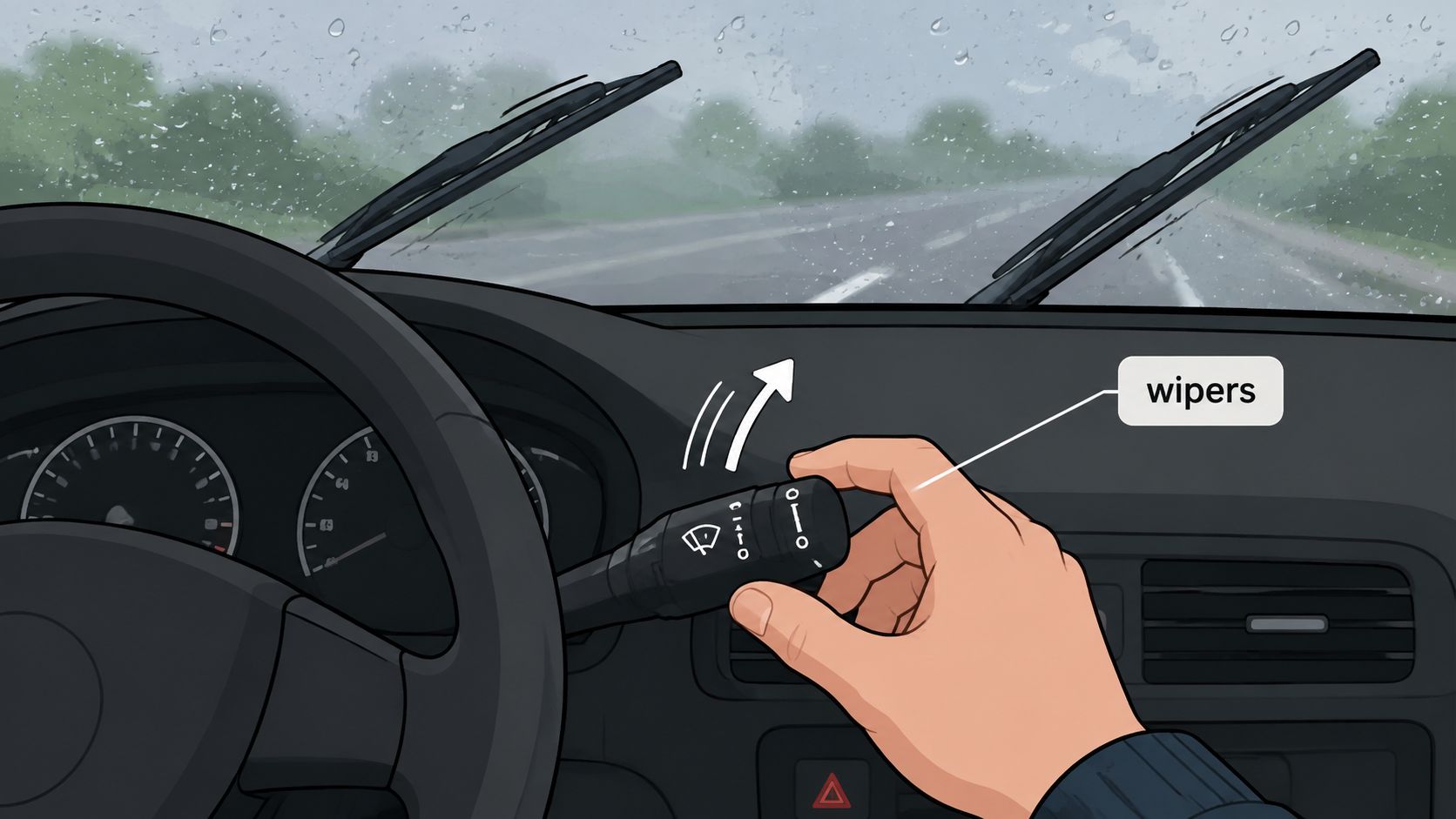
Table of Contents
- 1. Show Me Operating the Windscreen Wipers
- 2. Tell Me Checking Your Tyres for Safety and Legal Requirements
- 3. Show Me Operating the Dipped Beam and Headlight Adjustment
- 4. Tell Me Safe Use of Seatbelts and Child Seat Laws
- 5. Show Me Using the Horn Safely and Legally
- 6. Tell Me Identifying and Responding to Engine Temperature and Pressure Warning Lights
- 7. Show Me Demisting the Windscreen and Windows in Humid Conditions
- 8. Tell Me Checking Your Brakes and Brake Fluid Condition
- Show Me vs Tell Me: 8-Point Comparison
- Turn Eight Answers into Test-Day Confidence
1. Show Me Operating the Windscreen Wipers
This is one of the simplest show me tell me questions on paper, but it can still catch learners out in a different car. The examiner wants to see that you can locate and use the wiper control without hesitation, and that matters because control layouts vary between manufacturers. In many UK cars the stalk sits on the right-hand side of the steering column, but premium models and newer dashboards sometimes use a dial, a menu, or a touch-sensitive control.
A calm model answer is practical rather than chatty. You might say, “I'm looking for the wiper control,” then demonstrate the correct movement on the stalk or dial. If the vehicle has intermittent settings, you only need to operate what the examiner asked for, not explore every mode like you're doing a full workshop demo.
Practical rule: find the control first, then move it once with purpose. Fumbling around looks less safe than a brief pause to identify the right stalk.
A weak answer is guessing and tapping several controls at random. That suggests you don't know the vehicle, and it can make you look flustered before the test has properly started. Intensive learners should ask their instructor to place them in different cars where possible, because repetition in 3 or 4 vehicles makes the variation feel normal rather than surprising.
- In familiar cars, locate the stalk on the steering column and practise the standard wipe and wash movements.
- In newer models, check whether the wipers are controlled by a stalk, a ring on the stalk, or a central screen menu.
- In mock tests, say your thought process out loud once, then act. That keeps the examiner aware that you're methodical, not unsure.
2. Tell Me Checking Your Tyres for Safety and Legal Requirements
The examiner wants you to describe a structured tyre check, not just say the tyres look acceptable. A strong response covers condition, tread depth, and pressure in that order, so your answer sounds organised even under pressure.
You might say, “I would check the tyre sidewalls for cuts, cracks, bulges, or embedded objects, then check tread depth with a gauge or the 20p test, and finally make sure the pressure matches the vehicle handbook or the label on the door pillar.” The legal minimum tread depth is 1.6mm, and the Fast Track Driving Lessons guide on tyre tread depth is a useful revision point if you want to confirm the legal requirement. Learners often use the 20p coin as a memory aid, because it helps them picture the tread check in a test car.
A weak answer sounds like, “I'd check they're not flat.” That leaves out tyre condition and tread depth, and it does not show that you know how to judge legality. It also sounds improvised, which is a problem in a question that should feel routine.
Make the answer easy to remember
- Condition first, look for cuts, cracks, bulges, or anything lodged in the tyre.
- Tread second, know the legal minimum and remember that worn tread reduces grip.
- Pressure last, check it against the handbook or manufacturer label, not the sidewall.
For intensive learners, saying the answer in the same order every time helps under test pressure. It is easier to recall a short checklist than a vague description, especially if your instructor asks you a surprise mock question before or after a lesson.

3. Show Me Operating the Dipped Beam and Headlight Adjustment
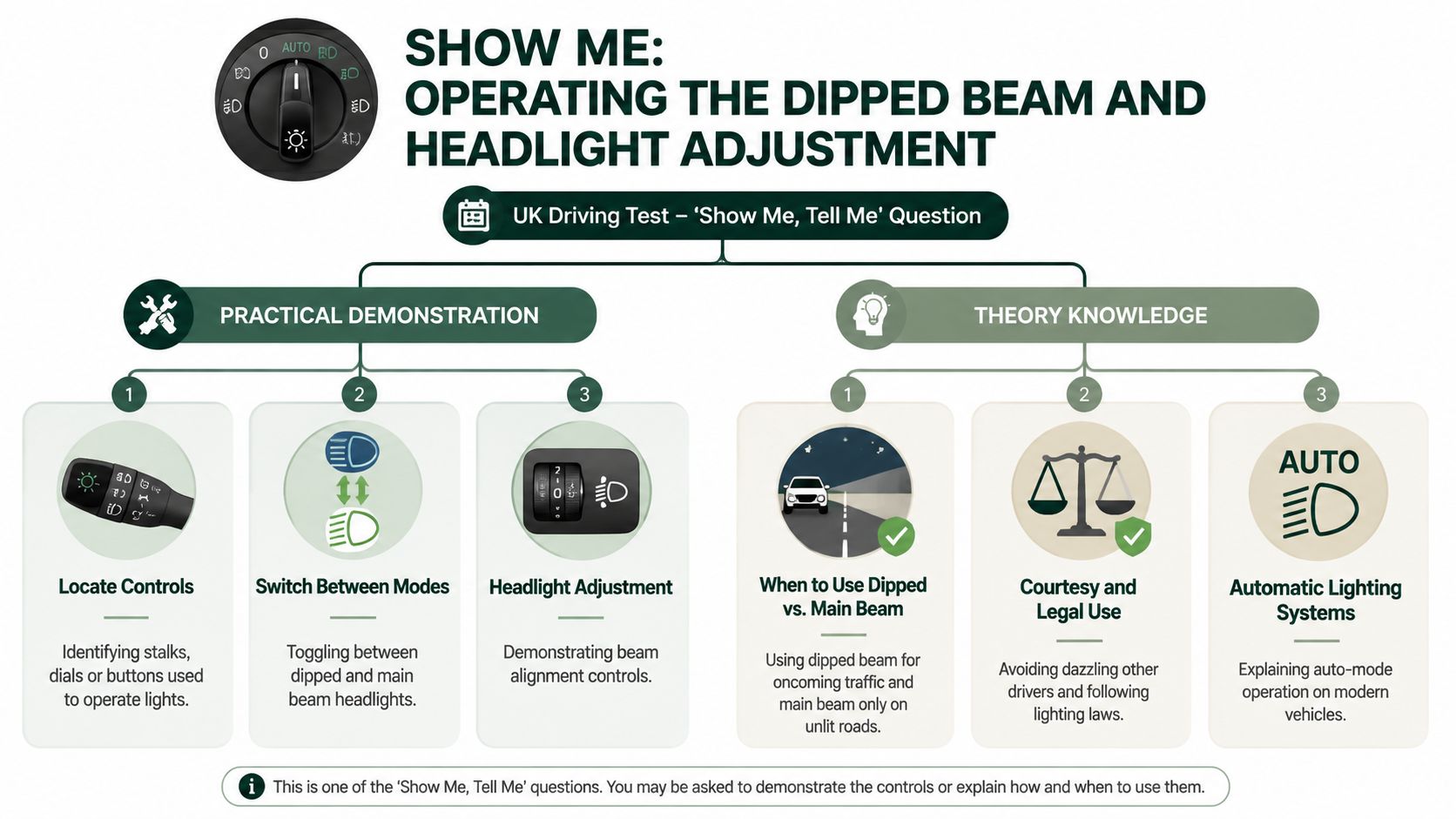
A test car can turn a simple light check into a skill check. The examiner wants to see that you can find the lighting control quickly, choose dipped beam at the right time, and avoid dazzling other road users. In some cars that means a stalk, in others a rotary switch plus a push or pull action. Automatic-lighting cars may use the auto setting, so you should still be ready to explain what the car is doing.
For a reminder on when dipped beams are required during daylight, see the relevant theory guide on dipped headlights.
A clear model answer starts with the control you can reach. You could say, “I'd locate the lighting stalk or dial, then switch to dipped beam,” and then use the correct movement for that vehicle. If the car has headlight adjustment, show where the adjuster is, or say you would check the handbook if the control is not obvious in the test car.
The skill being tested is control familiarity. It helps to know why each beam exists. Dipped beam is the safer choice when there is oncoming traffic or when the road layout could make full beam dazzle others. Main beam is for roads where it will not blind another driver.
In a test car you need both knowledge and the ability to locate the correct control quickly.
A weak answer sounds vague, such as, “I'd just turn the lights on.” That may sound calm, but it does not show which beam you would use or how you would adjust it. Intensive learners should practise this in more than one car if possible. Different dashboards can make the same task feel unfamiliar, so it helps to rehearse the control, the beam choice, and the wording together.
4. Tell Me Safe Use of Seatbelts and Child Seat Laws
This question is about responsibility as much as law. The examiner wants to know that you understand who needs a seatbelt, how child restraints work, and when exceptions apply. A short, structured answer is better than a long recitation that mixes adults, children, and penalties into one blurred paragraph.
A clear model response is, “Adults must wear seatbelts when the vehicle is moving unless a legal exemption applies. Children must use the correct child restraint for their size and age, and I'd check the vehicle and the law for the right seat type. If someone can't wear a seatbelt for medical reasons, I'd advise them to speak to a doctor or check the official exemption guidance.” That keeps the answer safe and sensible without pretending you're a lawyer.
A weak answer is, “Everyone should wear one.” That's true in spirit, but it doesn't show that you know the rules around child seats or exemptions. It also doesn't show the examiner that you understand the difference between an adult passenger and a young child who needs the right restraint.
Keep the response tidy
- Adults, wear the seatbelt whenever the vehicle is moving, unless an exemption applies.
- Children, use the correct child restraint for their size and age.
- Exceptions, know that some situations, such as reversing, can change whether a seatbelt is fitted or used.
If you're revising with learners' materials, focus on meaning rather than memorising every legal phrase perfectly. The examiner is looking for safe awareness, not a courtroom performance. For a learner preparing under time pressure, it's enough to show that you know seatbelts and child restraints are not optional extras, they're core safety equipment.
5. Show Me Using the Horn Safely and Legally
The horn sounds like an easy question, and the physical part is easy. The examiner wants you to locate the horn pad on the steering wheel and press it, usually with a quick, clean action. What matters more is that you understand it's a warning device, not a way to express irritation at another driver.
A strong answer is short: “I'd locate the horn in the centre of the steering wheel and press it to warn other road users if necessary.” That is enough. You do not need to explain your entire theory of road rage, and you certainly don't want to fumble around searching for the horn while the examiner is waiting for a simple demonstration.
The horn is for warning of danger or presence, not for frustration, impatience, or punishment.
A weak answer is making a big show of it, or pressing randomly around the wheel because you're unsure where the pad is. That can make the test feel messier than it needs to be. It also suggests that the learner hasn't spent enough time in the actual tuition car learning the layout.
For intensive learners, the best habit is to notice the horn location every time you get into the instructor's car. That way, the control becomes part of your normal setup routine, like seat adjustment and mirror checks. A tester might also ask the question when you're already slightly busy, so having the control location fixed in memory helps you stay composed.
6. Tell Me Identifying and Responding to Engine Temperature and Pressure Warning Lights
A dashboard light can change a simple drive into a test of judgement. The examiner is checking whether you can recognise a warning, judge its seriousness, and take the right first step without hesitation. That means reading the light, not guessing at it, and acting in the order a safe driver would.
A clear answer is easy to follow. “A red engine temperature warning means the engine may be overheating, so I'd stop safely as soon as possible, switch off the engine, and let it cool. A red oil pressure warning means I'd stop immediately to avoid engine damage. An amber battery or charging warning means I'd get the vehicle checked, but I'd look for a safe place to stop rather than ignore it.” The logic is simple, like a traffic signal for the car itself. Red asks for immediate action. Amber asks for attention and a safe plan.
The key difference is red and amber. Red means the car needs urgent protection, because continuing can make the fault worse. Amber means the vehicle may still reach a safe place, but the fault should not be brushed aside. Intensive learners often benefit from sitting in the training car and naming the main dashboard lights with the instructor before a mock test, because the same symbol can feel much less confusing once you have seen it in context.
Don't overcomplicate the response
- Red temperature, stop safely and switch off.
- Red oil pressure, stop immediately.
- Amber battery or charging, find a safe place to stop and seek help.
A weak answer like “I'd go to a mechanic” leaves out the decision the examiner needs to hear. The first response matters most. If the warning is serious, delay can turn a small fault into engine damage, and that is exactly what the examiner wants to know you would avoid.
7. Show Me Demisting the Windscreen and Windows in Humid Conditions
Demisting is one of the most practical show me tell me questions because it deals with something learners face in real weather, not just in theory. The examiner wants to know that you can clear condensation from the windscreen and side windows using the controls in front of you. That means finding the airflow direction, temperature, and, where fitted, the air conditioning or rear demister controls.
A good demonstration is straightforward. “I'd set the airflow to the windscreen, turn on the heater, and use air conditioning if fitted to dry the air. I'd also use the rear demister for the back window if needed.” The point is not to perform every control in a dramatic sequence, it's to show that you know how to restore visibility quickly and safely.
If you want to understand the logic, think dry air plus directed airflow. Heating helps clear the glass, and air conditioning removes moisture from the cabin air. On a humid morning, both together usually work faster than heat alone. For a visual refresher, the short video below shows the kind of control movement learners often need to practise in the actual car.
After you've seen the controls once, the job gets easier.
A weak answer is turning the temperature up and hoping for the best. That can clear the glass eventually, but it doesn't show that you understand the vehicle's demist function or the rear window heater. The examiner wants to see a useful routine, not a lucky guess.
8. Tell Me Checking Your Brakes and Brake Fluid Condition
Brakes are too important to answer vaguely. The examiner wants to hear that you know how to inspect brake condition, what the pedal should feel like, and when a warning sign means the vehicle needs immediate attention. A good answer shows a proper safety mindset, not just a hope that “the brakes work.”
A solid response is, “I'd check the brake pads and discs for wear or damage, make sure the pedal feels firm, and check the brake fluid is between the minimum and maximum marks and looks clean. If the pedal felt spongy, or if there were a red brake warning light or grinding noise, I'd stop and get the car checked.” That gives the examiner a complete answer in a calm order.
You're looking for three things. First, visual wear on pads and discs. Second, pedal feel, because a soft or spongy pedal suggests a problem in the system. Third, brake fluid level and condition, because fluid that looks dark or contaminated is a warning sign that service is due. For a learner who wants a clear follow-up on brake safety after water exposure, this Fast Track Driving Lessons guide on checking brakes after floodwater is a useful revision prompt.
Practical rule: a brake question is never just about “can the car slow down”. It's about whether you'd notice a fault before it becomes dangerous.
A weak answer is, “I'd make sure they work.” That might be true, but it doesn't show any actual inspection method. The examiner wants a learner who understands that braking is part of monthly vehicle care, not something you only think about when you press the pedal and hope for the best.
Show Me vs Tell Me: 8-Point Comparison
| Item (Mode) | Implementation complexity | Resource requirements | Expected outcomes | Ideal use cases | Key advantages |
|---|---|---|---|---|---|
| Show Me: Operating the Windscreen Wipers (Show) | Low, simple action but controls vary by make | Access to multiple vehicles for practice; instructor guidance optional | Locate and operate intermittent/fast/slow wiper settings reliably | Test start, pre-drive familiarisation, intensive courses | Quick, low-stress, transferable across vehicles |
| Tell Me: Checking Your Tyres for Safety and Legal Requirements (Tell) | Low, factual recall of legal minima and inspection routine | Tyre gauge or 20p coin for practice; vehicle handbook for pressures | Accurate description of tread depth, damage checks and pressure checks | Theory revision, monthly vehicle checks, pre-test preparation | Standardised DVSA guidance; easily memorised |
| Show Me: Operating the Dipped Beam and Headlight Adjustment (Show) | Low–Medium, controls vary; automatic systems add complexity | Vehicle with manual/automatic lighting; practice in different cars | Correct switching and explanation of dipped vs main beam usage | Night/unlit roads, test scenarios, intensive familiarisation | Safety-critical; improves night-driving awareness |
| Tell Me: Safe Use of Seatbelts and Child Seat Laws (Tell) | Medium, many rules and frequent updates | Up-to-date legal guidance and vehicle handbook | Clear statement of adult seatbelt rules, child seat groups and exceptions | Family drivers, theory preparation, pre-trip checks | Legally defined answers; high-impact safety information |
| Show Me: Using the Horn Safely and Legally (Show) | Very low, simple physical action | Any vehicle; minimal practice recommended | Locate and briefly operate horn; understand lawful use cases | Quick show-me at test start, basic control familiarisation | Very quick to demonstrate; low stress |
| Tell Me: Identifying and Responding to Engine Temperature and Pressure Warning Lights (Tell) | Medium, requires prioritising red vs amber warnings | Vehicle handbook; exposure to dashboard symbols (instructor/demo) | Correct immediate actions for red (stop) and amber (monitor) warnings | Long drives, intensive courses, emergency preparedness | Critical mechanical knowledge; prevents severe damage |
| Show Me: Demisting Windscreen and Windows in Humid Conditions (Show) | Medium, multiple HVAC settings and vehicle variations | Vehicle with heating/A/C; humid/wet conditions for practice | Set airflow/temperature to clear windscreen and side windows effectively | Winter/damp weather, pre-drive safety checks, tests | Directly improves visibility and road safety |
| Tell Me: Checking Your Brakes and Brake Fluid Condition (Tell) | Medium–High, technical details (pad wear, fluid, pedal feel) | Visual inspection access, vehicle handbook; occasional tools for checks | Explain pad wear limits, pedal firmness checks and fluid level/condition | Monthly maintenance, pre-trip safety, theory revision | Life-saving knowledge; standardised DVSA answers |
Turn Eight Answers into Test-Day Confidence
The easiest way to get better at show me tell me questions is to split them into two types and revise them differently. For show me controls, practise the physical movement in the actual tuition vehicle until you can find the control without searching. For tell me answers, rehearse a three-part structure, identify the system, explain the check, and say what happens if something looks wrong. That keeps your answer short, clear, and useful under pressure.
The biggest mistake learners make is treating these questions like a memory test only. They aren't. The examiner is also checking whether you understand safe vehicle use, whether you know how to control the car you're in, and whether you can stay calm when something unfamiliar appears. If you're in a semi-intensive or intensive course, ask your instructor to mix these questions into the lesson without warning, because surprise practice is closer to the test than reading notes on your own.
A good routine looks like this. Practise each show me control in the car you'll use for lessons. Speak each tell me answer out loud in plain English. Then do both again while someone watches, because people often know the answer until they have to say it confidently. Fast Track Driving Lessons' Learner Hub, theory training, vehicle familiarisation, and route-based mock tests are useful places to rehearse that pattern if you want your revision to feel more like the test and less like a memory exercise.
Use safety as the standard, not speed. If you need a second to find a control, take it. If you need to say, “I'd check the handbook,” that's better than pretending. The examiner wants a driver who behaves carefully and understands the car, not someone who rushes through a perfect-sounding answer with no real control.
If you're getting ready for your practical test, visit Fast Track Driving Lessons and use the Learner Hub, instructor-led tuition, and mock-test preparation to build confidence in these exact questions. Practise them in the car, speak them clearly, and turn a nervous part of the test into one of the easiest marks to handle.
Written by Fast Track editorial team.