
You might be staring at two unhelpful choices right now. Weekly lessons feel painfully slow, but a crash course sounds too hard to fit around work, family, or nerves. A semi intensive driving course sits in the middle for a reason, and in 2026 that middle path is less about chasing speed and more about lining up lessons with a practical test slot that may not arrive when you want it to.
Table of Contents
- What a Semi Intensive Driving Course Actually Means
- Typical Hours, Lesson Length and Weekly Schedule
- Semi Intensive vs Intensive and Weekly Lessons
- Planning a 20 to 25 Hour Course Around Your Test
- Test Waiting Times and Why Timing Matters in 2026
- Who Semi Intensive Courses Work Best For
- Vetting Instructors and Reading the Price
- Choosing and Booking a Semi Intensive Course With Confidence
What a Semi Intensive Driving Course Actually Means
A lot of learners start here because they're trying to solve a simple problem with awkward options. One instructor offers one lesson a week, but the test date keeps creeping away. Another advertises a five-day crash course, and the pace feels too sharp if you're already anxious or juggling shifts.
A semi intensive driving course is the structured middle ground. In UK driving-school language, it usually means a package of around 20 to 25 hours of in-car tuition spread over two to four weeks, often in two-hour blocks rather than one-hour single sessions. Schools use the term as shorthand, not as a DVSA category, so the exact lesson length, package size and payment terms can vary, but the pattern stays similar across the UK.
Why the format exists
The appeal is straightforward. You get enough frequency for the learning to stick, without the fatigue of driving every day. That matters for nervous adults, returners, and part-trained learners who need momentum but still want time to think between sessions.
A good school should be clear about what's included before you pay. If you're comparing providers, it helps to see the structure in writing rather than relying on a phone promise, especially if you're trying to map lessons against a test slot. If you need a practical way to organise course enquiries, an online course form builder can help schools capture the right details up front, which reduces back-and-forth for learners as well.
Practical rule: if the course description can't tell you the hours, the lesson length and the likely spread, assume the planning is weaker than it should be.
Typical Hours, Lesson Length and Weekly Schedule
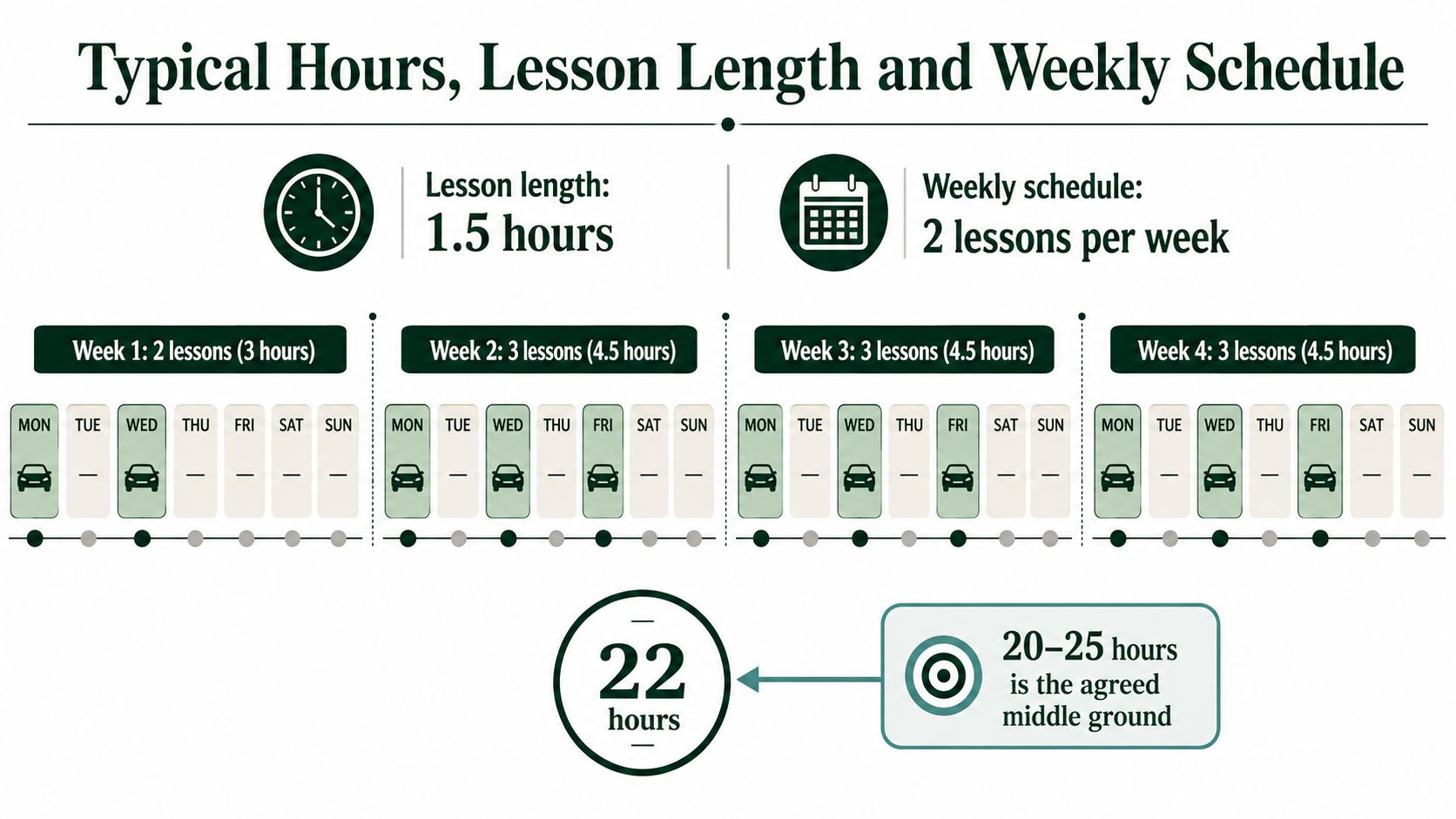
The most useful way to think about a semi intensive course is not as a slogan, but as a timetable. A realistic package often lands around 22 hours, because that sits comfortably inside the wider 20 to 25 hour range and gives enough room for core skills, a mock test and a final polish without feeling endless. The RAC's UK guidance says a week-long crash course can cost around £1,000, while a two-week intensive course may exceed £2,000, and Confused.com's UK guide says 20-hour intensive courses are typically priced at £800 to £1,200 with 5 to 7 hours of driving per day being common, which shows why many learners look for something less compressed than a crash course but more focused than weekly lessons. RAC intensive driving course guidance
How the hours usually fit together
A simple model is easy to follow. Two two-hour lessons each week gives you four hours a week, which is steady but slow. Three two-hour lessons a week gives you six hours, which starts to feel properly concentrated. If your instructor and your diary can handle a stronger pace, you can finish the package faster, but the trade-off is more pressure and less breathing room between sessions.
A useful benchmark comes from the DVSA guidance on learning to drive, which says there's no minimum number of lessons before taking the test, but many learners need around 45 hours of professional instruction plus 20 hours of private practice as a practical yardstick. That's why a semi intensive course usually handles the structured in-car tuition while you and your instructor keep private practice or independent revision going alongside it. DVSA guidance on taking driving lessons
If you can only spare two blocks a week, don't treat that as a weak plan. It's often the right pace for absorbing junction work, manoeuvres and test feedback without losing the thread between lessons.
What a 22-hour package looks like in real life
A learner doing two lessons per week, with each lesson lasting two hours, gets through the course in around three weeks, then keeps a buffer week free for mock testing, route practice or a rescheduled session. Move to three sessions a week and the whole thing compresses further. Drop to five hours a week and the same course can stretch past a month, which starts to look more like a flexible block of lessons than a semi intensive one.
That's the value of the format. It gives you enough pace to stay “in the groove” while still leaving space to digest feedback.
Semi Intensive vs Intensive and Weekly Lessons
Learners often ask the wrong question first. They ask which format is fastest. A better question is which format gives you the best balance of pace, retention and test timing, because a quick course is useless if you forget half of it before the test date arrives.
| Format | Total Hours | Lesson Length | Typical Duration | Best For |
|---|---|---|---|---|
| Semi Intensive | Around 20 to 25 hours | Usually 2-hour blocks | Around 2 to 4 weeks | Learners who need structure, momentum and room to retain skills |
| Intensive | Often around 30 to 40 hours | Daily or back-to-back sessions | About 1 to 2 weeks | Confident learners who can handle pressure and fatigue |
| Weekly Lessons | Varies by learner | Often 1 hour | Several months | People with little time pressure and no fixed test date |
The middle option makes sense because it softens the downsides of both extremes. A crash course can drive progress quickly, but the concentration required is high and the pace can be draining. Traditional weekly lessons are gentler, but they can drift past the practical test slot you've spent months waiting for.
A well-run semi intensive course tries to solve both problems at once. It keeps the learner close enough to the material that mistakes can be corrected before they harden, but it doesn't demand all-day stamina. That's why many instructors use it for learners who already know the basics, or for people who want a course that feels organised without feeling punishing.
For a direct comparison of how the formats differ in normal use, this intensive course vs weekly lessons guide is useful background reading. It helps you see why the cheapest hourly rate isn't always the best value once gaps, retakes and lost momentum are factored in.
Planning a 20 to 25 Hour Course Around Your Test
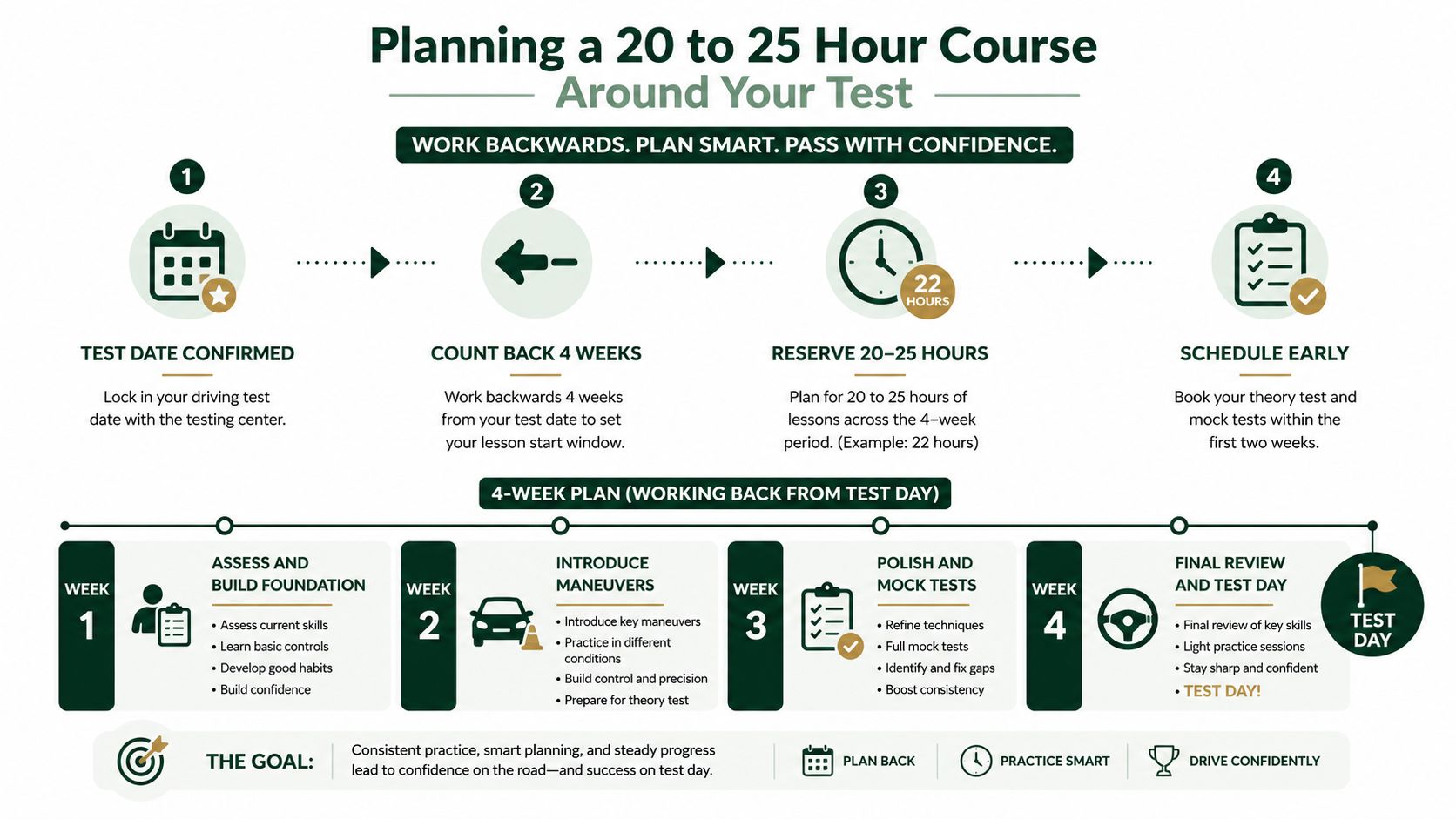
The smartest way to book a semi intensive course in 2026 is to work backwards from the test date, not forwards from the first available lesson. That sounds obvious, but a lot of learners do the opposite, then discover the test slot and the course finish date don't line up. When that happens, the learner either has a long gap with no driving or has to rush the final sessions.
Start with the test date, then count back
If your practical test is already booked, count back far enough to give yourself a proper lesson window. A four-week run works well for many learners, because it gives room for the first lessons, a mid-course review, mock tests and a final tidy-up. If you're still waiting to book, the structure should still be built as if a date could appear soon, because the DVSA booking system and cancellations can shift quickly.
The 2025 short-notice cancellation rule matters here. Car tests can now be swapped into earlier slots found inside ten working days, which means a semi intensive course needs to leave breathing space for an earlier opportunity rather than locking every day solidly. A tight course is only useful if your instructor can pivot with it.
Where theory and mock tests fit
Your theory test status shapes the first half of the course. If you've already passed, the instructor can focus sooner on practical faults, route familiarity and exam standard driving. If you haven't, you'll split your attention, and that usually slows progress because test nerves and theory revision compete for headspace.
Mock practical tests usually belong in the last two or three sessions. That's where the course shifts from learning to proving. For a weekday morning test, a common pattern is a two-week block with three to four hours daily near the end, then a final light session before test day. For a Saturday test, the same logic can be rearranged into a weekend-heavy schedule with weekday top-ups.
For a course booking page that reflects this kind of planning, the 20-hour course outline shows how a shorter intensive block can be structured around readiness rather than random lesson availability.
Agree the sequence before you pay
Before you confirm anything, make sure the instructor agrees the order of work. That should cover theory timing, mock test placement, any cancellation flexibility and the final lesson before test day. If those points aren't discussed early, the course can look neat on paper and still fail in practice.
Test Waiting Times and Why Timing Matters in 2026
A lot of course pages still sell semi intensive learning as a speed product. That's too simple for the UK in 2026. The core issue is not just how quickly you can learn, it's how cleanly your lessons sync with the practical test system you're booking into.
The government's June 2026 update said the national median wait between booking and taking a car driving test was 9.7 weeks, while the older “10% availability” measure stood at 21.8 weeks. BBC reporting the same month said the average waiting time to book a test was nearly 22 weeks, and that the backlog would not return to a seven-week target until autumn 2027, while pre-pandemic waits were about five weeks. Government update on driving test waiting times Those figures explain why a short, concentrated course can be useful even when it doesn't look “faster” in the old sense.
Region changes the picture
The same reporting also showed wide variation by nation in April 2026, with England at 22.7 weeks, Scotland at 22.9 weeks and Wales at 17.3 weeks. The DVSA also said it would publish monthly per-test-centre waiting-time data and a median measure because the old headline figure overstated waits at some centres. BBC reporting on regional driving test waits
| Region | Average Wait (Weeks) | Typical Test Centre Example |
|---|---|---|
| England | 22.7 | Busy urban centres in major cities |
| Scotland | 22.9 | Higher-demand city centres |
| Wales | 17.3 | Mixed urban and regional centres |
A learner in a busy area like London, Birmingham or the South East can't treat a course as a loose bundle of lessons. The gap between lessons and the test slot is the whole story. If the gap grows too large, the learner loses sharpness, confidence dips, and the final sessions become catch-up rather than preparation.
Key point: the best semi intensive course in 2026 is usually the one that keeps your driving fresh until the first realistic test slot, not the one that simply crams the most hours into the fewest days.
For a wider look at booking pressure and how it affects planning, this driving test waiting times guide is worth reading before you lock in dates.
Who Semi Intensive Courses Work Best For
This format is not for every learner, and that honesty matters. It works best when the learner already has some driving context, enough diary flexibility to attend regularly, and a clear reason to aim for a fixed test window. If those pieces are missing, weekly lessons may be a better fit.
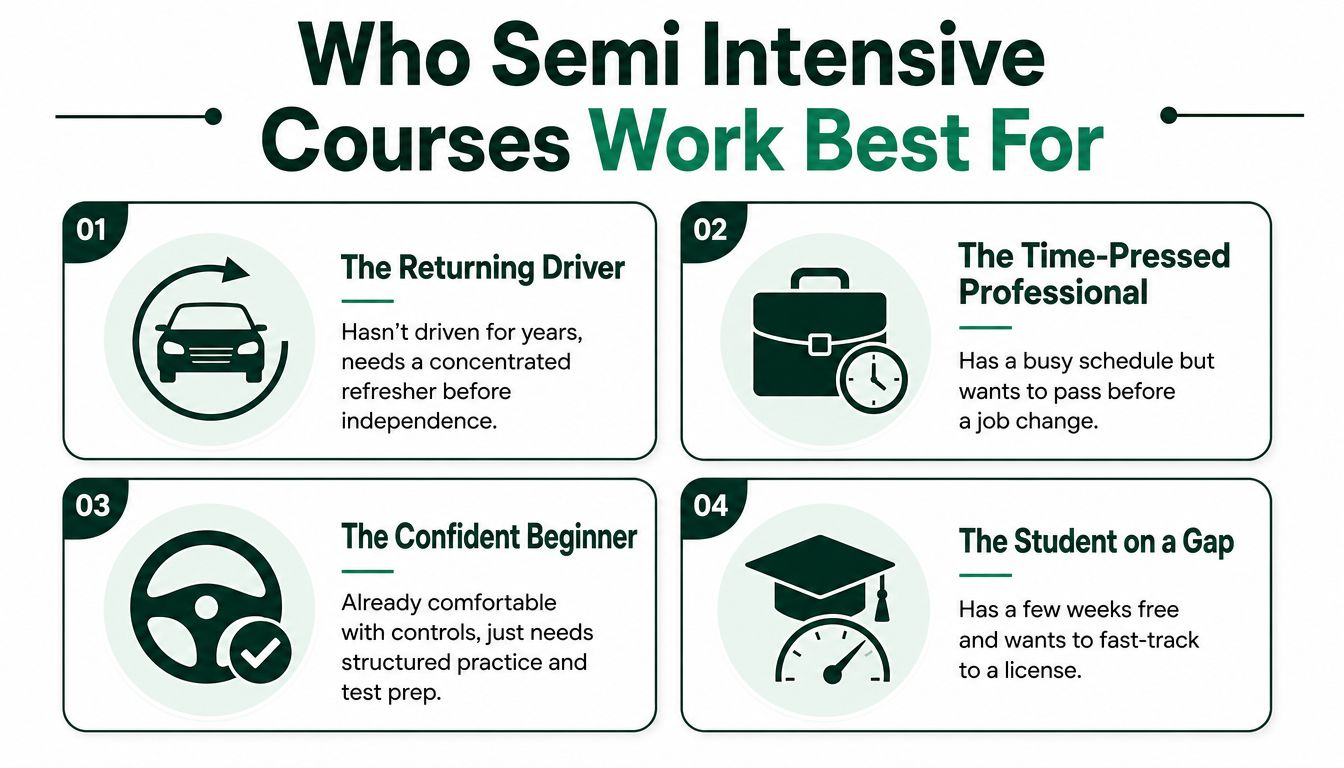
Four learner profiles that fit the format
The Returning Driver: someone who held a licence abroad or drove years ago, then needs a concentrated refresher on UK road rules, junctions and local habits. A 20 to 25 hour block usually works better than restarting from scratch with one-hour weekly lessons.
The Time-Pressed Professional: a learner with shift work or a changing job who can protect two-hour windows across a fortnight. The course gives enough momentum to keep progress moving without demanding a full week away from work.
The Confident Beginner: a part-trained learner who knows the controls, can move off smoothly and mainly needs structure, manoeuvre practice and mock tests. They tend to benefit from the course rhythm because the basics are already in place.
The Student on a Gap: someone with a few free weeks who wants to turn spare time into a booked test attempt. The lesson blocks stay concentrated enough to feel purposeful, but not so extreme that the learner burns out halfway through.
Who it suits less well
Complete novices with no theory pass usually struggle most with this format. They're trying to learn the car, the rules and the test format at the same time, which splits attention and slows retention. In that case, a slower start with broader theory support is usually the calmer route.
Vetting Instructors and Reading the Price
A semi intensive course is only as good as the person delivering it. The safest first step is to check that the instructor is a DVSA-registered ADI on the official government register, then confirm the school covers your area and teaches in the transmission you want, manual or automatic. To become an Approved Driving Instructor, first-time applicants need a new Disclosure and Barring Service check, DVSA registration and the relevant licences and qualifications, and the DBS check and registration must be renewed every 4 years, with at least one standards check in that same period. Official guidance on becoming a driving instructor
What a credible package should show
A proper quote should spell out the lesson structure, the hours included, whether the test-day car is part of the price and what happens if the instructor is unavailable. It should also explain whether you're paying for theory materials, mock tests or cancellation support. The more fixed the package, the easier it is to compare schools fairly.
Watch for warning signs. Vague per-hour pricing, cash-only deposits and pressure to waive your cooling-off rights are all awkward signals. If the school is using its own car for the test, ask for proof of the relevant franchise or hire-and-reward insurance, because that's part of the practical setup many learners forget to ask about.
Ask for the quote in writing. If a school is clear, it won't mind being clear again.
One thing to keep in mind is that the statutory 14-day cooling-off period gives you breathing room after online or distance booking. That matters if your test date shifts, your work rota changes or the course details don't match what was promised. A transparent price should protect you, not trap you.
A provider such as Fast Track Driving Lessons offers manual and automatic semi-intensive tuition with fixed hourly pricing, local instructor matching and test support, so it's one option to compare against any local school that's quoting you a package rate. For readers thinking about spreading payments rather than paying everything up front, this guide on how to reduce checkout friction with payment plans is useful context.
Quick checklist before you hand over money
- Check the ADI record: confirm the instructor is registered and active.
- Read the package terms: make sure hours, test-day car use and extras are listed.
- Confirm the timing: the course should line up with a booked or soon-to-be-booked test.
- Keep the paperwork: receipts, terms and the cancellation window should be clear from day one.
Choosing and Booking a Semi Intensive Course With Confidence
The best way to choose is to compare schools on the same three questions, not on the cheapest advert you happen to see. First, is the instructor properly registered? Second, does the quote tell you exactly what you're buying? Third, does the schedule fit the test date you're working towards?
A simple booking sequence
Start by checking the instructor on the DVSA register, then ask for a fixed written quote that lists the hours, inclusions and any test-day vehicle use. Next, confirm that your theory pass is current and recorded, because a practical course works far better when that admin is already done. After that, agree a start date that lines up with a booked practical slot, or at least a realistic booking window.
Only then should you pay the deposit, and keep it inside the 14-day right to cancel if you're booking online or at a distance. Avoid cash-only arrangements if you can, because cards and written receipts give you a cleaner paper trail if the diary changes. Staged payments can be sensible if the provider is clear about what each stage covers and when it becomes due.
A practical comparison becomes much easier when each school is answering the same questions. One may offer a slightly higher hourly rate but include mock tests, while another looks cheaper until you add the test-day car and admin fee. That's why the total package matters more than a headline hourly figure.
If you want a school that matches learners to DVSA-approved instructors and keeps the structure clear from the start, Fast Track Driving Lessons is a sensible place to begin. Speak to the team, compare the course outline against your test timing, and book only when the schedule fits your life and your readiness.
Written by Fast Track editorial team.