
You've booked lessons around work, university or family commitments, but the gaps between weekly sessions are making progress feel painfully slow. Then you check the practical test queue and realise that being ready to drive isn't the only timing problem. The key question is whether an intensive course can bring your skills and a realistic test slot together.
Table of Contents
- Introduction to Intensive Driving Lessons in the UK
- How Intensive and Semi Intensive Learning Actually Works
- Choosing the Right Course Length for Your Experience Level
- UK Test Waiting Times and Regional Availability Explained
- How to Book and Prepare for Your Intensive Course
- Costs Instructor Checks and What Is Included
- Making Your Intensive Course Count on Test Day
Introduction to Intensive Driving Lessons in the UK
Intensive driving lessons in the UK compress your training into a shorter calendar period. Instead of driving once a week and revisiting the same skills after several days, you might use consecutive sessions to build continuity through junctions, manoeuvres, hazard perception and independent driving.
That doesn't mean intensive tuition removes the work required to become safe. DVSA guidance commonly used for learner planning is 45 hours of professional instruction plus 22 hours of private practice before passing, so an intensive course is better understood as a way to organise that learning volume, not as a shortcut around it. The DVSA-based learner guidance on intensive tuition also frames the main benefit as reduced calendar time and less skill fade between lessons.
Consider two learners. A returner may already control the car comfortably but hesitate at busy roundabouts and make inconsistent observations during manoeuvres. A complete beginner may still be learning clutch control, steering accuracy and basic road positioning. Giving both learners the same short course would be like giving a beginner pianist and someone preparing for a recital the same practice plan.
The test queue adds another complication. The DVSA's latest published measure for Great Britain recorded a median practical car test wait of 11.1 weeks for learners who took their tests in July 2026, while a separate availability measure for the same period was 20.2 weeks. Those figures describe different parts of the booking system, and confusing them can lead learners to schedule lessons around a test date that isn't available locally. The distinction is reported in BBC coverage of the July 2026 DVSA waiting-time figures.
This guide will help you decide whether a booster, semi-intensive plan or larger block fits your experience. You'll also learn how to compare regional queues, book around live availability, prepare for concentrated driving days and check that the provider's pricing and instructor arrangements are clear.
How Intensive and Semi Intensive Learning Actually Works
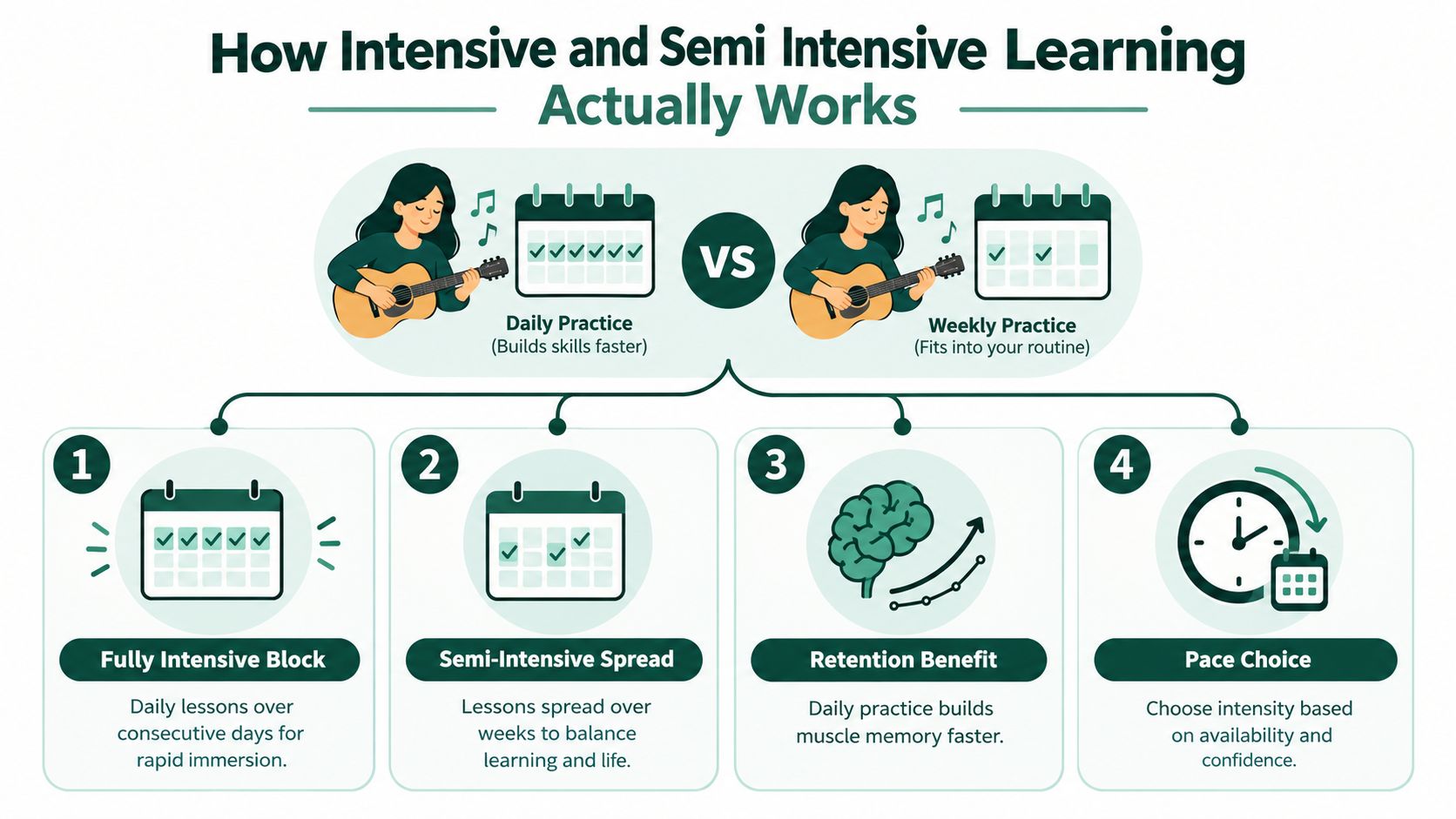
Learning to drive is closer to learning an instrument than memorising a list of rules. If you practise a difficult piece every day, your fingers begin to find the pattern. If you play it once and leave it for a week, you spend part of the next session remembering where you left off.
Driving skills work in a similar way. Consecutive lessons can help you carry forward the feel of clutch engagement, steering control, mirror checks and speed adjustments. An instructor can correct a recurring habit during one session, then ask you to repeat the same skill soon afterwards while the correction is still fresh.
Fully intensive or semi-intensive
A fully intensive block uses lessons over consecutive days. It can suit a learner with a clear period away from work or study, particularly when the practical test is already booked or a suitable cancellation is being monitored.
A semi-intensive course spreads lessons across a longer window, often 2 to 4 weeks through providers offering this format. It still gives you regular repetition, but leaves room for sleep, private practice, work and the gradual consolidation of more demanding skills.
The format should follow your capacity, not your impatience. Long sessions require sustained concentration, and fatigue can affect clutch control, hazard scanning and decision-making. A learner who drives while exhausted may spend the final part of a session repeating mistakes rather than absorbing useful feedback.
Practical rule: Intensive learning reduces the gaps between sessions. It doesn't reduce the total attention, practice and recovery you need.
Manual and automatic tuition can both be delivered in dual-control vehicles that meet practical test requirements. Manual learners have the additional task of coordinating clutch, gears and speed, while automatic learners can focus earlier on observation, positioning and planning. That doesn't make automatic driving effortless, because the examiner still assesses safe judgement and control.
A sensible schedule might place a focused morning session alongside a shorter later session, with a review of what improved and what needs attention next. The exact timetable should be agreed with the instructor, especially for complete beginners or nervous learners. The aim is steady learning density, not filling every available hour.
Choosing the Right Course Length for Your Experience Level
Course length should reflect what you can already do consistently, not the number of days you'd like to spend learning. A short course can be useful when only a few weaknesses remain, but it can leave a beginner overwhelmed and a test booking poorly timed.
A 10-hour Test Booster is most suitable for someone who's close to test standard and needs a structured review. That might include correcting hesitation at junctions, improving independent driving or preparing for a retest. A 15-hour Manoeuvre Finisher is more targeted, particularly where parking, reversing or observations during manoeuvres are holding the learner back.
The middle options give learners more space to build consistency. A 20-hour Semi-Intensive can suit someone with previous tuition who needs regular practice across a few weeks. A 25-hour Confident Starter is aimed at a learner who has begun before, understands basic controls and needs a fuller period of guided development.
For people with larger gaps in experience, the longer blocks are more realistic. A 30-hour Fast-Track can provide substantial concentrated training, while a 35-hour Beginner Plus allows a complete beginner to develop skills without relying on an unrealistically short burst. A 40-hour Complete Beginner is designed for someone starting from scratch who needs a larger share of the professional instruction commonly used in DVSA learner planning.
| Course | Hours | Best For | Typical Outcome |
|---|---|---|---|
| Test Booster | 10 | Near test-ready learners and retest preparation | Polishes existing skills and targets specific faults |
| Manoeuvre Finisher | 15 | Learners whose manoeuvres or observations need work | Builds consistency in parking and reversing exercises |
| Semi-Intensive | 20 | Learners with previous experience who need structured continuity | Develops progress across a concentrated multi-week plan |
| Confident Starter | 25 | Learners with basic experience who lack confidence | Strengthens core control and road decision-making |
| Fast-Track | 30 | Learners needing a substantial focused block | Covers a broad range of test-related driving skills |
| Beginner Plus | 35 | Beginners who need more time to consolidate | Builds skills through a longer intensive programme |
| Complete Beginner | 40 | Learners starting from scratch | Provides a large, structured foundation towards test readiness |
A returner might choose 10 or 15 hours after an assessment if their control is sound and their weaknesses are narrow. A complete beginner shouldn't assume that a short course is better value because it costs less upfront. The right question is whether the hours allow enough repetition for skills to become dependable.
Theory status matters too. You should have passed the theory test before arranging the practical test, otherwise your driving progress may reach the correct standard before you're legally able to take the next step. If your practical test is already booked, work backwards from that date, then leave enough flexibility for the instructor to recommend additional tuition if your assessment reveals gaps.
UK Test Waiting Times and Regional Availability Explained
An intensive course can create strong learning momentum, but the practical test queue determines whether you can use that momentum promptly. A learner who finishes a concentrated block without a suitable test appointment may need extra practice later, particularly if the local wait is longer than expected.
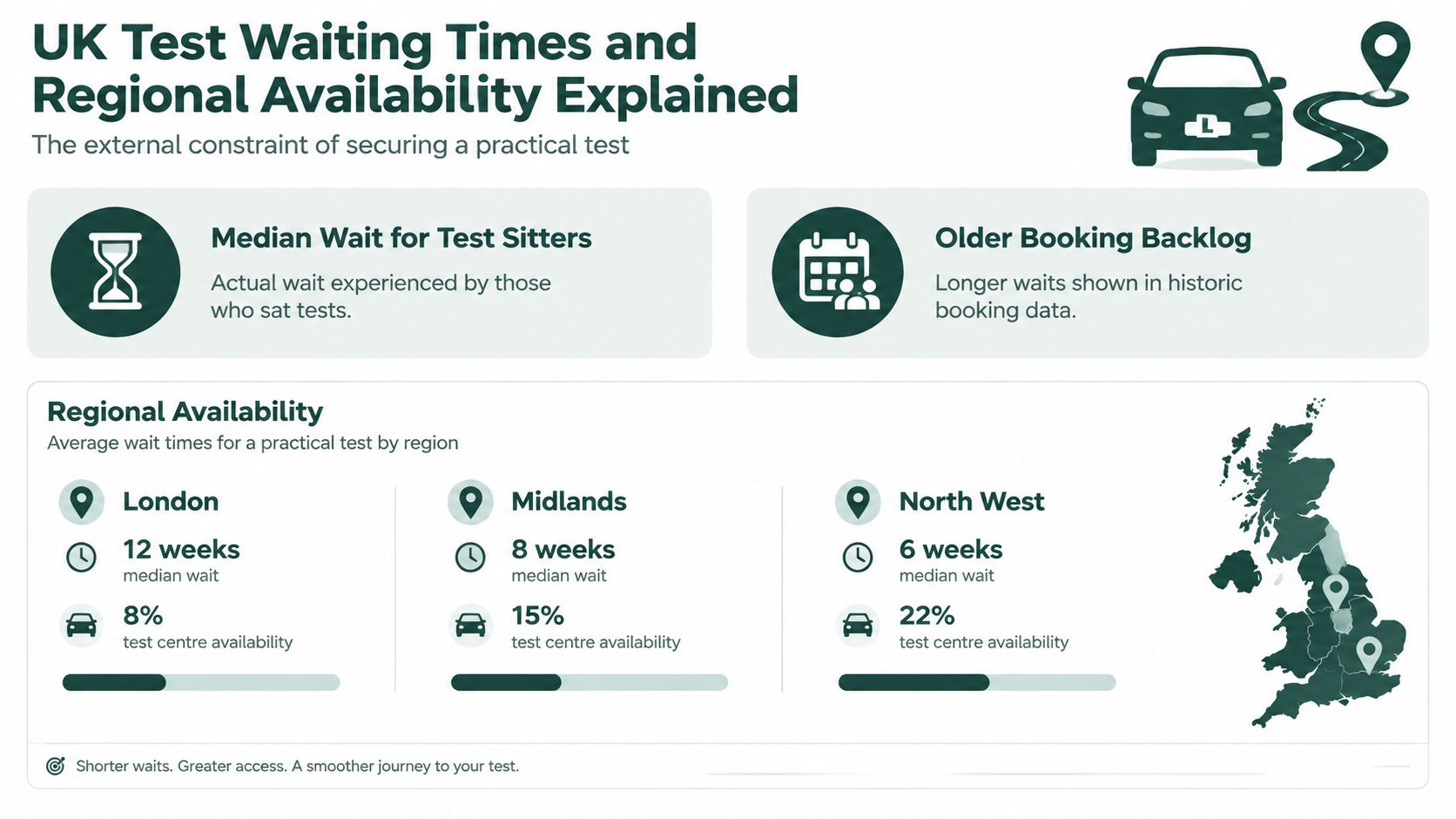
The figures need careful reading. The 11.1-week median reported for learners who took car tests in July 2026 describes the experience of completed test takers. The separate 20.2-week availability measure describes the older booking pressure visible when appointments were being sought. The DVSA dataset was updated on 12 August 2026 with data through July and covers Great Britain, while the related guidance explains that waiting-time figures are updated monthly and based on learners who took their test in the previous calendar month. These distinctions are set out in guidance explaining how 2026 driving test wait data is measured.
Why your region changes the plan
July 2026 regional figures show a 15.6-week median wait in Scotland, 14.7 weeks in London and 7.6 weeks in Wales, as reported in DVSA's explanation of the clearer waiting-time picture. Those numbers shouldn't be treated as a promise for every test centre, but they show why a nationwide timetable can mislead.
Earlier reporting shows how unstable the system has been. The National Audit Office recorded an average wait of 22 weeks in September 2025, with 70% of DVSA permanent test centres at the 24-week maximum at that point. Its summary also said DVSA expected to reach its seven-week waiting-time target by November 2027, rather than the earlier target of December 2025. The National Audit Office summary of the practical test backlog explains why course planning has to account for capacity as well as learner readiness.
Use live information when choosing dates. Check the preferred centre, consider nearby centres where appropriate, and monitor cancellations rather than assuming a fixed course end date will produce a test immediately. A short booster may fit well beside a realistic appointment, while a 30 to 40-hour block may need more careful scheduling so the learner doesn't reach test standard long before a slot appears.
For a practical explanation of how queues affect planning, see what to expect from UK driving test waiting times. The useful takeaway is simple: course speed and test access are separate variables. You need both in the same plan.
How to Book and Prepare for Your Intensive Course
Start with the appointment and eligibility details, not the first available lesson date. A practical booking plan should answer five questions in order.
1. Check your theory position
You'll need a passed theory test before taking the practical test. If you're still revising, use DVSA-style questions and hazard-perception practice through a structured learner resource, then use the theory test booking guidance to confirm the process.
2. Choose the car and area
Decide whether you'll learn in a manual or automatic vehicle, then identify the test centre or centres you can realistically use. Automatic tuition removes clutch and gear-change coordination, but you'll still need strong observation, planning and vehicle positioning. Your preferred area also affects instructor availability and the kind of roads you'll practise on.
3. Arrange an assessment and instructor match
Tell the provider whether you're a complete beginner, a returner, a nervous learner or close to test standard. Matching should consider transmission, location, availability and learning preferences, rather than treating every learner as interchangeable.
4. Fix a workable schedule
Agree dates around sleep, work, childcare and study. Consecutive lessons can be productive, but you'll retain more if you arrive rested and have time to process feedback. A semi-intensive plan may be more effective than a compressed block if long driving days make your concentration deteriorate.
Ask how mock tests will be arranged. Practice should include roads near the chosen centre, independent driving and examiner-marked fault conditions, not just a familiar loop that feels comfortable.
5. Prepare between sessions and protect momentum
Revise theory alongside practical tuition. Use step-by-step manoeuvre guides to understand the routine, but don't try to memorise a fixed sequence so rigidly that you stop responding to the road.
PracticalTest Assist-style cancellation monitoring can help identify suitable earlier appointments, but a moved slot may require the course plan to change. Keep a record of your recurring faults, rest properly before each lesson and use any private practice safely and legally. If a cancellation appears before you're ready, don't book it because it's earlier.
The course should finish with a clear readiness decision. That might mean taking the test, adding targeted tuition or moving the appointment so you can prepare properly.
Costs Instructor Checks and What Is Included
Price comparisons only help when the packages cover the same things. Look for the hourly rate, total tuition time, vehicle use, test-day support, cancellation terms and any separate DVSA charges.
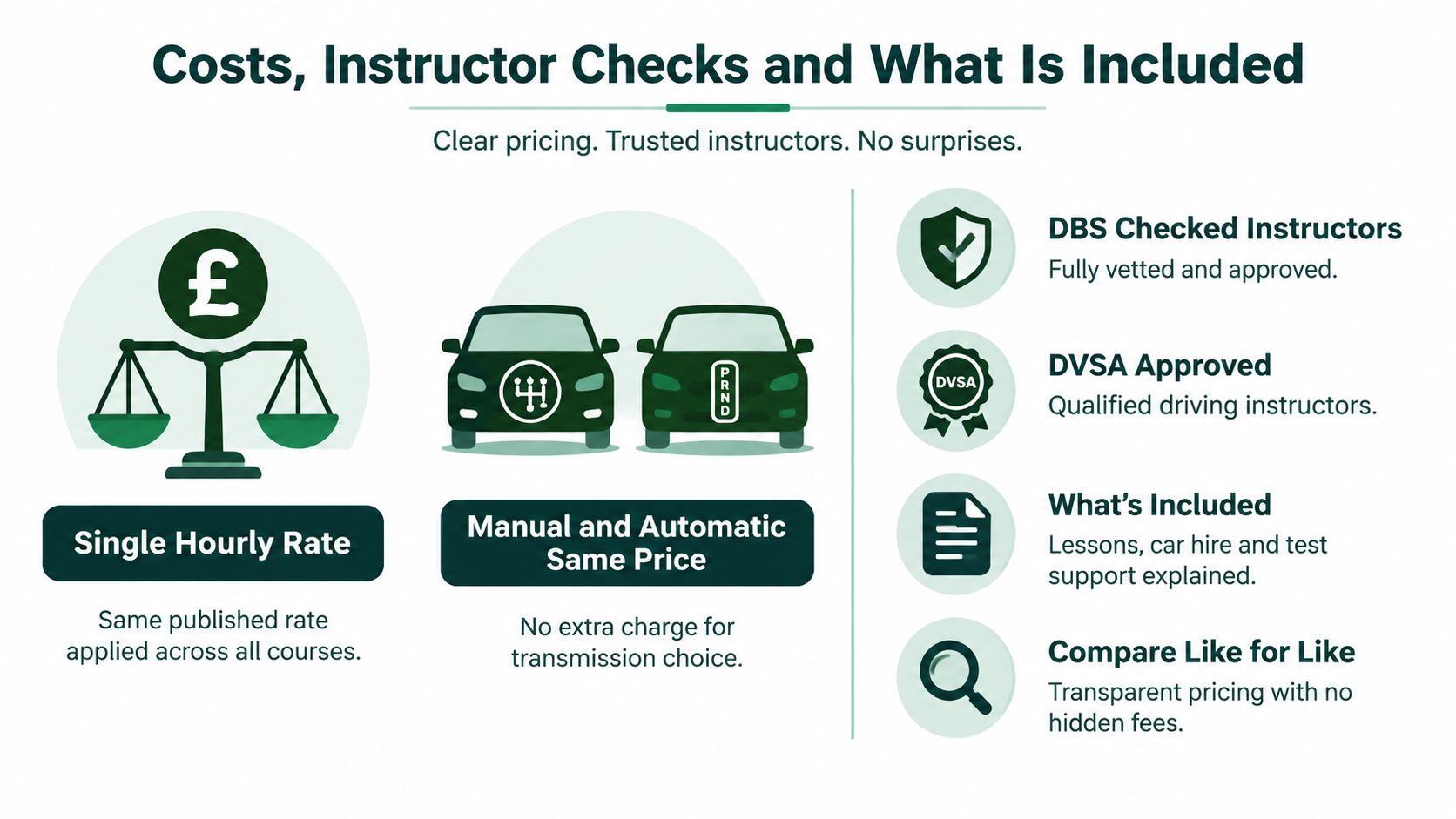
Fast Track Driving Lessons publishes a single hourly rate of £61.23 across its courses, with no booking or administration fees, as described on its intensive lesson pricing page. Manual and automatic tuition is priced identically, so the transmission choice doesn't create an added provider premium. DVSA fees remain separate and are paid directly to the government.
Check the instructor, not just the package
A trustworthy provider should explain whether your instructor is an Approved Driving Instructor, known as an ADI, or a Potential Driving Instructor, known as a PDI. ADI badge details should be validated, and annual re-checks, enhanced DBS checks, insurance for dual-control tuition, valid MOT documentation and vehicle standards should be part of the verification process.
Ask what happens if the instructor becomes unavailable during your course. A replacement instructor can protect continuity where local cover exists, and an instructor swap without an extra charge may be possible when alternatives are available. Get that policy in writing rather than relying on a reassuring conversation.
A simple buying checklist
- Total price: Confirm the number of hours and what the quoted amount includes.
- Transmission: Check that manual and automatic options are clearly priced.
- Test support: Ask whether the car, instructor and preparation on test day are included.
- Payment terms: Check whether card, Apple Pay, Google Pay, interest-free instalments or deposit-and-balance options are available.
- Written protection: Read the terms, refund policy and receipts, including the 14-day cooling-off period where it applies.
The cheapest-looking course may not be the least expensive route if missing support leads to more lessons or a poorly timed test. Equally, a higher total can be reasonable when it clearly includes the hours and assistance you need. Compare like for like, and don't pay until the arrangements are understandable.
Making Your Intensive Course Count on Test Day
The final days should be about reliability, not collecting new tricks. Your instructor should use mock tests to recreate examiner-marked fault conditions, including independent driving, routine manoeuvres, observation at junctions and decisions on unfamiliar roads.
Local route familiarity can reduce uncertainty, but it shouldn't become dependence on one memorised route. Test examiners can take you in different directions, so practise the underlying skills rather than treating a route map as a script.
Nerves need a practical plan. Arrive rested, allow time to settle before the test and use the same observation routines you've practised throughout the course. If one mistake happens, continue driving safely instead of mentally replaying it for the rest of the test.
The national first-attempt pass rate was 48.2% for 2024 to 2025, according to published DVSA driving test results. That figure is a useful reminder that an intensive course doesn't guarantee a pass. It can shorten the time to readiness by reducing gaps between lessons, but you should take the test only when your driving is consistently safe and your instructor's mock-test feedback supports the decision.
Match the course to your starting point, then match its dates to a realistic local test slot. Check instructor availability, ask how cancellations are monitored and leave room for targeted top-up tuition if your assessment shows that the shortest option would be rushed.
Fast Track Driving Lessons offers intensive and semi-intensive courses from 10 to 40 hours, with manual and automatic tuition matched to learners through local instructor availability and area preferences. Visit Fast Track Driving Lessons to check suitable course options and start aligning your training window with a realistic DVSA test appointment.
Written by Fast Track editorial team.