
You've just turned 17, passed your theory test, and want to learn quickly before university, a new job or a change in family circumstances. Then you check practical test availability and discover that the date you want may be weeks away. At the same time, weekly lessons feel slow, while booking a large block of lessons feels like a financial gamble.
That situation makes an intensive driving course for beginners sound attractive, but speed alone doesn't make a course suitable. A complete beginner needs enough time to build safe habits, recognise hazards and handle unfamiliar roads, not just complete a set number of hours. The right choice depends on three things working together: your theory preparation, your instructor's availability and a realistic DVSA test window.
Table of Contents
- Introduction to Intensive Learning When You Are Starting From Scratch
- How Intensive and Semi Intensive Courses Work for Beginners
- Choosing the Right Package From 10 to 40 Hours
- Scheduling Your Course and Securing a Practical Test Slot
- What to Expect Day by Day and How to Prepare
- Common Mistakes Beginners Make and How to Avoid Them
- Your Next Steps to Confident Test Readiness
Introduction to Intensive Learning When You Are Starting From Scratch
You have passed your theory test, found an instructor and hope to drive independently soon. Then you realise that learning quickly does not guarantee a practical test slot. An intensive course can shorten the gap between lessons, but it still has to match your ability, concentration and the date you may take the test.
Intensive tuition means driving frequently over a planned period rather than leaving long gaps between occasional lessons. The arrangement can keep steering routines, clutch control, observation checks and road positioning fresh, because feedback is followed by more practice soon afterwards. It works best when you can concentrate consistently and recover between sessions.
The result is not automatic test readiness. The DVSA's national practical car test pass rate was 48.7% in 2024-25, with a first-time pass rate of 48.9%, according to the published UK pass-rate summary at PassRates UK. That figure is a useful reminder that completing tuition quickly is different from showing safe, repeatable competence.
Maya has never sat in the driver's seat, feels nervous about every control, has passed theory and can attend several consecutive days. A substantial intensive plan may suit her if it builds basic control before progressing to busier roads. Daniel has had a few lessons, has not passed theory and can study only after college. A semi-intensive arrangement may fit better, giving him time to prepare while lessons develop steadily.
The practical target is consistent, safe competence when conditions change.
Test availability also affects the choice. In August 2026, the DVSA reported a 20-week national average wait for a car practical test, while the median time from booking to taking it was 11.1 weeks, as reported by the BBC's coverage of DVSA waiting times. Training may finish before the test date arrives, so theory study, tuition and booking need coordinating from the start.
The useful question is whether the learning rhythm fits your starting point and likely test window.
How Intensive and Semi Intensive Courses Work for Beginners
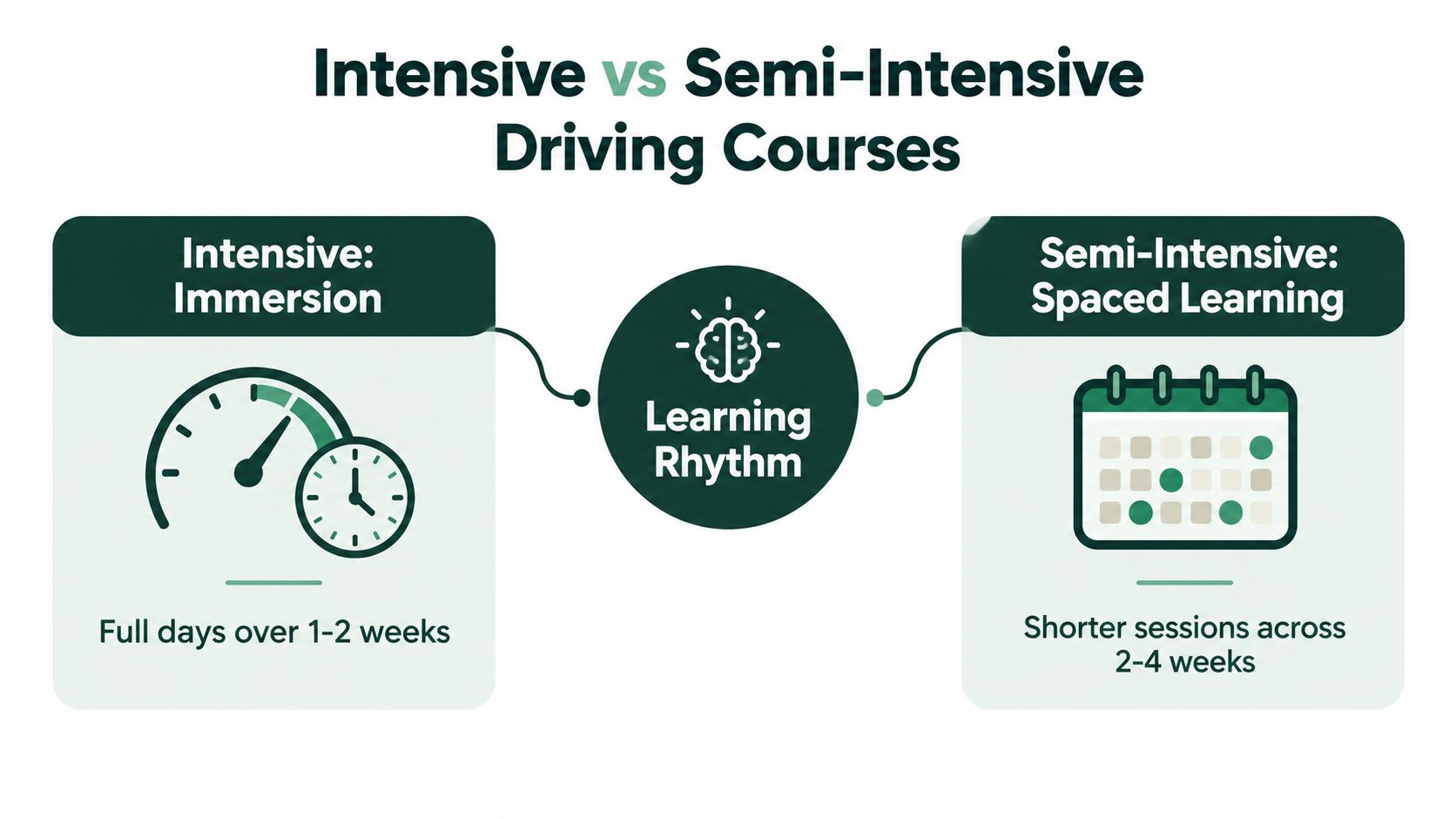
Intensive and semi-intensive courses use the same basic learning process, but they arrange practice differently. Think of learning to drive like learning a language. Intensive tuition is immersion, where you use the skill repeatedly over a short period. Semi-intensive tuition is spaced learning, where shorter sessions give you time to reflect and practise between visits.
An intensive plan might place several lessons across consecutive days. A semi-intensive plan spreads regular sessions over 2–4 weeks, which can work better if you're balancing school, work, caring responsibilities or theory revision. Neither rhythm removes the need for repetition. The difference is how quickly you return to the car and how much recovery time you have.
What the first lessons usually build
A complete beginner normally starts with the cockpit drill, controls, moving off, stopping and steering on quieter roads. The instructor then introduces routines for mirrors, signals, speed and position before increasing the difficulty.
Progress often develops in this order:
- Vehicle control: steering, braking, clutch control where relevant and smooth stopping.
- Road decisions: junctions, meeting traffic, roundabouts and changing lanes.
- Independent driving: following signs, planning ahead and responding to unfamiliar situations.
- Test preparation: manoeuvres, show-me-tell-me tasks, mock tests and correction of recurring faults.
Dual-control tuition means the teaching vehicle has additional controls that allow the instructor to assist when necessary. The government also requires learners to be supervised by an approved instructor or another qualified driver, while test vehicles must meet DVSA standards, including dual controls for many teaching arrangements. You can check the difference between a fully qualified ADI and a trainee PDI before booking.
Which rhythm fits a beginner
Choose intensive learning when you can concentrate consistently, attend frequent sessions and retain feedback from one lesson to the next. Choose semi-intensive learning when you need time to consolidate skills, prepare for theory or manage an uncertain test date.
Manual and automatic tuition are both valid choices. A manual course includes clutch and gear work, while an automatic course removes those tasks and lets you focus earlier on observation, judgement and positioning. The available course information states that manual and automatic lessons are offered at the same published hourly rate, so transmission choice should be based on your needs rather than an assumed price difference.
The DVSA learner-driver benchmark is about 45 hours of professional tuition plus 22 hours of private practice, according to this UK guide to recommended driving lesson hours. That isn't a legal minimum, and there's no fixed number of hours that guarantees readiness. It does show why a beginner course should be viewed as a structured training period, not a shortcut around practice.
For a closer comparison of learning rhythms, see these semi-intensive driving lesson options.
Choosing the Right Package From 10 to 40 Hours
The number of hours should reflect what you can already do without prompting. A 10-hour package may help an experienced learner correct weaknesses, but it's unlikely to provide a complete foundation for someone who has never driven. A 40-hour package gives a true beginner more room to develop, but even that should remain flexible if an assessment reveals that you need additional practice or a different pace.
Fast Track's published range includes Test Booster at 10 hours, Manoeuvre Finisher at 15 hours, Semi-Intensive at 20 hours, Confident Starter at 25 hours, Fast-Track at 30 hours, Beginner Plus at 35 hours and Complete Beginner at 40 hours. The published hourly rate is £61.23, with no booking or administration fees, according to the supplied publisher information. DVSA charges are separated from tuition costs and paid directly to the government.
Match the package to your starting point
| Package and hours | Best for | What it typically covers |
|---|---|---|
| Test Booster, 10 hours | A nearly test-ready learner or someone returning after a recent attempt | Targeted correction, test routines and focused practice |
| Manoeuvre Finisher, 15 hours | A learner who handles general driving but lacks confidence with manoeuvres | Bay parking, parallel parking, reversing exercises and fault correction |
| Semi-Intensive, 20 hours | A learner with some experience who needs regular structured progress | Consolidation, junctions, roundabouts and preparation across a short timetable |
| Confident Starter, 25 hours | A beginner who has basic control but needs more road experience | Building decision-making, traffic handling and independent driving |
| Fast-Track, 30 hours | A learner with a reasonable foundation and a clear time window | More frequent tuition, mock-test preparation and local-route work |
| Beginner Plus, 35 hours | A nervous or developing learner who needs substantial repetition | Core skills, complex traffic situations, manoeuvres and targeted practice |
| Complete Beginner, 40 hours | Someone starting from scratch | A broad programme from initial controls towards independent, test-focused driving |
These descriptions are starting points, not promises. A learner who has driven privately may still need intensive professional correction if their habits are inconsistent. Someone who has never driven may progress quickly with strong concentration, but that shouldn't lead an instructor to skip essential stages.
Questions to ask before paying
Start by describing your actual experience, not the package you hope to buy. Say whether you've driven a car before, whether you've practised privately, whether you want manual or automatic tuition and which test area you're considering.
Instructor matching also matters. Availability, transmission, local knowledge and teaching style can determine whether a course feels coherent. A change of instructor midway through a compressed course can interrupt momentum, so ask what cover or instructor-swap arrangements exist before making payment.
If you're unsure whether your experience points towards 20, 30, 35 or 40 hours, use the course recommender as a starting point, then discuss the result with an instructor. The most responsible recommendation may be a smaller initial block followed by an assessment, rather than the biggest package by default.
Scheduling Your Course and Securing a Practical Test Slot
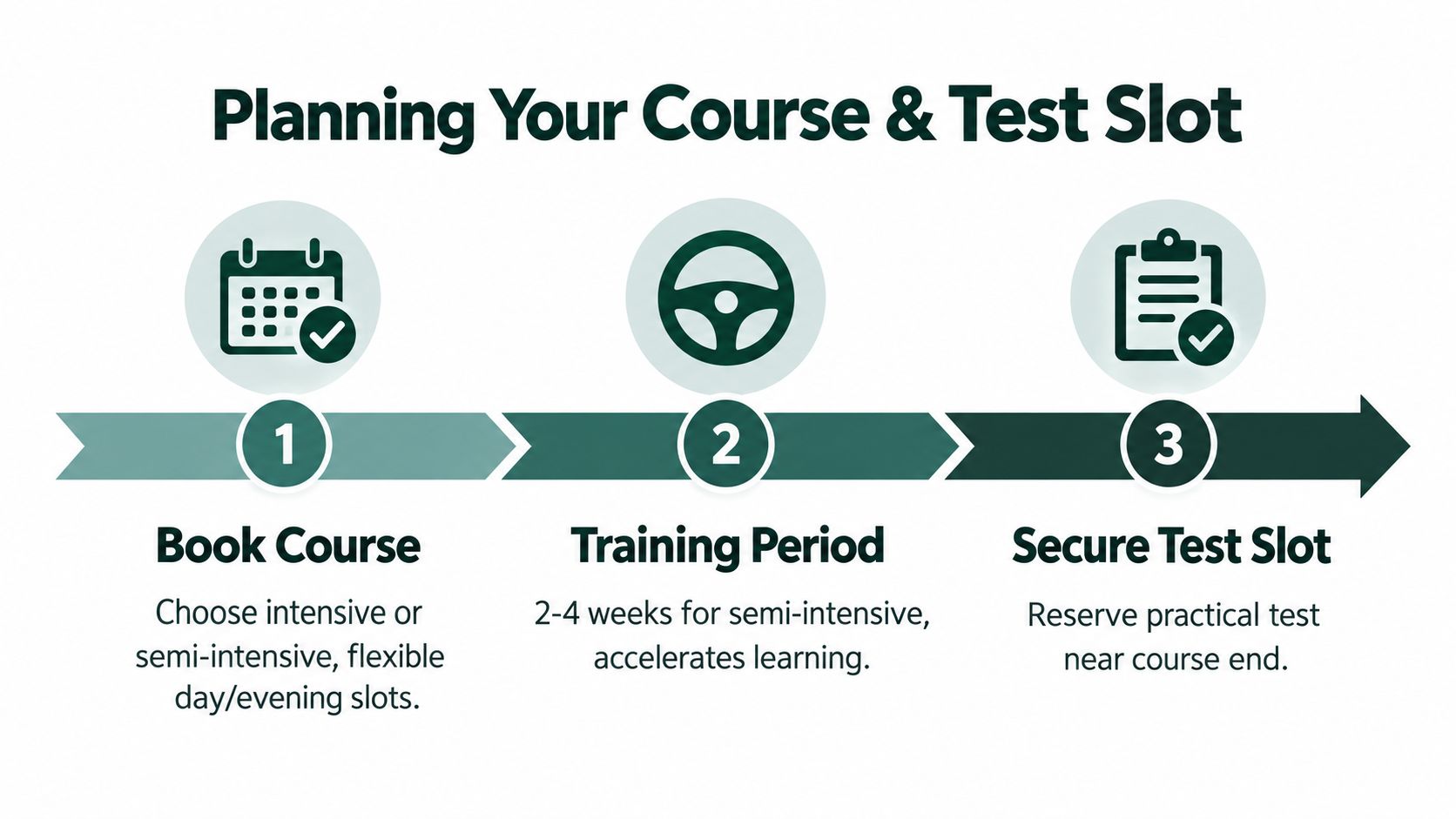
A beginner may finish an intensive course ready for a test, then discover that the next suitable appointment is weeks away. Another learner may book first, only to find that lessons cannot be arranged close enough to the test date. The training calendar and the DVSA test calendar must therefore be planned together.
The DVSA reported a median wait of 11.1 weeks between booking and taking a practical test in Great Britain in August 2026. The wider average was about 20 weeks, according to the government guidance on driving-test appointments. The National Audit Office reported an average wait of 22 weeks in September 2025, compared with just over five weeks in February 2020. It said at the time that the DVSA did not expect to meet its seven-week target until November 2027, as stated in its investigation into car driving test waiting times.
These waits affect the choice between intensive and semi-intensive learning. An intensive course can suit someone with a confirmed test window and enough time to practise consistently. Semi-intensive lessons may fit better where the test date is uncertain, because skills can develop while the learner monitors availability.
Build the timeline in the right order
- Check theory readiness. A practical test plan depends on having passed the theory test. If theory is still outstanding, allow time for revision and booking rather than assuming both appointments will align.
- Confirm transmission and area. Choose manual or automatic tuition, then identify the test centre or centres the instructor can realistically cover.
- Ask about availability. Compare consecutive daytime sessions with shorter evening lessons over several weeks. A compressed plan only works if the learner can concentrate and recover between sessions.
- Place training near the likely test window. Keep the final lessons for consistency, independent decisions and local road conditions.
- Monitor earlier opportunities. PracticalTest Assist uses real-time DVSA alert monitoring to help learners identify suitable cancellations. Review the driving-test cancellation support before relying on an earlier slot.
Most test centres do not operate a conventional waiting or cancellation list. Learners may therefore need to check appointments actively instead of expecting an automatic call.
Check who will teach you
A green badge identifies an approved driving instructor, while a pink badge identifies a potential driving instructor during qualification. Ask which instructor will teach you, whether the vehicle has suitable dual controls and what happens if that instructor becomes unavailable.
A provider covering England, Scotland and Wales may still have different availability in each area. Confirm your town, test centre, transmission and preferred lesson times in writing. Flexible daytime and evening options can make semi-intensive learning practical without forcing exhausting full-day sessions.
What to Expect Day by Day and How to Prepare
An intensive course can feel demanding because every lesson asks you to process new information while controlling a moving vehicle. The first day may be dominated by simple tasks that seem less exciting than roundabouts or manoeuvres. That foundation matters, because poor steering, braking or observation habits become harder to correct once traffic becomes complex.
A typical progression might begin with cockpit drill, moving off and stopping, then quiet-road steering and controlled junctions. Later sessions can introduce busier junctions, roundabouts, road positioning, dual carriageways, manoeuvres and independent driving. Near the chosen test centre, the instructor can use representative roads and mock tests to reveal faults that only appear when you're managing several decisions at once.
Prepare before the first lesson
Theory work should begin before or alongside practical tuition. The theory test requires 50 multiple-choice questions, with at least 43 correct answers, followed by hazard perception where you must score at least 44 out of 75. Both parts must be passed at the same appointment, according to this guide to the DVSA theory test pass requirements.
Use DVSA-style questions to learn why an answer is correct, rather than memorising patterns. A free Learner Hub with theory questions and step-by-step driving guides can support that preparation, particularly when you review the road situations that caused mistakes during lessons.
Bring your provisional licence, suitable footwear, water and a willingness to take notes. Sleep also matters. A tired learner may spend a long session repeating the same error without absorbing the correction, so a shorter, focused block can be more productive than forcing extra time.
Use feedback as a loop
At the end of each session, ask for one or two priorities rather than trying to fix everything at once. For example, if you're approaching junctions too quickly, concentrate first on early speed reduction and observation. Once that becomes reliable, the instructor can add lane choice and traffic judgement.
Mock tests should feel diagnostic, not like a final verdict. Examiner-marked faults show where your routine breaks down, whether that's missed mirrors, hesitation, weak observations during manoeuvres or poor planning on unfamiliar roads.
Payment can also be planned around your timetable. The available options include card, Apple Pay, Google Pay, interest-free instalments and deposit-and-balance arrangements. Check the written terms before booking so the payment schedule matches your ability to attend.
Common Mistakes Beginners Make and How to Avoid Them
A beginner may finish an intensive course with plenty of practice but still lack a clear route to the practical test. This happens when the timetable, theory preparation and test availability are treated as separate problems. They work more like three points on the same map. If one is missing, reaching the destination becomes harder.
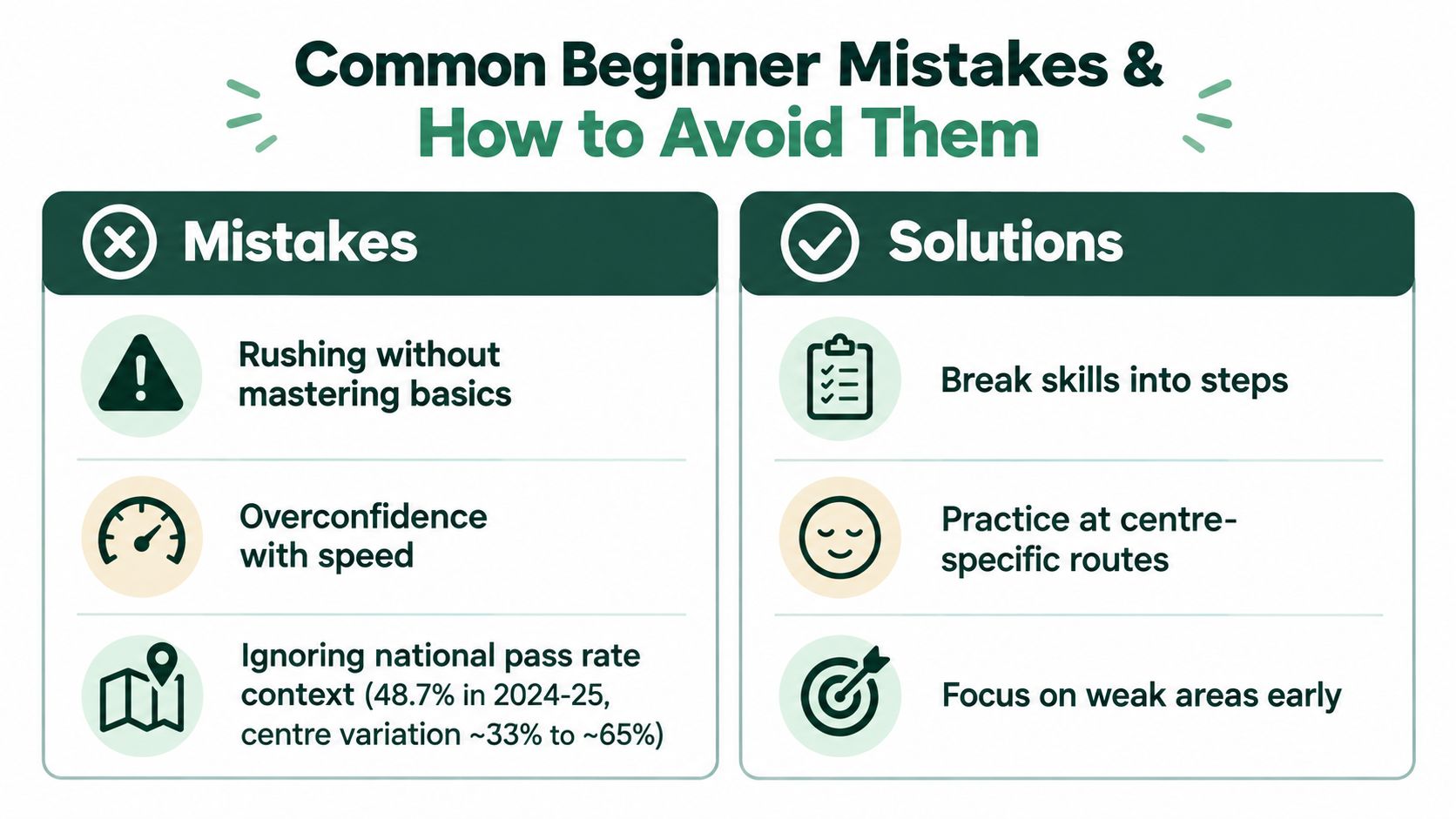
A compressed schedule can preserve momentum, but it exposes gaps quickly. If you still need prompts for mirrors, speed control or junction observations, moving directly towards a practical test may create a delay rather than save time. The national result provides useful context, with centre-level outcomes varying widely, so local roads, test-centre choice and targeted preparation deserve attention.
Errors that create avoidable pressure
- Rushing past the basics: Steering is only one part of control. If your speed changes are rough, ask the instructor to divide the task into smaller stages.
- Buying hours without an assessment: The package should match your starting point and learning rate, not the date you hope to finish.
- Ignoring local conditions: Practise the junctions, roundabouts and road layouts near the chosen test centre. Familiarity with a route is not enough, but local experience helps you apply the right routines.
- Treating mock tests as optional: A mock test can reveal a repeated fault while there is still time to correct it.
- Starting practical tuition before theory is under control: A practical course may progress faster than your test pathway if theory study and appointment planning are left until later.
For a complete beginner, booking 20–40 hours before passing theory can mean training without a practical test date to work towards. Practical appointments may already be difficult to secure, so the final lessons could be separated from the assessment by an unplanned wait. A semi-intensive course can act like a bridge, keeping regular practice in place while you study, watch availability and decide when a test slot fits your progress.
Corrective practice should be specific. Ask the instructor to identify the faults affecting readiness, work on them deliberately, then repeat the same decisions in varied traffic and weather where possible. Confidence comes from making safe choices repeatedly, not from reaching the final hour shown on a booking receipt.
This video can help you recognise common learning errors before committing to a timetable.
Your Next Steps to Confident Test Readiness
Use a simple decision check before booking:
- Theory: Have you passed both parts, or do you have a realistic study plan and appointment?
- Test window: Can you identify a practical test date that fits the likely end of tuition?
- Starting point: Are you starting from scratch, or do you already control the car and need correction?
- Transmission: Have you chosen manual or automatic based on your future driving needs and learning preference?
- Coverage: Can the provider match you with a suitable instructor in your part of England, Scotland or Wales?
- Verification: Have you checked whether the instructor is an ADI or PDI and confirmed the vehicle arrangements?
- Terms: Have you read the written price, cancellation terms, refund policy and 14-day cooling-off period?
Remember that hours are evidence of training, not evidence of readiness. You're ready when you can control the vehicle, identify hazards, plan ahead and respond safely without constant prompts. If an instructor swap becomes necessary, maintain momentum with a replacement who can work in the same area and transmission.
You can book now if theory and test availability align. If they don't, semi-intensive learning may protect your progress while you resolve both uncertainties.
Fast Track Driving Lessons matches learners with DVSA-approved instructors for manual and automatic intensive or semi-intensive tuition across England, Scotland and Wales. Visit Fast Track Driving Lessons to compare beginner course options, check local matching and plan lessons around your theory and practical test window.
Written by Fast Track editorial team.