
Intensive driving courses in the UK typically cost £800 to £2,500, depending on the hours, region and whether the DVSA test fee is included. In 2024, the most common hourly rate was £36 to £40, so the course fee is only the starting point for your real budget.
You may be looking at several websites, seeing apparently similar packages, and wondering why one costs £799 while another asks for £2,400. That spread isn't automatically a sign that one school is honest and the other is ripping you off. The difference usually comes from the number of hours, your experience, the car you learn in, local demand and the costs hidden outside the headline price.
The mistake is budgeting for tuition alone. A sensible UK budget also allows for the practical test, the car on test day, extra lessons if your skills aren't ready, and the possibility that your test date won't line up neatly with the end of your intensive block.
Table of Contents
- What an Intensive Driving Course Actually Costs in 2026
- What an Intensive Driving Course Is and Why Hours Drive the Price
- The Real Factors That Push the Price Up or Down
- Typical Package Prices by Hours and Transmission
- DVSA Test Fees and the True Total You Need to Budget For
- How to Spot Genuine Value Beyond the Headline Price
- Building a Realistic Total Budget Before You Book
What an Intensive Driving Course Actually Costs in 2026
Maya has saved £1,500 and finds intensive course quotes from £799 to £2,400. The headline price does not tell her whether tuition, the practical test, the test-day car or enough preparation is included. Her real decision is whether the package leaves room for the costs that appear after booking.
For 2026, UK intensive courses broadly sit between £800 and £2,500, depending on course length, location and included extras, according to this 2026 UK intensive course cost guide. A short refresher belongs near the lower end. Beginner tuition, automatic lessons, busy-city instruction and short-notice bookings can take the total much higher.
The package price is only Maya's first figure. She also needs to budget for DVSA charges, test-day car hire and contingency lessons. If her test date falls after the intensive block, she may need extra practice or another lesson to keep her skills fresh. Waiting times can also make a cheap regional package less attractive if travel, accommodation or additional local lessons become necessary.
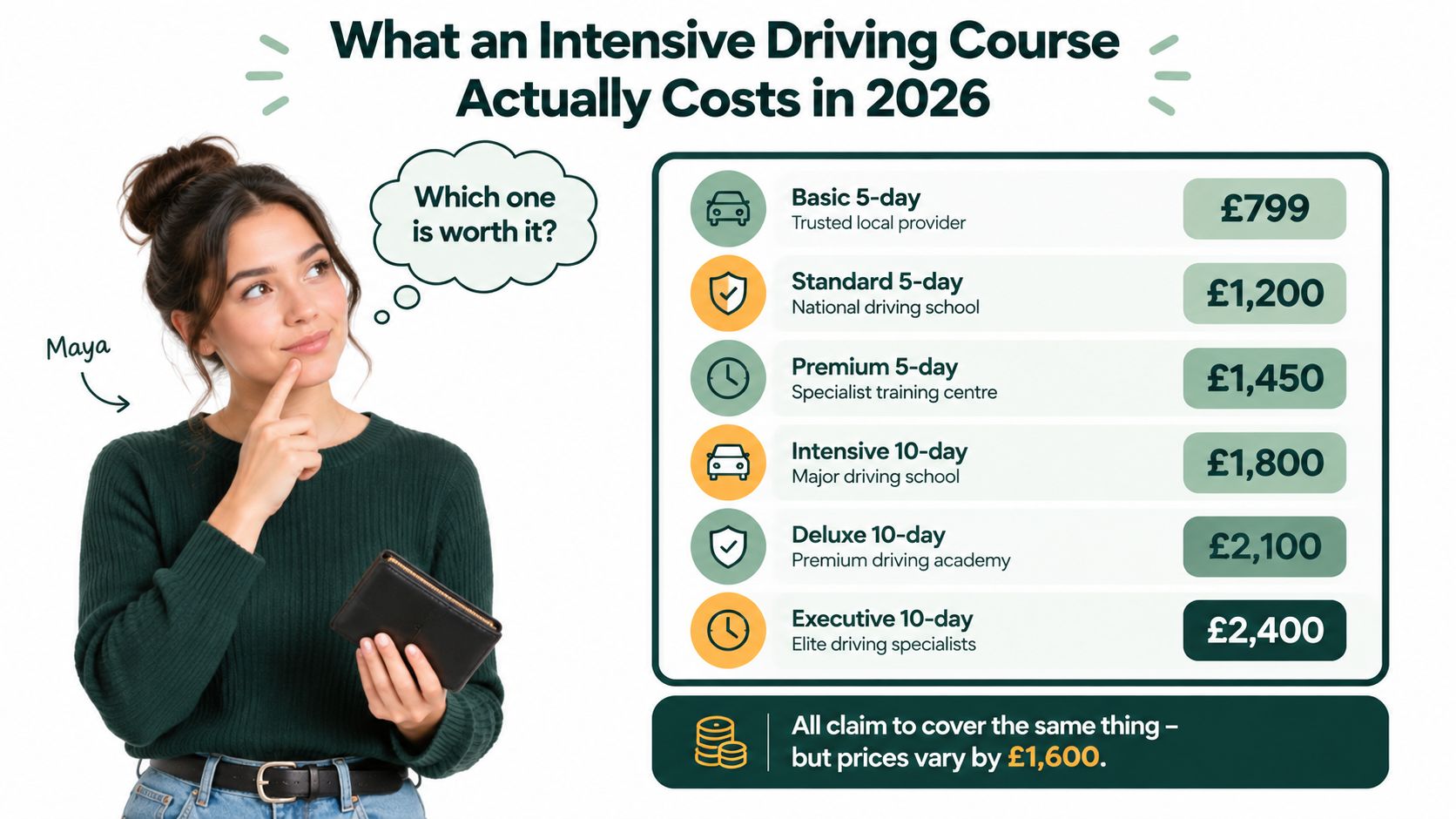
Use the price as a starting point
A low quote often reflects fewer teaching hours rather than better value. A learner who already controls the car may need a focused refresher, while a complete beginner must pay for car control, junctions, traffic, higher-speed roads and test preparation before a practical test makes sense.
Treat any full course below £700 with caution. It could be a genuine short refresher, but a supposed beginner package requires a close check of the hours, instructor status, test arrangements and cancellation terms.
Maya should compare the complete budget, not six headline prices. The sensible total combines tuition, DVSA charges, test-day car hire and contingency lessons, with enough allowance for delays between finishing lessons and taking the test.
What an Intensive Driving Course Is and Why Hours Drive the Price
An intensive driving course compresses tuition into a concentrated period rather than spreading lessons over a long run of weekly appointments. The exact schedule varies, but the principle is simple: you drive repeatedly while the previous session is still fresh.
Think of it as the difference between a gym membership and a personal training sprint. Weekly lessons give you more time between sessions, while an intensive course ties several hours together and demands a larger upfront payment. The faster format can suit a learner with a deadline, but it won't remove the need for practice.
Hours are the main cost driver because the instructor is selling time in a dual-control car. Fuel, insurance, maintenance and the opportunity cost of a booked diary all sit behind the hourly price. A 20-hour course will therefore usually cost roughly half as much as a 40-hour course, although block packages may include small pricing differences.
Match the hours to your starting point
A test-ready learner who has recently failed may need targeted work on manoeuvres, independent driving or serious faults. Someone starting from scratch needs car control, junctions, meeting traffic, higher-speed roads and test preparation before they should even think about booking a practical test.
The 20-hour intensive driving course option makes more sense for a learner with existing experience than for somebody who has never driven. Buying too few hours to protect your budget often creates a worse result, because you may finish the course needing more lessons and still have a test fee to pay.
The widely used planning benchmark is around 40 hours of professional instruction for a learner to reach test standard, but individual needs vary. The honest question isn't, “What's the cheapest package?” It's, “How many hours will give me a realistic chance of being safe and test-ready?”
Your course price is therefore best understood as:
hours of tuition multiplied by the hourly rate, plus the test fee and any extras.
That formula explains why a short refresher can be affordable while a full beginner route becomes a major financial commitment.
The Real Factors That Push the Price Up or Down
Two providers can quote very different prices for what appears to be the same course. The label “30-hour intensive” doesn't tell you enough. You need to inspect what those hours cover and how the school delivers them.
Experience changes the required block
A learner close to test standard may need a focused top-up. A complete beginner without private practice may need a longer course and more time to consolidate difficult skills. This is the biggest variable because every additional hour directly increases tuition.
Transmission affects the quote
Manual and automatic courses don't always follow the same pricing pattern. Published comparisons show automatic packages can be priced higher in several bands, including examples where a 3-day course costs £720 manual and £810 automatic, while a 10-day course costs £2,460 manual and £2,760 automatic, with the test fee excluded. See this manual and automatic intensive course price comparison for the detailed examples.
Don't assume automatic is always cheaper because there are fewer controls to learn. The vehicle supply, instructor demand and local market can matter more than the teaching method.
Region and availability matter
London and busy South East areas commonly cost more than less pressured regions. A popular instructor with a full diary can charge more than a new provider trying to fill availability. Last-minute bookings also reduce your bargaining power.
Scheduling has a real cost
A course delivered as a tightly packed block occupies the instructor's diary. Evening and weekend availability can carry a premium, particularly when you need specific dates before a test.
Other charges may appear for a school-owned vehicle, a shared car, examiner collection, test-day hire or changes to the agreed schedule.
| Factor | Effect on Price | Typical Range |
|---|---|---|
| Hours required | More tuition raises the total directly | 20 to 40 hours is a common planning spread |
| Transmission | Automatic and manual prices vary by provider and vehicle | Check the full package, not just the hourly rate |
| Region | Higher demand generally produces higher quotes | London and the South East often sit towards the top |
| Instructor availability | Busy or short-notice diaries can cost more | Confirm who will teach every session |
| Schedule | Dense weekday, evening or weekend blocks may carry a premium | Ask whether dates are fixed or flexible |
| Extras | Test-day car, examiner collection and changes can increase spend | Require an itemised written quote |
Practical rule: Compare identical inclusions. A £1,200 course with no test-day car isn't automatically cheaper than a £1,400 course that includes the car and a mock test.
Typical Package Prices by Hours and Transmission
A package price only helps if you know what it covers. Use £36 to £40 per hour as a manual tuition guide, then price the practical test, test-day car and any extra hours separately. The ADI pricing information supports this common hourly band. Automatic lessons may match manual pricing, but some providers charge more for the vehicle and instructor time.
| Hours | Manual tuition guide | Automatic tuition guide | Budget check |
|---|---|---|---|
| 10 | £360 to £400 | Ask for the automatic total in writing | Add the weekday or evening and weekend DVSA fee |
| 20 | £720 to £800 | Confirm whether the automatic package costs more | Include any test-day car charge |
| 30 | £1,080 to £1,200 | Compare the full automatic package, not the hourly rate | Keep money aside for contingency lessons |
| 40 | £1,440 to £1,600 | Check whether extra hours or vehicle use are included | Add test, car hire and any booking charges |
These figures are tuition anchors, not finished budgets. A provider may include mock tests, booking help or the instructor's car for the practical test, while another may list each item separately. Check the written inclusions before comparing quotes. The course pricing page is useful for seeing how one provider presents hourly and package charges.
What the transmission choice really changes
Automatic can make sense if clutch control is slowing your progress or you expect to drive an automatic after passing. Manual gives you wider vehicle choice, although gear changes and clutch work can make early lessons harder.
Transmission alone does not determine value. Some automatic packages cost more, while other schools charge the same for both options. Compare the final total, the number of tuition hours, the car supplied on test day and the policy for extra lessons.
For a 20-hour intermediate course, independent UK guidance places tuition around £800 to £1,200. A 40-hour beginner course commonly sits around £1,500 to £2,500, with region and inclusions affecting the quote, according to the UK intensive course cost benchmark.
A low headline price is only useful when the course gives you enough hours to reach test standard. If the package leaves you short, the extra lessons and a delayed test can cost more than choosing a properly sized course at the start.
DVSA Test Fees and the True Total You Need to Budget For
Treat the course quote as the starting point, not the finished budget. Tuition and the practical test are separate unless the provider states otherwise. The DVSA standard car practical test costs £62 on a weekday or £75 in the evening or at weekends, according to the DVSA test waiting-time and fee information. For a plain explanation of the wider charges, see the current DVSA practical test prices and what is included.
You may also need to pay for the instructor's car on test day. The theory test and provisional licence are separate earlier costs, so check what you have already paid before adding them again. Confirm every current charge rather than relying on a package headline.
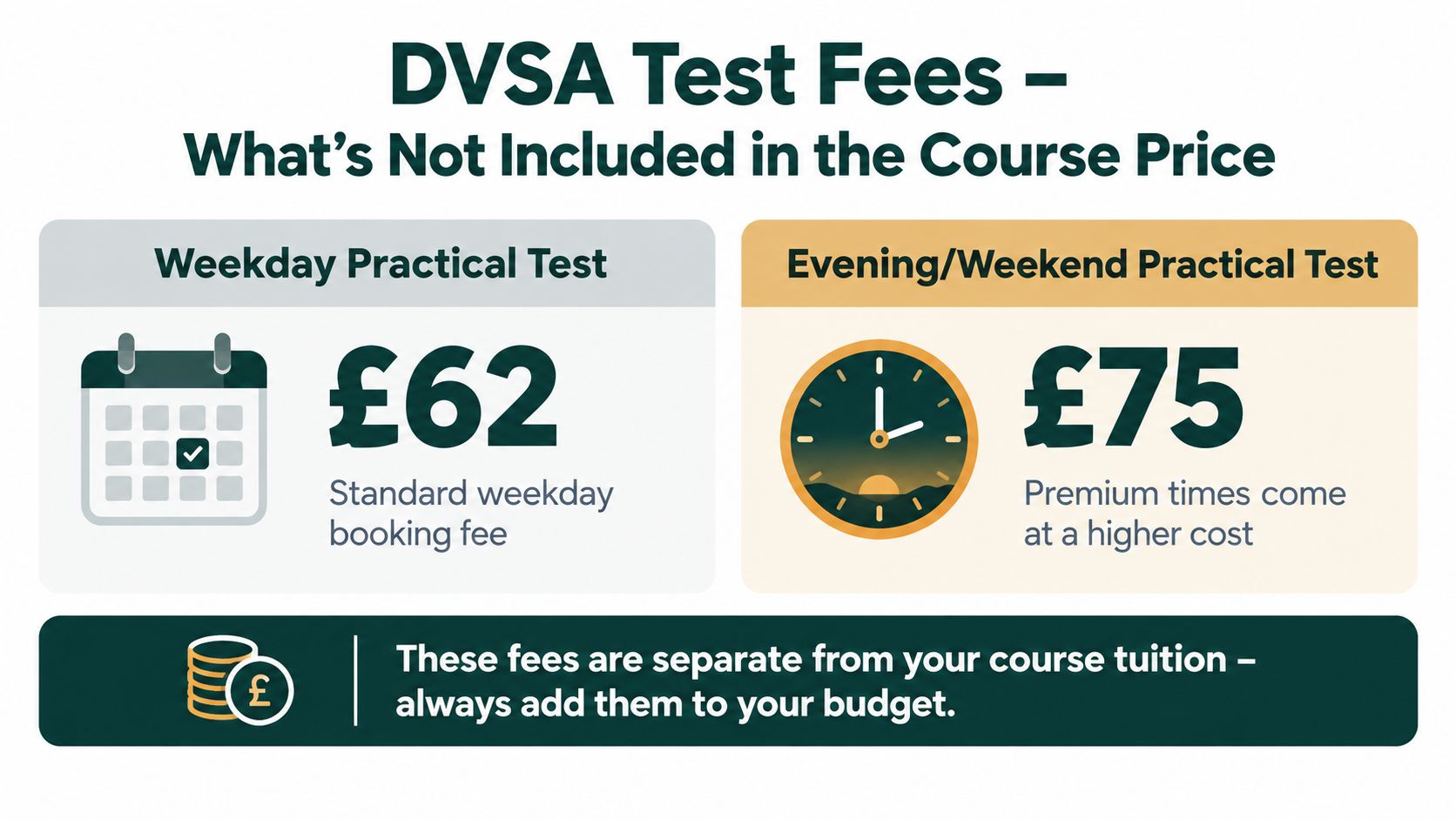
Separate the money into four pots
- Tuition: The agreed course hours at the provider's hourly or package price.
- DVSA charge: The practical test fee, paid separately unless explicitly bundled.
- Test-day vehicle: The instructor's car, including any collection or examiner-related charge.
- Contingency: Extra lessons if manoeuvres, independent driving or test nerves still need work.
For example, a 30-hour manual course at £1,200 followed by a weekend test at £75 already totals £1,275 before test-day car hire. Add that charge and a modest reserve, and the realistic commitment becomes a £1,400-plus budget. Put that money aside before booking. Otherwise, the cheapest-looking package can leave you unable to afford the final preparation.
The contingency pot is the one learners most often omit. Reserve it for targeted practice, not automatic extra hours. Ask the instructor which faults could still require paid lessons and whether test-day support is included in writing.
Check the current fee, inclusions and cancellation terms before paying a deposit. A clear four-pot budget shows whether the course fits your finances and exposes charges hidden behind the headline price.
Here is a short explanation of how practical test charges fit into the wider process:
How to Spot Genuine Value Beyond the Headline Price
The highest quote doesn't guarantee the best tuition, and the lowest quote doesn't automatically mean poor instruction. Value comes from getting the right hours with a properly verified instructor, clear terms and a test plan that doesn't leave you stranded.
Check the person, not just the brand
Ask for the instructor's name and confirm that they hold the appropriate DVSA-approved instructor status. Find out whether the same person will teach the whole block. Continuity matters because your instructor can track recurring faults instead of starting from scratch at every session.
A school should also explain what happens if the instructor becomes ill. A replacement arrangement is useful only if it is clear who provides cover and whether the replacement has access to your progress record.
Read the terms before paying
Look for these points in writing:
- Test cancellation: Confirm what happens if DVSA cancels or moves the appointment.
- Course cancellation: Check the notice period, refund rules and any administrative deductions.
- Instructor cover: Ask whether another instructor can continue the block if your original booking fails.
- Deposit protection: Don't pay a large deposit without an itemised agreement and receipt.
- Test-day arrangements: Confirm the car, duration, collection point and any extra charge.
- Pass claims: Reject promises that imply a guaranteed pass or unrealistic timescale.
A polished website can hide weak booking terms. Ask for the full course price, the number of hours, the exact dates, the transmission, the test arrangements and the rescheduling policy in one written message.
A serious provider will tell you when the package you've chosen isn't enough. That honesty is worth more than a cheap promise to get you test-ready in a fixed number of days.
You can use a platform such as Fast Track Driving Lessons as one comparison option. It matches learners with DVSA-approved instructors for manual and automatic intensive or semi-intensive tuition, and presents course charges separately from DVSA fees. Compare its written terms with other providers rather than assuming a branded package is automatically better value.
Building a Realistic Total Budget Before You Book
Take the headline price and turn it into a cash plan before you pay anything. Your checklist should include the course, the practical test, test-day car hire, extra tuition and a reserve for waiting-time problems.
A practical example starts with a 30-hour manual course at £36 per hour, giving £1,080 in tuition. Add a £62 weekday DVSA test fee, five contingency hours at £36, or £180, and a £100 general buffer for theory retakes or extra city practice. The resulting working budget is £1,422.
The buffer matters because waiting times can vary by region. A learner in a location with a long delay may need refresher lessons or another test booking if the course and appointment don't align.
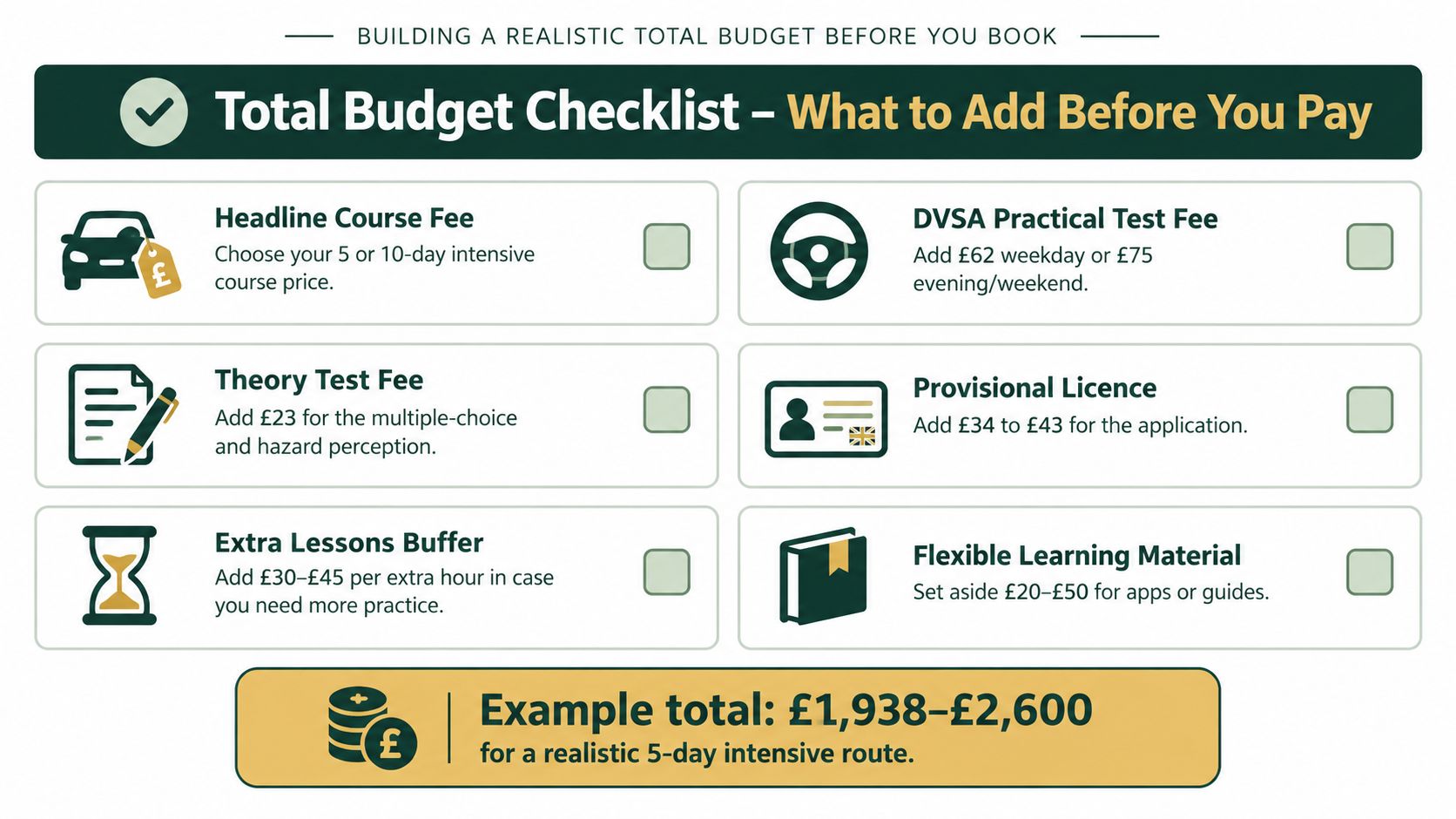
Choose your budget tier
- Lean budget, £1,500: Suitable for a learner with some existing ability, a weekday test and limited extra tuition.
- Standard budget, £1,800: A sensible target for many learners who need a substantial block plus test-day flexibility.
- Comfortable budget, £2,200: Gives a complete beginner more room for additional hours, automatic pricing differences, regional costs or a delayed test.
These tiers are planning targets, not guarantees. Your instructor's assessment should decide the hours, while the written quote should identify every included and excluded charge.
Request that quote before paying a deposit. It should separate tuition, DVSA test fee, test-day vehicle, additional lesson rate, cancellation terms and refund terms. If the provider won't put those details in writing, don't book.
Set your budget around the total, not the advertised course fee. Compare the fixed-hour intensive and semi-intensive options available through Fast Track Driving Lessons, then request a written quote that separates tuition from DVSA charges and confirms the instructor, dates and test-day arrangements.
Written by Fast Track editorial team.