
You type “driving lessons near me” into a search box and get a long list of names, phone numbers and polished promises. The difficult part isn't finding someone who offers lessons. It's working out who is properly authorised, who has space for you, and who can provide steady tuition near your chosen test centre.
That's where DVSA-approved driving instructors come in. The green badge gives you an important legal and regulatory starting point, but it doesn't tell you whether an instructor can take you on this month, teaches in the transmission you want, or suits the way you learn. A qualified instructor with no available hours is still a practical dead end.
Table of Contents
- What DVSA Approval Actually Means for Learners
- How an Instructor Earns ADI Status
- How DVSA Keeps Approved Instructors in Check
- Verifying an Instructor's Credentials Before You Book
- Why Local Availability Matters as Much as Approval
- ADI vs PDI and What That Means for Your Lessons
- Choosing the Right Approved Instructor for You
- Quick Checklist Before You Book Your First Lesson
What DVSA Approval Actually Means for Learners
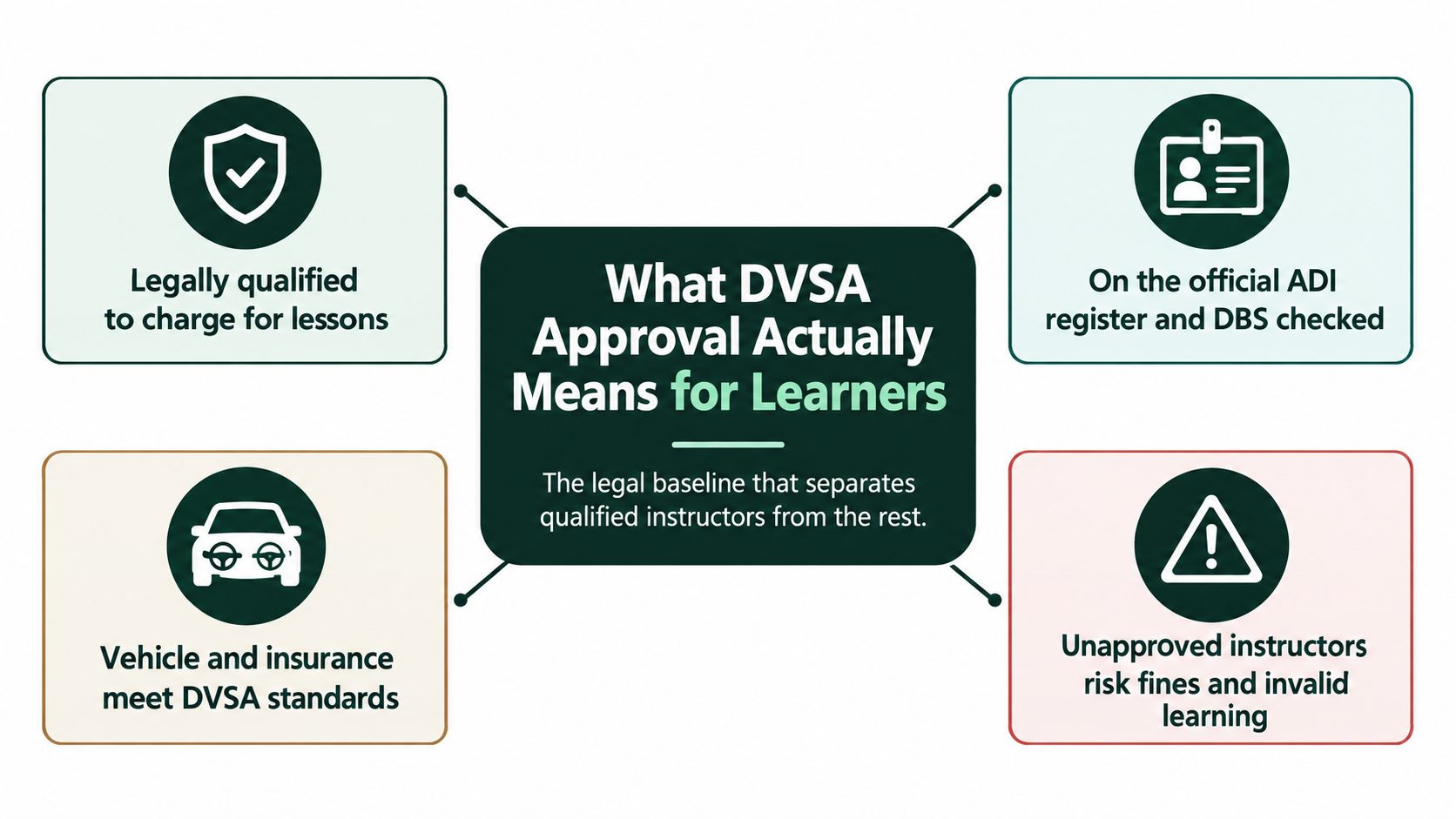
You may find an instructor who sounds suitable, then discover that their diary is full or that they do not teach near your test centre. DVSA approval answers one question first: whether the person is legally recognised to provide paid car-driving tuition in Great Britain. Anyone providing that tuition must appear on the DVSA Approved Driving Instructors register or hold a trainee driving instructor licence, as explained in the official ADI register guide.
An approved instructor has passed the three qualifying tests, met the registration conditions and joined the statutory register. The requirements include being at least 21, holding the appropriate full driving licence for at least 3 years, and renewing registration on a 4-year cycle. If registration has lapsed for more than 12 months, the instructor must retake the qualifying tests instead of re-registering.
What the badge gives you
The green ADI badge shows that the instructor belongs to a regulated profession, rather than offering informal help. The Regulated Professions Register states that ADIs must be fit and proper persons and complete a criminal records check during registration.
Approval also comes with requirements related to professional tuition, such as suitable insurance and a vehicle fitted for instruction. These safeguards matter because lessons take place in a moving vehicle, often before you can recognise a teaching or safety problem yourself.
Practical rule: Treat the green badge as a quality floor, not proof that the instructor suits you.
It does not confirm a particular pass rate, teaching style, personality or diary space. It also does not tell you whether the instructor teaches automatic, covers your test centre, offers evening lessons or can arrange an intensive course around your work. Check those practical details separately before booking. A qualified instructor who cannot fit your location and timeline is not a usable choice.
How an Instructor Earns ADI Status
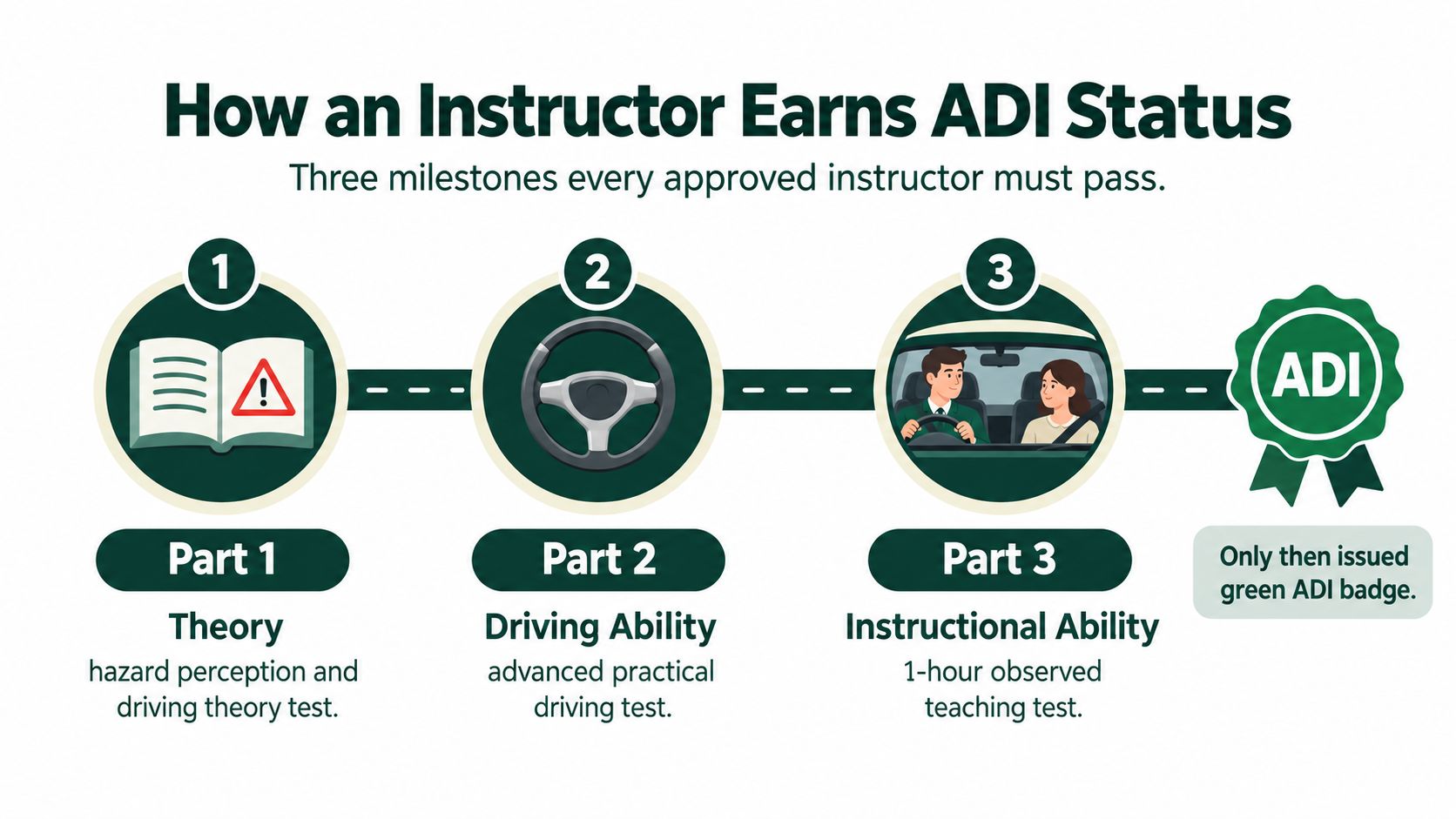
Becoming a DVSA approved driving instructor involves three separate stages. An instructor earns ADI status by passing the required tests and joining the statutory register, as described in the DVSA's instructor statistics.
The first milestone is Part 1, the theory test. It covers driving theory and hazard perception, so candidates must understand the risks learners will later need to identify. Candidates can use the official revision guidance and approved practice materials while preparing.
The three qualifying tests
Part 2 is the driving ability test. It checks whether the candidate can drive to a high standard, control the vehicle accurately and respond safely to road conditions. For a learner, this is one reason the green badge carries meaning: it sits behind a formal assessment of driving ability.
Part 3 assesses instructional ability. The candidate teaches a real learner while a DVSA examiner observes the lesson. Strong driving skills alone do not guarantee clear explanations, patience or the ability to adapt instruction to someone's needs.
The published 2022/23 figures show how the route filters candidates. There were 19,425 Part 1 theory tests, 9,357 Part 2 driving-ability tests and 7,887 Part 3 instructional-ability tests, with pass rates of 38.2%, 57.0% and 36.3% respectively, according to the official DVSA instructor statistics publication.
Candidates take on the training and testing time and costs themselves. Part 3 can be particularly demanding because the candidate must drive the lesson forward while spotting a learner's weaknesses and giving useful guidance.
Passing the route does not guarantee that an instructor is available near you. Registration also has to remain current through the required renewal cycle. For learners, that means checking both the qualification and practical booking details, such as location, vehicle type and diary space.
How DVSA Keeps Approved Instructors in Check
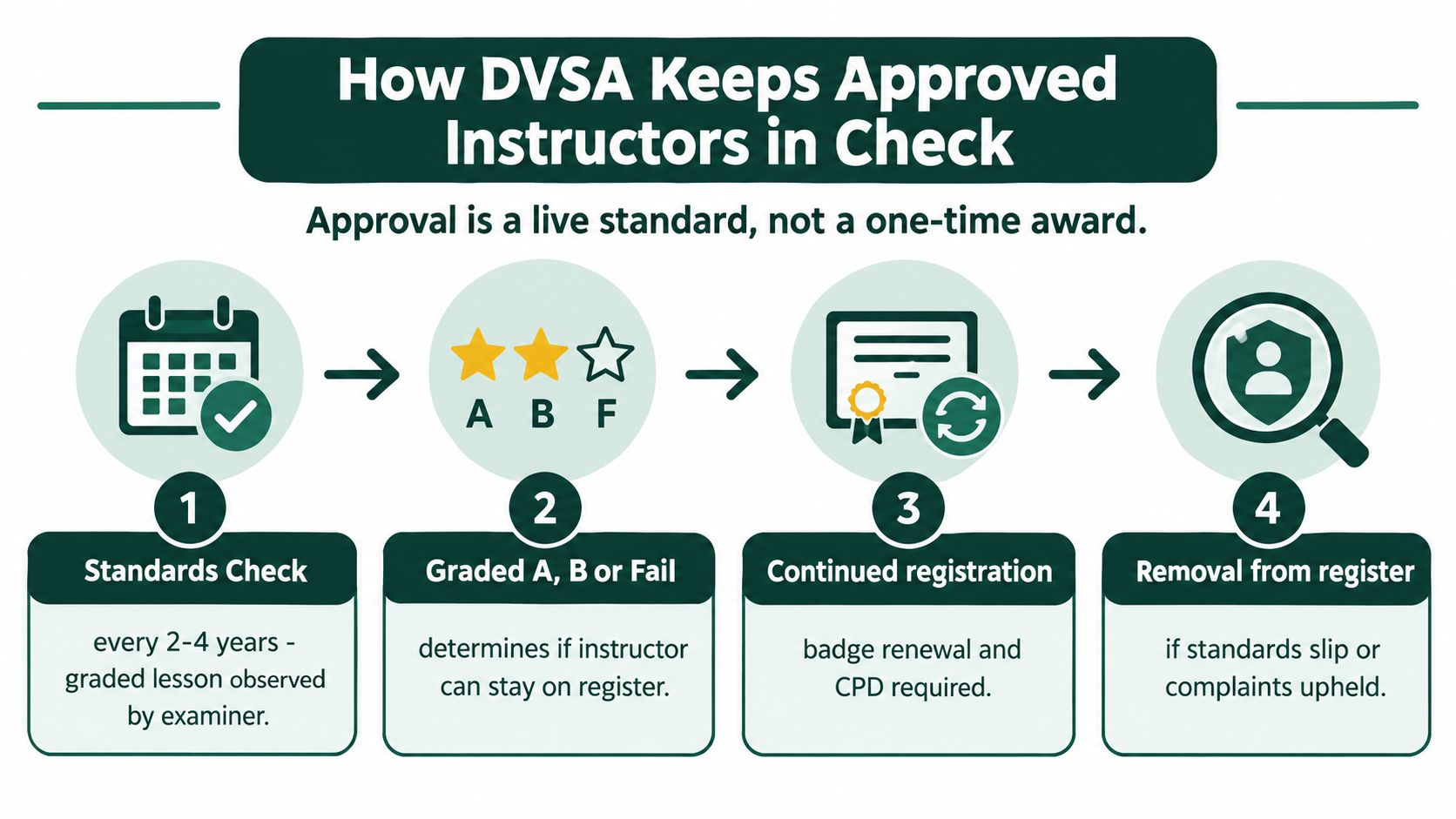
A green badge shows that an instructor is approved today. It does not describe every lesson they will give, so DVSA continues checking standards after registration. The ADI standards check reviews 17 competencies, each scored from 0 to 3, for a maximum of 51, according to the published ADI standards check framework.
The result is grouped into Grade A at 43 to 51, Grade B at 31 to 42, or a fail below 31. Safety has its own gate: a risk-management score of 7 or less means the instructor fails, even if the overall score is higher.
What performance indicators reveal
DVSA also reviews rolling 12-month indicators connected with pupil tests. These cover average driving faults per test, average serious faults per test, the share of tests involving physical intervention by the examiner, and overall pass rate. The published trigger levels are 6 or more driving faults, 0.55 or more serious faults, 10% or higher physical intervention, and a pass rate of 55% or lower, as explained in the ADI standards-check indicators and triggers guidance.
If an instructor reaches 3 or more trigger points, DVSA can ask them to complete a standards check. These measures provide warning signs, not a simple ranking. Results can reflect learner experience, test-centre conditions, the pupils an instructor accepts, and whether their work is mainly with beginners or test-ready drivers.
Complaints may also lead to investigation. Concerns about conduct or teaching can have serious consequences, including suspension or removal from the register. For learners, the practical lesson is clear: approval means ongoing regulation, while questions about teaching methods and current availability help reveal whether that instructor fits your needs and timetable.
Verifying an Instructor's Credentials Before You Book
You arrive for your first lesson and the person beside the car does not match the advert photograph. A quick check before paying a deposit can prevent that awkward start, while a second check at the lesson confirms that the badge, instructor and vehicle still line up.
Begin with the official DVSA register. Search using the instructor's name or ADI number, compare the result with the number they gave you, and save a screenshot. The DVSA instructor verification guide is useful alongside the register, not in place of it.
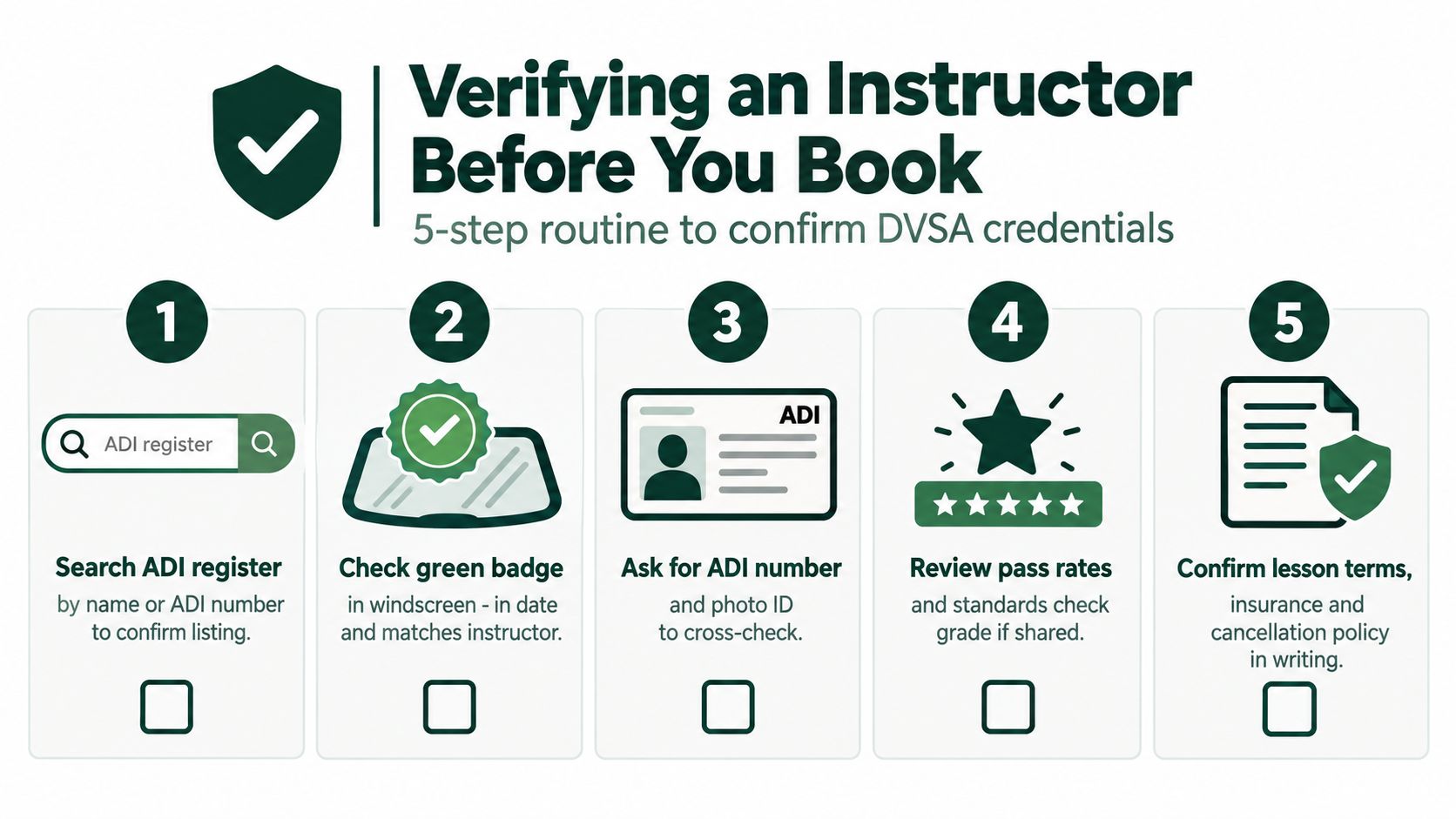
Five sensible checks
Match the badge. Ask to see the green ADI badge at your first lesson. Check the photograph and details against the person teaching you, then confirm the expiry date.
Ask about the criminal-record check. A recent DBS certificate can offer extra reassurance. Ask whether the instructor uses the update service, while remembering that DBS evidence does not confirm current DVSA registration.
Request insurance evidence. Ask for proof of driving-school liability cover and insurance allowing paid tuition in the car you will use. The instructor should be able to explain what the policy covers.
Check the car. Confirm its registration, MOT status and properly fitted dual controls. It should be suitable for the driving test and match your chosen transmission.
Put terms in writing. Confirm the lesson price, cancellation rules, deposit, payment timing and arrangements if the instructor becomes unavailable. Written terms give both sides a clear reference instead of leaving details in a phone conversation.
Pay attention to evasive or inconsistent answers. An instructor who will not show the badge or answer reasonable questions deserves caution. Approval can lapse, the car can change, and an advert can stay online after circumstances change. Check the person and vehicle you will use, then decide whether both fit your booking plans.
Why Local Availability Matters as Much as Approval
You may find an approved instructor, contact them promptly, and still discover that they cannot offer a lesson near you before your test. DVSA approval confirms professional status, not an open diary, a nearby pickup point or a timetable that matches yours.
The DVSA register is a national record rather than a live booking system. Published figures are updated through regular releases, so the available instructor supply changes over time. The DVSA driving tests and instructors statistics collection helps explain that broader picture, but it cannot show which instructors currently have space in your area.
| Region Type | Typical ADI Density | Avg Wait for Weekly Slot | Test Centres Often Covered |
|---|---|---|---|
| Large urban area | More concentrated supply, with demand also concentrated | Can still be limited around popular centres | Several nearby centres, depending on the instructor |
| Suburban area | Mixed availability across neighbourhoods | Regular slots may require advance planning | The closest centre and neighbouring centres |
| Rural area | More widely spread instructors and longer travel distances | A regular weekly slot can be harder to secure | Fewer centres, often with longer pickup routes |
These are practical categories, not official regional measurements. They describe common booking pressures. An instructor may be approved yet fully booked, serve a different test centre, or lack the regular lesson pattern your learning plan requires.
A green badge is therefore only one part of the decision. A qualified instructor who cannot provide enough lessons before your test is unavailable for that particular plan.
Ask about four points before you commit:
- Can they hold a consistent weekly slot?
- Do they cover your chosen test centre?
- Are evening or early-morning lessons available?
- If you want intensive tuition, can they confirm the complete block before you book a test?
Local coverage also affects the car you will practise in, the routes you can learn and the time spent travelling between pickups. Use the Fast Track Driving Lessons area search to compare local coverage, transmission and availability. Then match those details against your test date, rather than treating approval alone as proof that the instructor is usable.
ADI vs PDI and What That Means for Your Lessons
You arrive for your first lesson expecting a green badge, but the instructor's windscreen shows pink. That colour changes what you should ask before settling into the driver's seat.
An ADI, or Approved Driving Instructor, has passed all three qualifying parts and displays a green badge. A PDI, or Potential Driving Instructor, is still completing the qualification process and displays a pink badge.
| Factor | ADI (Approved) | PDI (Potential) |
|---|---|---|
| Qualification | Has passed Part 1, Part 2 and Part 3 | Still completing one or more qualifying parts |
| Badge | Green ADI badge | Pink trainee badge |
| Supervision | Can teach as a registered ADI | Must teach under the required supervision arrangements |
| Experience | Fully qualified, though experience still varies | Developing teaching experience |
| Your decision | Ask about style, availability and local coverage | Ask who supervises the training and how progress is reviewed |
A PDI is not automatically a poor choice. Some learners prefer the lower price or appreciate the enthusiasm of someone building teaching experience. The practical safeguard is clear information: confirm who will teach you, which stage they have reached and what supervision is arranged.
For paid car instruction in Great Britain, the instructor must be on the ADI register or hold a trainee licence. The badge is therefore a useful first check, not a complete booking decision.
Look at the windscreen before the lesson begins. If you expected green but see pink, ask why. Find out whether a supervising ADI will be involved, who sets the lesson plans and who handles concerns. Also consider whether the arrangement suits your timing and location, because a qualified teacher is only useful if you can secure lessons that fit your plan. For a learner-focused comparison, read the ADI versus PDI guidance.
Choosing the Right Approved Instructor for You
You have checked the green badge and found an instructor who is approved. At the first lesson, the key question is whether that approval fits your needs, schedule and learning style. A qualified instructor may still be difficult to book, teach in the wrong transmission or cover an area you cannot reach.
Approval confirms that this person is legally qualified to provide regulated tuition. It does not tell you how clearly they explain junctions, how reliably they keep appointments or whether their vehicle suits your test plans. Start with those practical checks, then compare pace, patience, feedback, lesson length, pickup arrangements and familiarity with your test centre.
A nervous beginner may learn best with calm explanations, predictable routines and time to process each decision. A confident returner may prefer faster progression and more independent driving. Neither approach is always right. The useful match is the one that helps you stay engaged and ask questions.
Questions that expose the fit
Ask how the first lesson is organised. The instructor should explain what they will assess, how they set objectives and how they choose the next practice task. Ask how progress is recorded too. Lessons built from unrelated drives can hide repeated faults, much like practising random routes without checking the same junction skill twice.
Confirm the transmission before booking. Manual and automatic lessons require different vehicle-control skills, so the car should match the one you intend to use for your test. Ask about continuity as well. A regular weekly slot usually makes progress easier to organise than appointments that move whenever the diary changes.
Treat a taster lesson as a two-way check. Notice whether instructions arrive early enough, mistakes are corrected without embarrassment and unsafe decisions are explained clearly. If confusion makes you afraid to speak, technical knowledge alone will not make the lessons productive.
Fast Track Driving Lessons is one example of a platform that matches learners with instructors by area, transmission, availability and preferences, while stating terms and checking instructor credentials before booking. An independent instructor can work just as well if you carry out the same checks yourself. Approval is the starting point. Local coverage and a usable timetable determine whether lessons can happen.
Quick Checklist Before You Book Your First Lesson
Keep this checklist open during your first call or message. A suitable instructor should answer clearly, explain what applies to your situation and provide reasonable evidence of their status.
Credentials
- Ask for the ADI number: Search the official register and check that the listing matches the instructor's name.
- Check the green badge: Ask to see it at the first lesson and note its expiry date.
- Request DBS confirmation: Ask when the criminal-record check was completed and what evidence the instructor can provide.
- Confirm the driving licence: Check that the instructor holds the correct full licence and meets the required experience period.
- Clarify training status: Ask directly whether you will be taught by an ADI or a PDI.
These checks confirm who may teach you. They do not confirm that the instructor can offer lessons where and when you need them.
Lesson logistics
- Ask which car you'll use: Confirm manual or automatic, the registration and whether dual controls are fitted.
- Agree the lesson length: Find out whether sessions are shorter appointments or longer blocks.
- Check the pickup area: Ask whether home, college, work or another meeting point is included.
- Discuss timing: Confirm weekday, evening and weekend availability before you commit.
- Understand cancellations: Ask how much notice you must give and what happens if the instructor cancels.
- Ask about test centres: Find out which local centres the instructor uses and whether route practice is included.
Availability deserves the same attention as approval. An instructor with the right badge is not a practical choice if the pickup area is too far away, the timetable cannot fit your week or the next lesson is difficult to book. Ask about the earliest realistic start date and whether regular slots can be maintained.
Cost and written terms
- Request the full price: Ask for the lesson rate, any deposit and the total cost of a block.
- Check payment arrangements: Confirm accepted methods and when payment is due.
- Ask about block bookings: Find out whether prepayment changes the price and what happens if you stop lessons.
- Check additional charges: Ask about test-day use, cancellations and vehicle hire.
- Get terms in writing: Keep the booking conditions, refund process and cancellation policy somewhere accessible.
Your first lesson
- Ask about the assessment: Check whether the first session includes a structured review of your experience and confidence.
- Agree the objective: Ask what the instructor plans to cover and how the lesson will change if your starting point differs.
- Discuss progress records: Find out whether faults, goals and practice priorities are recorded after each lesson.
- Set communication expectations: Confirm how you will book future sessions and how quickly the instructor usually replies.
- Review the match afterwards: Consider whether you felt safe, heard and able to ask questions before booking a course.
The strongest booking decision combines current approval, genuine availability, clear terms and a teaching style that suits you. Check the legal status first, then test whether the practical arrangement can carry you consistently towards your test.
Fast Track Driving Lessons matches learners with DVSA-approved instructors for manual and automatic intensive or semi-intensive tuition across England, Scotland and Wales. Local availability and instructor verification are considered before booking. Visit Fast Track Driving Lessons to compare lesson options and check what is available in your area.
Written by Fast Track editorial team.