
You can sit in the car park outside a test centre, thinking you've got the route nailed, then watch the examiner turn the wheel the other way. That's the moment a lot of learners realise the driving test route isn't a fixed script you can recite from memory. It's a moving picture of local roads, junctions, traffic, and decisions, and the main task is to drive well whatever comes next.
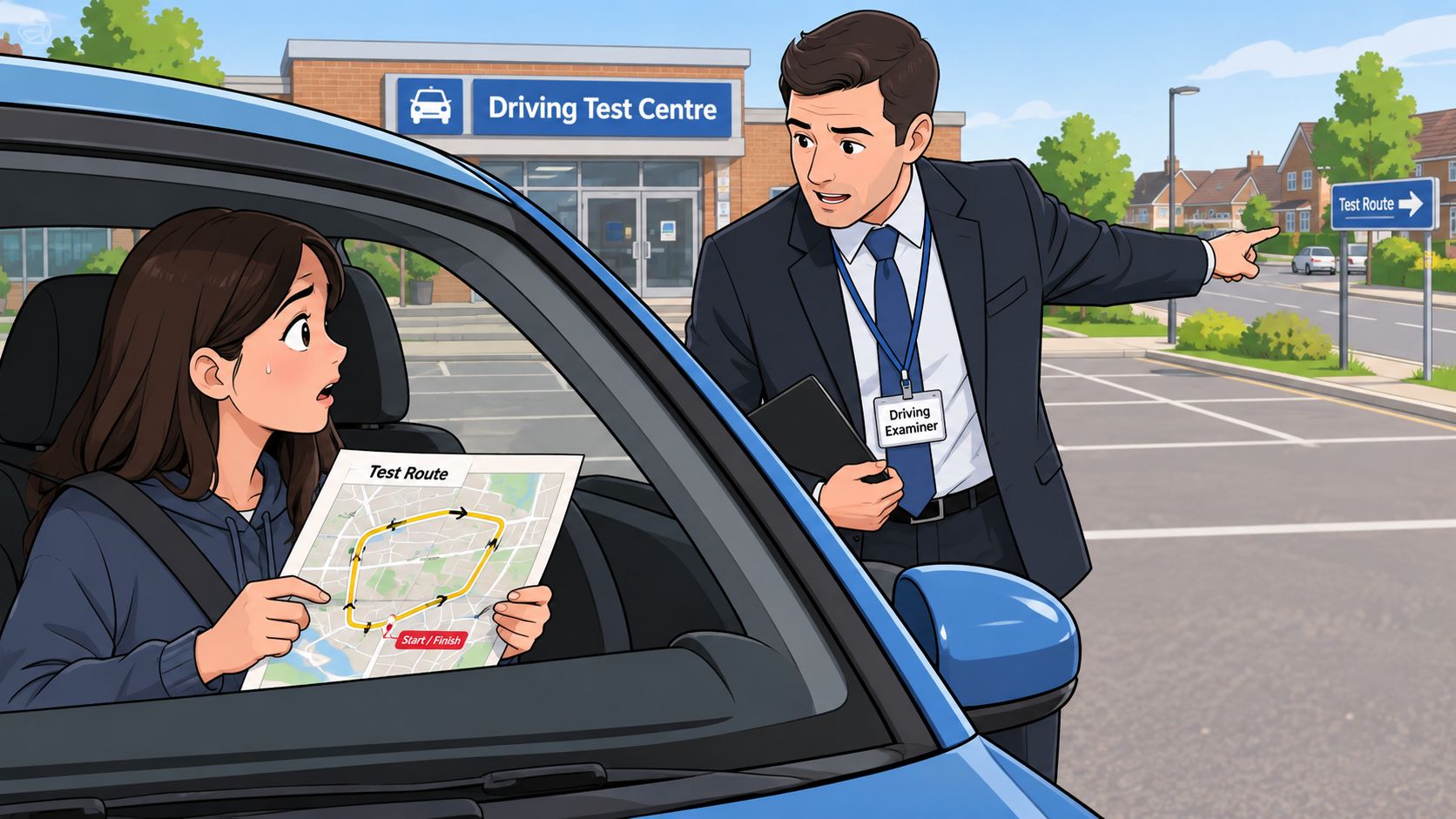
What happens on test day matters because the first shock is often mental, not mechanical. Once learners stop chasing a perfect map, they can start building the right kind of confidence, the sort that holds up when the examiner chooses a different road than the one they practised yesterday.
Core idea: a driving test route is something you prepare for by learning the area, not by memorising a single line on a map.
That shift sounds small. In practice, it changes how you take lessons, how you review mistakes, and how you judge whether you're ready.
Table of Contents
- Understanding What a Driving Test Route Really Is
- How Examiners Select Routes and Why They Vary
- Why Driving Test Routes Differ Across the UK
- How to Practise Your Local Driving Test Routes Effectively
- How Mock Tests Replicate Real Test Centre Routes
- Building Confidence for Any Route on Test Day
Understanding What a Driving Test Route Really Is
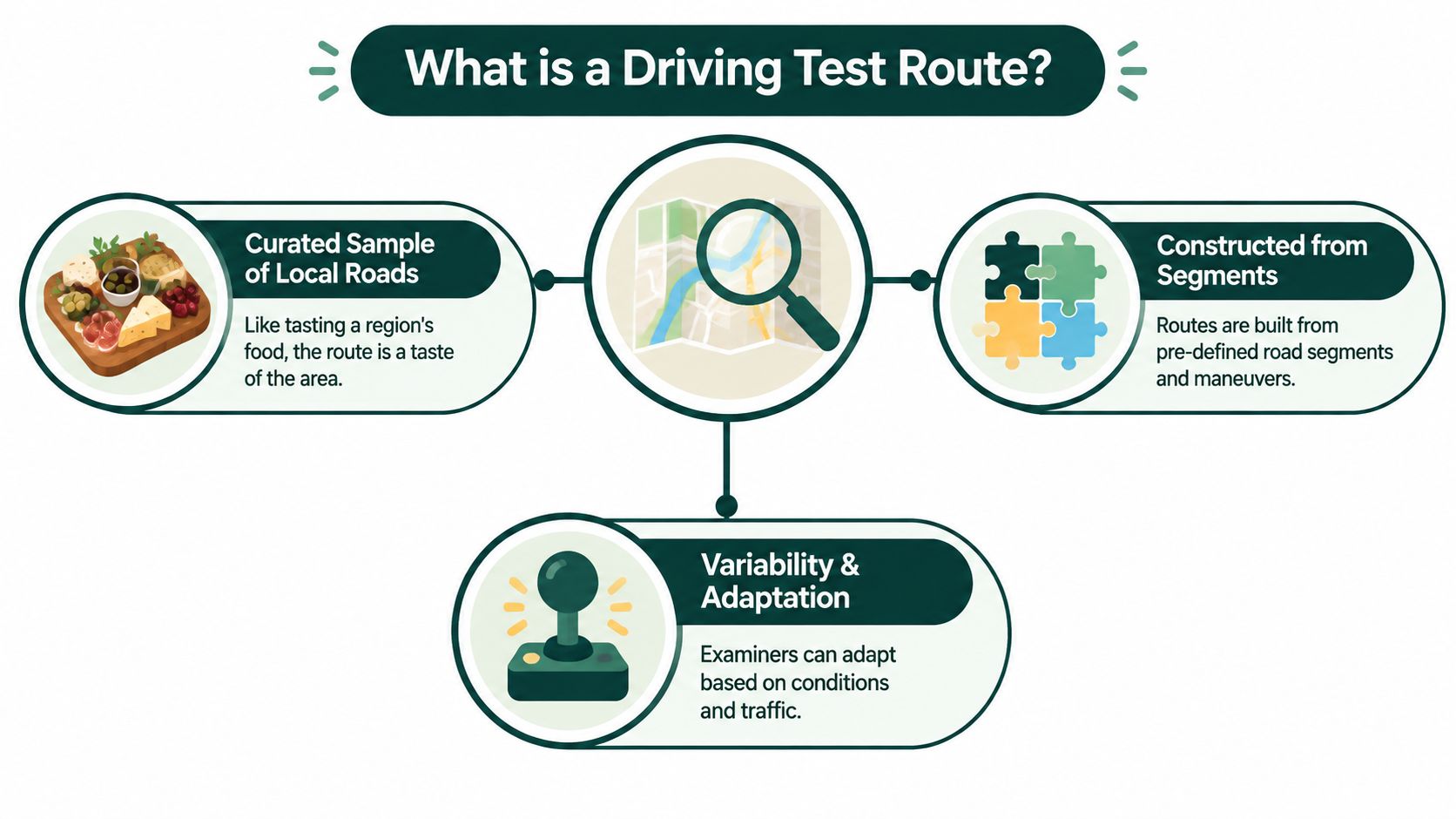
A driving test route is best thought of as a curated sample of the roads around a test centre. It gives the examiner a way to assess a learner across different conditions, not a way to test whether they can remember a hidden sequence of turns. Independent UK route guidance says the DVSA stopped publishing official routes in 2010, which is why modern preparation focuses on the road system around the centre rather than a published loop (PassMeFast).
Start with the simplest model
Think of the route like a tasting menu from a local restaurant. You're not getting every dish in the kitchen, just enough to show what the area is like. On test day that usually means a mix of residential streets, busier main roads, roundabouts, junctions, and sometimes changes in speed limit or road character.
The key point is coverage. If a learner only practises one turn sequence, they can still be rattled when the examiner brings in a different junction style or a road with more traffic. If they learn the common road types around the centre, they've got something useful whatever the route turns into.
Why sequence matters less than coverage
The DVSA's official car test data collection has been the main national dataset for practical test performance since 2013, and it now underpins route and test-centre analysis in Great Britain (DVSA statistical data set). That matters because the numbers are usually read at centre level, not as a promise of one fixed route. Test-centre data show how learners perform across an area, which is exactly why route preparation needs to match the area, not a printed path.
A route is not a secret answer sheet. It's a local test area with multiple possible paths through it.
So the practical question is simple. Can you handle the road types, hazards, and routine decisions that keep appearing around your centre? If the answer is yes, the exact sequence stops being the main problem.
How Examiners Select Routes and Why They Vary
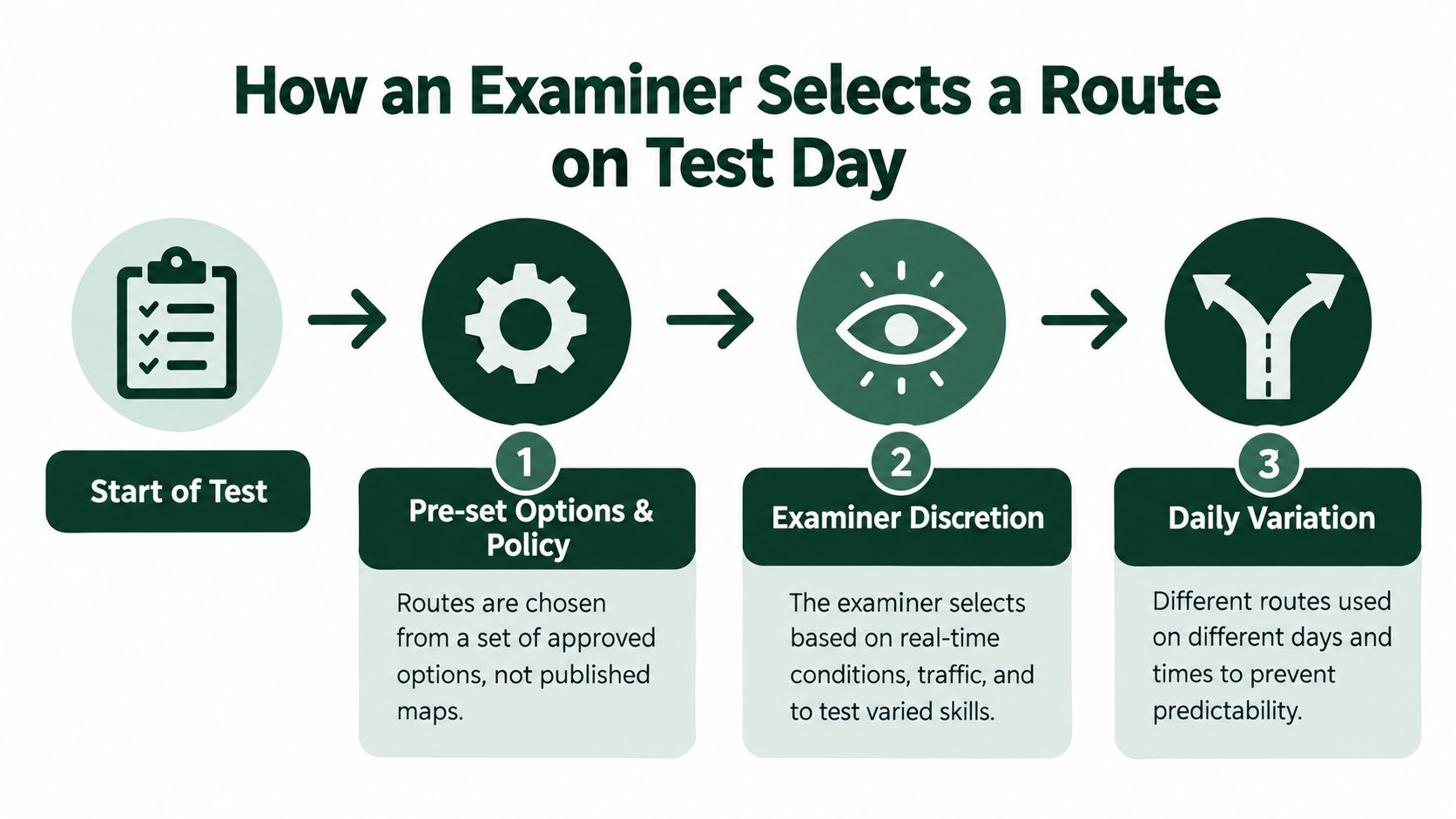
Examiners don't work from a public map that learners can study in advance. The DVSA says examiners can vary routes at their discretion, and independent UK guidance repeats that official routes were stopped in 2010 (Intensive Lessons). That policy exists for a reason. If learners could memorise the exact path, the test would reward recall more than safe, flexible driving.
What the examiner is actually balancing
The route usually has to do a few jobs at once. It needs to give the examiner a fair chance to see whether the learner can manage everyday driving, deal with changing traffic, and show control under normal test conditions. That means the examiner may pick different roads on different days, or choose a path that suits what's happening locally.
The important distinction is between what is chosen in advance and what is chosen on the day. The centre has a stock of possible roads and route segments. The exact order, turns, and junctions can change, which is why route memorisation is a weak strategy even when you've found an online route library.
What you can and can't predict
You can usually predict the sort of roads near a centre, especially if you've driven there often. You can't predict the exact combination the examiner will use. Independent route-methodology guidance says routes can change at any time, and that the core task is understanding route types, local hazard clusters, and how route choice varies by centre (Driving Test Routes methodology).
That's the useful mental model. The examiner is not trying to trick you with randomness. They're trying to see whether you can cope with the area in a normal, safe way. If you're ready for the common road patterns, then a change of turn doesn't throw the whole test off.
Practical rule: train for the roads around the centre, not for one memorised route.
Why Driving Test Routes Differ Across the UK
A learner arriving in a busy city centre often faces a very different test day from someone booked at a quieter rural site. More junctions, more traffic control, and more split-second decisions can make an urban route feel like a packed roundabout at rush hour, while a calmer area may give more space to settle without making the test easy.
Test-centre figures help explain that gap. Independent UK route analysis reports a national average pass rate of 52.8% for 2024 to 25, with London examples much lower and some rural centres much higher (Six Point Check routes). The same analysis also shows a 10.7-point gap between the 18 London test centres and the UK national figure. A table like this is best read as a signpost, not a judgement on the driver.
| Centre Type | Example Centre | Pass Rate 2024-25 |
|---|---|---|
| London urban | Chingford | 36.0% |
| London urban | Barking | 38.0% |
| London urban | Greenford | 39.0% |
| London urban | Goodmayes | 44.0% |
| Rural or smaller centre | Isles of Scilly | 88.0% |
| Rural or smaller centre | Dorchester | 66.0% |
| Rural or smaller centre | Yeovil | 61.0% |
What the spread tells you
The pattern is usually straightforward. Centres with denser roads ask more of the learner at once, especially where traffic is moving, parked vehicles are tight to the kerb, and decisions come quickly. Quieter centres may reduce that pressure, but they can still catch learners out with awkward bends, narrow roads, or unfamiliar priority rules.
That is why the same driving skill can look different from one centre to the next. Like practising on a flat pitch before going onto rough ground, the local setting changes how much work the driver has to do.
How to use centre data wisely
Use the figures to guide your practice, not to hunt for the easiest booking. Waiting time matters as well, because a shorter queue can be worth more than a slightly gentler road pattern. The Fast Track Driving Lessons' test-centre guides can help you compare the local setup with the roads you are likely to meet.
A centre with a long wait can cost more in time and momentum than one with a tougher road pattern.
How to Practise Your Local Driving Test Routes Effectively
Good practice starts with the roads around the centre, not with a printout of a supposed exact route. If you know the area by type, you can adapt when the examiner changes direction. That's the difference between being prepared and being merely familiar.
Build your practice area properly
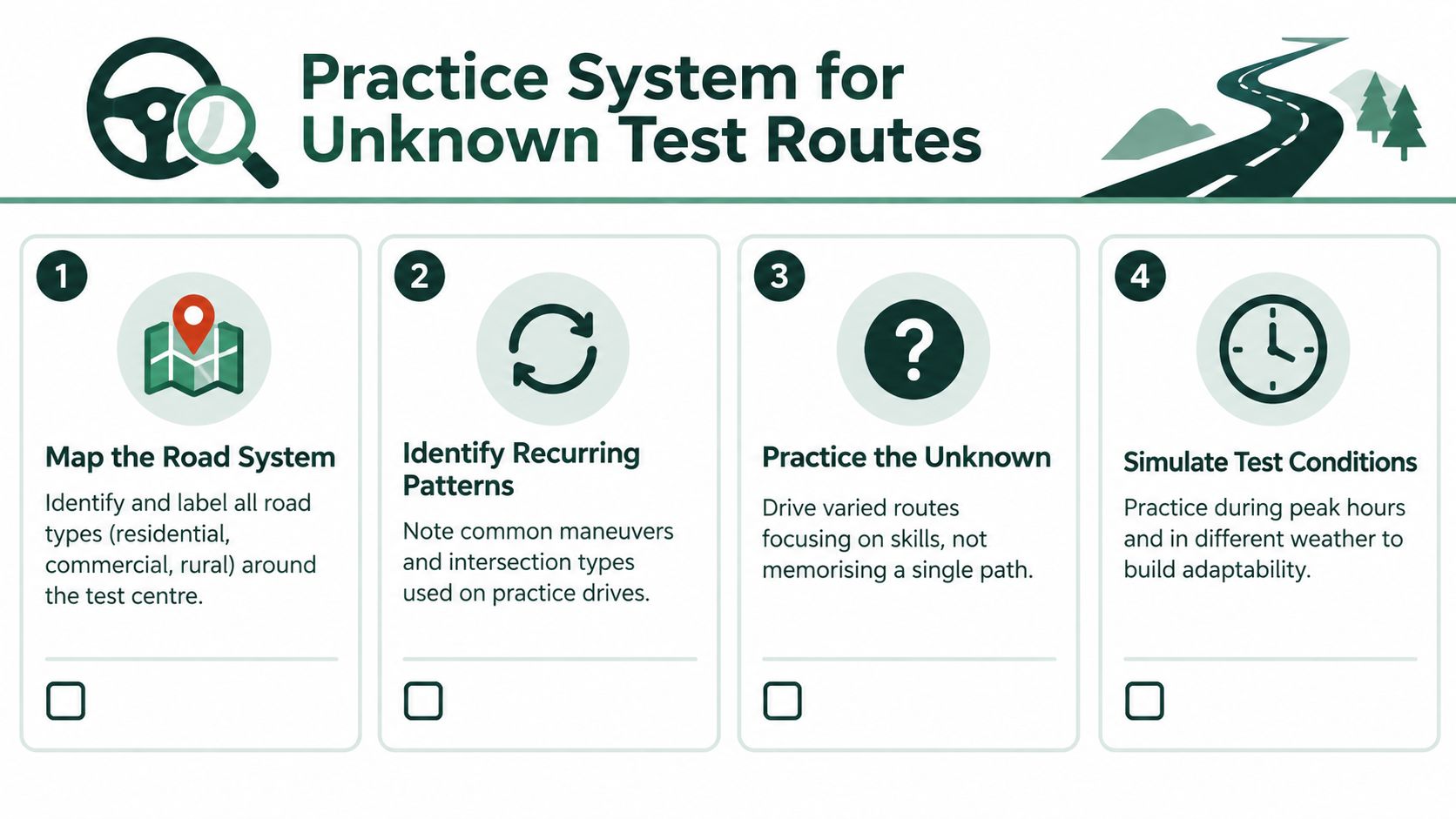
Start by mapping the roads around the test centre into simple groups. Mark the residential sections, the busier commercial stretches, any awkward roundabouts, and the roads where speed changes catch people out. You don't need a fancy system, just a clear picture of where the pressure points are.
Then watch for repeated patterns. If a centre throws up the same sort of mini-roundabout, the same tight left turn, or the same merge lane, practise those pieces until they feel routine. That's far more useful than hoping the examiner will copy a route you've seen online.
Use varied runs, not one favourite loop
A lot of learners get stuck driving the same loop because it feels safe. The trouble is that safety can turn into fragility. If one unexpected road appears, the learner's attention goes straight to the map in their head instead of the traffic in front of them.
Use route libraries, local knowledge, and instructor guidance as practice areas, not scripts. Fast Track Driving Lessons includes route familiarisation as part of its 25-hour driving course, along with mock tests and route practice near the test centre, which fits this approach well. You can also use local drives to compare how the same junction feels at different times of day.
Track what keeps going wrong
Keep a simple log after each lesson. Note where you hesitated, where lane position drifted, and which junctions made you rush. Then make the next lesson about those weak spots rather than repeating what already feels comfortable.
The goal is adaptable competence. If you can handle the same junction in light traffic, then again when it's busier, your confidence becomes portable. That's the skill the examiner is really looking for.
How Mock Tests Replicate Real Test Centre Routes
A well-run mock test takes the guesswork out of the final stage. It doesn't just check whether you can drive. It checks whether you can drive while being observed, judged, and asked to cope with the same kind of road mixture you'll meet near the test centre.
What a useful mock should include
A decent mock test should cover independent driving, manoeuvres, varied road types, and fault marking. It should also feel slightly formal, because that pressure is part of the actual test experience. If the mock happens only on quiet roads, it can miss the exact kind of judgement calls that catch learners out on busier local routes.
Feedback matters more than the score. A good instructor won't just say where you went wrong, they'll point out the pattern behind it. Maybe you rush when the road narrows. Maybe you hesitate at roundabouts. Maybe you lose confidence after one small error and then the next decision gets weaker.
Turn the results into final prep
That's where mocks become useful for route preparation. They show whether you're weak on certain road types, not just whether you had one bad drive. If the same issue appears twice or three times, it deserves a lesson plan of its own.
Mock driving tests are especially helpful when they're done on roads similar to the chosen centre. They let you rehearse the shape of the area, the pacing of the drive, and the mental load of being assessed without pretending that the route itself is fixed.
Best use of a mock: treat it like a diagnostic, not a verdict.
Once you use mocks that way, the final lessons become sharper. You're not just “doing another practice drive”. You're removing the habits that keep showing up in the same places.
Building Confidence for Any Route on Test Day
Confidence on test day comes from being ready for variation. That means you've practised enough local road types, you've seen enough junction patterns, and you've learnt not to panic when the examiner turns somewhere unexpected. The route might change, but the driving standards don't.
Keep the right habits close
Before test day, keep your focus on the basics that travel well from one route to another.
- Read the road early. Scan signs, lane markings, and traffic flow before you commit.
- Keep speed matched to the environment. Don't rush into a road just because it feels familiar.
- Treat every junction as new. Even a road you know can behave differently in heavier traffic.
- Reset after a mistake. One missed cue doesn't mean the rest of the drive is lost.
- Stay with the examiner's instructions. Listen first, then act cleanly and calmly.
The biggest mistake is still the same one at every centre, believing the test is about remembering a route rather than driving the road in front of you. Once learners accept that, their practice changes in a useful way. They stop asking, “What route is it?” and start asking, “What kinds of roads do I need to be ready for?”
That mindset also makes lesson planning simpler. Practice should cover the road types near your centre, the awkward manoeuvre points, and the times of day when traffic changes the feel of a junction. If you can do that, you're no longer hoping for a lucky route. You're ready for a normal one.
Fast Track Driving Lessons supports learners who need structured local practice, mock tests, and area-specific preparation around their chosen centre. If you want help turning route knowledge into calm, test-ready driving, visit Fast Track Driving Lessons and look at the lessons and learner tools available for your area.
Written by Fast Track editorial team.