
One in ten people who fail the practical driving test in England, Scotland and Wales say nerves were the main reason. That finding from the UK government's Ready to Pass? campaign changes the question. Driving test nerves aren't proof that you're incapable of driving. They're a measurable part of the test experience, and they can affect people who drive well during ordinary lessons. (Driving test nerves and how to calm them)
The pressure also sits inside a difficult booking system. Practical test results remain around the high-40% range nationally, with a cited first-time pass rate of 48.9% in 2024–25, so slightly more than half of candidates fail at least once. (DVSA driving test anxiety and pass-rate context) A long wait, a high-stakes appointment and an unfamiliar examiner can turn a normal driving task into an intense performance. The useful response isn't to blame yourself. It's to understand what's happening, then prepare for the actual conditions that trigger it.
Table of Contents
- The Reality of Driving Test Anxiety in the UK
- The Science Behind Evaluative Stress and Cognitive Load
- How Systemic Booking Delays Amplify Learner Nerves
- Evidence-Backed Strategies to Reduce Cognitive Pressure
- Using Formal Mock Tests to Neutralise Evaluative Pressure
- Structuring Intensive Preparation and Day-Of Routines
- Moving Forward With Confidence and Control
The Reality of Driving Test Anxiety in the UK
Only 53% of learners felt completely prepared for their first practical test, even though 66.6% had taken at least one mock test and 45.5% had used private practice. These figures show why test nerves cannot be explained merely as a learner lacking confidence. Preparation needs to cover the assessment setting, not just the driving tasks. (UK research on preparation and test nerves)
A learner might handle every lesson on the A40 roundabout, complete manoeuvres safely and drive independently without help. Then the examiner says, “turn left at the next junction”, and the learner stalls while trying to process the instruction, check the road and judge what the examiner is recording. The driving skill has not disappeared. The pressure has changed how that skill is accessed.
A nervous reaction is information, not a verdict. It shows that the test environment needs to become part of your practice.
Why capable learners still struggle
A normal lesson contains support that is easy to overlook. Your instructor can explain an instruction, give you time to recover and help you review a mistake. In the practical test, an unfamiliar person sits beside you while you process directions independently, respond to traffic and possibly follow a satnav. A long booking delay can add another layer, because the appointment may feel too important to waste and your memories of previous lessons may seem less secure by the day.
One small error can then feel like proof that the result is already decided. A learner who takes a wrong turn may stop attending to the road and start predicting failure. That prediction uses the attention needed for the next junction, increasing the risk of another mistake. Rehearsing recovery, rather than demanding that you “relax”, helps interrupt the pattern.
What your nerves are responding to
Driving test anxiety often combines:
- Evaluation: another person is judging each decision.
- Uncertainty: the route, traffic and instructions cannot be predicted completely.
- Consequences: the result may affect work, family responsibilities or future plans.
- Waiting: booking delays leave a long period for worry to grow.
- Memory: a previous failure can make the next test feel like a repeat threat.
If fear extends beyond the test, understanding fear of driving may help separate wider concerns from assessment nerves. For test-specific pressure, arrange formal mock tests and practise under realistic conditions. An intensive course can also give preparation a clear structure, concentrating practice around the available test date rather than leaving skills and confidence to drift during a long wait.
The Science Behind Evaluative Stress and Cognitive Load
Heart rate and state anxiety during the examination increased significantly more among candidates who failed than among successful candidates in a British driving-test study. The difference did not appear during baseline conditions or a mock-driving test. The finding points to a situation-sensitive response, rather than proof that a learner's driving ability has suddenly disappeared. (British study of heart rate and anxiety during driving tests)
A formal test changes the conditions surrounding familiar skills. The car may be the same, but an examiner is watching, the route may be uncertain and each decision is being assessed. State anxiety describes anxiety linked to the immediate situation. It does not automatically mean a permanent lack of confidence or poor driving ability.
What cognitive load means behind the wheel
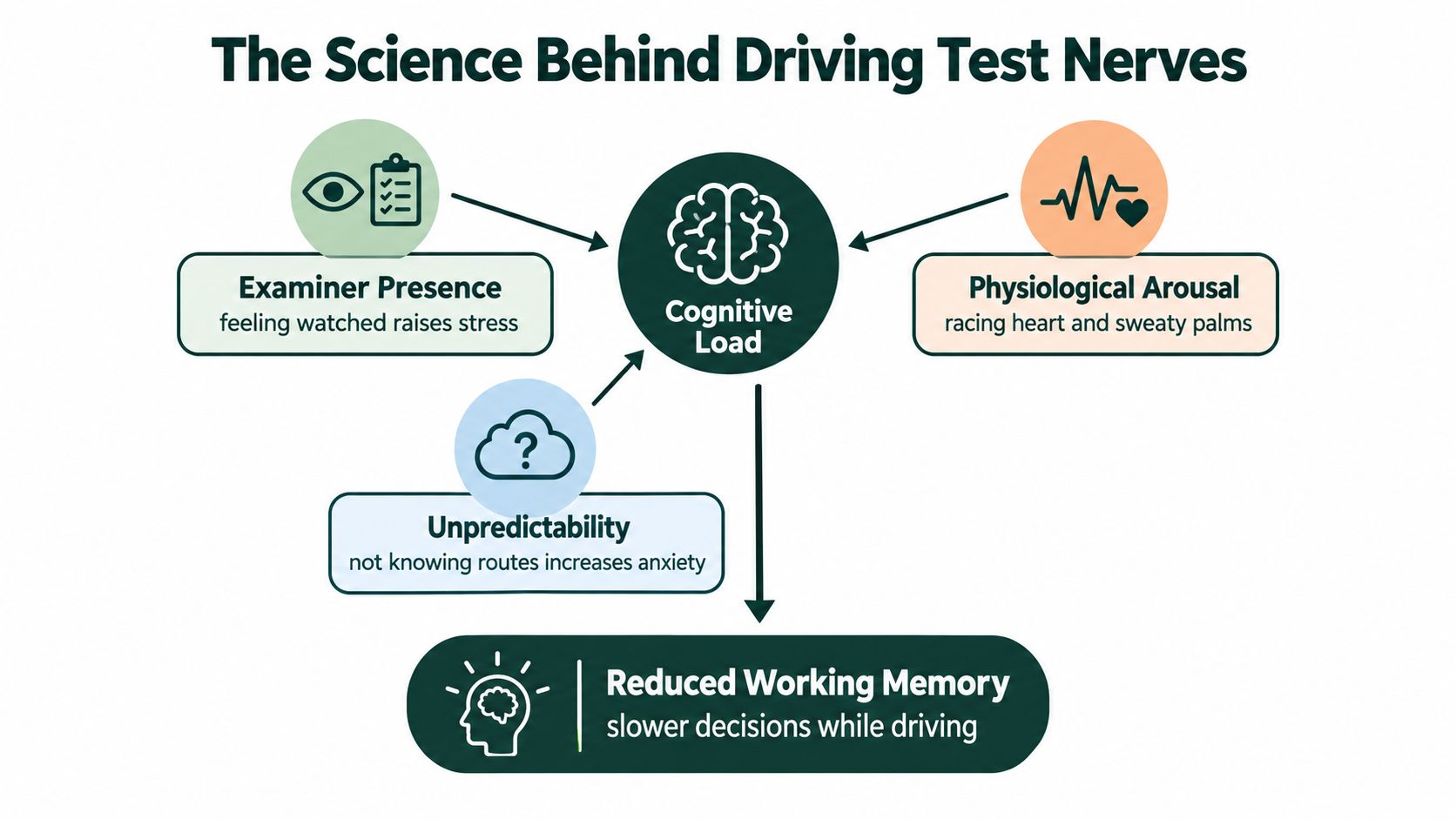
Cognitive load is the amount of mental processing being handled at one time. Driving already involves scanning for hazards, judging speed, positioning the car, selecting gaps and responding to other road users. The test adds another layer, much like trying to follow a familiar recipe while someone checks every movement.
At one moment, you may be:
- Listening to the examiner's instruction.
- Checking that you understood it correctly.
- Following satnav directions.
- Monitoring mirrors and blind spots.
- Choosing the correct lane.
- Remembering the next stage of a manoeuvre.
- Wondering whether a fault has been recorded.
Each task is manageable alone. Difficulty rises when several arrive together while stress has already activated the body. A racing heart, tense shoulders or sweaty palms can become extra information for the brain to monitor. Attention is then diverted from the road, reducing the capacity available for observation and decision-making.
A short physical routine can reduce that extra load. Practise box breathing, inhaling for four counts, holding for four, exhaling for four and holding for four, for two minutes before moving off. The aim is not to force anxiety away. It is to give your attention a predictable task before the driving begins.
Why route uncertainty matters
Uncertainty increases the preparation required in the moment. Knowing what comes next leaves more attention for observation and control. Uncertainty about whether the satnav will direct you left, right or straight on keeps part of your attention waiting for the next instruction.
Evidence linked to DVSA guidance suggests that satnav use reduced some anxiety connected with interacting with the examiner. Separating route instructions from assessment can make the roles clearer: the satnav provides directions while the examiner concentrates on evaluating the driving. (Government guidance on driving test nerves)
This arrangement does not remove pressure, but it gives you something specific to rehearse. Formal mock tests can reproduce the divided attention of an examination, while an intensive course can concentrate practice around the available test date. Preparation then addresses the testing conditions, rather than treating every nervous reaction as a personal weakness.
If anxiety affects other areas of life too, a Vernon anxiety therapist may help you examine broader patterns. For test-specific nerves, repeated realistic rehearsal can teach your brain that an examiner's presence is demanding, yet manageable.
How Systemic Booking Delays Amplify Learner Nerves
In September 2025, the average driving-test wait in Great Britain was 22 weeks, according to the National Audit Office investigation into car driving test waiting times. Only 73 of 240 permanent test centres had waits below 24 weeks, while 70% of DVSA permanent centres were operating at the 24-week maximum. The DVSA was not forecast to meet its seven-week target until November 2027, and that was a projection rather than an achieved result.
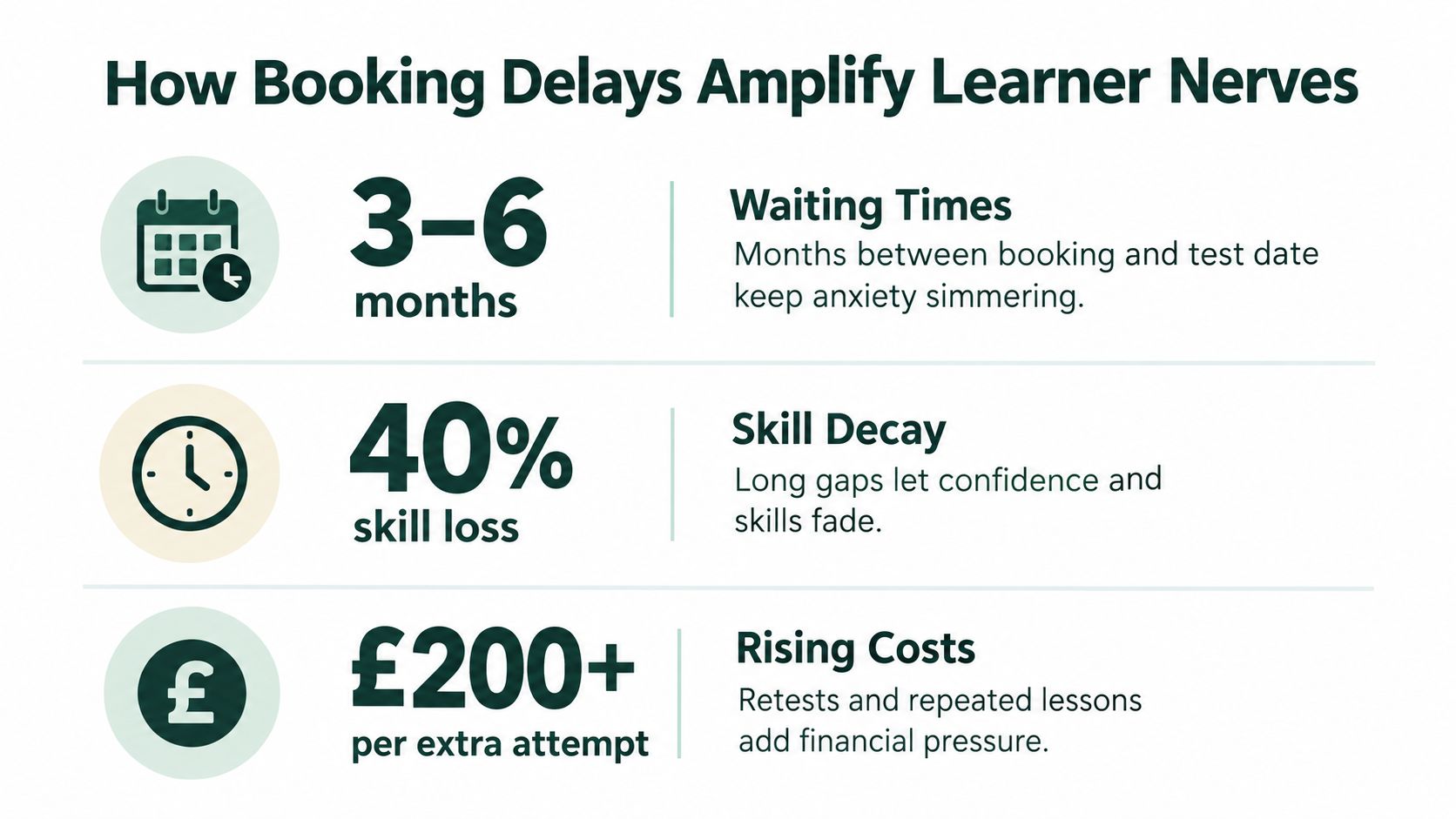
A learner can feel ready when booking a test, then doubt that readiness by the appointment date. Their driving may not have deteriorated. A long gap can interrupt lesson momentum, reduce practice opportunities and turn preparation into a cycle of checking, postponing and worrying. The test date starts to feel like a distant assessment rather than the next step in a steady routine.
Median waits do not show every learner's experience
The DVSA publishes monthly waiting-time information because one headline measure can give a distorted impression. In May 2026, the national median waiting time was 9.7 weeks, while the older availability measure was 21.8 weeks. These figures describe different parts of the booking system. The median represents the middle waiting experience for candidates who took tests. The availability measure reflects the point at which only 10% of appointments remained available.
That distinction matters psychologically. A learner may assume that everyone faces the longer figure, or that their own wait proves they have been unusually unlucky. Pressure also varies sharply by centre. Banbury recorded a 24.3-week median, while Pinner reached 24 weeks on the availability measure, as explained in the DVSA explanation of driving-test waiting-time measures.
Regional differences add another layer of uncertainty. In April 2026, reported average waits were 22.7 weeks in England, 22.9 weeks in Scotland and 17.3 weeks in Wales. Across Britain, the overall wait was longer than five months, according to BBC reporting on regional driving-test waits.
Planning around the booking system
DVSA guidance says new appointments are added 24 weeks in advance, and there is no waiting list or cancellation list. Learners seeking an earlier date must check for released appointments themselves, rather than joining a formal queue. The DVSA guidance on booking appointments and finding earlier tests sets out that process.
A stable preparation plan gives the waiting period some structure. Keep lessons at a realistic rhythm, then arrange a focused refresher period near the test. An intensive course can concentrate practice around the available appointment, while formal mock tests provide clear evidence of progress instead of relying on how confident you feel that day.
Check cancellations only if doing so will not keep you in a constant state of alert. Guidance on driving-test waiting times and what to expect can help separate a difficult booking system from a genuine skill gap. For comparison, learners may read how to book Ontario drive test appointment online, but Ontario's process differs from the UK. Appointment availability is part of the learner's practical experience, not merely an administrative detail.
Evidence-Backed Strategies to Reduce Cognitive Pressure
Cognitive pressure falls when preparation turns decisions into familiar actions. The aim is not to force anxiety away. It is to give your attention a clear job, so nerves do not consume the concentration needed for safe driving.
Rehearse the complete task
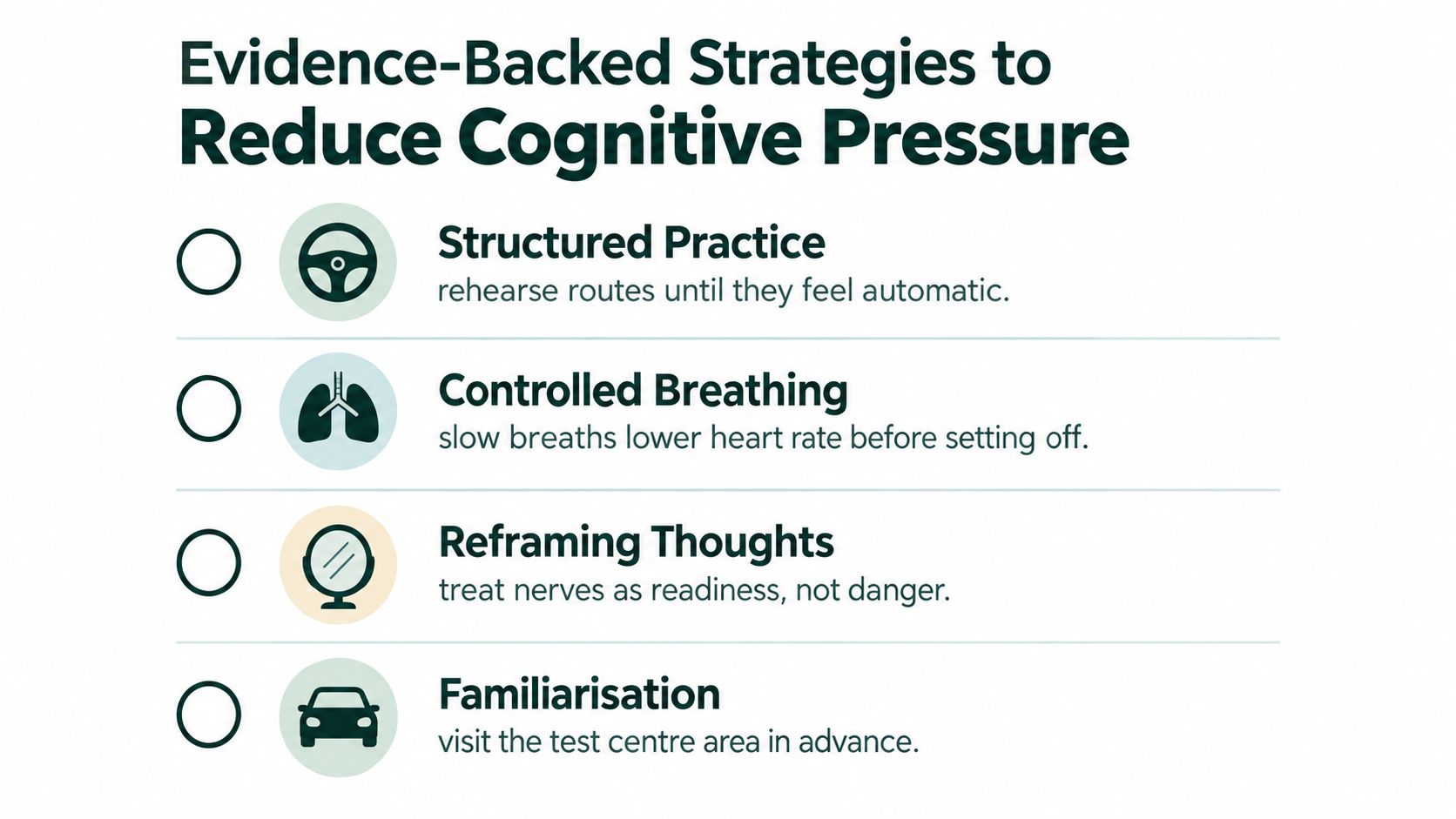
Practise drives that resemble the actual test, including unfamiliar roads and satnav instructions. During your next lesson, ask your instructor to give brief directions such as “second exit left”, then use satnav voice guidance for part of an independent drive. This separates route decisions from constant spoken instruction without turning the exercise into another explanation of the theory.
Ask your instructor to keep reassurance limited during this practice. You need to rehearse checking mirrors, choosing speed, responding to hazards and continuing after a small mistake while another person observes. Short periods of silence can feel uncomfortable at first, which makes them useful preparation for the test.
Use a simple rehearsal checklist:
- Arrive near the test centre with enough time to settle.
- Complete the eyesight and vehicle-safety questions.
- Adjust the seat, mirrors and controls before moving off.
- Follow directions without asking for unnecessary prompts.
- Complete manoeuvres without coaching.
- Discuss faults only after the drive has ended.
The DVSA-linked guidance on satnav and test anxiety supports using clear task boundaries during practice. Apply that idea as a practical exercise, rather than treating satnav as a guarantee that nerves will disappear. The booking system may have created a long gap before your test, but an intensive course or several planned rehearsals can rebuild familiarity around the appointment.
Lower physical arousal before moving
Practise one breathing routine in the car before test day. Breathe in gently, then make the out-breath slower and longer. Lower your shoulders, loosen your grip on the wheel and place both feet comfortably before setting off.
Breathing cannot correct an unsafe gap or a missed observation. It can prevent a racing heartbeat from becoming a second problem. If you interpret physical tension as proof that you will fail, the thought can increase the tension. A slower exhale gives you a small, repeatable action while you wait.
Grounding can support the same process. Notice your hands on the wheel, the seat beneath you and the view through the windscreen. Practise these checks during ordinary lessons, so they remain familiar when the test centre feels unfamiliar.
Change the meaning of the sensation
Nerves and readiness can produce similar sensations, including alertness, a faster heartbeat and sharper attention. Replace “I must not feel nervous” with “My body is preparing me to pay attention.”
This reframing does not excuse poor observation or unsafe decisions. It stops you spending attention on the demand to feel perfectly calm. The standard is controlled, safe driving, not an empty mind.
Learners who find revision, appointments or routines difficult may find practical ideas in work planning for ADHD. Put preparation tasks on a visible plan, including lessons, mock drives and rest, instead of making memory carry every detail.
A short visual demonstration can support breathing and mental preparation:
Using Formal Mock Tests to Neutralise Evaluative Pressure
Casual practice and a formal mock test prepare different parts of driving. A parent may offer reassurance from the passenger seat, while an instructor may step in before a situation becomes difficult. That support helps build skill, but it can also hide the silence, uncertainty and judgement that make the practical test feel different.
Booking delays can make this gap wider. A learner may be ready for lessons but wait weeks for an appointment, then spend that time practising without a clear test date. A formal mock gives that waiting period a useful structure. It turns general worry into specific observations about how the learner drives when nobody supplies prompts or reassurance.
A mock should add pressure gradually. As noted earlier, the British study showed that a mock does not automatically reproduce the arousal of the actual examination. Use that finding to design the session rather than dismissing mocks. Add one stressor at a time, such as quiet driving, satnav directions or starting near the test centre, and record which demand causes the greatest disruption.

What a high-fidelity mock includes
A useful mock should feel less comfortable than an ordinary lesson, while remaining safe and constructive. The instructor should reduce unnecessary help, not create fear or allow unsafe driving to continue.
Ask for:
- A realistic start: Use the test-centre area, settle into the car and follow the same opening routine.
- Route uncertainty: Drive on local roads without receiving every turn in advance.
- Examiner-style instructions: Keep directions brief, clear and neutral.
- Satnav practice: Use the device and instruction style expected on the test.
- Quiet driving time: Allow pauses without filling them with commentary.
- Fault-based feedback: Review the drive afterwards, then select a small number of priorities.
- A repeat plan: Revisit the same pressure points instead of collecting unrelated corrections.
A route near the chosen test centre links road practice with the setting associated with the appointment. Learners can arrange mock driving tests and examiner-marked fault preparation with Fast Track Driving Lessons as part of that preparation.
Treat the result as a diagnostic
A mock result is evidence about current demands, not a fixed prediction. If accuracy drops when the car becomes quiet, repeat silent driving. If satnav instructions lead to late lane changes, practise making route decisions earlier. If the opening minutes feel disorganised, rehearse that start until the sequence becomes familiar.
The target is familiarity with pressure, not artificial confidence. Each realistic run shows what to practise before the booked test, so the learner does not meet every pressure point for the first time during the assessment.
The best mock test doesn't flatter you. It shows you what to practise while there's still time to improve it.
Structuring Intensive Preparation and Day-Of Routines
Long booking delays can turn preparation into stop-start practice. A learner may complete strong lessons, book an appointment weeks or months ahead, and then practise only occasionally while waiting. As the test approaches, the car may still feel familiar, but the steady rhythm needed for confident decisions has faded. That pattern reflects the booking system as well as the learner's preparation.
An intensive or semi-intensive course can restore that rhythm by concentrating lessons within a defined period. Available options range from a 10-hour Test Booster to a 40-hour Complete Beginner course, with intermediate plans of 15-hour, 20-hour, 25-hour, 30-hour and 35-hour formats. The suitable choice depends on current ability, the instructor's assessment and the time remaining before the test. A shorter plan may refresh established skills, while a longer course may be more suitable when long gaps have interrupted progress.
A practical preparation timeline
A nearly test-ready learner might organise the final period like this:
- Early preparation: Identify faults that appear under pressure, such as hesitation at busy junctions, rushed observations or weak independent driving.
- Middle preparation: Combine local routes, manoeuvres and the decisions likely to become difficult under assessment. Keep sessions frequent enough to maintain momentum.
- Final preparation: Complete formal mocks, review the most important corrections and rehearse the opening routine.
- The day before: Prepare documents, route details and clothing. Avoid trying to learn a completely new manoeuvre late at night.
- Test morning: Eat something familiar, allow time to arrive without rushing and use the breathing routine already practised.
A fixed schedule turns uncertainty into visible tasks. Rather than repeatedly asking whether you feel “confident enough”, check whether you have completed the planned mock, addressed its main fault and kept recent practice consistent. The schedule acts like a handrail: it supports decisions when nerves make broad judgements unreliable.
Build a calm start
Arrive with enough time to park, use the toilet and sit in silence for a few minutes. Avoid comparing yourself with other candidates. Their stillness, conversation or apparent confidence gives you no reliable information about how they will drive.
When the examiner arrives, listen carefully and answer naturally. You do not need to act cheerful or apologise for feeling nervous. If an instruction is unclear, ask for it to be repeated. A calm question is safer than guessing.
If you make an error, direct your attention to the next safe action. Do not try to decide what the fault means while you are still driving. The assessment continues across the whole drive, so keep making sound decisions until the test ends.
Moving Forward With Confidence and Control
Driving test nerves are a predictable response to evaluation, uncertainty and delay. An examiner's presence, an unfamiliar route and the consequences of failure can raise arousal, while a long wait may make the appointment feel more threatening than the driving itself.
Treat preparation as a system measured through completed actions. Begin with a formal mock at the test centre, then ask your instructor to identify the few behaviours that need attention. Keep those skills active through an intensive or semi-intensive schedule, especially after gaps in practice. Satnav routes and short breathing exercises can reduce pressure during sessions.
Use a written plan with clear checks: complete the mock, practise mirror routines, control speed, make independent decisions and respond safely to hazards. The booking system may limit your choices, but this process gives each waiting week a useful purpose. Free theory questions and step-by-step guidance through the Fast Track Learner Hub can keep wider preparation organised.
Fast Track Driving Lessons offers intensive and semi-intensive tuition, local instructor matching, test-centre mock tests and support with suitable earlier-test alerts. Choose a structured course or mock test, and turn the wait into a defined plan.
Written by Fast Track editorial team.