

A driving lesson gift voucher is a prepaid block of professional instruction, not a shortcut to passing the test itself. With 692,000 car theory tests and 449,000 car practical tests recorded in Great Britain in July to September 2024, the useful gift is the one that matches lesson hours to the learner's stage, availability and test timeline. Government testing statistics show why preparation matters, but a voucher only creates value when the recipient can book and use the tuition effectively.
Someone has asked you for “something useful” for a learner driver, and a voucher seems safer than guessing at equipment, insurance or a car. That instinct is sound, but the purchase needs more thought than choosing the largest package on a sales page. The learner may still be building basic control, may prefer an automatic, or may already be close to test standard and need route practice rather than a long beginner course.
A well-chosen voucher supports progress. A poorly timed one can sit unused while instructor availability, test-centre waits and the recipient's schedule work against it.
Table of Contents
- What a Driving Lesson Gift Voucher Actually Is
- Voucher Value Explained and Common Misconceptions
- How to Choose the Right Driving Lesson Package
- Purchasing Terms, Fees and Validity You Should Check
- Who Benefits Most from a Driving Lesson Gift Voucher
- Redemption, Booking and Practical Next Steps
- Hidden Risks and How to Avoid Them
What a Driving Lesson Gift Voucher Actually Is
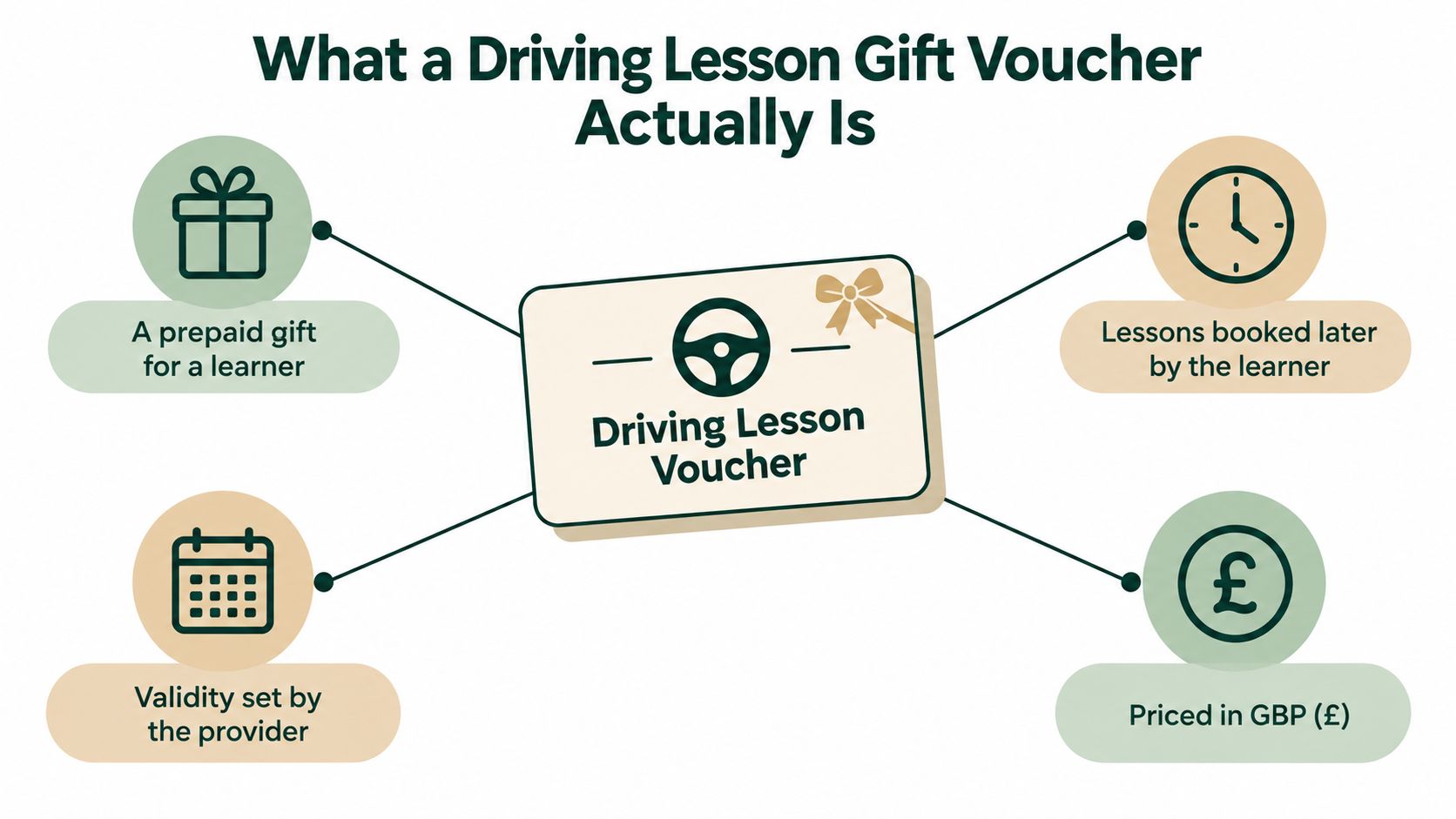
A typical gift-giving situation looks simple. You want to give a learner something practical, but you don't know whether a lesson voucher is merely a prepaid experience or a structured route towards a licence. In plain terms, it's credit for professional tuition, redeemed by the learner with an instructor or driving school under published terms.
That tuition might be sold as individual sessions, an intensive course or a semi-intensive programme. It may be available for manual or automatic cars, depending on the provider and local instructor coverage. The voucher normally pays for teaching time, vehicle use and the agreed course service. It doesn't automatically pay the government's testing charges.
The distinction matters because the official car theory test costs £23, while the standard car practical test costs £62. Different practical-test prices apply for evenings, weekends and bank holidays. These charges are separate from lessons, and the official GOV.UK driving and motorcycle test prices also warn that unofficial booking websites may charge more.
Treat the voucher as tuition credit
A voucher is not a guaranteed pass, a reserved test date or an unlimited future balance. Its practical value depends on:
- The learner's stage: A complete beginner needs a different plan from someone who has already had weekly lessons.
- The transmission: Manual and automatic preferences should be confirmed before purchase.
- The expiry terms: The recipient must have enough time to arrange lessons and use the balance.
- The provider's coverage: A voucher is only useful if an appropriate instructor serves the learner's postcode.
For buyers comparing different ways to contribute towards a present, an EasyRegistry cash fund option can help organise contributions, but the recipient still needs a clear tuition provider, written terms and a realistic booking plan. The best gift removes uncertainty rather than adding a large number of hours.
Voucher Value Explained and Common Misconceptions
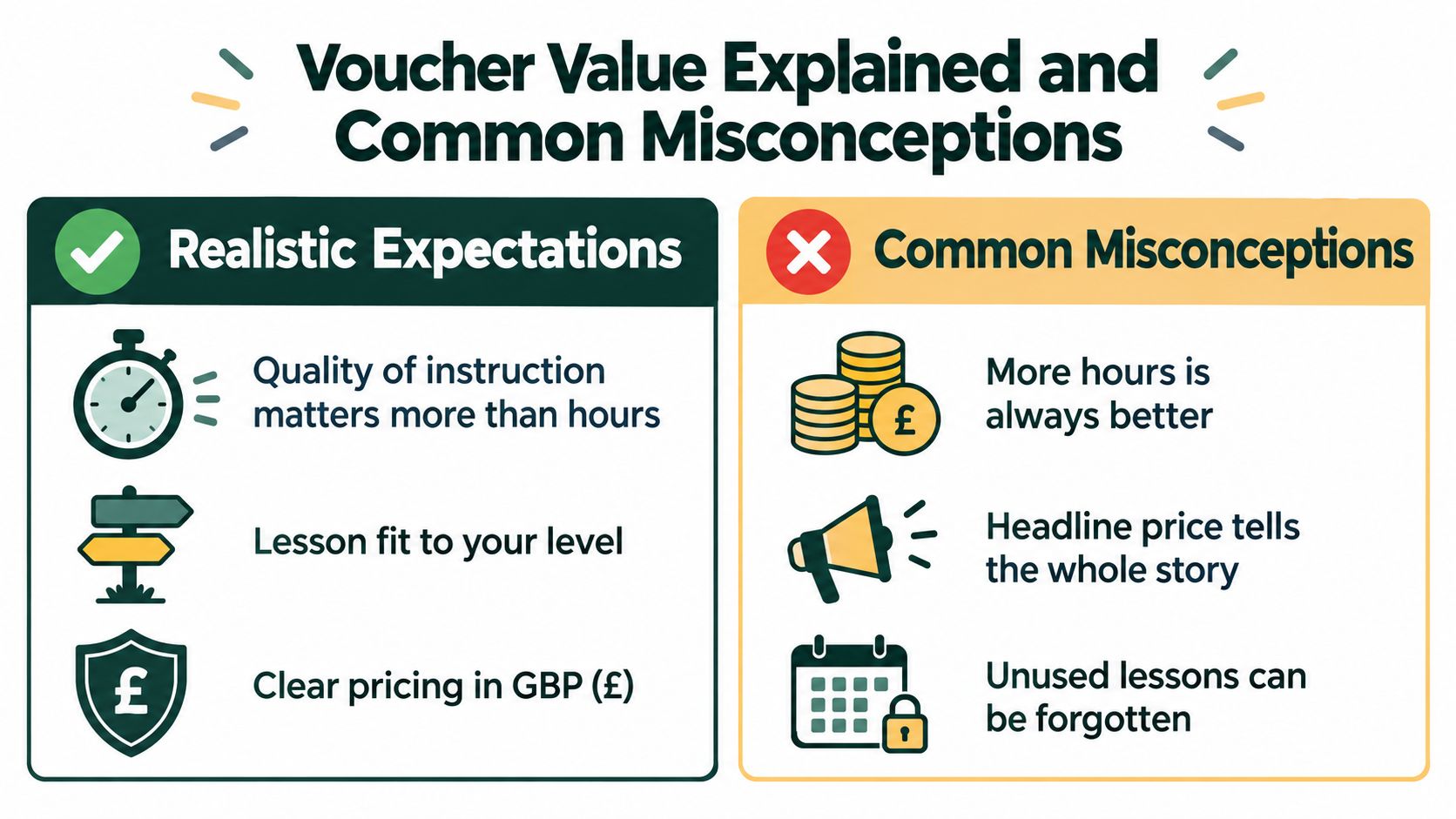
A buyer often sees a 10-hour or 20-hour package and assumes the bigger block is the better gift. In practice, value comes from timing and fit. If the learner cannot start soon, has not passed theory, or cannot book lessons consistently around work or study, a larger voucher can sit unused while confidence and momentum drop.
The better question is simple. What does this voucher help the learner do next?
For some learners, that next step is basic car control and road awareness. For others, it is sorting out roundabouts, manoeuvres, independent driving, and mock-test nerves. A voucher has real value when it matches that stage and can be used at the right pace. It has poor value when the hours look generous on paper but do not line up with the learner's readiness, local instructor availability, or likely test window.
| Realistic expectation | Common misconception |
|---|---|
| Structured preparation builds competence over several lessons. | A voucher guarantees a pass. |
| Flexible tuition can suit manual or automatic learners. | Any package works for every recipient. |
| Mock tests and feedback reveal remaining weaknesses. | More hours always equal better value. |
| Clear terms protect the buyer and learner. | Unused lessons can be ignored until later. |
Pass rates remain below half in recent DVSA quarterly reporting, which is a useful reminder that paid tuition should be sold as preparation, not certainty. The practical point for buyers is not the headline percentage. It is that many learners need lessons spaced properly, with time to absorb feedback and correct faults, rather than one oversized block bought too early.
Check the provider's driving lesson course pricing before you buy. Look at what is included, whether manual and automatic tuition are priced differently, and whether cancellations, transfers, and expiry are explained clearly. A smaller voucher used promptly with a workable booking pattern often does more good than a bigger package with awkward terms and no clear route to test-ready driving.
How to Choose the Right Driving Lesson Package
Start with the learner's current position, not the occasion. A complete beginner may benefit from regular, concentrated tuition that establishes vehicle control and observation habits. Someone with previous lessons may get more from a semi-intensive block that targets manoeuvres, junctions, independent driving and test-standard decision-making.
The choice between intensive and semi-intensive teaching is practical. Intensive tuition compresses learning into a shorter period, which can help a learner maintain continuity. Semi-intensive tuition spreads sessions across a longer window, giving the learner time to practise between appointments and absorb feedback. Neither format guarantees a pass, and both depend on instructor availability and the learner's ability to attend.
| Course Type | Ideal For | Key Consideration |
|---|---|---|
| Intensive | Learners ready to commit to frequent sessions | Confirm availability before purchasing a large block |
| Semi-intensive | Learners balancing work, study or family commitments | Lesson spacing must still be regular enough to maintain progress |
| Manual tuition | Learners who want a manual licence and can manage clutch control | The learner must be comfortable with gears and clutch work |
| Automatic tuition | Learners who want to focus on observation, positioning and traffic decisions without gear changes | Confirm local automatic-car coverage and licence implications |
| Mock-test package | Learners close to test standard | Most useful when a test route and realistic booking timeline exist |
Check the instructor status
Paid instruction must come from someone legally permitted to charge. GOV.UK explains the Approved Driving Instructor register, including the requirement for an instructor to be a registered ADI or hold a trainee driving-instructor licence and display the relevant badge or licence.
A trainee instructor, often called a PDI, isn't the same as a fully qualified ADI. The trainee driving-instructor licence rules state that a trainee may receive up to six months of on-road teaching experience before the Part 3 test, subject to the scheme's conditions. The provider should identify that status before lessons begin.
Transmission should also be agreed before payment. Automatic tuition can suit learners who find clutch control distracting, while manual tuition remains the right route for someone who specifically wants to learn in a manual car. For a broader comparison of experience gifts, you might also browse golf lesson vouchers, but driving tuition needs extra checks around instructor status, test readiness and vehicle suitability. A course recommender can help frame the choice around the learner's stage rather than the gift's price tag.
Purchasing Terms, Fees and Validity You Should Check
The expiry date is not a minor footnote. There's no general statutory minimum validity period for retailer or service-provider gift vouchers in the UK, so the issuer normally sets the period and conditions. Those terms still need to meet the Consumer Rights Act 2015 requirements for fairness and transparency. A short or obscure expiry restriction can create consumer-law risk, particularly where scheduling difficulties make redemption difficult.
Before paying, ask for the written terms and check:
- The validity period: Is the expiry date shown before purchase, and can the provider extend it if the instructor becomes unavailable?
- The total price: Is the hourly rate clear, and are booking, administration or transfer fees added?
- The service included: Does the voucher cover tuition only, or does it include any contribution towards official test charges?
- Cancellations: How much notice is required, and what happens when the learner is ill or the instructor cancels?
- Instructor changes: Can the learner receive a replacement instructor if the original instructor stops teaching in the area?
- Refunds and cooling-off: Does the provider explain any applicable 14-day cooling-off period and the effect of booking lessons during it?
The practical problem is that lessons rely on capacity, weather, test-centre demand and the recipient's timetable. The Northern Ireland Assembly summary on voucher expiry and consumer protections reflects the wider UK concern that voucher terms should be visible and fair. Buyers should keep the receipt, voucher code and conditions together.
For purchases above £100 made by credit card, Section 75 may provide joint-liability recourse for misrepresentation or breach of contract. It doesn't normally resolve a clearly disclosed short-expiry term, so payment protection isn't a substitute for reading the contract.
The payment journey itself can also affect the final amount. A practical overview of how Samba cuts payment costs may help businesses understand why transparent pricing and clearly itemised charges matter to customers.
If a provider's refund wording is vague, compare it with the published refund policy before committing.
Who Benefits Most from a Driving Lesson Gift Voucher
The same voucher can produce very different results for different learners. A complete beginner usually needs structured, regular tuition, because early lessons establish steering, moving off, stopping, gear control where relevant and observation. A recipient who already understands the basics may need fewer foundational hours and more targeted practice.
Consider four common profiles:
- Complete beginners: Choose a programme that provides continuity, instructor matching and enough flexibility to build confidence without rushing the first lessons.
- Learners with some experience: A semi-intensive block can consolidate weak areas, particularly junction planning, manoeuvres and independent driving.
- Adults returning after a break: The gift may work best as a refresher package focused on confidence, busy traffic, parking or a different vehicle.
- Nearly test-ready learners: Prioritise mock tests, examiner-style feedback and practice near the chosen test centre rather than buying a broad beginner course.
Automatic tuition can be particularly helpful for a learner who finds clutch control increases workload, but the buyer should confirm the recipient's preference first. Accessibility requirements, anxiety, instructor compatibility and travel distance can matter more than the number of hours printed on the voucher.
The learner's timeline also matters. In Great Britain, the minimum age for driving a car is 17, and a theory-test pass remains valid for two years, according to the government consultation on learner drivers. A voucher should therefore support a realistic period of tuition, rather than assume the recipient can redeem it immediately or indefinitely.
Redemption, Booking and Practical Next Steps
The smoothest redemption process begins with information, not payment. Give the recipient the voucher terms, receipt and provider contact details, then confirm the learner's postcode, provisional-licence status, preferred transmission and available days.
A sensible sequence is:
- Confirm coverage: Ask whether an instructor serves the learner's area and whether a replacement is available if circumstances change.
- Match the teaching style: Tell the provider whether the learner is a beginner, returning driver or nearly test-ready.
- Discuss the test centre: If a practical test is booked, share the centre so route practice and mock-test planning are relevant.
- Set a redemption plan: Book the first lessons promptly and avoid assuming the voucher can remain unused until the last moment.
- Keep records: Save the expiry date, cancellations procedure, instructor details and any agreed changes.
DVSA publishes several waiting-time measures, and they don't always tell the same story. The national median between booking and taking a test was 11.1 weeks, while a separate availability measure could be much longer in some locations. At one centre, the apparent availability wait was 21.8 weeks, while the median actual wait was 9.7 weeks, as explained in the DVSA guidance on appointments and earlier tests.
That difference is why the recipient may need to book lessons around a test date rather than redeem a large package blindly. If the learner changes test centre, ask whether the voucher can still be used, transferred or converted into refresher lessons and mock tests.
Hidden Risks and How to Avoid Them
The most expensive mistake is often not the voucher price. It's buying a large block before the learner has a workable schedule or test timeline.
Test availability varies between centres, and DVSA's published measures can diverge sharply. A voucher that expires while the learner waits for a suitable appointment may still be technically valid on paper but difficult to use in practice. The safer approach is to choose a provider with clear extension terms, bookable local coverage and a realistic plan for concentrating lessons after a test date is secured.
A gift should create usable time behind the wheel, not pressure to redeem lessons before the learner is ready.
The second risk is assuming every person teaching paid lessons is a fully qualified ADI. GOV.UK states that paid instruction must be delivered by a registered ADI or someone holding the relevant trainee licence. A trainee can gain valuable teaching experience, but the learner should know that status before the first lesson, and the provider must not present a trainee as a qualified ADI.
Ask these questions before buying:
- Who will teach the learner? Confirm whether the instructor is an ADI or a PDI.
- What happens if the instructor leaves? Look for a written replacement or transfer process.
- Can the learner change instructor? Compatibility matters, particularly for anxious beginners.
- Does the car fit the learner? Confirm manual or automatic transmission and any accessibility needs.
- What does the voucher exclude? Separate tuition from theory and practical test fees.
- When does the clock start? Check the exact expiry date and extension conditions.
The strongest driving lesson gift vouchers are transparent about price, instructor status, vehicle type, coverage and scheduling. They don't promise a pass. They give the learner a practical route from current ability to better preparation, with enough flexibility to respond when the test centre, instructor or timetable changes.
Fast Track Driving Lessons matches learners with DVSA-approved instructors for intensive and semi-intensive manual and automatic tuition across England, Scotland and Wales. Visit Fast Track Driving Lessons to compare a suitable course, check clear terms and plan lessons around the recipient's real test timeline.
Written by Fast Track editorial team.