
You're probably staring at the same problem most learners are facing right now. You've done the lessons, you're getting more consistent, and your instructor says you're close. Then you try to book a practical test and realise the bottleneck isn't your driving, it's the gap between being ready and getting a DVSA slot.
That's why driving fast track matters in the UK in 2026. The value isn't just “more lessons, faster”. The value is compressed training that lines up with a scarce test date, because the waiting system has become part of the course itself. The National Audit Office reported in September 2025 that the average wait to book a car driving test in Great Britain was 22 weeks, up from just over five weeks in February 2020, and that 70% of DVSA's 240 permanent test centres were at the 24-week maximum waiting time, with only 5% of booking slots visible in the system at that point (NAO-linked summary). If you're planning a fast-track course without thinking about the booking queue, you're planning half a job.
Table of Contents
- What Driving Fast Track Really Means
- Why Test Waiting Times Change the Calculation
- Course Lengths and How to Choose
- What a Typical Fast Track Week Looks Like
- Pros and Cons of Going Intensive
- Who Benefits Most From Fast Track Lessons
- Pricing, Instructors and Booking Checklist
- Choosing Your Fast Track Starting Point
What Driving Fast Track Really Means
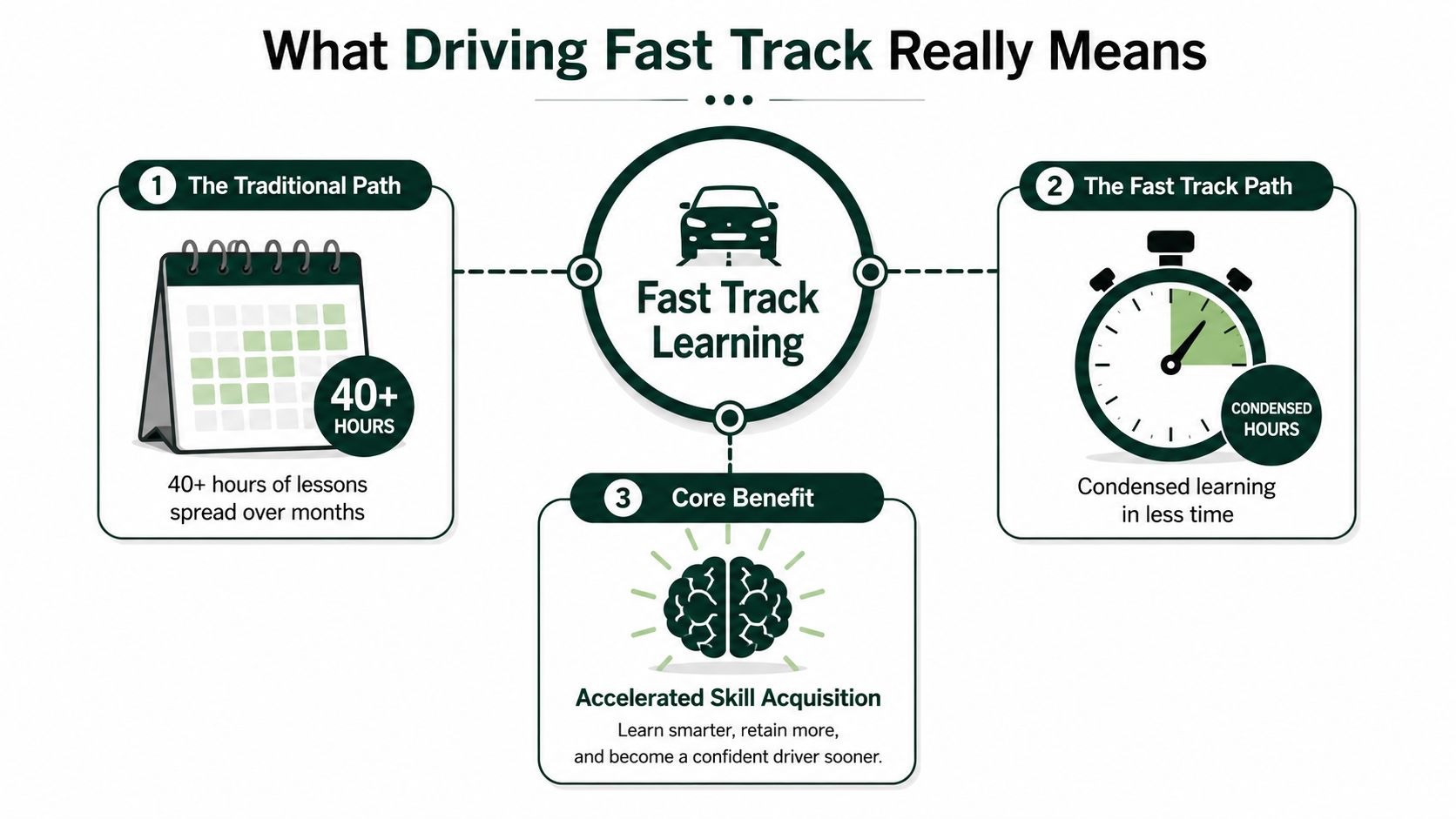
A learner sitting at the kitchen table after work, checking the diary again, is a normal starting point. Childcare is being shuffled. Shift patterns keep changing. Two evening lessons a week are not building a finished skill. Driving fast track cuts through that drift. It compresses the learning journey into a focused block, often five days to six weeks, depending on what the learner already knows and how quickly a test-ready result is needed.
What the course is
You are paying for structured intensity. In practice, that means a DVSA-registered Approved Driving Instructor working through a school or franchise with a planned sequence of lessons, rather than one hour here and there. The package might be residential, semi-intensive, or a mixed block of weekday and weekend sessions. The aim stays the same. Build rhythm, correct faults quickly, and keep the standard DVSA test format in view from the start.
Fast track still lives inside the normal testing system. The theory test remains in place. The practical test stays the same. DVSA standards do not soften. You still need a valid provisional licence, and you still face show-me tell-me questions, independent driving, manoeuvres, and the usual road rules. The gain comes from concentrated repetition and a tighter learning rhythm.
What you're really buying
You are buying time discipline, instructor continuity, and a clearer chance of arriving at the test prepared in both skill and mindset. That is different from refresher work after a failed test, automatic-only tuition, or motorway coaching added on later. Those services can sit alongside a fast-track plan, but they are separate products.
Fast-track packages should also be judged on booking support. If the course does not explain how test booking is handled, treat that as a warning sign. A proper package should spell out how it fits around a real DVSA slot, because the schedule matters as much as the tuition.
Why Test Waiting Times Change the Calculation
A learner can hit test standard quickly and still miss the point if the DVSA queue drags on. That is the fast-track problem in 2026. You are not just buying compressed tuition. You are buying a plan that keeps a learner sharp while the test slot stays scarce. Once the gap between readiness and the actual practical test gets too wide, confidence slips, bad habits creep back, and the course loses value.
The official picture is uneven, so you have to read the queue properly. Analysts behind the NAO-linked summary reported an average Great Britain wait of 22 weeks and only 5% of slots visible in the system, which shows how tight things had become. DVSA's published data for July 2026 shows a median of 11.1 weeks from booking to test date for learners who took a test, while the BBC reported April 2026 waits of 22.7 weeks in England, 22.9 weeks in Scotland and 17.3 weeks in Wales. The point is plain. Waiting times vary by measure, but they stay long enough to shape the value of any intensive course (DVSA statistics collection) and (BBC report on practical test waits).
The planning problem no one talks about
A course only works if the slot lines up with the learning. If a learner gets a test in four weeks, a 30-hour block can be a clean fit because the practice stays fresh and the mock-test standard lands close to the actual date. If the same learner is sitting on an 18-week booking, the value drops unless the school keeps them driving, watches cancellations, and adjusts the plan around the queue. That is why serious intensive providers tie tuition to a confirmed or pending test date and keep pushing for an earlier slot.
The queue is part of the product.
UK Practical Test Waiting Times by Region 2026
| Region | Average Wait Weeks | Implication for Fast Track |
|---|---|---|
| England | 22.7 | You need tighter booking control and fewer idle weeks between lessons and test day |
| Scotland | 22.9 | Fast-track value depends on cancellation monitoring and instructor coordination |
| Wales | 17.3 | Still slow enough that timing the course to the slot matters a lot |
| London and other major urban centres | Longer in practice | Book early, assume the queue will fight you |
| Birmingham and Manchester areas | Longer in practice | Intensive tuition only pays off if the slot is secured or actively chased |
| Rural Scotland and East Anglia | Shorter in practice | Fast track can work well if the learner is already near test standard |
A useful comparison sits in this waiting-time guide for driving test booking, because it shows why “fast” now means fast to readiness, then ruthless about the slot.
Course Lengths and How to Choose
The biggest mistake learners make is buying the wrong intensity. Too short, and they spend money on a stressful cram that doesn't stick. Too long, and they overpay for hours they didn't need. The right move is to match the package to your starting point, not your ego.
The common tiers
A 10-hour taster suits a complete novice who wants a real start, not a fantasy promise. It's usually best for two to five days residential, or a short semi-intensive block, and it gives you enough time to build control, road position and basic junction handling. A 20-hour beginner package works better for someone who has already driven before, maybe with gaps, maybe with an instructor in the past, and wants to get back into rhythm fast.
A 30-hour course is the workhorse. It's the standard intensive route for many first-time passes because it can cover the DVSA syllabus properly without pretending that every learner starts from the same place. A 35 to 40-hour extended course suits nervous learners or people returning after a long break. Then there's the 45-hour-plus style block, which is really for pupils who've failed before, drive infrequently, or need more repetition before they can hold their nerve on test day.
The internal course recommender at Fast Track Driving Lessons course matching is built around this kind of decision, and that's exactly how learners should think about it, by starting point and deadline rather than by guesswork.
How to choose without overthinking it
If you've driven before, start at 20 hours. If you haven't, budget 30 to 40 hours and accept that the timeline may be longer. That's the honest answer. Most of the trouble comes from learners buying too small a block because it sounds cheaper, then needing extra hours anyway.
Fast Track Course Lengths Compared
| Course Length | Typical Timeline | Best For |
|---|---|---|
| 10 hours | Two to five days | Complete novices wanting a head start |
| 20 hours | One to two weeks | Learners with some prior experience |
| 30 hours | One to two weeks or a short residential block | First-time pass candidates who need full syllabus coverage |
| 35 to 40 hours | Around a month, sometimes longer | Nervous learners or those returning after a long gap |
| 45 hours plus | Month-plus, often mixed with ongoing practice | Previous failers or very infrequent drivers |
Prices generally rise with hours and with how tightly you want the lessons packed. Don't shop for the cheapest headline number. Shop for the block that gets you to the test with enough headroom to pass.
What a Typical Fast Track Week Looks Like
A good intensive week feels organised, not chaotic. You start at 9am, not because mornings are magic, but because the brain is fresher and the roads are usually easier to read. The first part of the day should always be a recap of the weak points from yesterday, because repeated mistakes don't fix themselves.
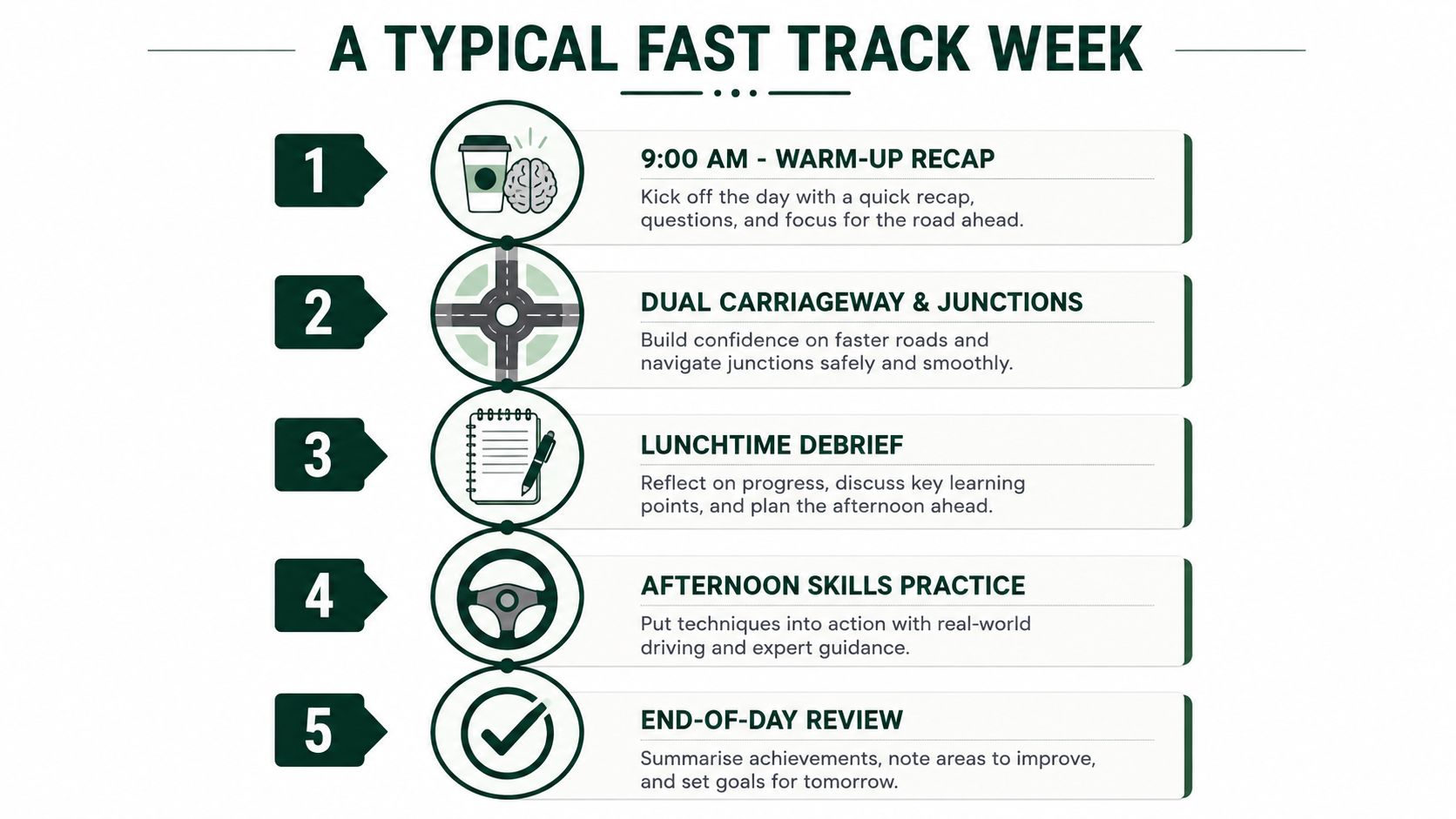
A proper day on fast track usually includes a couple of focused blocks, one aimed at road flow and one aimed at control. You might spend the morning on dual carriageways and complex junctions, break for a debrief, then return to manoeuvres, mock-test scenarios and the exact faults that are still creeping in. The point is to keep learning connected. A learner who does a roundabout on Monday, then another one on Thursday, often wastes half the lesson reloading confidence.
How the week should feel
Monday to Friday often runs 4 to 6 hours daily in total, though most instructors won't keep a learner driving flat out for that long without breaks. After day three, fatigue starts to show, especially when someone is trying to absorb a lot of new information at speed. That's when performance gets sloppy, so experienced instructors cap practice sensibly and use the evening for Highway Code revision, theory gaps and visualising the next day's route.
Weather and traffic will interrupt the pattern. That's normal. Wet roads, roadworks and school-run congestion aren't failures of the course, they're part of the tuition. The learner usually notices progress accelerating after day two, once clutch control, steering correction and lane discipline stop feeling like separate tasks and start feeling automatic.
Practical rule: if the instructor is packing too much into one day and nobody is taking proper breaks, the course is being sold as intensity but run as exhaustion.
A good week has one clear aim
By the end of the week, the learner should not just “have had lessons”. They should know where they lose marks, how the test route feels, and whether they're ready to sit the exam or need a final polish. That's the difference between intensive and random.
Pros and Cons of Going Intensive
The upside of intensive training is obvious once you've seen both formats. Consecutive lessons build skill retention, because the learner isn't spending a week forgetting what they did last Tuesday. The theory-to-practice gap also shrinks, which matters when a learner has to apply a rule in traffic, not recite it in a quiet classroom.
The other big advantage is commitment. A fixed block forces action. Procrastinators hate it, which is exactly why it works for them. Once a course is booked around a test slot, there's less room for drift, and that can cut the painful months of half-finished progress that weekly lessons often create.
Where intensive courses bite back
The downside is blunt. If the test fails, the knowledge can collapse fast without a weekly lesson to keep everything fresh. The money also lands as one larger upfront cost rather than being spread out in smaller payments. Nervous learners can plateau under pressure, especially if they absorb less after hour three or need time to let one lesson sink in before the next one begins.
That's why the DVSA backlog matters here. If tests were easy to book, the case for intensity would be weaker. But with booking pressure this tight, the value of getting test-ready quickly becomes more obvious, because a learner who can hold their level for a short window is much better placed than someone waiting around for months.
The right question isn't “Is intensive better?” It's “Can this learner keep the standard stable under pressure until test day?”
Intensive vs Weekly Lessons Trade-Off Comparison
| Factor | Intensive Fast Track | Weekly Lessons |
|---|---|---|
| Skill retention | Strong, because sessions are close together | Weaker, because gaps slow memory and confidence |
| Time to test readiness | Shorter | Longer |
| Cost shape | Larger lump sum | Spread out over time |
| Pressure level | Higher | Lower |
| Best for | Learners who need momentum | Learners who need space and repetition |
| Risk after a fail | Knowledge can fade quickly | Easier to rebuild gradually |
For a fuller comparison, the intensive course versus weekly lessons guide is useful, but the basic trade-off stays the same. Speed helps, but only if the learner can cope with it.
Who Benefits Most From Fast Track Lessons
Some people get a huge return from fast track. Others just get stressed and poorer. That's the honest split, and instructors see it quickly.
The strongest fits
A learner with a foreign licence who needs a quick UK pass is often a strong candidate, because they usually already understand road behaviour and just need UK-specific polish. Returning drivers are another good fit, especially if they've had a long gap and want their confidence rebuilt fast. University students between terms also do well, because they can commit to the block.
Career changers are the clearest example. If a licence is needed for a new job, waiting around for weekly lessons makes no sense. The same goes for learners who already know the theory and just need a practical push to turn knowledge into a pass.
Who should slow down
Complete beginners can do fast track, but they shouldn't pretend it's the easiest route. If someone has no real driving exposure, anxiety and information overload can make a compressed block feel like a wall instead of a plan. Shift workers often struggle too, because a fast-track course depends on consistency, and a broken schedule wrecks momentum.
This is also where the current market matters. In 2026, the test queue makes a compressed block more valuable for many people, because the alternative is a long wait with no guarantee of steady progress. But that doesn't mean every learner should rush. It means the right learner should move decisively.
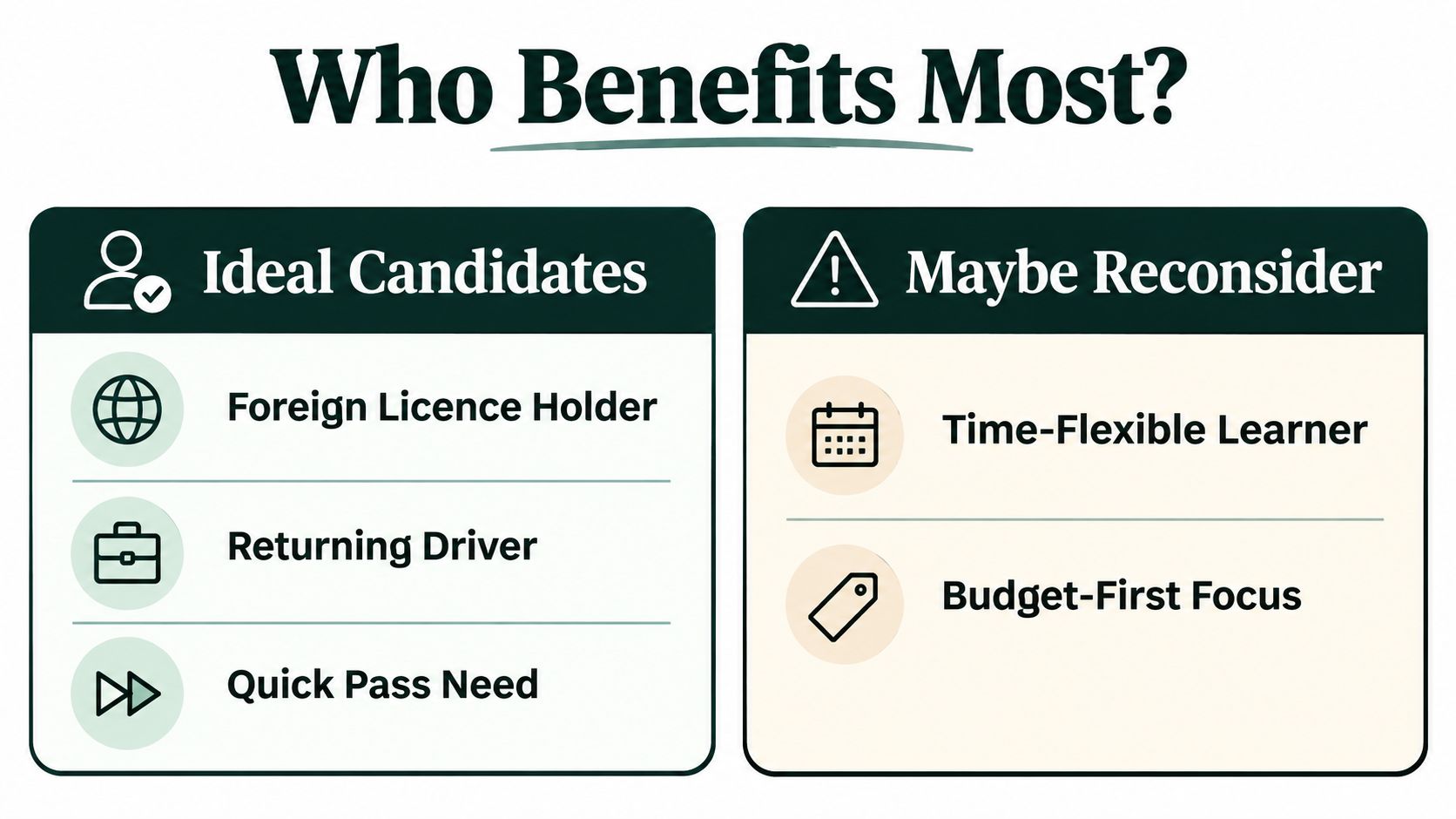
Bottom line: fast track rewards people who already have some road sense or can fully commit to the block. If your diary is chaotic, weekly lessons may be the smarter move.
Pricing, Instructors and Booking Checklist
The numbers matter, but only if they're attached to real terms. In this market, you should be checking the instructor, the refund rules and whether the school is honest about what happens if your test date slips. A cheap package that leaves you stranded is expensive in the end.
What to verify before you pay
Check that the instructor is a DVSA-registered ADI, and ask whether you're being taught by an ADI or a trainee PDI. Confirm what happens to unused hours, whether the school guarantees instructor continuity, and whether the vehicle is insured for dual-control tuition. Ask whether the school is a franchise, because that can affect how support and substitutions are handled.
You should also ask how test booking is managed. If the school mentions real-time cancellation monitoring, test-date support or local route preparation, that's useful. If they only talk about a discount and push hard for an immediate deposit, be careful.
A simple booking checklist
- ADI status: Ask for the instructor's DVSA badge details and confirm the name on the booking.
- Refund terms: Read the cooling-off and refund window before paying anything.
- Unused hours: Get a written answer on what happens if the course finishes early or the test is delayed.
- Cover policy: Find out whether another instructor can step in if the booked one becomes unavailable.
- Insurance and vehicle: Confirm the lesson car is properly insured and road-legal for tuition.
- Test support: Ask whether the school helps with cancellation alerts and test timing.
- Pressure selling: Ignore countdown timers and “last chance” language unless the terms are still visible in writing.
Fast Track Driving Lessons states a fixed hourly rate of £61.23 with no booking or admin fees, plus a 14-day cooling-off period, which is the sort of clarity learners should demand from any provider.
Don't fall for the fake bargain
Unusually cheap offers often hide one of two problems. Either the school is stuffing too many hours into too few days, or the learner will be pushed into extra payments when the first block runs short. A proper fast-track quote should tell you the hours, the terms and the likely outcome without theatrics.
Choosing Your Fast Track Starting Point
Do a quick self-check before you book anything. Ask yourself four questions. How much real driving experience do you already have. How hard is your deadline. What's your budget ceiling. And are you comfortable with motorway-style speed, night driving and sustained concentration for more than one session at a time.
If you're nearly ready and just need polishing, book a 10-hour top-up and ask the school to reserve or chase a test slot immediately. If you've driven before but need structure, commit to a 20-hour or 30-hour intensive and make the booking call with one question ready, “How are you handling test dates and cancellation monitoring for my area?” If you're a nervous complete beginner with no fixed slot yet, step back to weekly lessons until a practical test date can be lined up.
A decision you can make today
If your answer is “I need the pass soon and I can commit the time”, go intensive. If your answer is “I'm still building basics and my diary is messy”, slow down and avoid wasting money. The worst choice is drifting for another month while the queue gets longer.
Pick the route, make the call, and stop treating the test booking like someone else's problem.
Fast Track Driving Lessons works with learner drivers who need intensive or semi-intensive tuition, including help matching with DVSA-approved instructors, route-focused practice and test-date support. If you want a structured way to turn readiness into a practical test booking, visit Fast Track Driving Lessons and check the course that fits your starting point.
Written by Fast Track editorial team.