
Most UK learners need around 45 hours of professional tuition plus 22 hours of private practice, and practical test waits currently average over 20 weeks, making course timing a key factor. A well-chosen course of driving lessons should therefore match your current ability, available practice time and the reality of booking a test.
You may be looking at a calendar full of lesson slots, checking cancellation apps and wondering whether weekly lessons will get you ready before your provisional licence becomes a permanent reminder of an unfinished plan. The old approach, one lesson whenever an instructor has space, is much harder to manage while test availability remains unpredictable.
The answer isn't automatically to book the biggest package. A complete beginner needs a different structure from someone who only needs motorway confidence, manoeuvre practice or a final assessment. The right plan brings together lesson intensity, private practice, theory preparation, instructor quality and the test centre's availability.
Table of Contents
- Why Planning Your Driving Course Matters Now
- Navigating Different Course Structures
- Understanding Pricing and Total Costs
- Verifying Instructor and Vehicle Standards
- Building a Complete Preparation Plan
- Making the Right Choice for Your Journey
Why Planning Your Driving Course Matters Now
A learner can make steady progress for months and still lose momentum if the practical test is booked too late. In Great Britain, the average wait to book a driving test was 20 weeks in August 2026, while the median time from booking to sitting the test was 11.1 weeks. Those are different measures, and both affect how you should organise lessons. The figures are reported in the DVSA explanation of driving test waiting times.
Consider a learner who has passed the theory test, has some experience with family practice and wants to pass before starting a new job. Booking one weekly lesson without checking test availability can create two problems. They may become test-ready long before the appointment, or they may reach the booking stage with skills that have faded because lessons were too widely spaced.

The practical test backlog has changed the value of a structured course. The National Audit Office reported that the average waiting time for a car practical test in Great Britain rose from just over 5 weeks in February 2020 to 22 weeks in September 2025. It also reported that 70% of DVSA's 240 permanent test centres were operating at the 24-week maximum waiting time in September 2025, while DVSA forecast that its seven-week target wouldn't be met until November 2027. These figures appear in the National Audit Office investigation into car driving test waiting times.
Treat the hours as a course
The commonly used DVSA benchmark is about 45 hours of professional lessons and 22 hours of private practice before test readiness, as outlined in this UK guidance on how many driving lessons learners need. It isn't a promise that every learner will need exactly that amount. It is a useful planning baseline.
Intensive and semi-intensive lessons can compress supervised tuition into a shorter period, reducing the gaps in which new routines are forgotten. That doesn't replace private practice or guarantee a pass. It does make it easier for an instructor to build one skill on the next, identify weaknesses quickly and adjust the plan before a test slot arrives.
Practical rule: Book around the test window, not just around the instructor's next available lesson.
Start by checking the test-centre situation, then ask an instructor for an honest assessment. If you're close to test standard, a short course may be sensible. If you're starting from scratch, trying to force a small package usually creates more lessons later, not a saving.
Navigating Different Course Structures
A course of driving lessons should describe a learning path, not merely a number of hours. Intensive and semi-intensive options are available from 10 to 40 hours, including Test Booster, Manoeuvre Finisher, Semi-Intensive, Confident Starter, Fast-Track, Beginner Plus and Complete Beginner options. The intensive driving course overview provides further context on compressed scheduling and varying learner needs.
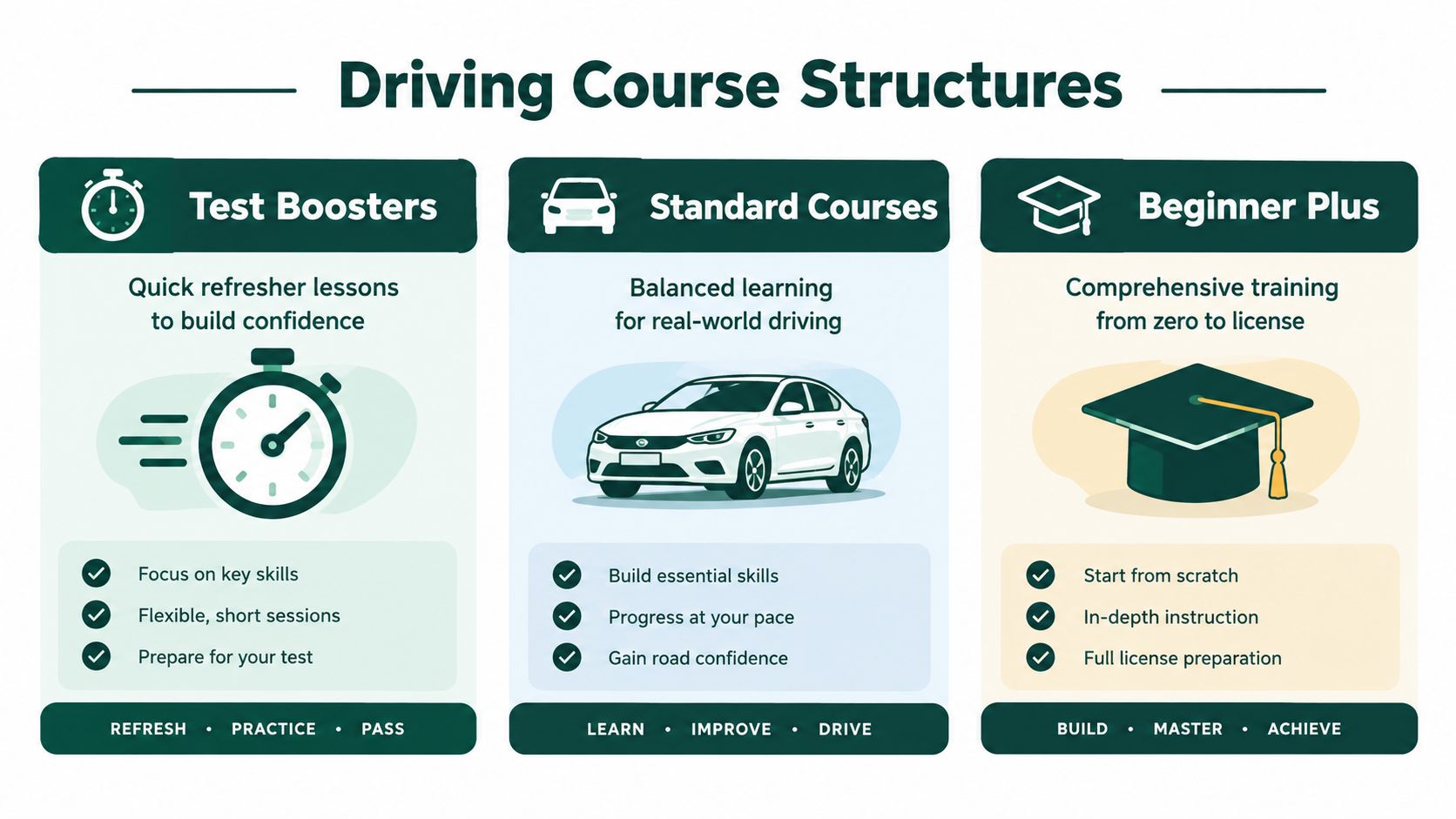
The useful comparison is between your starting point and the work still required:
| Course structure | Typical purpose | Who should consider it |
|---|---|---|
| Test Booster | Consolidates existing skills and exposes test weaknesses | A learner who is nearly ready and needs an instructor's assessment |
| Manoeuvre Finisher | Concentrates on manoeuvres, positioning and recurring faults | Someone who drives competently but loses marks on specific tasks |
| Semi-Intensive | Builds regular momentum over a planned period | A learner who needs structure but can't dedicate every day to lessons |
| Confident Starter | Develops basic control and road awareness | A beginner with some previous exposure |
| Fast-Track | Delivers a substantial block of tuition at pace | A learner who can practise privately and has a clear deadline |
| Beginner Plus | Provides broader development from an early stage | A learner who has little experience but can practise between sessions |
| Complete Beginner | Covers the learning journey from the first controls onwards | Someone starting from zero who needs the most guided tuition |
A 10-hour package is not a realistic substitute for a full beginner programme. It can be effective when an instructor confirms that your core driving is already sound. A 20-hour semi-intensive course suits learners who have practised before and need consistent correction. The longer paths are more appropriate when you need instruction across traffic systems, independent driving, manoeuvres and test-style decision-making.
Choose intensity around real availability
Intensive doesn't have to mean lessons every day. A semi-intensive plan may spread sessions across several weeks, giving you time to practise privately while keeping professional feedback frequent enough to maintain progress. Longer lesson blocks can be demanding, so concentration and recovery matter. If you finish a session mentally overloaded, your instructor should adjust the pace rather than treat exhaustion as commitment.
For a useful comparison of concentrated tuition and traditional scheduling, read this guide to intensive courses versus weekly lessons. Also, if you're researching wider defensive-driving education or want to understand how driving courses are discussed outside ordinary learner tuition, you can browse ticket shield PLLC guidance.
Don't choose a package because its name sounds fast. Ask what happens if the instructor's assessment shows that you need more hours, whether you can change scheduling, and how the provider handles a test date that moves.
Understanding Pricing and Total Costs
The hourly lesson price is only one part of the budget. You also need to account for the practical test, theory test, travel, private practice and any additional lessons caused by a failed test or a long gap before the next appointment.
Current UK coverage puts the first-time practical pass rate at about 48.5%, so a first-attempt pass shouldn't be treated as the default. The same reporting places typical lesson prices at £35 to £38 per hour, with overall learning costs commonly around £1,400 to £1,750 before retests. A separate estimate puts a full budget at roughly £1,529 for 40 lessons plus test and pre-test costs. These figures and the wider cost pressures are discussed in The Guardian's report on the cost of learning to drive.
A fixed hourly rate makes comparison easier because you can calculate the tuition element without guessing which package carries a hidden premium. Fast Track Driving Lessons publishes a single rate of £61.23 per hour across its course options, with no booking or administration fees, while DVSA charges are separated and paid directly to the government. Check the provider's current terms before paying, because prices and policies can change.
| Course name | Hours | Best for |
|---|---|---|
| Test Booster | 10 | Nearly test-ready learners |
| Manoeuvre Finisher | 15 | Learners needing focused manoeuvre work |
| Semi-Intensive | 20 | Learners with some previous experience |
| Confident Starter | 25 | Early-stage learners building control |
| Fast-Track | 30 | Learners seeking a substantial structured block |
| Beginner Plus | 35 | Learners needing broad development |
| Complete Beginner | 40 | Learners starting from zero |
Use the real cost of learning to drive guide to separate tuition from government charges and retest exposure. Don't compare a package's headline total with another provider's hourly figure unless both include the same things.
Interest-free instalments or a deposit-and-balance arrangement can make a planned course easier to fund, but payment flexibility doesn't make an unsuitable course affordable. Get a written total before booking, including cancellation rules, the expected lesson frequency and what happens if you need extra tuition.
Verifying Instructor and Vehicle Standards
A cheap course delivered in an unsuitable car is a poor bargain. Before you commit, verify who will teach you, what badge they display and whether the vehicle gives the instructor a safe way to intervene.
Check the instructor first
Anyone paid to teach driving in the UK must be an Approved Driving Instructor, known as an ADI, or a trainee driving instructor. The instructor must display a DVSA badge in the windscreen. A green badge identifies a qualified instructor, while a pink badge identifies a trainee. You can read the official ADI register guidance from GOV.UK.
Ask the provider to confirm the instructor's status before your first lesson. Don't rely only on a profile photograph or a package name. You should also ask how the provider checks insurance, vehicle condition and instructor availability, especially if your course is concentrated and a replacement would interrupt several connected lessons.
The guide to checking whether an instructor is approved gives you a practical verification route. If you're considering a particular learner car, a vehicle-history or safety resource such as this VinCheck Honda CR-V report can help you understand the kind of information available about a model, although it doesn't replace the instructor's own MOT, insurance and maintenance checks.
Inspect the tuition vehicle
A learner car must meet practical test requirements and have dual controls, allowing the instructor to intervene in an emergency. That safeguard matters on every lesson, but especially during longer intensive blocks when you spend more continuous time dealing with unfamiliar traffic situations.
Before setting off, check that the vehicle is clean, comfortable and correctly adjusted for you. Tell the instructor about any concern with visibility, pedals or seating position. A professional should explain the controls, agree the lesson objective and give you a useful debrief rather than rushing you from one booking to the next.
Use the following video as an additional visual aid when considering what professional tuition should look like.
The car is part of the training environment. If the instructor cannot clearly explain the vehicle's standards or badge status, choose another provider.
Building a Complete Preparation Plan
Driving lessons alone won't prepare you for every part of the test. You need a plan that joins practical driving, theory knowledge, independent practice and test-centre familiarity.
The theory test has 50 multiple-choice questions followed by hazard perception clips, and you must answer at least 43 questions correctly in the multiple-choice section. Practise with DVSA-style questions rather than memorising isolated answers. The aim is to recognise developing hazards and apply rules while driving, not just to complete a practice quiz.
You also need a valid UK provisional driving licence and a valid theory test pass certificate before you can book or take the practical test. The practical test is conducted by a DVSA examiner and typically lasts about 40 minutes, as explained in this guide to booking the practical driving test.
A workable preparation sequence
Take an early assessment. Ask the instructor to identify your starting level, weak areas and likely lesson requirement. This prevents you from choosing a short package based on optimism.
Set a regular rhythm. Use intensive blocks when you have time to concentrate, or choose semi-intensive scheduling when private practice and work commitments need to sit alongside lessons.
Practise between lessons. Repeat the exact skills your instructor has corrected, such as meeting traffic, lane discipline, controlled stops or manoeuvres. Private practice is most useful when it follows a clear objective.
Use mock tests before booking or attending. A mock test on roads near your chosen centre can reveal whether you make faults because of skill gaps, nerves or unfamiliar junction layouts.
Track recurring faults. Write down what happened, why it happened and what action prevents it next time. A vague note such as “bad roundabout” isn't useful. “Entered too quickly because I looked late” gives you something to practise.
A Free Learner Hub with theory questions and step-by-step guides can support revision, while PracticalTest Assist can monitor DVSA test alerts and help identify suitable cancellations. These tools don't replace an instructor's judgement, but they can help you keep lessons aligned with the appointment you eventually secure.
Making the Right Choice for Your Journey
The sensible choice is the smallest structured course that matches your actual ability, not the package with the lowest number of hours. A complete beginner who books a short refresher package may save money on day one and spend more later correcting foundations. A nearly test-ready learner who buys an extensive beginner course may pay for tuition they don't need.
The backlog makes structure more valuable than it used to be. The National Audit Office's figures show that many test centres have operated at lengthy waiting limits, and more recent regional figures remain uneven. In April 2026, average waits were 22.7 weeks in England, 22.9 weeks in Scotland and 17.3 weeks in Wales, according to the National Audit Office report. Your local centre may be very different from the national picture, so don't plan around a headline average alone.
Match the course to your circumstances
Choose a 10-hour Test Booster if an instructor has already confirmed that your independent driving is close to test standard. Choose a 15-hour Manoeuvre Finisher when one or two specific weaknesses are holding you back. A 20-hour Semi-Intensive course is a practical middle route for learners with previous experience who need continuity.
For someone learning from the beginning, the 30-hour Fast-Track, 35-hour Beginner Plus or 40-hour Complete Beginner options give more room to develop. The longer the course, the more important it is to ask about instructor cover, payment terms, vehicle standards and what happens if your test date changes.
A course should give you a clear next action after every lesson. If you can't explain what you'll practise before the next session, the plan isn't organised enough.
Book the theory test early, check practical test availability before committing to dates, and keep a contingency for extra lessons. Don't stop driving after reaching a good standard if your test is still weeks away. Maintain enough practice to protect the progress you've paid for.
Fast Track Driving Lessons offers 10 to 40-hour intensive and semi-intensive courses, manual and automatic tuition at the same published hourly rate, local instructor matching, mock tests and PracticalTest Assist for test alerts. It is one structured option to compare against other providers, provided the course length and local availability fit your circumstances.
If you're ready to turn scattered lessons into a planned course of driving lessons, visit Fast Track Driving Lessons to compare the available hour packages, check instructor matching and review the terms before you book. Choose the course that reflects your current ability, your private practice access and the test-centre timetable you can realistically manage.
Written by Fast Track editorial team.