
You've booked your practical test at Bletchley, but the date feels less useful than the questions around it. Should you take an intensive course now or wait? Is the centre's pass rate a helpful benchmark or just a number? Which local roads and manoeuvres deserve your limited practice time, and what happens if a cancellation appears before you're fully prepared?
Bletchley is best approached as a preparation and scheduling problem, not a centre-average problem. The right plan combines local-road practice, repeated mock tests, an instructor you can verify, and enough flexibility to cope with a movable DVSA appointment.
Table of Contents
- Arriving at Bletchley Driving Test Centre
- Location, Address and Parking at the Centre
- Bletchley Pass Rates and What They Really Mean
- Typical Bletchley Test Routes and Local Manoeuvres
- Booking Your Test and Managing the Waiting Time
- Choosing a Bletchley Instructor and Mock Test
- Test Day Routine and What to Bring
- Your Bletchley Test Preparation Checklist
Arriving at Bletchley Driving Test Centre
A learner arriving for a Bletchley test often has the same expression: focused, quiet, and trying not to think about every mistake made during the last lesson. The car turns on to Wilton Avenue in Bletchley, Milton Keynes, and suddenly small practical details matter. Is this the correct entrance? Where should the instructor leave the car? Has the learner brought the right licence, and can they settle before meeting the examiner?
Those details are worth resolving before test morning. Bletchley Driving Test Centre is on Wilton Avenue, and published listings use the postcode area MK3, although the exact address can appear differently across third-party sources. Your DVSA booking confirmation should take priority over any directory listing.
The more important decision is how you use the weeks before the appointment. Online route maps can help you recognise the area, but memorising a supposed route won't prepare you for a different junction, a changing traffic pattern or an examiner's instruction to follow signs. Local practice should build judgement, not dependence on a script.
Practical rule: Treat the pass rate as background information. Your own readiness is shown by safe, independent driving across several mock tests.
This guide focuses on the choices that affect your result: parking and arrival arrangements, local road types, manoeuvres, instructor checks, waiting-time risk and the timing of intensive tuition. Even creative tools such as Disney Pixar style AI video generators can make educational driving content more engaging, but no video can replace supervised practice on Bletchley roads.
Location, Address and Parking at the Centre
Bletchley Driving Test Centre sits on Wilton Avenue in Bletchley, Milton Keynes. Published centre information gives the postcode as MK3 6BT, while another listing identifies the site as Block 4, Government Buildings, Wilton Hostel, Wilton Avenue, MK3 6DH. Because those listings differ, check the address shown on your DVSA booking confirmation before setting off, rather than relying on a saved map pin.
Make a dry run if you're unfamiliar with the area. Travel by car at a similar time of day to your appointment and identify the final approach, the entrance and a lawful place to wait. If you're using public transport, allow time for a walk from the nearest suitable stop and avoid planning an arrival that depends on a perfectly timed connection. Your instructor may be able to advise on the practical approach, but the booking confirmation remains the final reference.
Parking arrangements can be tight around a test centre. Don't assume you can arrive early and occupy a space inside the centre. Follow any instructions from your instructor and centre staff, and make sure the vehicle isn't blocking the entrance or restricting another candidate's test. If you have mobility requirements, need step-free access or use a Blue Badge, raise this when arranging the test and confirm the practical details in advance.
Bletchley Driving Test Centre at a Glance
| Detail | Information |
|---|---|
| Centre location | Wilton Avenue, Bletchley, Milton Keynes |
| Published postcode information | MK3 6BT or MK3 6DH, depending on the listing |
| Best address to follow | The address shown on your DVSA booking confirmation |
| Test area | Bletchley and surrounding Milton Keynes roads |
| Arrival planning | Confirm the entrance, parking arrangements and travel time before test day |
| Accessibility | Discuss step-free access, Blue Badge parking or other requirements when booking |
The surrounding area combines residential streets with busier roads and larger Milton Keynes junctions. That means your final lesson shouldn't stop at the centre entrance. You need to rehearse the transition from quiet streets to more demanding traffic conditions while staying calm and observant.
Bletchley Pass Rates and What They Really Mean
A pass rate describes what happened to a group of candidates. It doesn't predict what will happen to you. That distinction matters at Bletchley because the historical record moves considerably over time.
The centre conducted 7,642 tests in 2007–08 and recorded a 49.9% pass rate. The rate reached its historical peak at 52.0% in 2008–09, then moved through 50.0% in 2009–10, 49.6% in 2010–11, 48.4% in 2011–12 and 48.3% in 2012–13. The published series shows rates of 45.8% in 2015–16, 45.7% in 2016–17, 45.1% in 2017–18, 44.6% in 2018–19 and 42.2% in 2019–20. The low point was 41.6% in 2020–21, during major disruption to UK driving-test availability. It then recovered to 46.8% in 2021–22, 47.6% in 2022–23, 46.8% in 2023–24 and 45.7% in 2024–25, as recorded in the published Bletchley pass-rate history.
The difference between the 52.0% peak and 41.6% low was 10.4 percentage points, so a single figure can't capture the conditions behind every annual result. Candidate mix, examiner availability, road conditions, test demand and wider disruption can all affect the total.
The recent figure needs context
For April 2025 to March 2026, Bletchley recorded 9,415 practical car tests and 4,845 passes, producing a 51.5% pass rate. The monthly result ranged from 47.4% in September 2025 to 55.2% in January 2026, so even the latest annual headline contains meaningful variation. Those figures are reported in the Bletchley test-centre breakdown.
A further comparison shows a 54.1% manual pass rate versus 47.9% for automatic tests, a difference of 6.2 percentage points, according to reported 2025–26 centre figures. That doesn't prove one transmission is easier. Automatic candidates may differ in experience, preparation, age, route choice or instructor support.
The DVSA standard remains personal and specific. You can have a good centre average and still fail through recurring observation, positioning or control faults. Measure progress through mock tests, safe independent driving and the removal of repeated errors, not by trying to match 51.5%.
Typical Bletchley Test Routes and Local Manoeuvres
Bletchley tests can move from residential roads around Wilton Avenue into busier Milton Keynes routes, larger roundabouts and junctions where lane choice matters. The challenge isn't one famous road. It's the change in pace, visibility and traffic complexity as the examiner takes you through different environments.
Bletchley serves candidates from across the surrounding area, and published postcode information commonly shows MK3 6BT or MK3 6DH, depending on the source, as described in the local centre and route information. That broad catchment is another reason not to overlearn a single circuit.
Practise decisions, not a memorised map
Online route lists can be useful for orientation, but they aren't official DVSA routes and they can't guarantee where your examiner will go. A route may change because of traffic, roadworks, safety considerations or the examiner's instructions. Your instructor should use local roads to create varied situations rather than repeatedly driving one familiar loop.
Practise the following as connected skills:
- Residential observation: Approach parked cars, side roads and pedestrian areas at a speed that gives you time to see and act.
- Roundabout positioning: Choose the correct lane early, check mirrors and maintain a safe position through the junction.
- Busier junctions: Look properly before emerging, especially where parked vehicles or limited visibility hide approaching traffic.
- Independent driving: Follow signs and directions without waiting for the instructor to rescue every decision.
Manoeuvres need controlled repetition
A turn-in-the-road tests observation, steering control and awareness of nearby traffic. Don't practise it as a mechanical sequence. The important question is whether you can stop, reassess and continue safely when the road isn't exactly as expected.
Reverse bay parking deserves the same treatment. Work on accurate observation before the car moves, controlled speed during the reverse and a calm correction when the first attempt isn't perfect. An emergency stop requires a prompt, controlled response, followed by a careful recovery before moving away.
Ask for a mock test in which the instructor gives minimal help. That exposes whether you're driving independently or only succeeding because you know what the next instruction will be.
Booking Your Test and Managing the Waiting Time
A test date can create false confidence. Once it appears in your diary, learners often book an intensive course around it, even when they haven't yet demonstrated consistent test-standard driving. At Bletchley, published waiting figures make that risky. The reported median booking-to-test wait was 14.6 weeks in August 2026, while other services gave materially different estimates, including 19.5 weeks or 24 weeks, because availability changes with cancellations, examiner capacity and the date of collection, as explained in the Bletchley waiting-time information.
The wider access problem is also significant. The National Audit Office recorded an average Great Britain waiting time of 22 weeks in September 2025, compared with just over five weeks in February 2020, while the government had targeted seven weeks by December 2025. The government's plan also aimed to provide 1.95 million car tests between April 2024 and March 2025, as outlined in its driving-test availability announcement.
Use a readiness decision tree
- Already driving safely and consistently: Book when your instructor can support a realistic test date and you have time for targeted polishing.
- Taking an intensive course soon: Leave room after the course for independent practice and a mock test. Finishing tuition on the same day as the test creates unnecessary pressure.
- Not yet test-ready: Don't book purely because a slot appears. A long wait may be frustrating, but a premature booking can create cancellation costs and rushed preparation.
- Considering a cancellation: Treat it as an option, not a promise. Monitoring services can identify availability, but they can't make you ready or guarantee that a suitable slot will appear.
From 8 April 2025, car-test changes or cancellations generally require 10 full working days' notice to avoid losing the fee. Check the current rule before moving an appointment, and consider how instructor availability, vehicle access and travel arrangements will fit around any replacement slot.
For a clearer explanation of how waiting periods affect course planning, read this guide to driving test waiting times and what to expect. The practical principle is simple: align your final lessons with a confirmed booking, but keep enough flexibility to delay the test if your mock result shows recurring faults.
Choosing a Bletchley Instructor and Mock Test
Local knowledge helps, but it shouldn't mean an instructor teaches you to memorise an unofficial route. Choose someone who can explain why a particular junction, roundabout or manoeuvre matters and who can reproduce the uncertainty of a real test.
Verify the person and the vehicle before paying for a course. An ADI is a fully qualified approved driving instructor, while a PDI is a trainee instructor still working towards qualification. Either may offer useful tuition, but you should know which one you're booking with and what supervision arrangements apply.
| Check | Why It Matters |
|---|---|
| ADI or PDI status | You know the instructor's qualification position before lessons begin |
| DVSA badge | The badge should be displayed as required during tuition |
| Enhanced DBS | Provides an additional safeguarding check |
| Dual-control insurance | Confirms the vehicle is set up and insured for professional tuition |
| Valid MOT and vehicle condition | Reduces avoidable disruption and supports safe practice |
| Bletchley mock-test experience | Helps the instructor create varied local practice rather than generic driving |
A suitable mock test should include independent driving, normal stops, junctions, roundabouts and at least one manoeuvre. The instructor should avoid feeding you the answer unless safety requires intervention. Otherwise, the result tells you very little about how you'll cope with examiner instructions.
A mock test is useful only when it can produce an honest go-or-no-go decision.
Afterwards, ask for faults grouped by cause. “You missed a mirror check” is less useful than identifying a pattern such as checking mirrors late whenever you change direction. You need a correction plan, not a long list that disappears by the next lesson. A structured mock driving test should leave you knowing what to practise before the actual appointment.
Test Day Routine and What to Bring
Arrive with enough time to settle, but don't turn up so early that you spend an hour imagining failures. Your instructor should confirm the meeting point, vehicle arrangements and centre access beforehand. Bring your required driving documents, wear comfortable clothing and choose footwear that lets you feel the pedals accurately.
Review the practical details in this guide on what to take to your driving test. Check your eyesight before the day, and don't rely on a last-minute scramble for paperwork.
The test begins with the required identity and eyesight checks, followed by vehicle-safety questions and the drive itself. You may complete independent driving and a manoeuvre, and the examiner can ask you to demonstrate a practical safety action while driving. Listen carefully, and ask for clarification if you have not understood an instruction.
An early driving fault isn't automatically a disaster. Keep driving safely and don't let one mark trigger several more through panic. At the end, listen to the explanation of the result and note the patterns behind any faults. That feedback is more useful than just knowing whether the outcome was a pass.
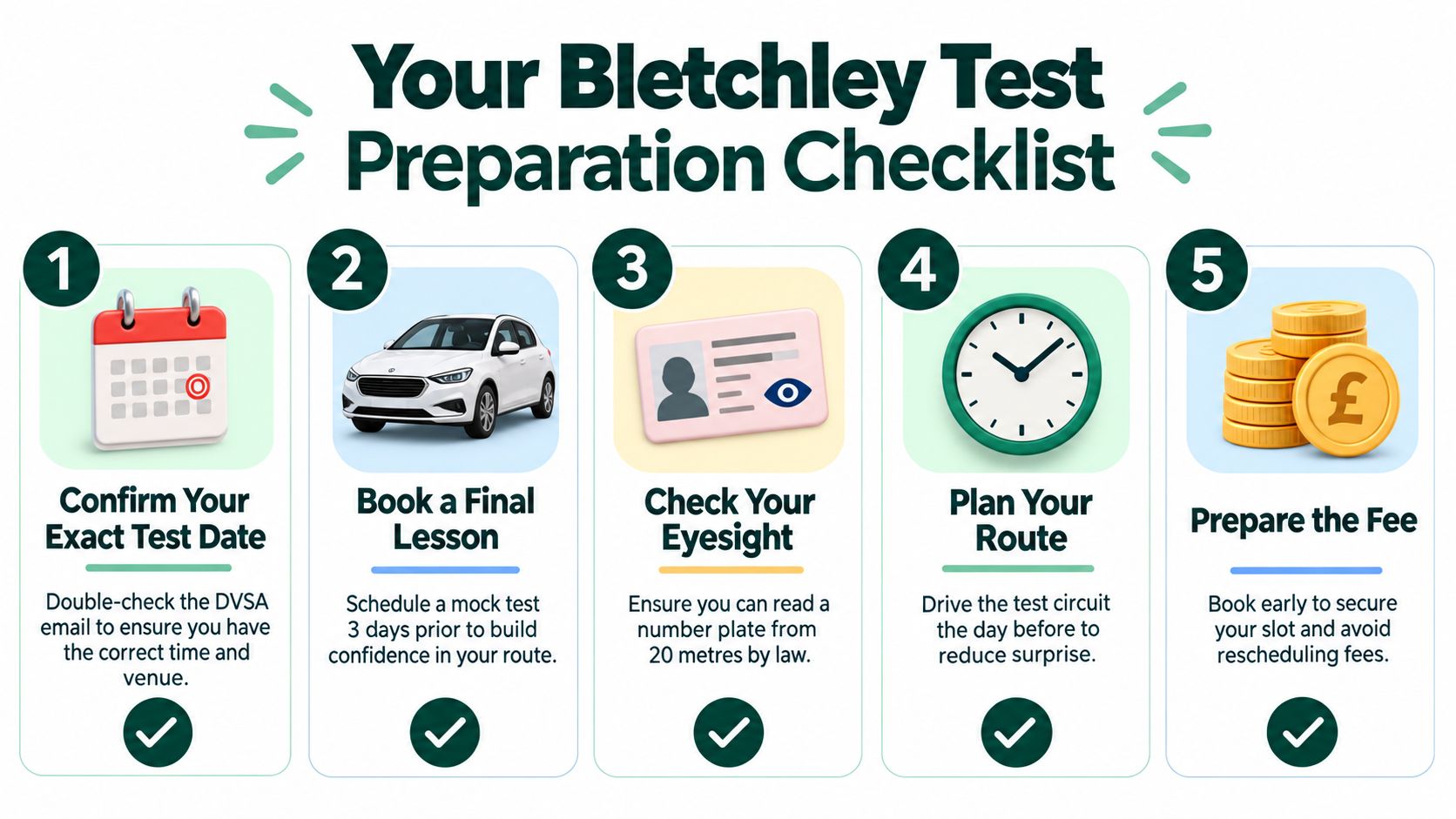
Your Bletchley Test Preparation Checklist
Use the final weeks to control the parts that are within your control. You can't choose the traffic, examiner or candidate mix behind a centre-level percentage, but you can verify the venue, practise varied roads and decide whether your mock performance supports taking the test.
- Confirm the booking: Check the DVSA confirmation for the exact date, time and address.
- Plan local practice: Include residential roads, larger junctions, roundabouts and independent driving.
- Book a realistic mock: Ask for minimal prompting and a clear go-or-no-go assessment.
- Review recurring faults: Fix patterns in observation, positioning, speed or control rather than collecting new route memories.
- Check cancellation risk: Understand the 10-working-day rule before accepting a different appointment.
- Arrange the vehicle and journey: Confirm instructor cover, documents, arrival arrangements and transport after the test.
A final refresher can help settle nerves, but it can't replace readiness built over time. If your instructor still needs to intervene for safety, treat that as useful evidence and adjust the booking rather than hoping the test route will be kinder.
Fast Track Driving Lessons matches learners with DVSA-approved instructors for intensive and semi-intensive tuition, including manual and automatic lessons, local mock tests and support with practical test scheduling. If you want a structured Bletchley preparation plan built around your availability and readiness, visit Fast Track Driving Lessons and arrange your next step.
Written by Fast Track editorial team.