
The most common advice on intensive driving courses is backwards. People ask whether they're faster, when the key question is whether the course is timed to a DVSA test slot you can use. If the lessons finish and the test is still weeks away, you've bought a burst of progress with a long gap in the middle, and that's when confidence and control start to slide.
In the UK right now, timing is the whole game. The National Audit Office reported an average practical car test wait of 22 weeks in Great Britain in September 2025, with 70% of permanent test centres at the 24-week maximum, and DVSA not expecting a return to a seven-week target until November 2027 (NAO and driving test waiting times). That doesn't make intensive courses pointless. It means they only make sense when the course is built backwards from the booking, not forwards from wishful thinking.
Table of Contents
- Why This Question Is Really About Timing, Not Speed
- What Intensive and Semi Intensive Courses Actually Mean
- The Bottleneck in 2026 Is the Test Appointment
- Honest Pros and Cons of Intensive Driving Courses
- What Decides Whether an Intensive Course Works
- Cost vs Time Trade Offs for Different Learner Types
- Matching the Course Format to Your Learner Profile
- A Practical Decision Checklist Before You Book
Why This Question Is Really About Timing, Not Speed
A lot of learners think an intensive course is a shortcut. It isn't, not in the way people imagine. The driving skill still has to be learned, absorbed and repeated, but the course format changes when that learning happens, not whether it happens at all.
The bottleneck is the appointment, not the lesson
If you've already got decent control and you're close to test standard, an intensive block can be sensible because it keeps everything fresh. The trouble starts when people book lessons first and leave the test date hanging. By the time the slot arrives, the sharpness they built in a short burst can have faded, especially if there's no structured practice in between.
That's why the smartest question isn't “Are intensive driving courses worth it?” It's, “Can I line this course up with a real test date, in my area, at the point I'm ready?” In a backlogged system, that matters more than the number of hours packed into a week.
Practical rule: if the test date isn't known, the course plan isn't really finished.
For a broader look at what learners are dealing with on the booking side, see the guide on driving test waiting times and what to expect. The key point is simple, the backlog sets the rhythm now, not the school brochure.
A sensible intensive booking is one that finishes close to the test, with enough breathing room to settle nerves but not enough time for skills to go stale. Anything else is just paying to sit on progress.
What Intensive and Semi Intensive Courses Actually Mean
These labels get thrown around loosely, so let's strip them back to plain English. An intensive course is a concentrated block of lessons over a short period, usually aimed at getting a learner from their current level to test-ready quickly. A semi-intensive course spreads the same idea over a little longer, so the pace is still brisk but less punishing.
The three formats in real-world terms
An intensive course is usually the closest thing to a driving boot camp. A semi-intensive course is more manageable for most adults because it gives your brain time to catch up between sessions. Weekly lessons are the old-school option, one or two hours at a time, often stretched over months, which suits some learners and frustrates others.
Here's the basic difference:
| Format | Total Hours | Typical Duration | Weekly Commitment | Best For |
|---|---|---|---|---|
| Intensive | 30 to 45 hours | 1 to 2 weeks | High, daily driving | Near-ready learners with a booked test |
| Semi-Intensive | 20 to 30 hours | 2 to 4 weeks | Moderate, several sessions a week | Learners who need pace without overload |
| Weekly Lessons | Varies | Several months | Low, 1 to 2 hours a week | True beginners and anxious learners |
A course page may look neat, but the wording on the website doesn't always match what happens on the road. Some providers sell fixed-hour blocks, others wrap that in a guaranteed-pass style promise, and those are not the same thing. Fixed hours give you a clear amount of tuition. A promise about passing is a different claim entirely, and you should treat it with caution.
If you want a practical example of how a semi-intensive format is presented, this semi-intensive driving lesson structure shows how shorter bursts can be packaged without pretending every learner needs the same speed.
The number on the brochure is not the same thing as the number of usable hours behind the wheel. Ask what's included, what happens if you need more, and whether the course can actually finish near your test date.
The Bottleneck in 2026 Is the Test Appointment
The course block is only half the job. The other half is getting a practical test slot when you need it. DVSA's public data shows how the wait has stretched, with the average car practical-test wait rising from 16.1 weeks in March 2024 to 21.9 weeks in March 2025 (DVSA driving test data). The National Audit Office then reported 22 weeks in Great Britain in September 2025, and said 70% of permanent test centres were at the 24-week maximum (NAO waiting times).
What that does to an intensive course
If you cram lessons into a short block and the test sits far away, the point of the course starts to disappear. Skills go stale. Nerves come back. You then pay for extra refreshers to bridge the gap, which is exactly the waste most learners are trying to avoid.
The DVSA also said the wait in April 2026 was 22.7 weeks in England, 22.9 weeks in Scotland and 17.3 weeks in Wales, and it recorded 64,500 no-shows out of 1,998,608 booked tests in 2024, or 3.2% wasted capacity (DVSA appointments guidance). That is why course value depends on matching training to the booking, not just on packing in more hours.
For learners outside the UK, the same logic still applies. A guide like how to book an Ontario driving test makes the same point clearly, secure the appointment first, then work backwards from it.
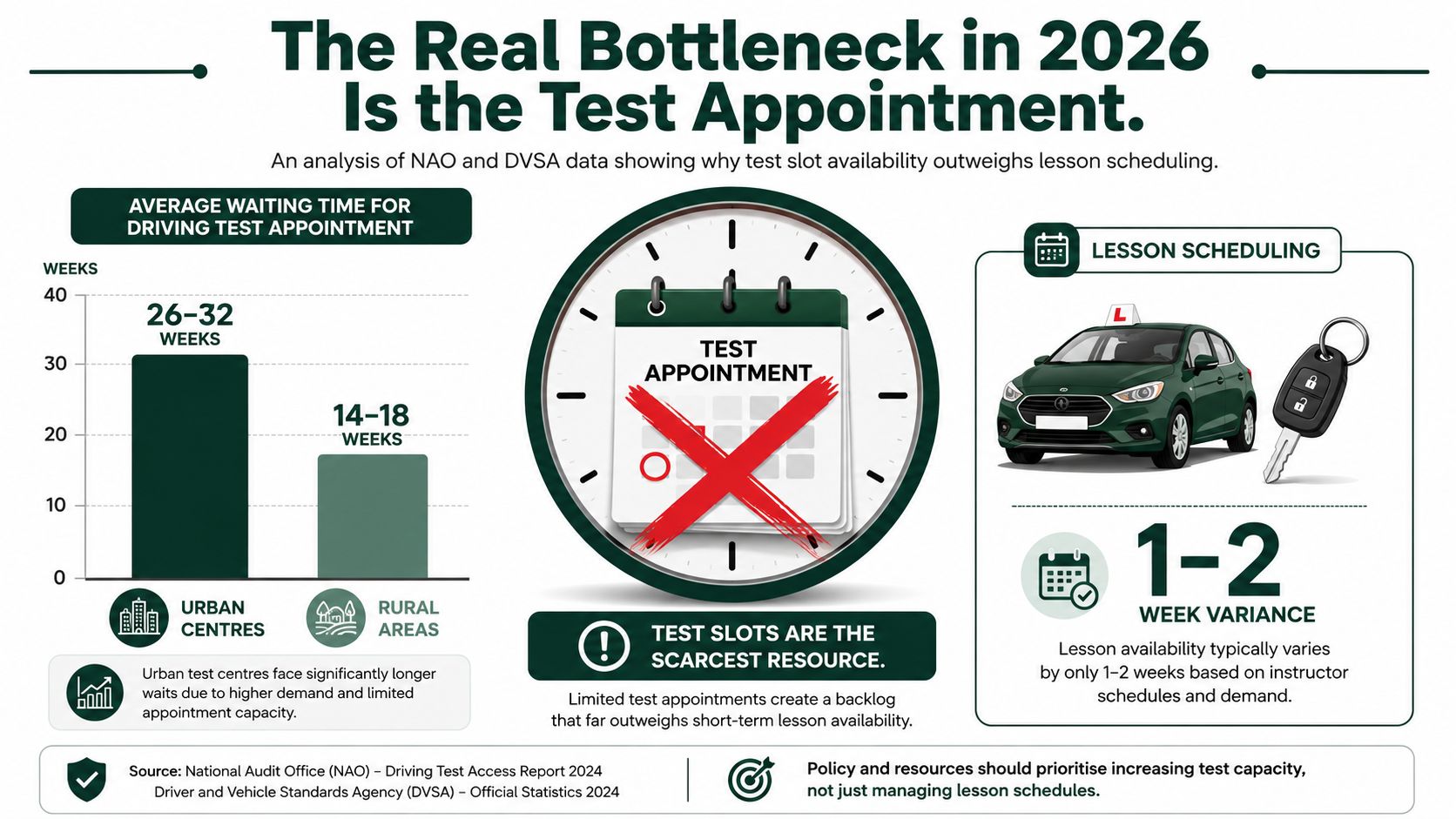
Best use of an intensive course: book the test first, then schedule the tuition so it ends close to the date. If the test is not near, the course is not an intensive finish. It is just expensive practice.
Honest Pros and Cons of Intensive Driving Courses
The upside of intensive tuition is real, but so are the trade-offs. This isn't a miracle format, and it doesn't suit every learner. It works well when the driver is already close to test standard and needs concentrated polishing, not basic instruction from scratch.
The good part
The strongest benefit is momentum. You don't spend days forgetting the last lesson or rebuilding confidence after a long gap. You also get quicker feedback, because the next drive comes soon after the last mistake, and that helps a competent learner tighten up fast.
It can also suit people with deadlines. If you need to be ready for work, relocation or family reasons, a short block is often the only practical way to build a plan around a real date. For some learners, that alone makes the format worth considering.
The part people ignore
The downside is fatigue. Long sessions can blur together, and once a learner gets tired, attention drops and habits get sloppy. That's particularly rough for people who already struggle with nerves, because the pressure of “I must pass this week” can make every mistake feel heavier than it should.
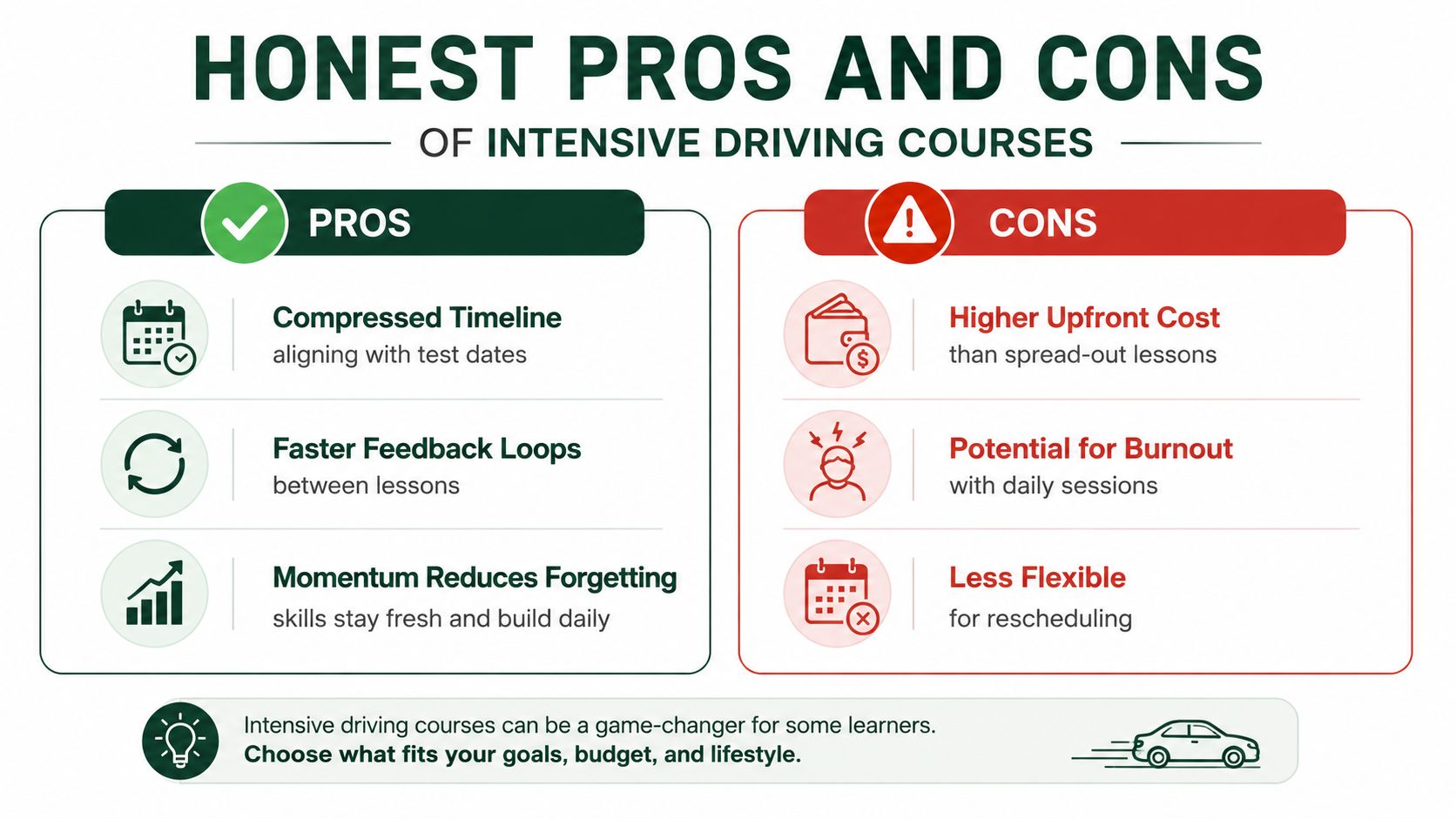
The other problem is simple, if you're not near-ready, the course exposes gaps rather than fixing them quickly. A learner who still needs to sort out clutch control, basic hazard judgement or calm decision-making won't benefit from being rushed. They need repetition, not compression.
The point is not that intensive tuition is bad. It's that it's unforgiving. If you're ready, it can sharpen you. If you're not, it can just make the weak spots more obvious.
Here's a blunt way to think about it, too many learners are trying to buy confidence with time pressure. That doesn't work. Confidence comes from enough correct repetition, then a test date that lands while the habit is still live.
Video for learners weighing the pace against the pressure:
What Decides Whether an Intensive Course Works
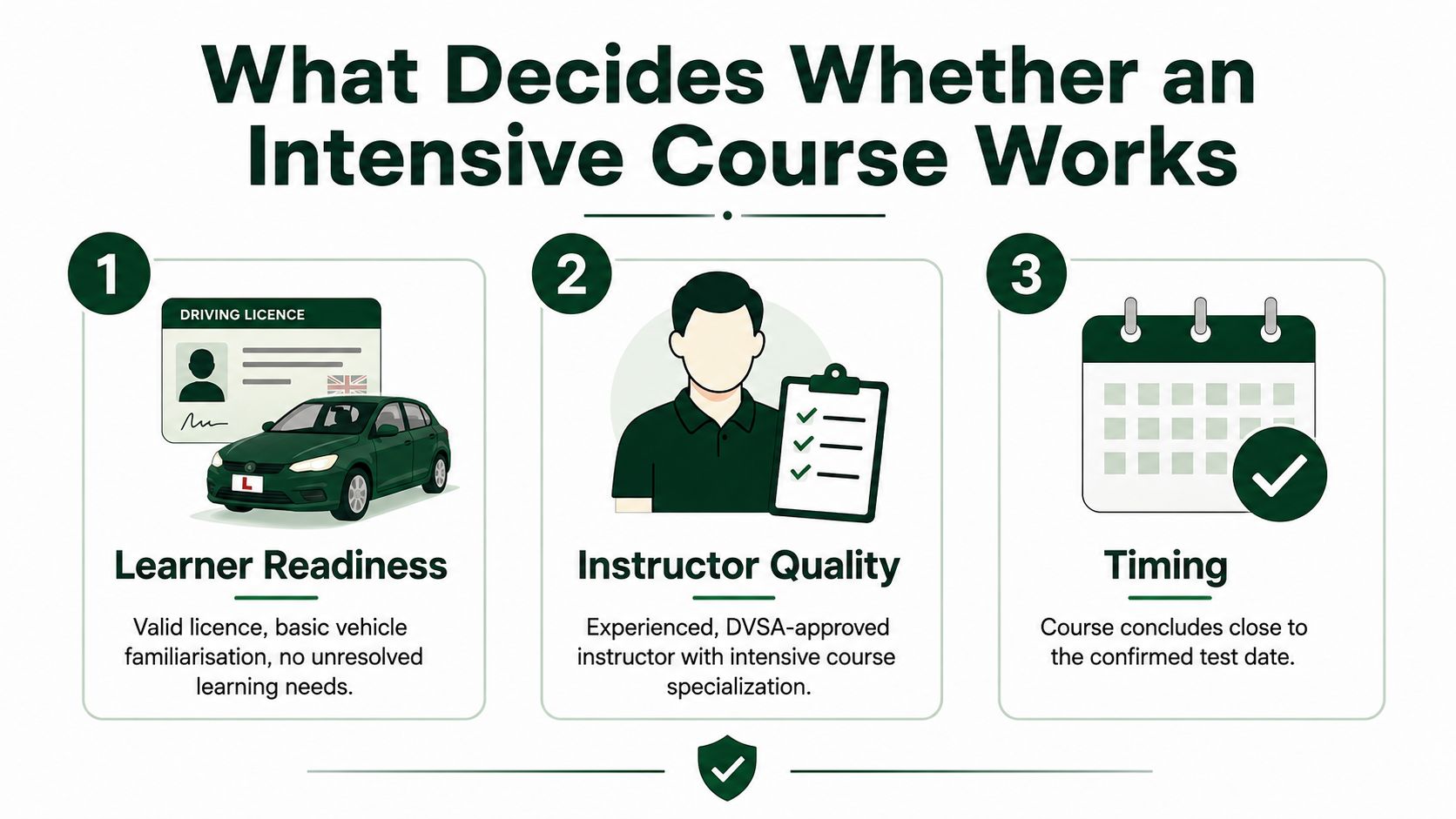
Three things decide whether the course converts into a pass, readiness, instructor quality, and timing. Miss one of them and the whole thing can wobble. Get all three right and the format can work very well.
Check the learner, not just the brochure
Start with your own level. If you still need to ask basic questions on every drive, you're not a strong candidate for a packed course. If you can already handle a route, manage roundabouts, and recover from small errors without freezing, you're closer to the right point.
Ask yourself these questions before paying anything:
- How many hours have I already driven? If the answer is “hardly any”, don't pretend you're near-ready.
- Can I drive a 30-minute route without constant prompting? If not, you probably need more foundational work.
- Have I passed my theory test? If not, fix that first.
- Can I deal with feedback without shutting down? Intensive tuition is direct, and it has to be.
Make the instructor do real work
A good instructor doesn't just fill the diary. They structure the course, judge readiness, and refuse to send you to test if you're not safe. That's not being awkward, it's doing the job properly. You want someone who can explain what each hour is for, not someone who just sells blocks.
For learners trying to understand the difference between practice that sticks and practice that just feels busy, the piece on effective skill development strategies is a useful read. It lines up with the practical reality, repetition only matters if it's targeted.
A decent instructor will say “not yet” if the test date is wrong or your control is still patchy. That honesty saves money.
If you're comparing training models and want a straightforward provider example, Fast Track Driving Lessons matches learners with DVSA-approved instructors for intensive and semi-intensive tuition across England, Scotland and Wales.
Cost vs Time Trade Offs for Different Learner Types
Money talk gets messy because learners compare the headline course price without asking what they need. The cost is not just the block you buy, it's the block plus any extra lessons caused by poor timing, unfinished basics or a delayed test slot. The right format depends on how much driving you already have in the bank.
Different profiles, different economics
A true beginner often needs more support, which means an intensive package can become expensive if it's used too early. A near-ready learner gets the best deal because the course is doing finishing work, not starting from scratch. Automatic-only learners and returning drivers often sit somewhere in the middle, and they can do very well if their main issue is confidence rather than raw control.
| Learner Profile | Typical Hours Needed | Intensive Course Cost (£) | Weekly Course Cost (£) | Approx. Time to Test |
|---|---|---|---|---|
| Complete beginner | 35 to 45 | Higher if extra hours are needed | Usually spread out, easier to top up | Several months |
| Near-ready candidate | 20 to 30 | Often the cleanest fit | Can drift longer than needed | Shorter, if a slot is secured |
| Automatic-only learner | 20 to 30 | Efficient if clutch work is the main barrier | Similar hours, slower pace | Depends on booking |
| Returning refresher driver | 10 to 25 | Strong value if skills are rusty, not missing | Can be too slow for urgent needs | Short to moderate |
The biggest money trap is buying a course before you know how close the test is. If the slot slips, you may need extra lessons just to stay sharp. That's why the course can look cheaper on paper and still cost more in practice.
If you want a pricing reference for how a school can present fixed rates and clear terms, see the pricing structure here. The important part isn't the number alone. It's whether the course size, the test date and your current ability all point in the same direction.
My take: near-ready learners and returning drivers usually get the clearest return. Complete beginners should be cautious and avoid paying intensive money for basic control they haven't built yet.
Matching the Course Format to Your Learner Profile
Many learners make the wrong call. They choose the format they'd prefer in theory, not the one their level supports. The better approach is to match the course to the learner profile, then make the schedule serve that choice.
Pick the format that fits the person, not the fantasy
A full beginner usually does better with weekly lessons first, then a short intensive block later if they're progressing well. A near-ready learner can often jump straight into semi-intensive or full intensive tuition, provided the test date is already in view. An automatic-only candidate often benefits from compression because there's less mechanical load, so the hours can focus on observation and judgement.
A returning refresher driver is often one of the best fits for intensive tuition, because they're not relearning everything from scratch. An anxious adult usually needs a gentler start, and forcing daily long sessions can backfire. A shift worker with awkward availability may prefer semi-intensive because it keeps momentum without demanding a full week off.
| Learner Profile | Recommended Format | Typical Hours | Indicative Cost (£) |
|---|---|---|---|
| Full beginner | Weekly lessons, then reassess | Higher overall | Variable |
| Near-ready after weekly lessons | Intensive or semi-intensive | 20 to 30 | Moderate to higher |
| Automatic-only candidate | Semi-intensive | 20 to 30 | Moderate |
| Returning refresher | Intensive or semi-intensive | 10 to 25 | Lower to moderate |
| Anxious adult | Weekly lessons, then short consolidation block | Varies | Variable |
| Shift worker | Semi-intensive | 20 to 30 | Moderate |
The wrong fit is easy to spot. If a learner has no meaningful time behind the wheel, no test standard and a lot of anxiety, an intensive booking can become a panic purchase. If they already drive well and just need a concentrated finish, the same format can be a neat solution.
When I'm being blunt with learners, this is the dividing line. Intensive is for converting ability into a pass. Weekly is for building ability in the first place. Semi-intensive sits in the middle and saves a lot of people from overcommitting.
A Practical Decision Checklist Before You Book
Before you hand over a deposit, check the basics. If the answers don't line up, don't force it. A bad booking is more expensive than a delayed booking, because rushed tuition usually means extra hours later.
Your go or no-go test
Use this list before you commit:
- Confirmed test slot: Don't book intensive tuition unless you have a real DVSA test date or a solid cancellation plan.
- Recent driving practice: You need enough recent behind-the-wheel time for the course to build on, not restart from zero.
- Instructor credentials: Check the instructor's DVSA registration and grade, and ask who will teach you.
- Written hour breakdown: You should know what each hour covers and how the course is structured.
- Refund or cooling-off terms: Read the cancellation wording before you pay, not after.
If the test slot is under six weeks away and you're already test-ready or near-ready, intensive tuition makes sense. If there's a gap to bridge, semi-intensive is usually the smarter move. If you're a true beginner, have more than six months before your test, or can't commit to regular daily driving, choose weekly lessons.
That rule is plain, but it saves money. It also stops people from buying a format that suits the marketing copy more than their actual situation.
Fast Track Driving Lessons offers intensive and semi-intensive tuition with DVSA-approved instructors, fixed hourly pricing and clear course structure, which makes it a sensible option when your test booking and your skill level are both lined up. If you're weighing up the right format for your own timing, take a look at Fast Track Driving Lessons and compare the course blocks against your current readiness before you pay a deposit.
Written by Fast Track editorial team.