
You've booked a 10-hour driving course because your test is coming up, or you're returning to driving after a long gap. It sounds like a substantial amount of time in the car. Then you check the practical test availability and discover that your appointment may be weeks or months away. The concern is reasonable: what happens if you finish the lessons, then lose your sharpness before test day?
Ten hours can be useful, but it isn't a universal shortcut. For some learners, it's enough time to correct faults, practise test routes and build consistency. For others, it only covers the foundations. In 2026, the most important question often isn't whether 10 hours is enough. It's whether those hours are scheduled close enough to the practical test to remain useful.
Table of Contents
- Where a 10-Hour Driving Block Actually Fits
- What Happens Across 10 Hours in the Seat
- Who 10 Hours Suits and Who It Leaves Behind
- Why More Hours Are Not Always the Answer
- Aligning 10 Hours with Actual Test Waiting Times
- What 10 Hours Really Costs Once You Add Everything In
- Is a 10-Hour Block the Right Move for You
Where a 10-Hour Driving Block Actually Fits
A learner called Sam might book an intensive course after passing the theory test. Sam has driven before, feels comfortable with steering and gears, and wants a concentrated push towards the practical test. The lessons go well, but the first available appointment is far away. By the time test week arrives, Sam remembers the manoeuvres but hesitates at roundabouts and needs reminders to scan properly.
That situation is becoming easier to understand when you look at the DVSA's current figures. In Great Britain, the August 2026 median wait from booking to taking a car practical test was 11.1 weeks, according to the DVSA update on driving test waiting times. The older availability-based measure was 20.2 weeks, while only 11.8% of appointments were available to book at the point measured. The same dataset reported that 143 test centres still showed a 24-week wait by 27 July 2026.
Those measures describe different parts of the booking picture, but they point to the same practical problem. A 10-hour block can finish long before the test date, leaving you with a choice between paying for more lessons later or arriving less prepared than you were at the end of the course.
The useful unit isn't just ten hours. It's ten hours placed in the right preparation window.
A 10-hour intensive course is best understood as a condensed programme, not a magic shortcut. It may be a sensible refresher for someone who already has road experience, or a focused final course for a learner with only a few specific gaps. It's rarely a complete beginner's route from first sitting in the driver's seat to safe, reliable test standard.
The scheduling needs to match the purpose. If you're using the block to rebuild confidence, you may spread it across a short period so each lesson can reinforce the previous one. If you're preparing for a booked test, you'll usually want the most demanding work, including mock tests and unfamiliar routes, close to the appointment.
A course provider should discuss your current ability and test date before treating 10 hours as the right answer. If they promise a pass without assessing your driving, be cautious. An experienced instructor will tell you whether the block is likely to polish existing skills or merely introduce areas you'll still need to practise.
What Happens Across 10 Hours in the Seat
A realistic 10-hour block should build from control to decision-making. The order matters because you can't safely handle complex junctions if moving away, steering or braking still takes all your attention.
| Hour | Focus | Skills Practised |
|---|---|---|
| 1 | Settling into the car | Cockpit checks, mirrors, moving away, stopping and basic control |
| 2 | Quiet roads | Steering accuracy, gear choice, speed control and simple junctions |
| 3 | Basic road decisions | Turning, meeting traffic, routine observations and emerging safely |
| 4 | Busier junctions | Roundabouts, pedestrian crossings and signal-controlled junctions |
| 5 | Traffic flow | Junction planning, lane discipline and dealing with heavier traffic |
| 6 | Faster roads | Dual carriageways, joining safely and maintaining appropriate speed |
| 7 | Space and pace | Following distance, speed management and hazard awareness |
| 8 | Independent driving | Unfamiliar routes, sat-nav instructions and making safe decisions |
| 9 | Mock test | Examiner-style drive, faults, decision-making and an honest debrief |
| 10 | Final polish | Show-me tell-me questions, bay parking and the most persistent weaknesses |
Hours one to three build the base
The first lesson should establish how you operate the particular car. You'll check the seating position, controls, mirrors and safety systems before moving away and stopping. In a manual car, the instructor will watch clutch control, steering coordination and gear selection. In an automatic, the focus may move more quickly towards observation, positioning and smooth speed changes.
Quiet roads give you room to practise without overloading your attention. You'll work on meeting traffic, emerging at junctions, turning left and right, and keeping a stable road position. The instructor isn't just teaching a sequence. They're helping you understand why a slower approach, an earlier mirror check or a better view can change the safety of the whole manoeuvre.
Hours four to seven add pressure
Roundabouts, pedestrian crossings and busier junctions expose weaknesses that quiet residential roads can hide. You need to read signs, choose the correct lane, judge gaps and respond to other road users without waiting for constant prompts.
The faster-road work then raises the consequences of poor planning. Dual carriageways require better joining decisions, speed control and following distance. You'll practise looking further ahead so you aren't forced into harsh braking or late lane changes.
Hours eight to ten test consistency
Independent driving is more than following a sat-nav instruction. You'll need to understand the instruction, plan your route and continue observing while making decisions. An unfamiliar road can reveal whether you've learned a transferable skill or memorised one local route.
The mock test should be uncomfortable in a useful way. The debrief identifies repeated faults, not every tiny imperfection. The final hour can then target bay parking, show-me tell-me questions, awkward junctions or whatever still needs work.
A block like this may leave some areas untouched. Night driving, motorway driving and broader independent experience may need separate practice, particularly where the learner has no access to a supervising driver. Ten hours should have a defined job, and that job shouldn't be disguised as complete driving education.
Who 10 Hours Suits and Who It Leaves Behind
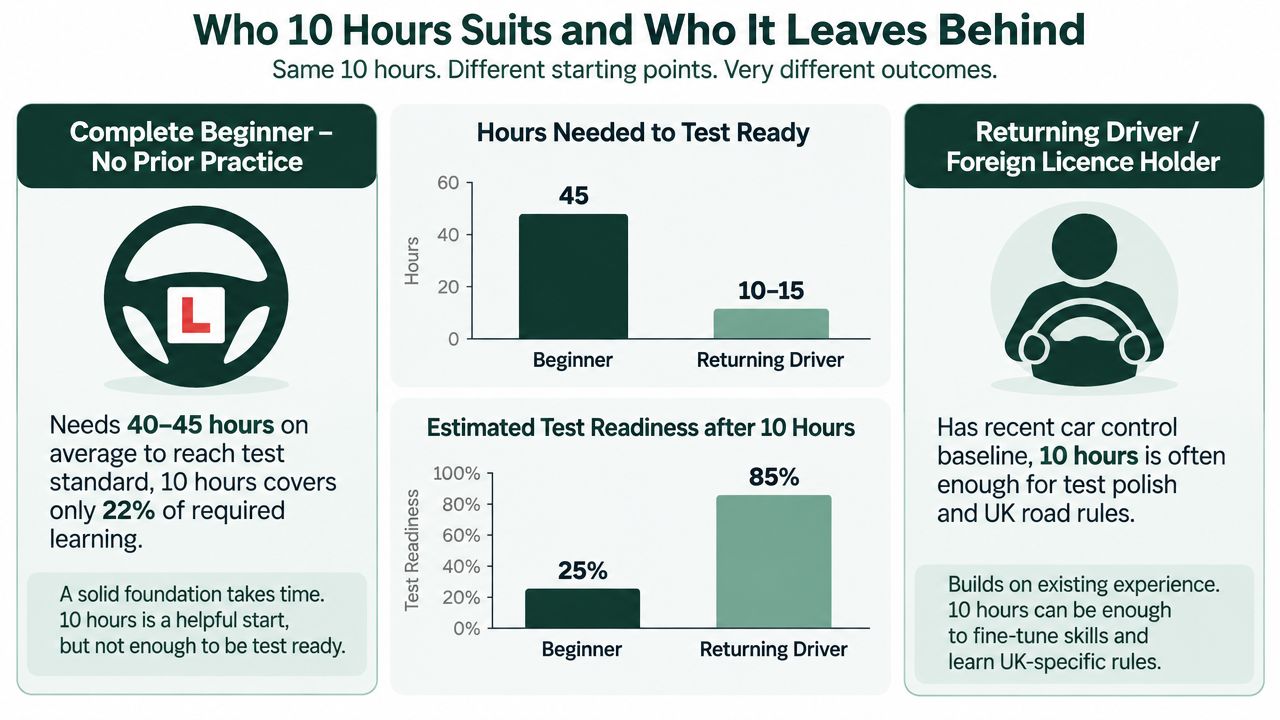
A complete beginner and a returning driver may both book 10 hours, but they aren't buying the same learning experience. The beginner is still building vehicle control, road awareness and confidence at the same time. The returning driver may already understand how a car behaves and need help adapting to UK rules, local junctions or the practical test format.
Independent UK driving-school guidance places complete beginners at around 30 to 45 hours of professional instruction, while learners with previous experience may need around 20 to 25 hours. These are broad guidance figures, not a pass guarantee, but they show why a 10-hour block is normally a targeted option rather than a full beginner programme. See the UK guidance on using an intensive course for that comparison.
The beginner's starting point
A complete beginner may spend the early sessions learning to move off, stop, steer and coordinate the pedals. That's essential work, but it leaves less time for roundabouts, independent driving and mock-test performance. Nervous beginners can progress steadily, but they often need repetition across different days and traffic conditions rather than one compressed burst.
The gap grows if there's no suitable car or supervising driver for private practice. You may understand an instructor's explanation during the lesson, then need to relearn the same process at the next session because you haven't practised it between visits.
The returning driver's advantage
A driver who has recently driven, holds a foreign licence or has substantial road experience may use the block differently. The instructor can identify UK-specific habits, improve observation, practise manoeuvres and assess test-standard decision-making instead of spending every hour teaching basic control.
That doesn't make 10 hours automatically sufficient. A returning driver who hasn't cracked roundabouts, bay parking or safe independent driving still has a meaningful skills gap. The right question is whether the learner can perform core tasks without frequent prompts, not whether they once held a licence.
Why More Hours Are Not Always the Answer
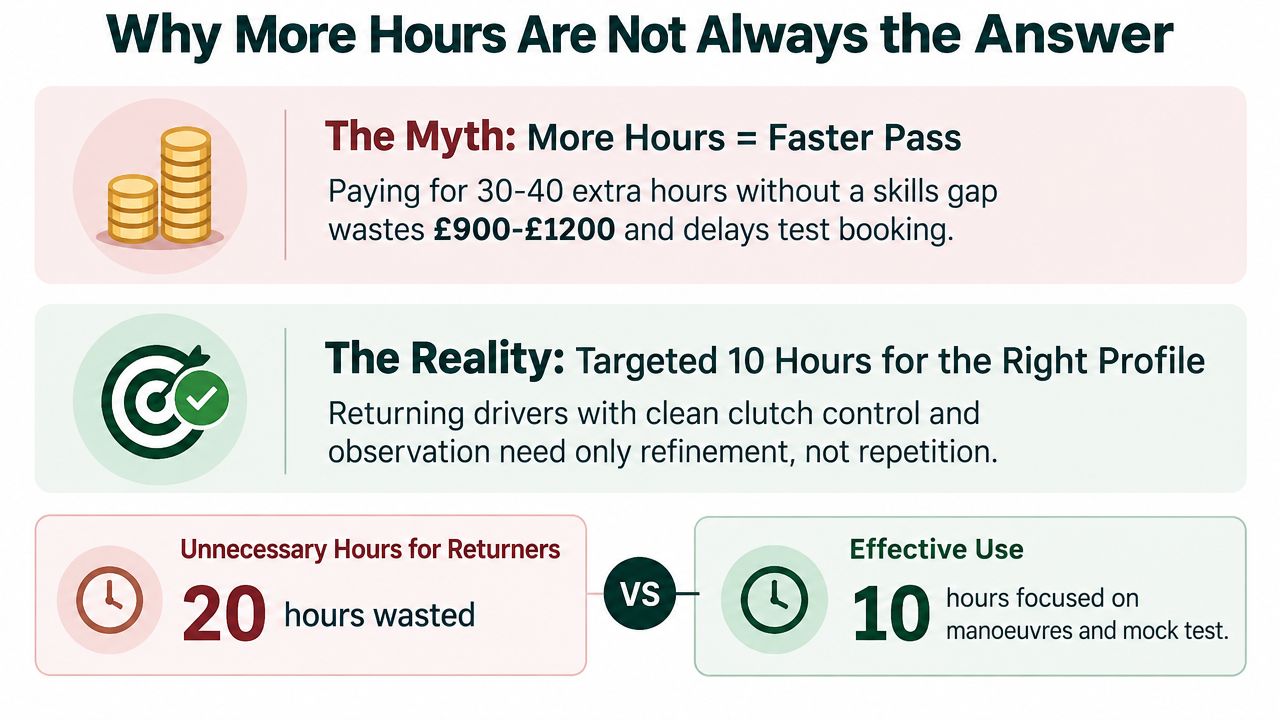
More tuition can help, but more tuition without a clear purpose can become expensive repetition. A returning driver with reliable clutch control may gain little from spending lesson after lesson on moving away, while a beginner may need far more than 10 hours before complex traffic feels manageable.
Long intensive days can also create a misleading impression of progress. You may perform well during the morning, then make avoidable observation or judgement errors when tired. Fatigue makes it harder to absorb feedback, and an instructor may need to shorten or reshape a session rather than push through the planned timetable.
Start with the skills gap
Before buying extra hours, check what goes wrong. A learner who controls the car smoothly but misses mirror checks needs different tuition from someone who stalls at every junction. One may need coached observation and independent planning. The other needs foundational coordination and more time in low-pressure situations.
Use these questions as a practical self-check:
- Recent practice: Have you driven regularly enough for basic actions to feel familiar?
- Car control: Can you move off, stop, steer and change speed without waiting for prompts?
- Roundabouts: Can you choose a lane, approach at a safe speed and respond to traffic independently?
- Manoeuvres: Can you complete bay parking and reversing while maintaining proper observations?
- Theory readiness: Have you passed the theory test and understood the hazards it assesses?
A plateau often means the method needs changing, not that you need a larger package. Sometimes shorter lessons, clearer goals or supervised practice between sessions will do more than adding hours to an unfocused block.
For a useful comparison of how concentrated tuition differs from regular weekly lessons, read this guide to intensive courses and weekly lessons. The important decision is not “how many hours can I buy?” It's which hours should come first, and what must each one achieve?
Aligning 10 Hours with Actual Test Waiting Times
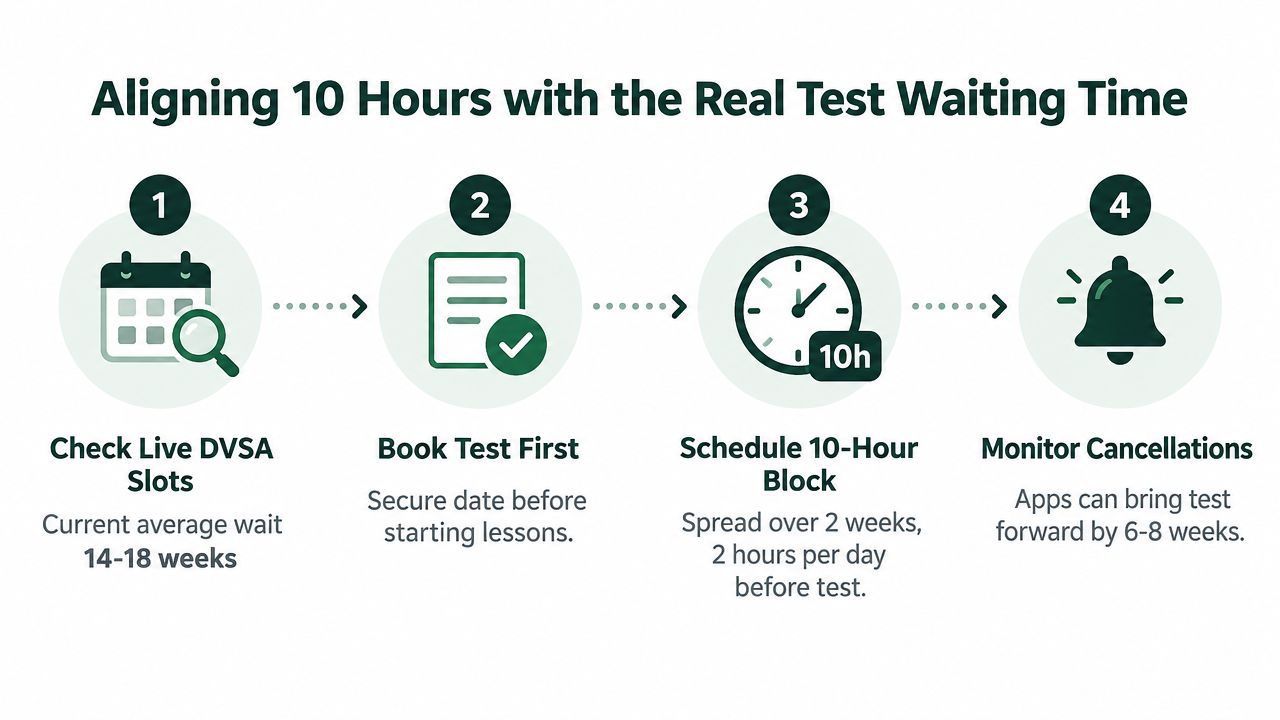
A practical test may be months away, while your ten lesson hours can be finished in a fortnight. Planning works best when you start with the test date and work backwards. In Great Britain, the DVSA reported that half of learners taking a car practical test in August 2026 waited no more than 11.1 weeks from booking to test, as explained in its clearer explanation of waiting-time measures. Waiting times differ between test centres, so another learner's experience may not match yours.
Secure the date before fixing the lessons
Check that your theory test result and certificate details are available. Then use the official booking service to find a suitable practical test date before arranging every lesson in a narrow period. The appointment gives your practice a clear target, but choosing an early date does not make you ready for it.
A learner with a solid skill base might place the ten hours across roughly 10 to 14 days before the test, leaving space to rest and correct small faults. A less experienced learner may need instruction earlier, followed by a shorter final refresher. Ten hours near the test can sharpen existing skills, but it cannot replace the longer process of learning traffic judgement, independent planning and consistent car control.
Cancellations sometimes make an earlier appointment available, although they need careful checking. As of 12 May 2026, only learners can book, change, swap or cancel car driving tests. The DVSA says third parties, including instructors and cancellation services, act unlawfully when they do this for another person, and it has cancelled 450 tests booked using payment cards linked to multiple learners. Read the DVSA notice about learner-only test changes before using a cancellation service.
Leave some breathing room after the final lesson. If that drive reveals a serious weakness, you need time to work on it rather than arriving at the test hoping it will disappear. Check the cancellation rules as soon as you book. For a car test in Great Britain, you must give 10 full working days' notice to change or cancel without losing the fee. Monday to Saturday count as working days, while Sundays and public holidays do not, according to the official guidance on changing a driving test.
Check the official service yourself, especially during school holidays and other busy periods when demand and instructor availability may become tighter. This guide to driving test waiting times explains how the timing can affect lesson planning, but the DVSA booking service is where you manage the appointment.
If an unavoidable problem means cancelling at short notice, have your UK driving licence number and either the driving test reference number or theory test pass certificate number ready. DVSA may also request evidence, such as a medical certificate, police crime reference or school exam letter, as set out in the official cancellation guidance.
What 10 Hours Really Costs Once You Add Everything In
The package price is only one part of the budget. You may also need the practical test fee, use of the instructor's car, extra tuition if the assessment exposes a weakness, and time away from work or college. A cheap headline package can become less cheap if it excludes the final test drive or leaves no room for top-up lessons.
UK learner-cost guidance places lesson prices commonly around £35 to £40 an hour nationally, with regional examples ranging from £28 to £33 up to £45 to £60 in London. DVSA practical test fees are £62 on weekdays and £75 during evenings, weekends and bank holidays, according to this UK breakdown of learning-to-drive costs.
Because prices vary by instructor, area and package terms, the table below shows what to include rather than pretending there's one national total.
| Cost Item | Best Case | Typical | Worst Case |
|---|---|---|---|
| 10-hour lesson block | The advertised package price | The local hourly rate multiplied by 10 | A higher regional or specialist rate |
| Practical test fee | Weekday booking | A suitable available appointment | Evening, weekend or bank-holiday booking |
| Instructor's car | Included in the course | Charged separately for the test | Charged separately, with an additional pre-test lesson |
| Top-up lessons | None | One or two hours for a weak area or nerves | Further tuition after an unsuccessful assessment |
| Theory test | Already passed | Still needs booking if outstanding | Additional preparation and a later booking if unsuccessful |
| Time and travel | Fits around existing plans | Time off work, college or caring duties | Repeated travel and rearranged appointments |
| Private practice | Access to a suitable supervised car | Fuel and running costs | No private car, so more paid tuition is needed |
The best-case column isn't a promise. It describes a learner whose skills are already stable, whose package includes the test vehicle and who needs no extra tuition. The worst-case outcome isn't inevitable either, but it's the risk you should understand before paying.
Ask whether the package includes the test-day car, mock tests, cancellation support, instructor replacement arrangements and a clear refund policy. Ask too whether the instructor is an approved driving instructor or a trainee, and whether manual and automatic tuition have different prices.
The real cost guide to learning to drive is useful for building a complete budget rather than comparing package labels alone. A written quote should separate lesson charges from DVSA fees paid directly to the government.
Is a 10-Hour Block the Right Move for You
A 10-hour block makes the most sense when timing, ability and budget point in the same direction. If one of those is missing, a different plan may protect your money and your confidence.
You're more likely to benefit if you can already move off, stop and steer without regular prompts, have some recent private or professional practice, and have a practical test booked within a manageable preparation window. It also helps if you're comfortable with basic manoeuvres and can identify the particular areas that still let you down.
The opposite signs matter just as much. If you've never driven before, still confuse the pedals, or haven't yet learned how to approach roundabouts, 10 hours may be too narrow a course. If your test is far away and you have no access to private practice, finishing all the lessons early could leave you needing another block later.
Use this self-check honestly
- Control: You can move off, stop and steer confidently without instructor prompts.
- Licence background: You hold a foreign licence or passed a test abroad within the last five years.
- Previous test: Your last test was three to six months ago and involved only minor faults.
- Private driving: You've driven regularly with supervision during the recent past.
- Test performance: You failed with a small number of minor faults and need refinement rather than a complete restart.
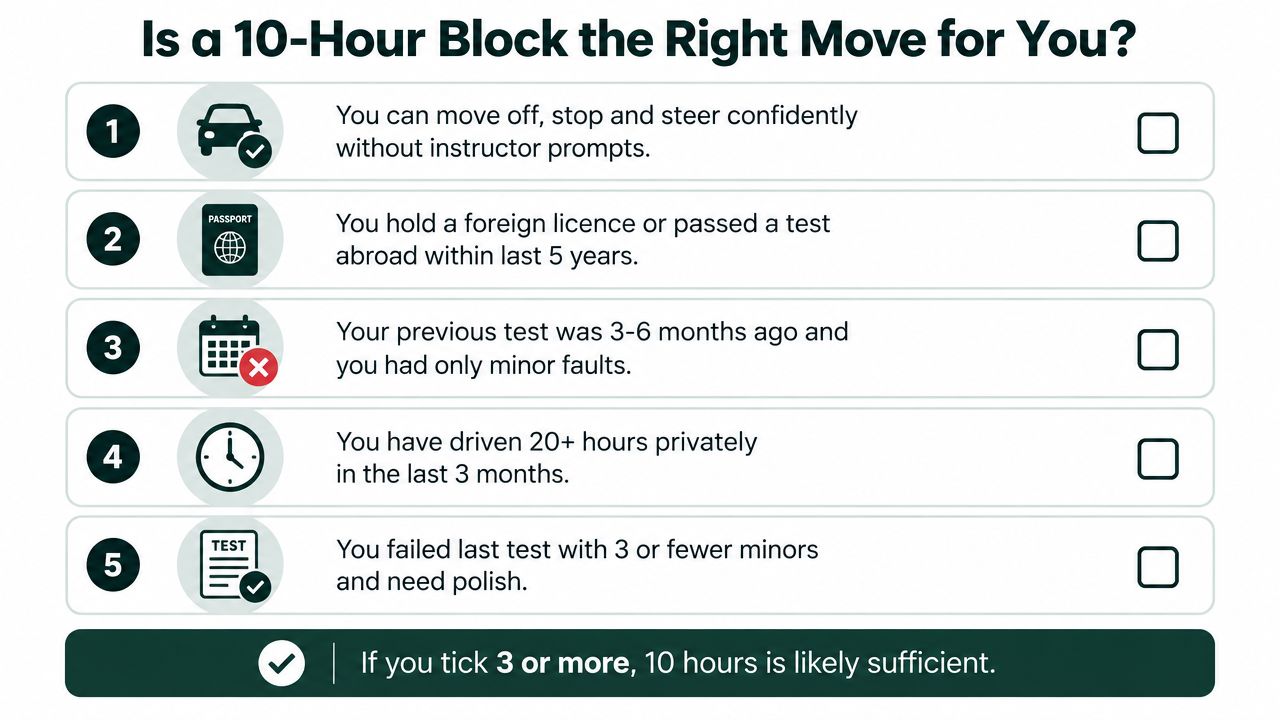
The checklist is a prompt, not a verdict. A nervous returning driver may need a slower schedule even with good technical ability, while a confident learner may still have a serious observation problem that only appears on unfamiliar roads.
If your question involves driving abroad, licence conversion or international documentation, the World Driving Permit blog offers background information that can sit alongside advice from the DVLA and DVSA. For UK test preparation, however, your instructor should assess your actual driving rather than rely on your paperwork.
Book a longer course if you're still developing the foundations. Choose a shorter refresher if your test is close and your faults are specific. If you're unsure, pay for an assessment lesson first and ask the instructor to explain exactly what 10 hours could achieve.
Fast Track Driving Lessons matches learners with DVSA-approved instructors for intensive and semi-intensive tuition across England, Scotland and Wales, with manual and automatic options, mock-test preparation and support monitoring suitable DVSA test cancellations. If 10 hours could fit your experience and test date, visit Fast Track Driving Lessons to review the available course options and arrange a plan around your actual preparation window.
Written by Fast Track editorial team.