
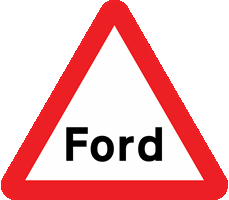
The answer options
- Bridge over road
- Water across roadCorrect
- Road ahead ends
- Uneven road surface
Why the other options are wrong
- “Bridge over road” is a distractor. It does not meet the standard the question is testing, which water across road does. Picking it in the real test costs a mark you cannot get back, and with a pass mark of 43 out of 50 you only have seven to spare.
- “Road ahead ends” is a distractor. It does not meet the standard the question is testing, which water across road does. Picking it in the real test costs a mark you cannot get back, and with a pass mark of 43 out of 50 you only have seven to spare.
- “Uneven road surface” is a distractor. It does not meet the standard the question is testing, which water across road does. Picking it in the real test costs a mark you cannot get back, and with a pass mark of 43 out of 50 you only have seven to spare.
Why that is the answer
This warning sign alerts you that there is water across the road ahead, such as a ford or shallow river crossing. When you see it, slow down and assess the depth before driving through, as deep water can flood your engine or carry your vehicle away. Official guidance advises testing your brakes gently as soon as you have passed safely through the water to ensure they are working correctly.
What road and traffic signs covers
- · Shape and colour rules for orders, warnings and information
- · Regulatory signs including no entry, no waiting and weight limits
- · Warning triangles for bends, junctions, crossings and gradients
- · Road markings: give way lines, hatching, box junctions, edge lines
Mistakes learners repeat on this topic
- · Reading a blue circle as advice rather than a compulsory instruction
- · Confusing the no-entry sign with the no-motor-vehicles sign
- · Assuming hatched areas bordered by a broken line may never be entered
- · Missing that the end-of-restriction sign returns you to the national limit, not to 30
Instructor tip: Answer from the shape first, then check the pictogram — it stops you second-guessing on the look-alike pairs.
How this comes up in the real test
Questions from road and traffic signs appear throughout the 50-question multiple-choice section, and the wording changes between versions. Learn the rule rather than the sentence: the DVSA can ask the same point from the opposite direction, and a memorised answer falls over the moment the phrasing moves.
The pass mark is 43 out of 50, so seven wrong answers is your entire margin. If a whole category is shaky, run the topic practice below until you are getting every question right for the right reason, then go back to full mocks under the clock.
More road and traffic signs questions
- A police car is following you. If a police officer gestures to go left while flashing their headlights, what should you do?
- After turning at a junction you should ensure your indicators are cancelled promptly. Why is this?
- At traffic lights, what does it mean when the amber light shows on its own?
- How can you identify traffic signs that give orders?
- How should one indicate a left turn with their arms?