
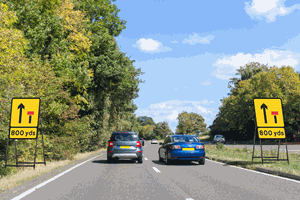
The answer options
- Traffic will not change
- Traffic will move into the left laneCorrect
- Traffic will move into the right lane
- Traffic will speed up
Why the other options are wrong
- “Traffic will not change” is a distractor. It does not meet the standard the question is testing, which traffic will move into the left lane does. Picking it in the real test costs a mark you cannot get back, and with a pass mark of 43 out of 50 you only have seven to spare.
- “Traffic will move into the right lane” is a distractor. It does not meet the standard the question is testing, which traffic will move into the left lane does. Picking it in the real test costs a mark you cannot get back, and with a pass mark of 43 out of 50 you only have seven to spare.
- “Traffic will speed up” is a distractor. It does not meet the standard the question is testing, which traffic will move into the left lane does. Picking it in the real test costs a mark you cannot get back, and with a pass mark of 43 out of 50 you only have seven to spare.
Why that is the answer
Road signs and road markings warn drivers well in advance when a right-hand lane is ending or blocked ahead. In this situation, you should expect vehicles travelling in the right lane to merge across into the left lane. Anticipating this movement allows you to ease off the accelerator and create a safe gap, rather than speeding up or assuming traffic flow will remain unchanged.
What hazard awareness covers
- · Static, moving and developing hazards and how they differ
- · Scanning, mirror use and planning your response early
- · Effects of tiredness, alcohol, drugs and prescription medicine
- · Weather, light and road-surface conditions that reduce your margin
Mistakes learners repeat on this topic
- · Choosing the reactive answer (brake hard) over the planning answer (ease off early)
- · Underestimating how long alcohol stays in the system overnight
- · Assuming a prescribed medicine cannot affect your fitness to drive
- · Treating a hazard as cleared before you have passed it
Instructor tip: If two answers both work, pick the one that acts earliest — the DVSA marks anticipation, not recovery.
How this comes up in the real test
Questions from hazard awareness appear throughout the 50-question multiple-choice section, and the wording changes between versions. Learn the rule rather than the sentence: the DVSA can ask the same point from the opposite direction, and a memorised answer falls over the moment the phrasing moves.
The pass mark is 43 out of 50, so seven wrong answers is your entire margin. If a whole category is shaky, run the topic practice below until you are getting every question right for the right reason, then go back to full mocks under the clock.
More hazard awareness questions
- A friend has given you some cough medicine. You take some and wish to drive your car, what should you do first?
- A motorcyclist has just overtaken you. What should you do if the motorcyclist sharply cuts in front of you?
- A police officer is making this signal to oncoming traffic. What does this mean?
- Before taking any medicine you should always check the leaflet. Why is this?
- Certain two-way streets have three lanes on them. Why do they pose a special risk?
- Do you need to plan rest stops when you’re planning a long journey?