
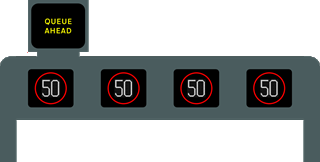
The answer options
- Only use the hard shoulder
- Pick a different lane than the hard shoulder.
- Use every lane, including the hard shoulderCorrect
- Use the three right hand lanes only
Why the other options are wrong
- “Only use the hard shoulder” is a distractor. It does not meet the standard the question is testing, which use every lane, including the hard shoulder does. Picking it in the real test costs a mark you cannot get back, and with a pass mark of 43 out of 50 you only have seven to spare.
- “Pick a different lane than the hard shoulder.” is a distractor. It does not meet the standard the question is testing, which use every lane, including the hard shoulder does. Picking it in the real test costs a mark you cannot get back, and with a pass mark of 43 out of 50 you only have seven to spare.
- “Use the three right hand lanes only” is a distractor. It does not meet the standard the question is testing, which use every lane, including the hard shoulder does. Picking it in the real test costs a mark you cannot get back, and with a pass mark of 43 out of 50 you only have seven to spare.
Why that is the answer
This sign shows that the hard shoulder is currently open as an extra traffic lane to help manage congestion. When a speed limit is displayed above the hard shoulder, you should use every lane available, including the hard shoulder. You must only avoid using the hard shoulder if a red X is displayed above it or if there is no speed limit shown above that specific lane.
What motorway rules covers
- · Joining and leaving via slip roads and matching traffic speed
- · Lane discipline and who may not use the right-hand lane
- · Red X signals, variable limits and emergency refuge areas
- · Breakdowns, hard shoulder use and where to wait
Mistakes learners repeat on this topic
- · Treating the right-hand lane as a permanent fast lane rather than for overtaking
- · Stopping on the hard shoulder for a phone call or a rest
- · Driving in a lane marked with a red X because it looks clear
- · Reversing back along a slip road after missing an exit
Instructor tip: Every breakdown answer follows the same order: get left, get out on the nearside, get behind the barrier, then call.
How this comes up in the real test
Questions from motorway rules appear throughout the 50-question multiple-choice section, and the wording changes between versions. Learn the rule rather than the sentence: the DVSA can ask the same point from the opposite direction, and a memorised answer falls over the moment the phrasing moves.
The pass mark is 43 out of 50, so seven wrong answers is your entire margin. If a whole category is shaky, run the topic practice below until you are getting every question right for the right reason, then go back to full mocks under the clock.
More motorway rules questions
- Before making a journey on the motorway it is important to check your vehicle fully. Why is this?
- Following a breakdown on the hard shoulder, how should you rejoin the motorway?
- How do smart motorways avoid traffic clustering?
- How should you deal with traffic already on the motorway when joining from a slip road?
- In England and Wales, traffic officers work on motorways as well as some secondary routes. What powers do they have?
- On a motorway, how are the lanes to be used?