
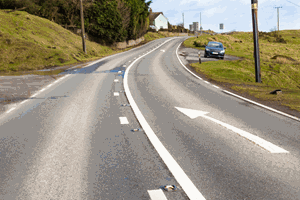
The answer options
- Road bend up ahead
- Road on the left has a weight limit
- Overtaking traffic must move back to the leftCorrect
- There is a camber to the left of the road ahead
Why the other options are wrong
- “Road bend up ahead” is a distractor. It does not meet the standard the question is testing, which overtaking traffic must move back to the left does. Picking it in the real test costs a mark you cannot get back, and with a pass mark of 43 out of 50 you only have seven to spare.
- “Road on the left has a weight limit” is a distractor. It does not meet the standard the question is testing, which overtaking traffic must move back to the left does. Picking it in the real test costs a mark you cannot get back, and with a pass mark of 43 out of 50 you only have seven to spare.
- “There is a camber to the left of the road ahead” is a distractor. It does not meet the standard the question is testing, which overtaking traffic must move back to the left does. Picking it in the real test costs a mark you cannot get back, and with a pass mark of 43 out of 50 you only have seven to spare.
Why that is the answer
This curved arrow painted on the road warns drivers who are overtaking, or straddling the centre line, that they must move back to the left. These deflection arrows usually show that a solid double white line system or another hazard is ahead. You must safely return to your lane before the line becomes solid. It does not indicate a bend ahead, which would be shown by an upright triangular warning sign.
What alertness covers
- · Mirror–signal–manoeuvre and when each mirror is checked
- · Blind spots and life-saver shoulder checks
- · Correct signalling, including when not to signal
- · Tiredness, breaks on long journeys and the 15-minute rest rule
Mistakes learners repeat on this topic
- · Signalling so early that other drivers act on the wrong junction
- · Checking mirrors after starting a manoeuvre rather than before
- · Opening a window as a cure for tiredness instead of stopping
- · Answering a hands-free call and assuming it is a safe alternative
Instructor tip: If a question offers 'stop somewhere safe and rest' for a tiredness scenario, that is almost always the marked answer.
How this comes up in the real test
Questions from alertness appear throughout the 50-question multiple-choice section, and the wording changes between versions. Learn the rule rather than the sentence: the DVSA can ask the same point from the opposite direction, and a memorised answer falls over the moment the phrasing moves.
The pass mark is 43 out of 50, so seven wrong answers is your entire margin. If a whole category is shaky, run the topic practice below until you are getting every question right for the right reason, then go back to full mocks under the clock.
More alertness questions
- Before making a U-turn, what should you do?
- Before slowing or stopping your vehicle, what is something you must do?
- How can you make sure that a satellite navigation (satnav) system doesn’t distract you when you’re driving?
- How should you pass the cyclists?
- Something is hanging from your rearview mirror. Why might this pose a risk?
- The windscreen pillar is restricting your view when waiting to emerge from a junction. What should you be especially cautious of?